Application of Traction in
Orthopaedics

By- Prabhnoor Singh Hayer

Moderated by- Dr. Rajesh Maheshwari
Definition

Traction is the application of a pulling
force to a part of the body
History
 Hippocrates- treated fracture shaft of femur and of leg with
the leg straight in extension

 Guy de chauliac- introduced continuous isotonic traction in
the fracture of femur
General Considerations
 Safe and dependable way of treating fractures for more
than 100 years

 Bone reduced and held by soft tissue
 Less risk of infection at fracture site
 No devascularization
 Allows more joint mobility than plaster
Indications
To reduce the fracture or dislocation
To maintain the reduction
To correct the deformity
To reduce the muscle spasm
Types Based On Method Of
Application
Skin traction
The traction force is applied over a large area of skin
• Adhesive
• Non-adhesive skin tractions

Skeletal traction
Applied directly to the bone either by a pin or wire through the
bone. (eg- Steinmann pin, Denham pin or Kirschner wire)
Types Based On Mechanism
 Fixed Traction
By applying force against a fixed point of body.

 Sliding Traction
By tilting bed so that patient tends to slide in opposite
direction to traction force
Advantages of Traction
 Decrease pain
 Minimize muscle spasms
 Reduces, aligns, and immobilizes fractures
 Reduce deformity
 Increase space between opposing surfaces
Disadvantages of Traction
 Costly in terms of hospital stay
 Hazards of prolonged bed rest
 Thromboembolism
 Decubiti
 Pneumonia

 Requires meticulous nursing care
 Can develop contractures
The Traction Suspension
System
• Bed and Balkan beam
• Splints- Thomas splint, Bohler-Braun frame, Fisk Splint
• Slings and padding
• Skin traction
• Skeletal traction- Steinmann pin, Denham pin or Kirschner wire
• Bohler Stirrup
• Cord
• Pulleys
• Weights
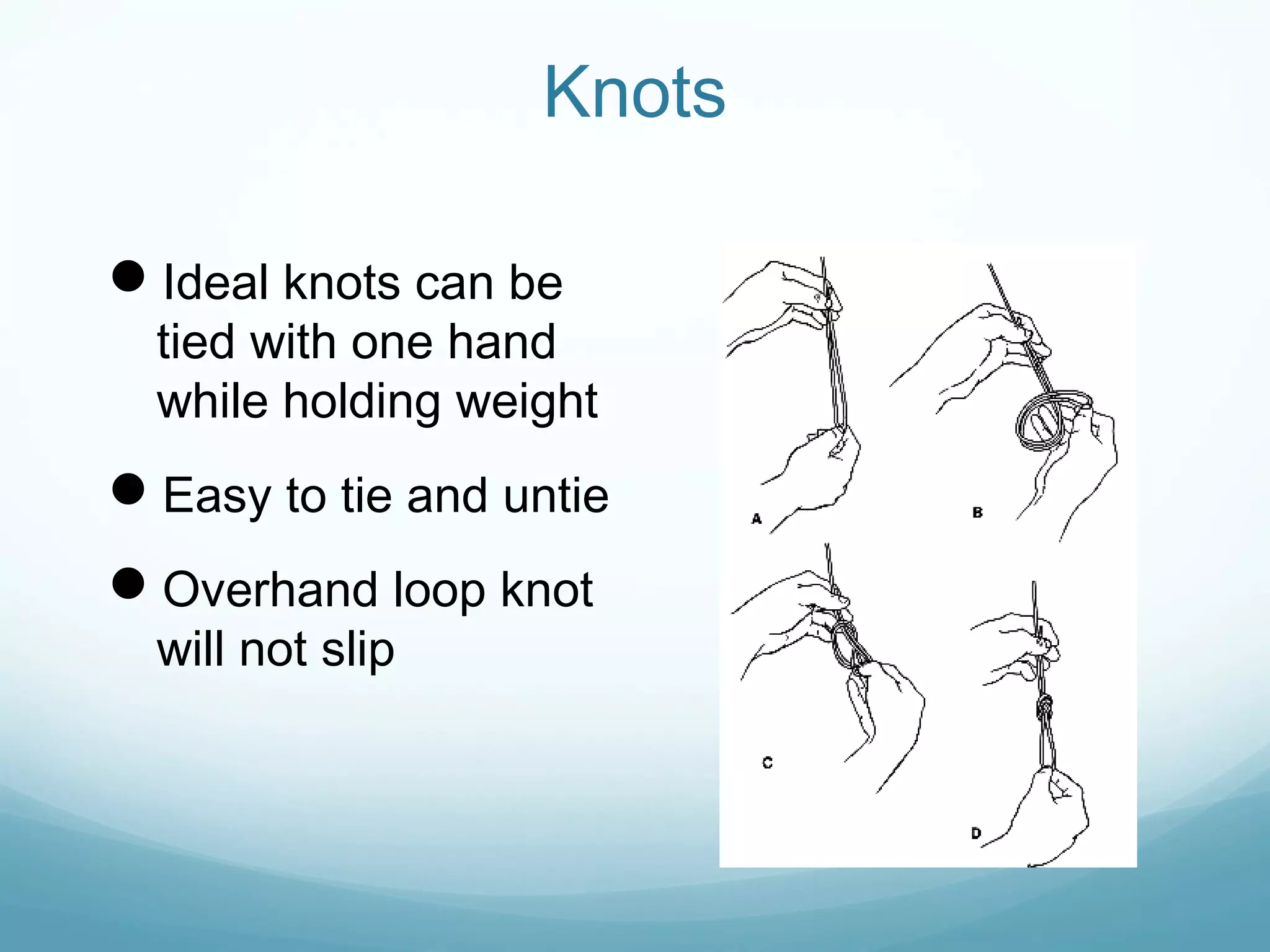
Knots
Ideal knots can be

tied with one hand
while holding weight

Easy to tie and untie
Overhand loop knot
will not slip
Knots
A slip knot tightens
under tension

Up and over, down
and over, up and
through
Knots - types
 Clover hitch
 Barrel hitch
 Reef knot
 Half hitch
 Two half hitches
Skin traction

Skin traction
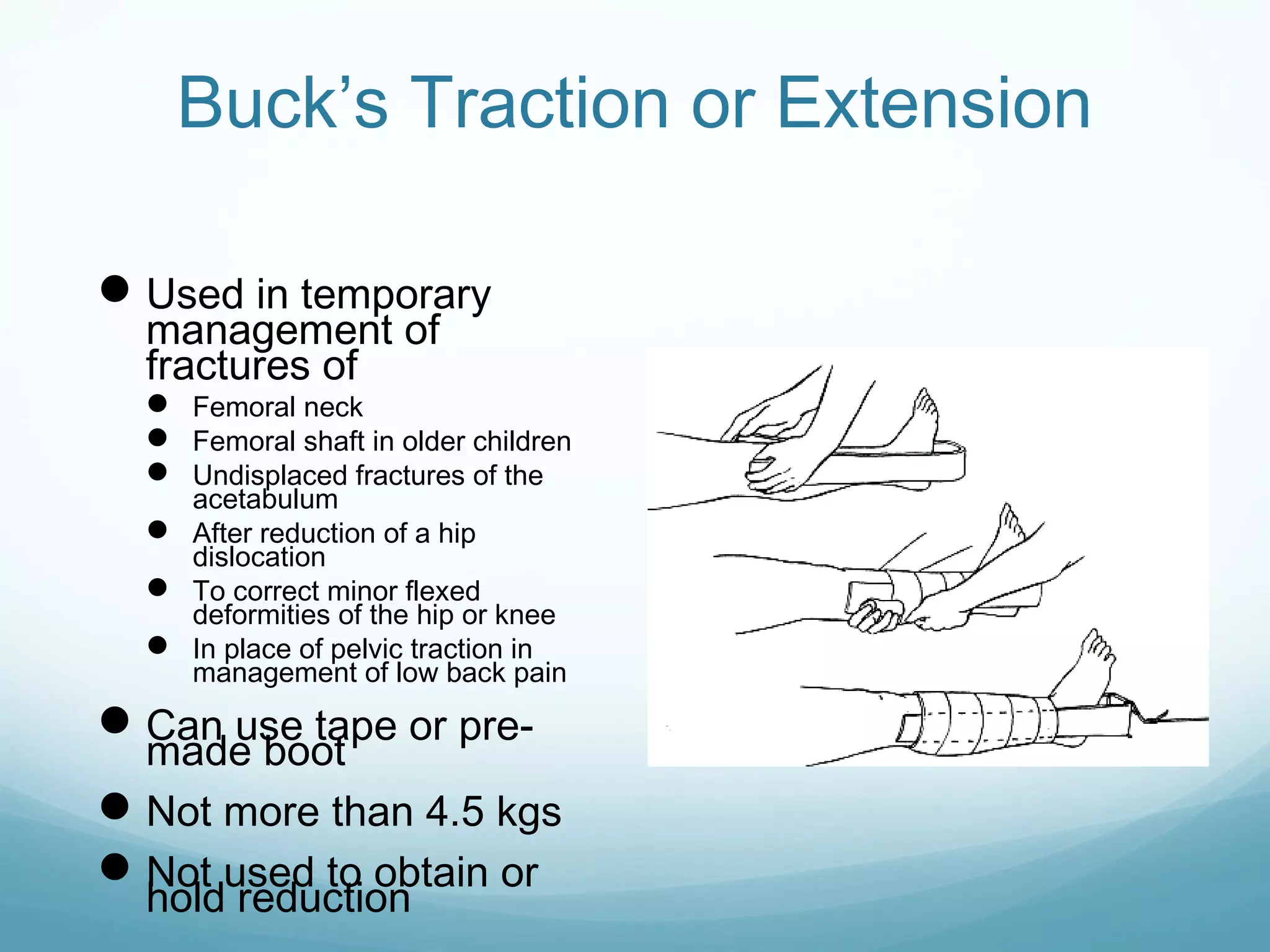
Buck’s Traction or Extension
 Used in temporary
management of
fractures of

 Femoral neck
 Femoral shaft in older children
 Undisplaced fractures of the
acetabulum
 After reduction of a hip
dislocation
 To correct minor flexed
deformities of the hip or knee
 In place of pelvic traction in
management of low back pain

 Can use tape or pre-

made boot
 Not more than 4.5 kgs
 Not used to obtain or
hold reduction
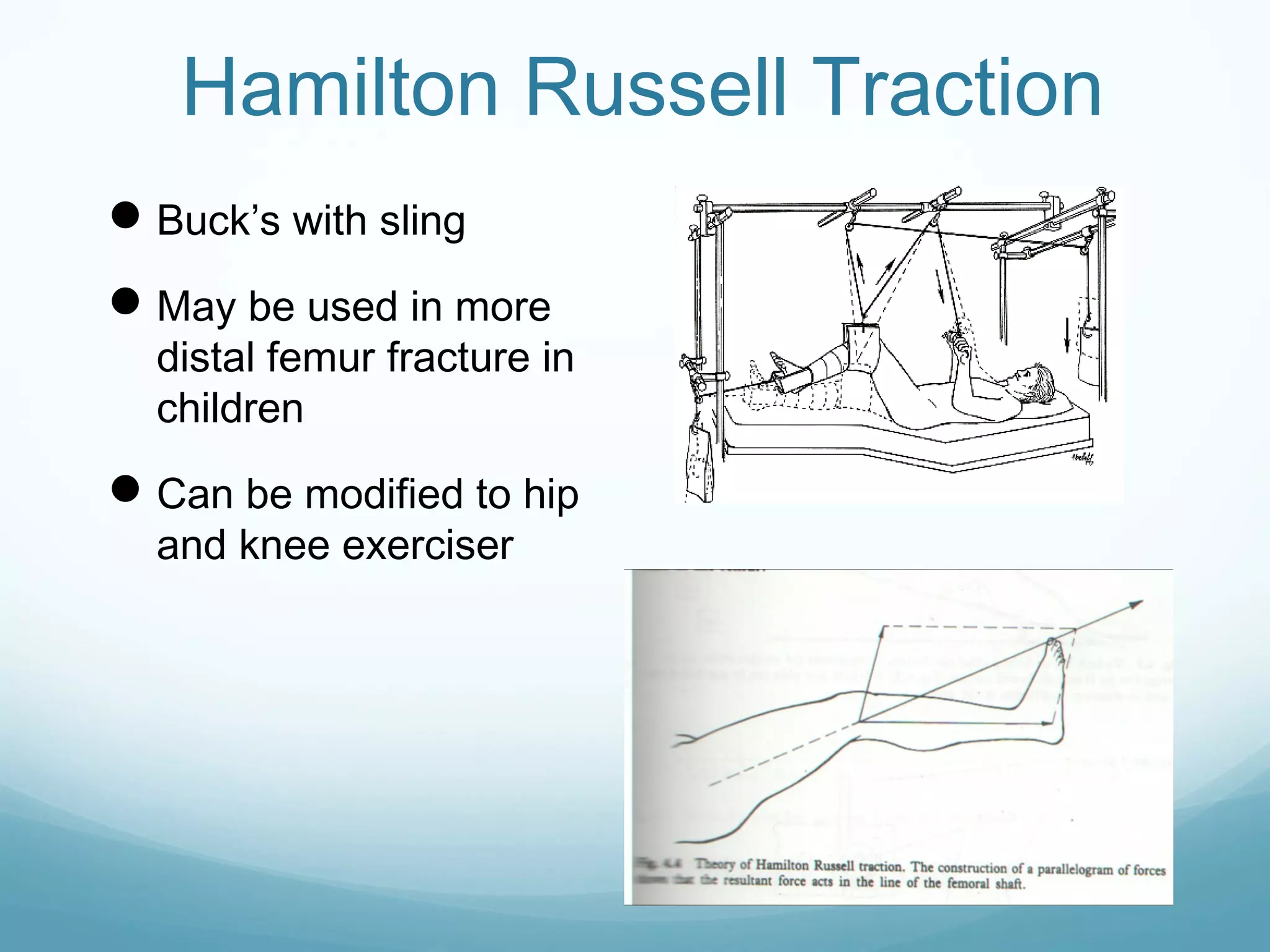
Hamilton Russell Traction
 Buck’s with sling
 May be used in more

distal femur fracture in
children

 Can be modified to hip
and knee exerciser
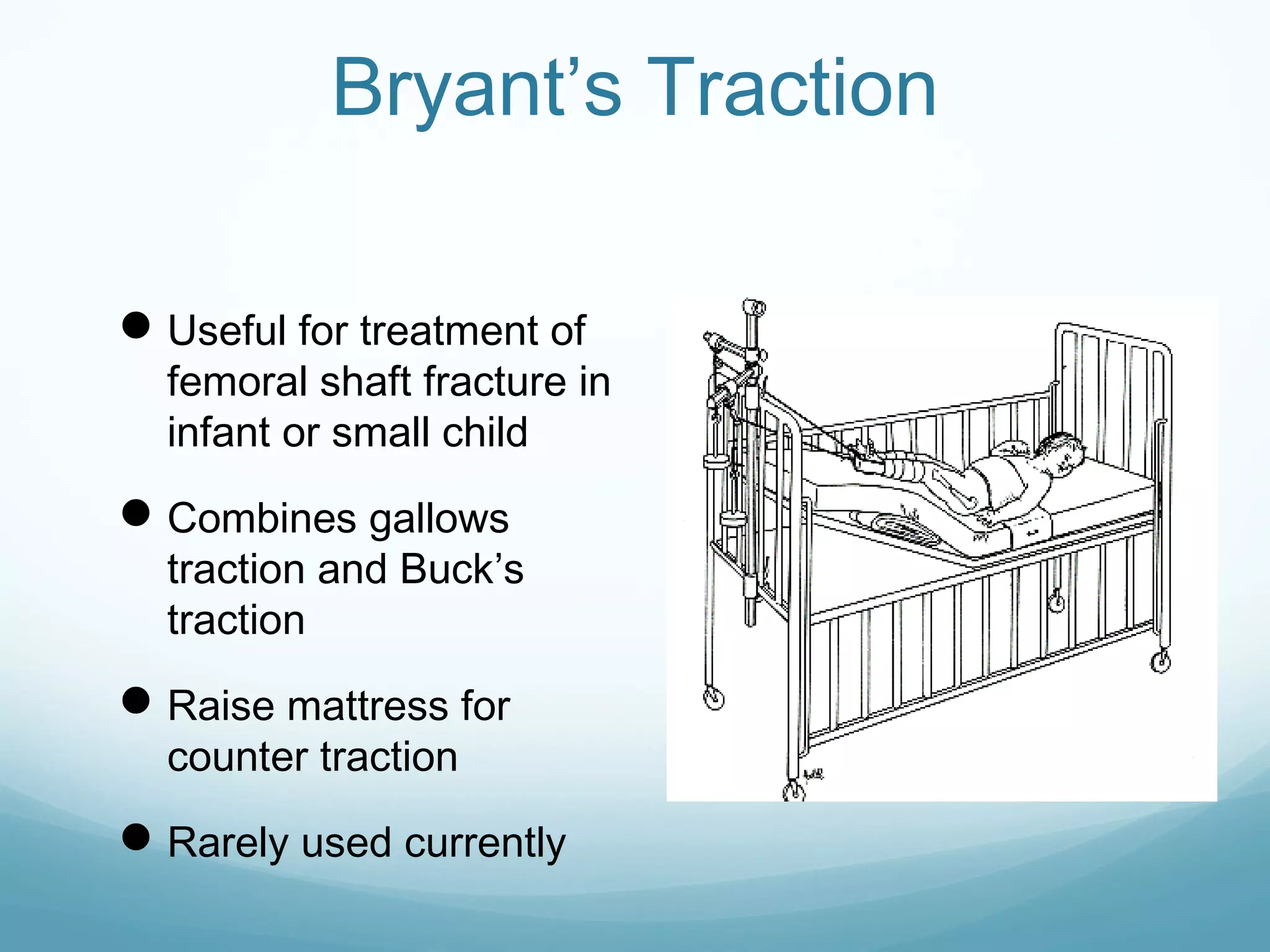
Bryant’s Traction
 Useful for treatment of

femoral shaft fracture in
infant or small child

 Combines gallows

traction and Buck’s
traction

 Raise mattress for
counter traction

 Rarely used currently
Forearm Skin Traction
 Adhesive strip with Ace
wrap

 Useful for elevation in
any injury

 Can treat difficult

clavicle fractures with
excellent cosmetic
result

 Risk is skin loss
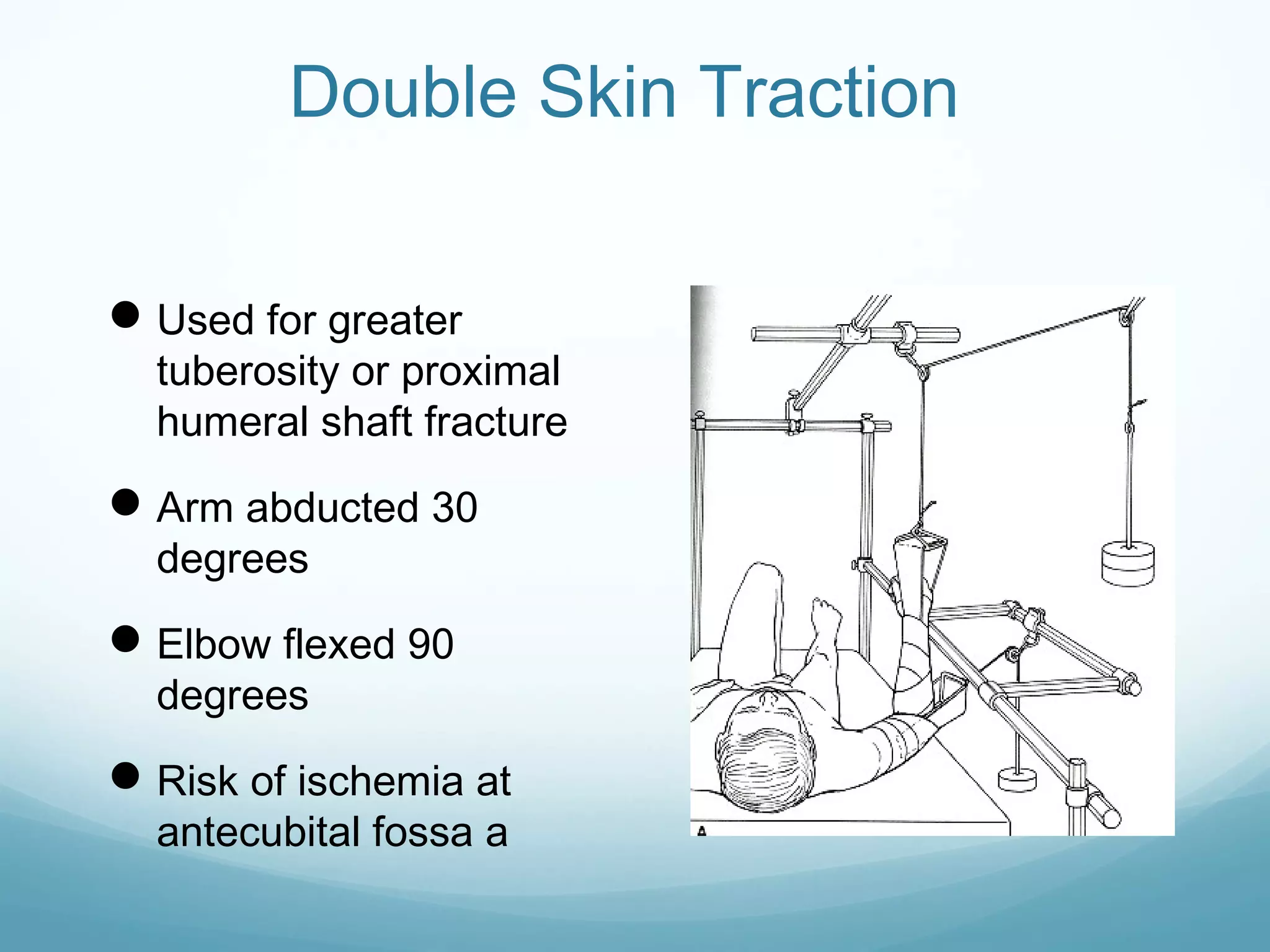
Double Skin Traction
 Used for greater

tuberosity or proximal
humeral shaft fracture

 Arm abducted 30
degrees

 Elbow flexed 90
degrees

 Risk of ischemia at
antecubital fossa a
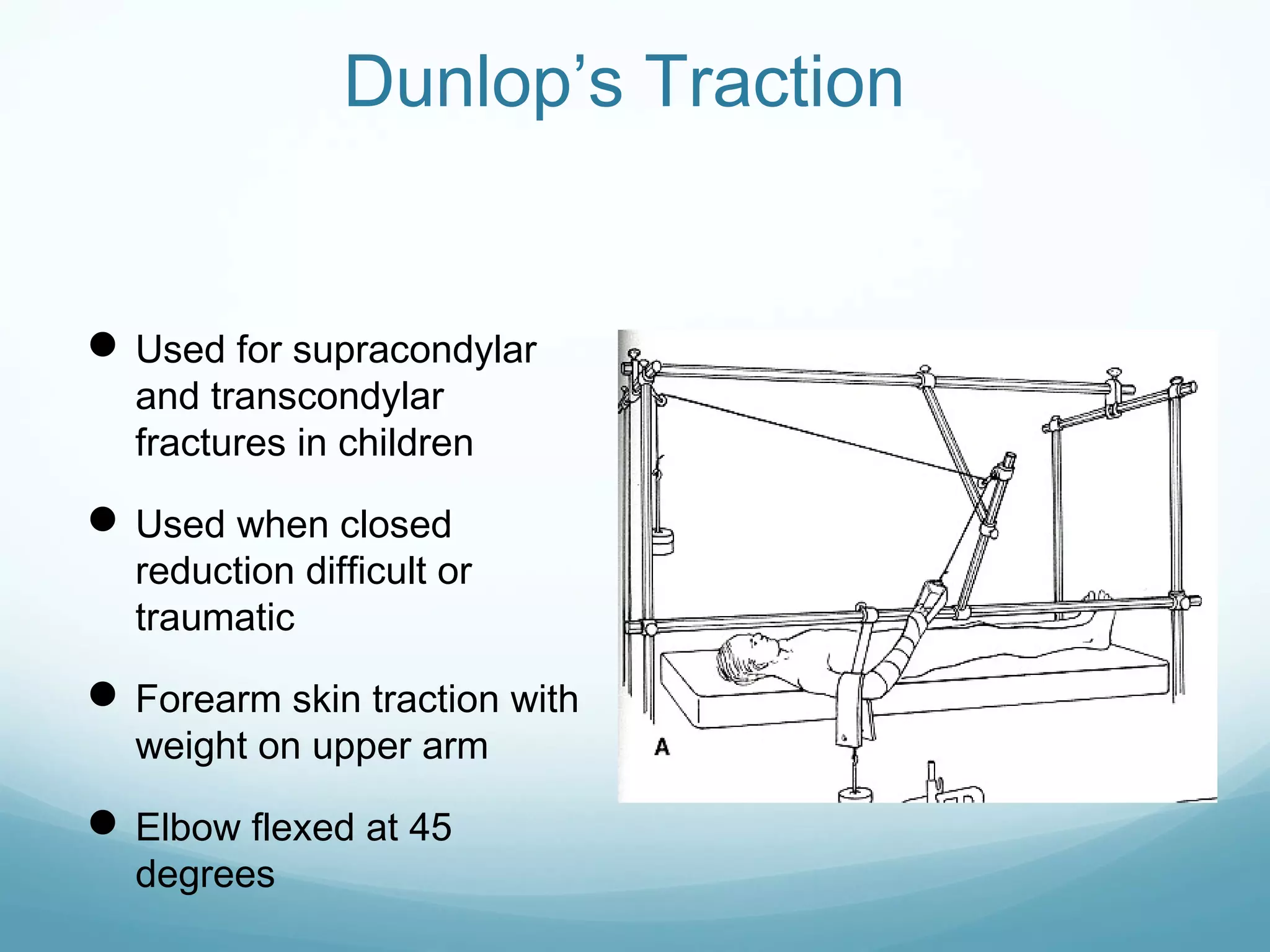
Dunlop’s Traction

 Used for supracondylar
and transcondylar
fractures in children

 Used when closed

reduction difficult or
traumatic

 Forearm skin traction with
weight on upper arm

 Elbow flexed at 45
degrees
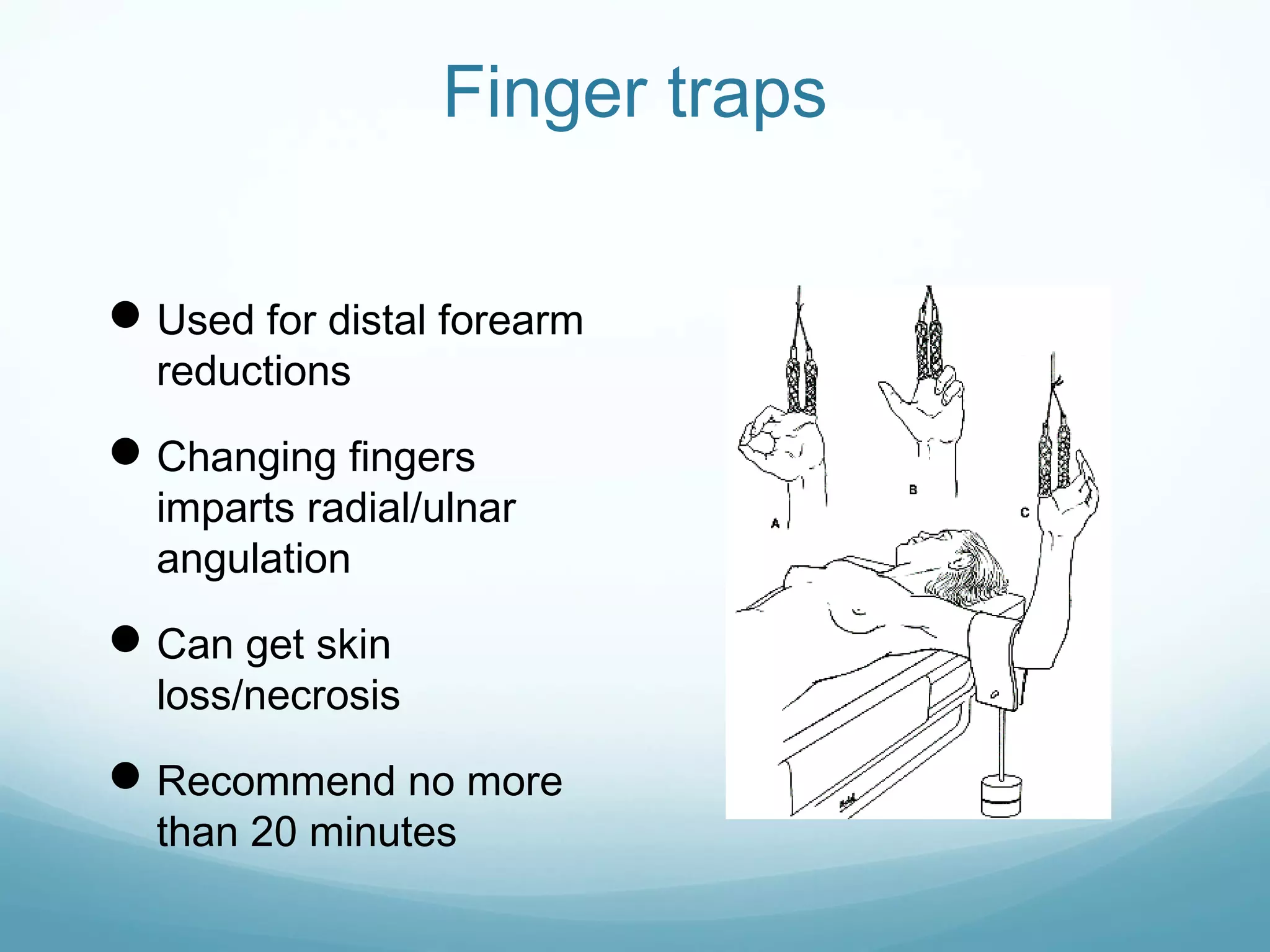
Finger traps
 Used for distal forearm
reductions

 Changing fingers

imparts radial/ulnar
angulation

 Can get skin

loss/necrosis

 Recommend no more
than 20 minutes
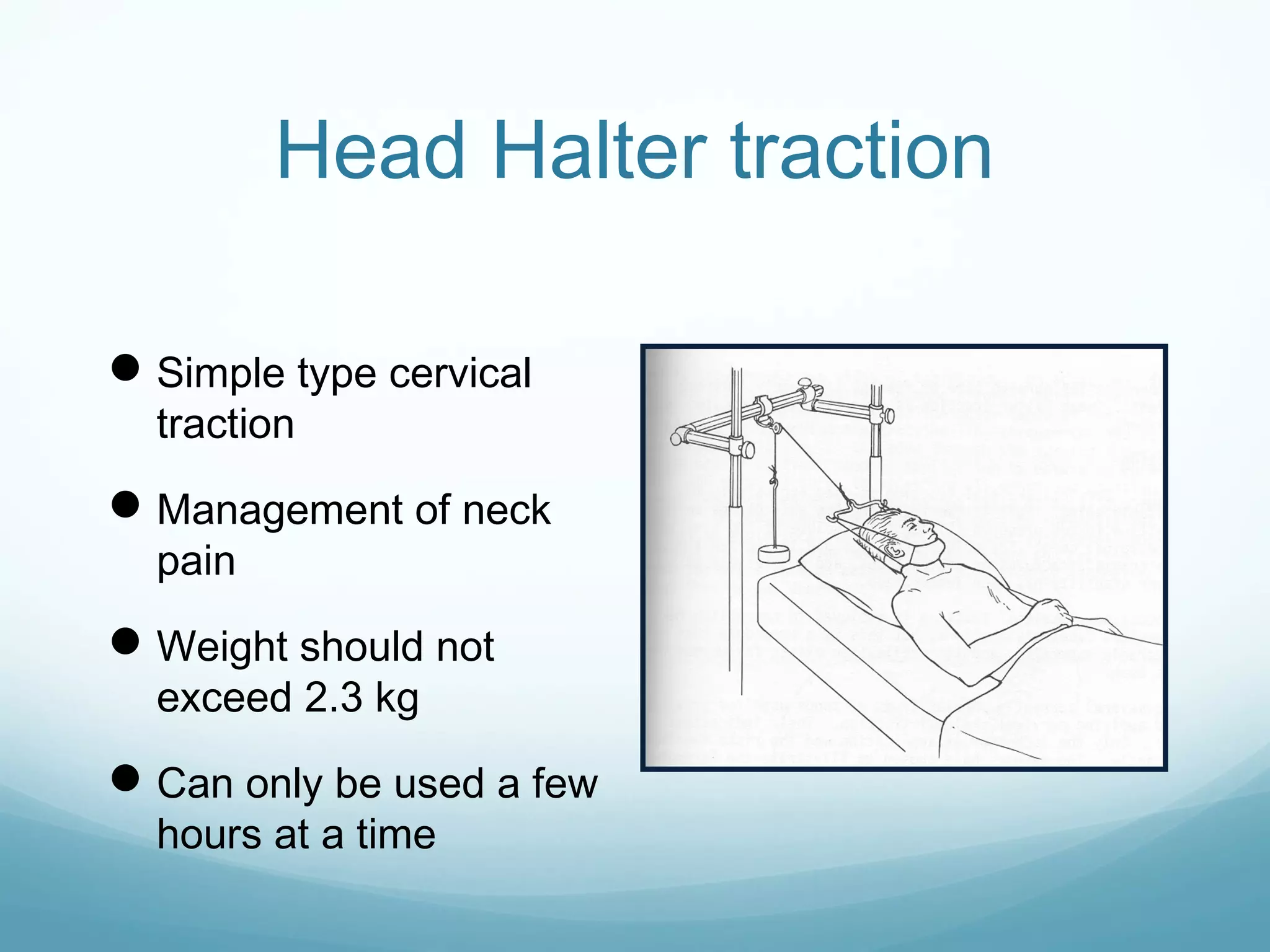
Head Halter traction
 Simple type cervical
traction

 Management of neck
pain

 Weight should not
exceed 2.3 kg

 Can only be used a few
hours at a time
Contraindications
 Abrasions and lacerations of skin in the area to which
traction is to be applied

 Impairment of circulation - Varicose veins, impending
gangrene

 Dermatitis
 When there is marked shortening of the bony fragments,

the traction weight required will be more then 6.7 kg which
cannot be applied through the skin
Complications
 Allergic reactions to adhesive
 Excortication of skin
 Pressure sores around the malleoli and over the tendo
calcaneus

 Common peroneal nerve palsy
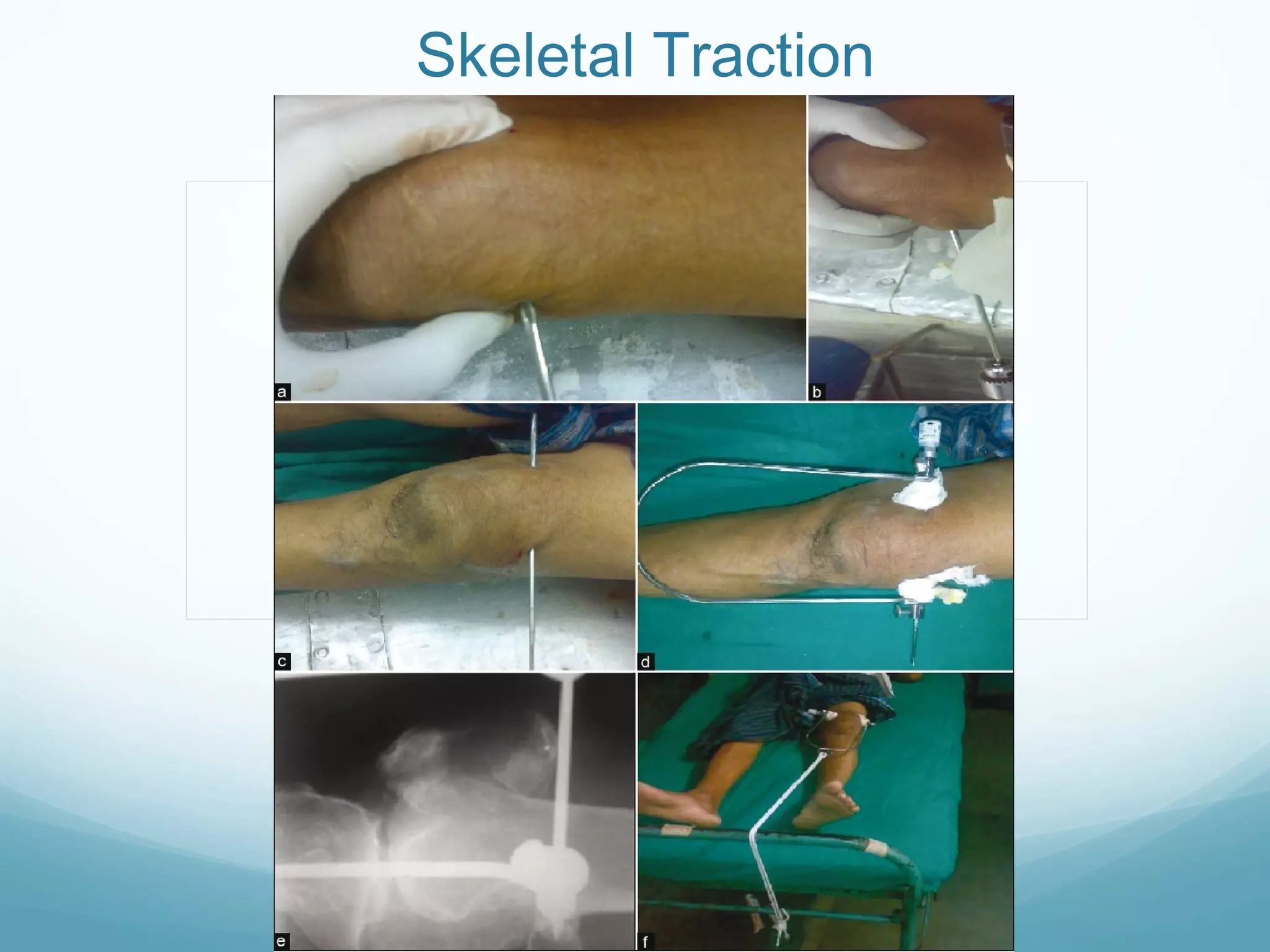
Skeletal Traction
Indications
 It should be reserved for those cases in which skin traction
is contraindicated

 In patients with lacerated wounds
 In patients with external fixator in situ
 When the weight required for traction is more then 6.5 kgsObese patients
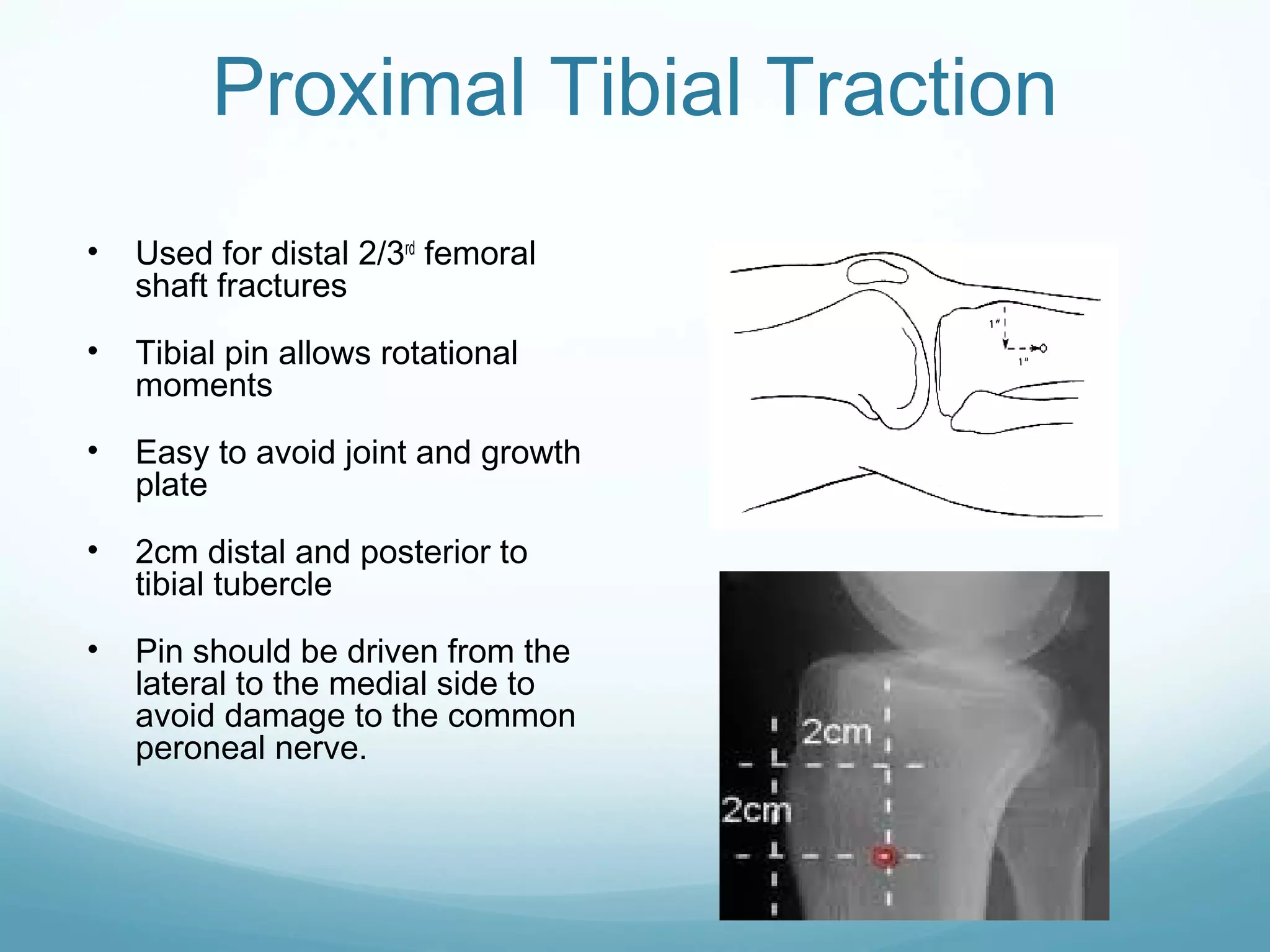
Proximal Tibial Traction
•

Used for distal 2/3rd femoral
shaft fractures

•

Tibial pin allows rotational
moments

•

Easy to avoid joint and growth
plate

•

2cm distal and posterior to
tibial tubercle

•

Pin should be driven from the
lateral to the medial side to
avoid damage to the common
peroneal nerve.
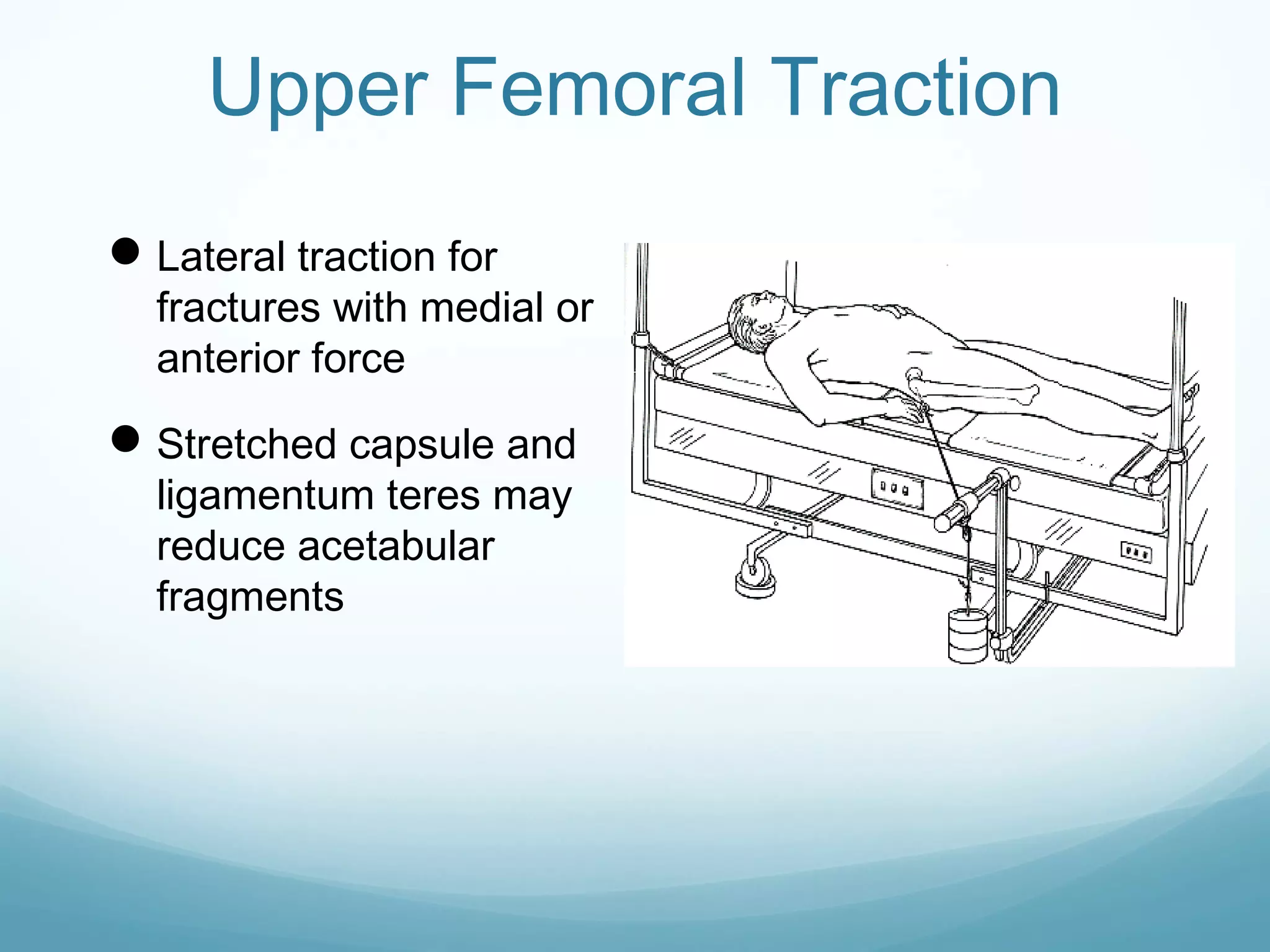
Upper Femoral Traction
 Lateral traction for

fractures with medial or
anterior force

 Stretched capsule and
ligamentum teres may
reduce acetabular
fragments
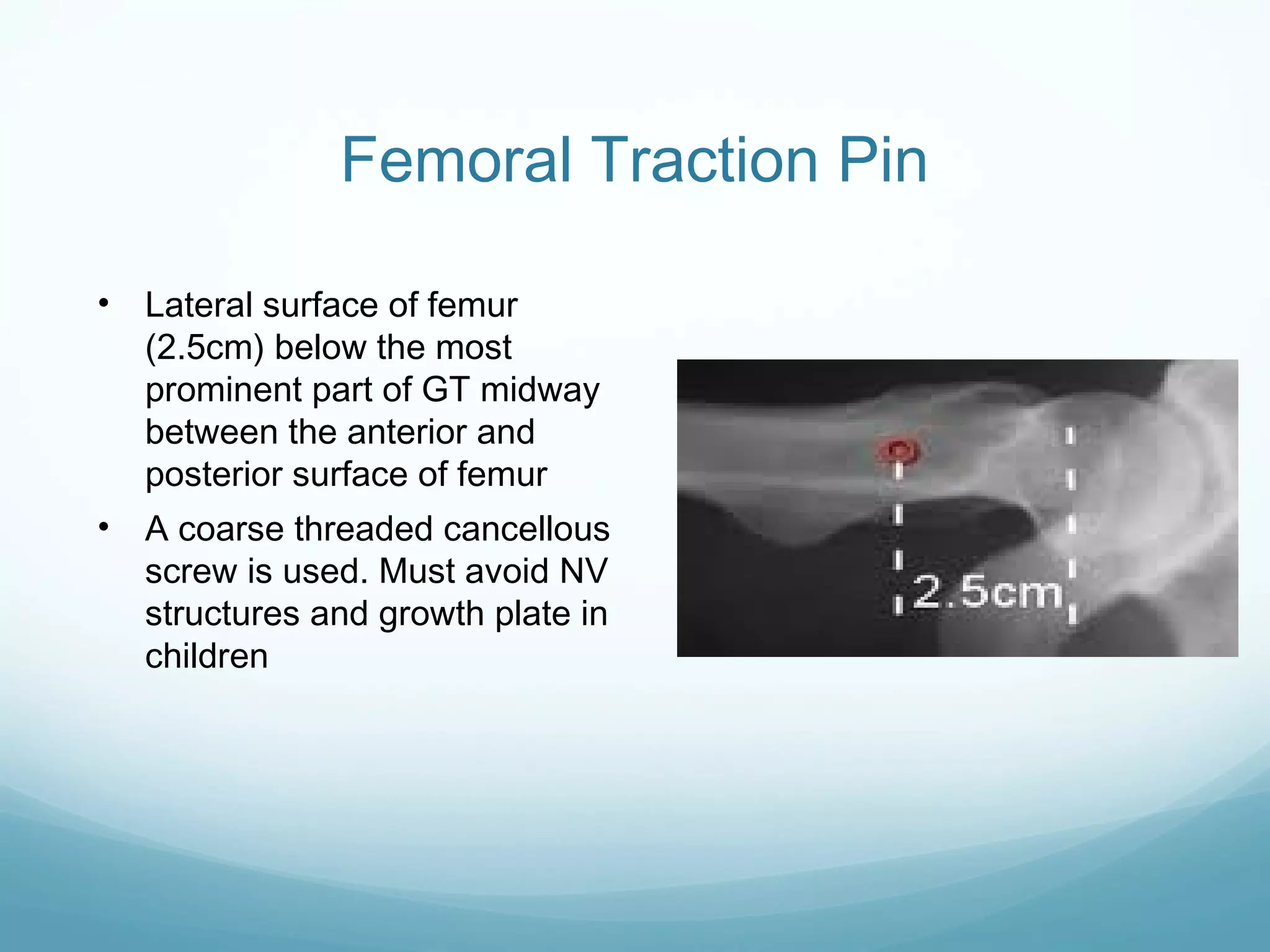
Femoral Traction Pin
•

Lateral surface of femur
(2.5cm) below the most
prominent part of GT midway
between the anterior and
posterior surface of femur

•

A coarse threaded cancellous
screw is used. Must avoid NV
structures and growth plate in
children
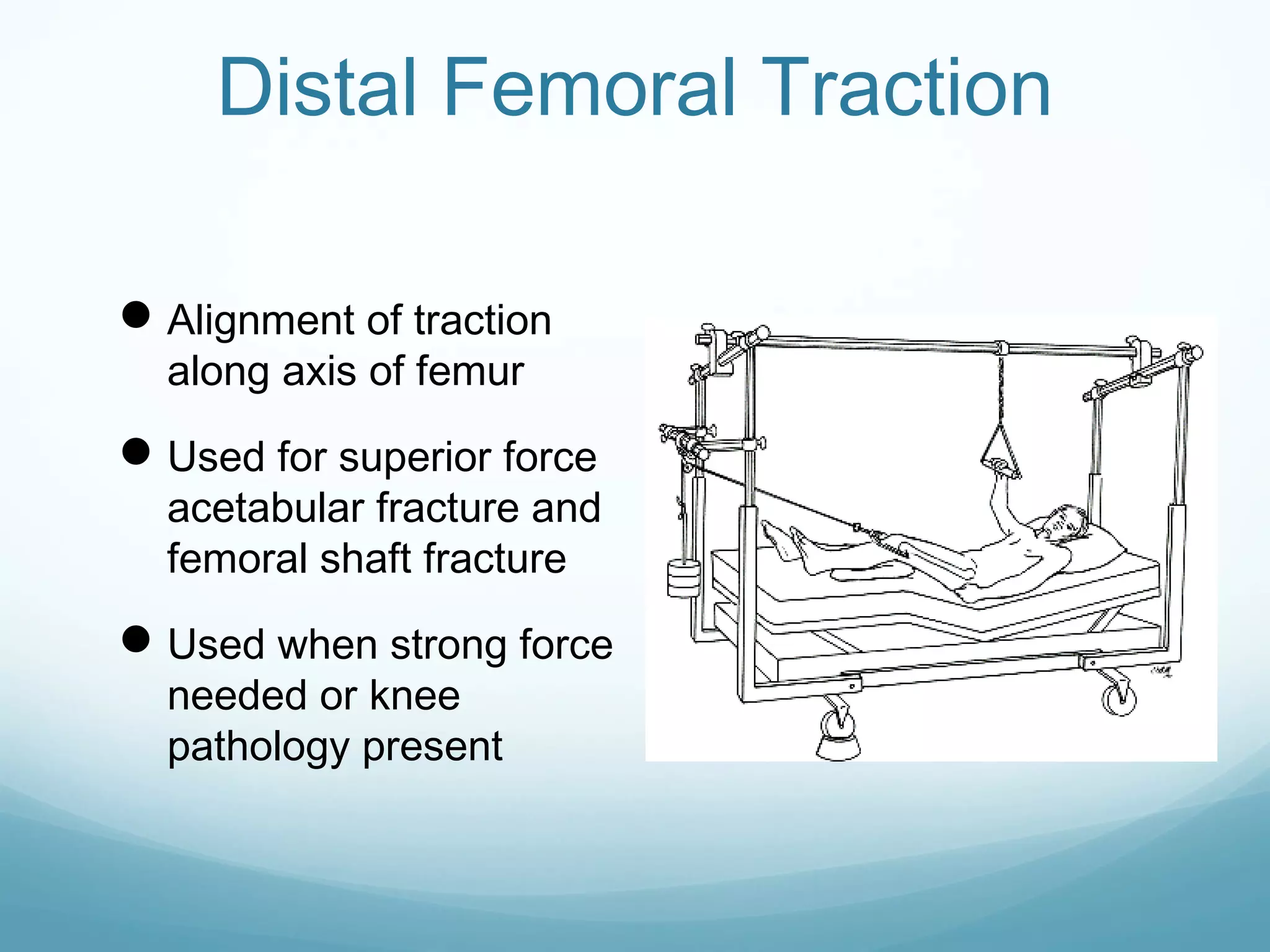
Distal Femoral Traction
 Alignment of traction
along axis of femur

 Used for superior force

acetabular fracture and
femoral shaft fracture

 Used when strong force
needed or knee
pathology present
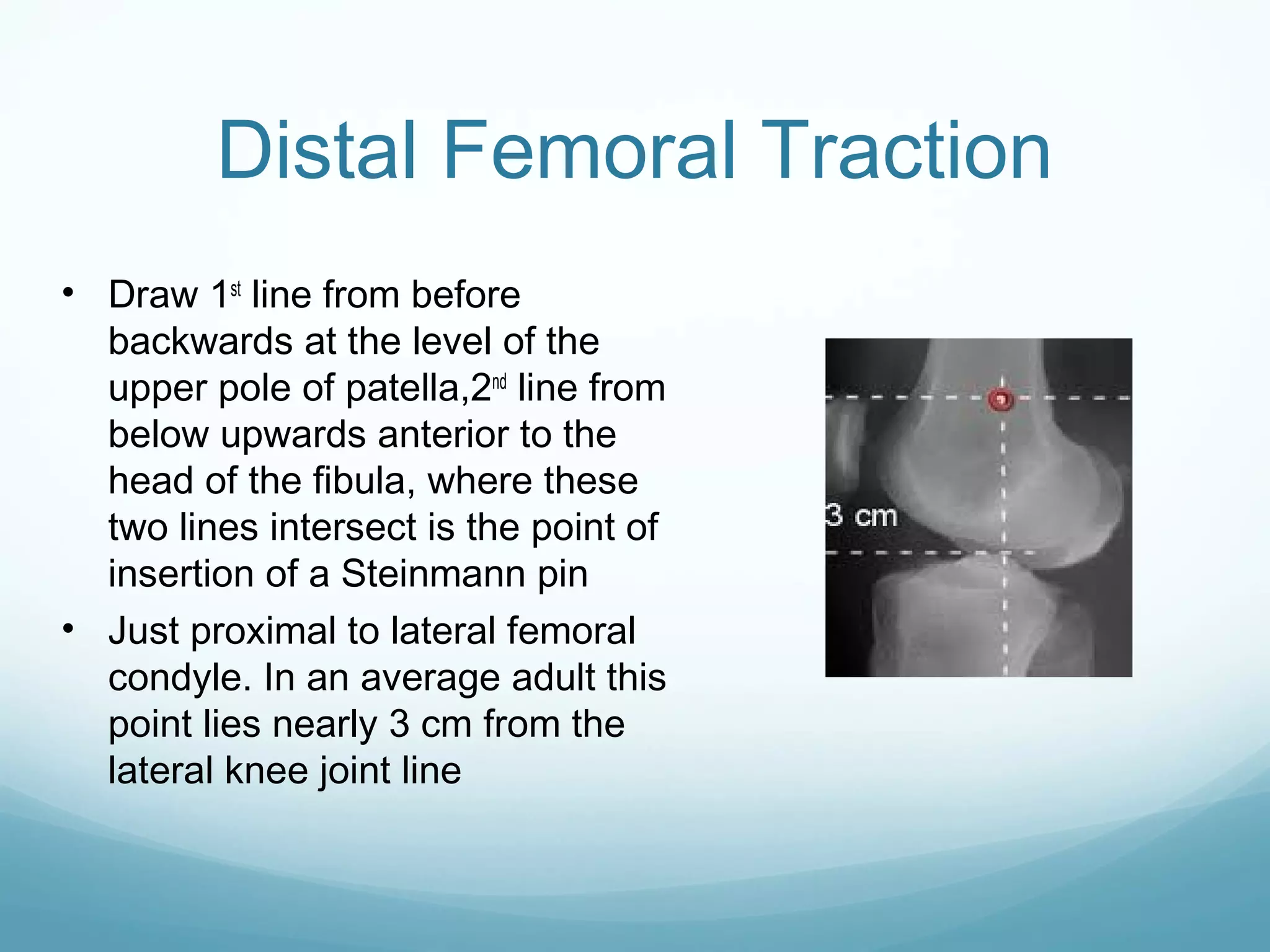
Distal Femoral Traction
• Draw 1st line from before
backwards at the level of the
upper pole of patella,2nd line from
below upwards anterior to the
head of the fibula, where these
two lines intersect is the point of
insertion of a Steinmann pin
• Just proximal to lateral femoral
condyle. In an average adult this
point lies nearly 3 cm from the
lateral knee joint line
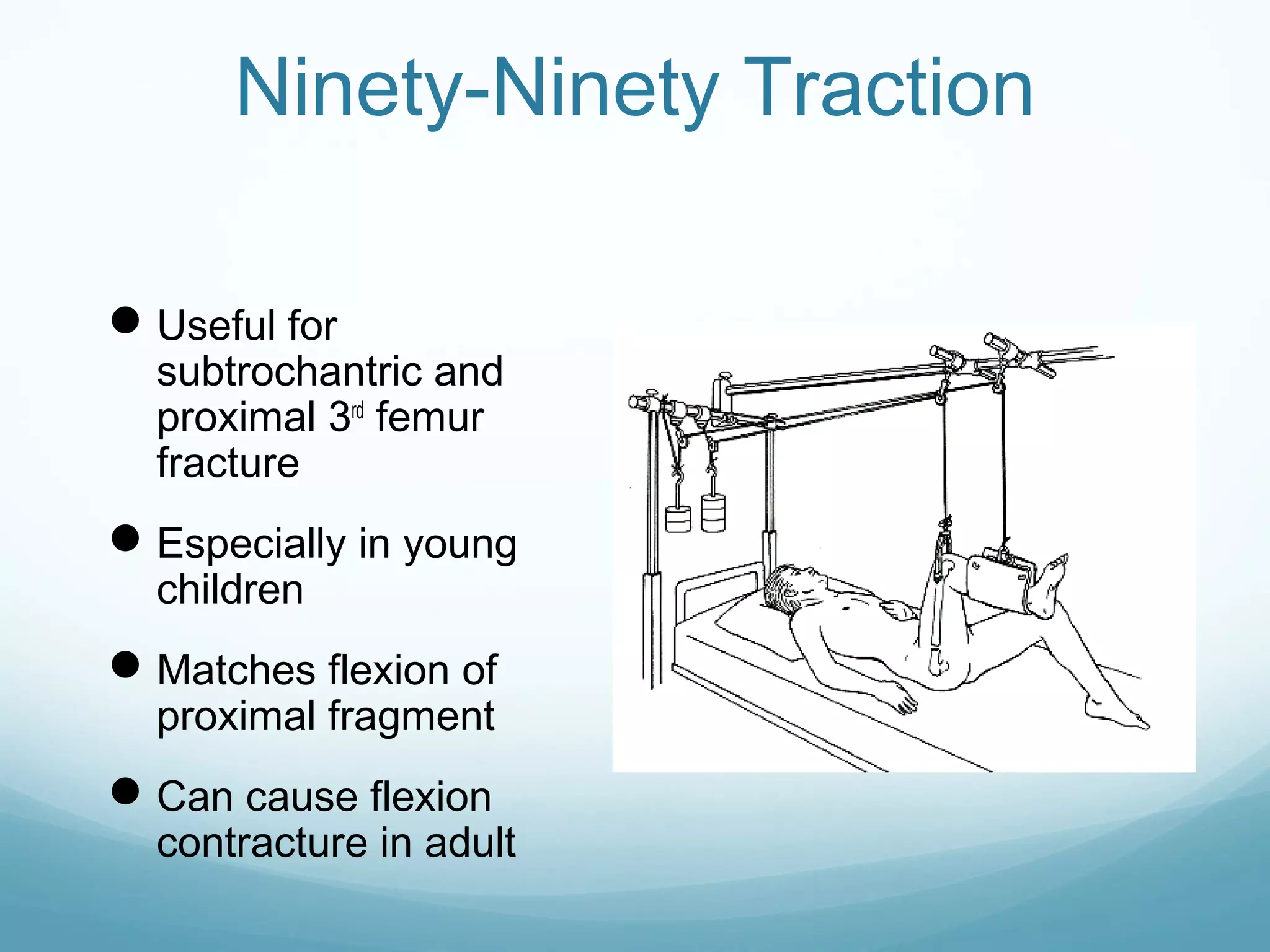
Ninety-Ninety Traction
 Useful for

subtrochantric and
proximal 3rd femur
fracture

 Especially in young
children

 Matches flexion of
proximal fragment

 Can cause flexion

contracture in adult
Perkin’s traction
Treatment of fractures of tibia and of the
femur from the subtrochantric region
distally.

 Basis of management is the use of skeletal traction

coupled with active movements of the injured limb
 By encouraging early muscular activity, the
development of stiff joint is frequently prevented by
both maintaining extensibility of muscles by reciprocal
innervation, and preventing stagnation of tissue fluid
Application of Perkin’s traction
 A Hadfield split bed is required
 Under General anaesthesia and full aseptic conditions, a Denham pin is
inserted through the upper end of tibia

 A Simonis swivel is attached to end of each Denham pin
 Two traction cords are connected to each of swivel
 4.6 kg weight is attached to each traction cord making a total traction weight of
9.2 kg

 Foot end of the bed is elevated by one inch for each 0.46 kg of traction weight
 One or more pillow is placed under the thigh to maintain the anterior bowing of
the femoral shaft

 Length of the limb is checked with a tape measure and total traction weight is
increased or decreased as necessary

 Active Quadriceps exercises are started immediately and continued
Perkin’s traction:
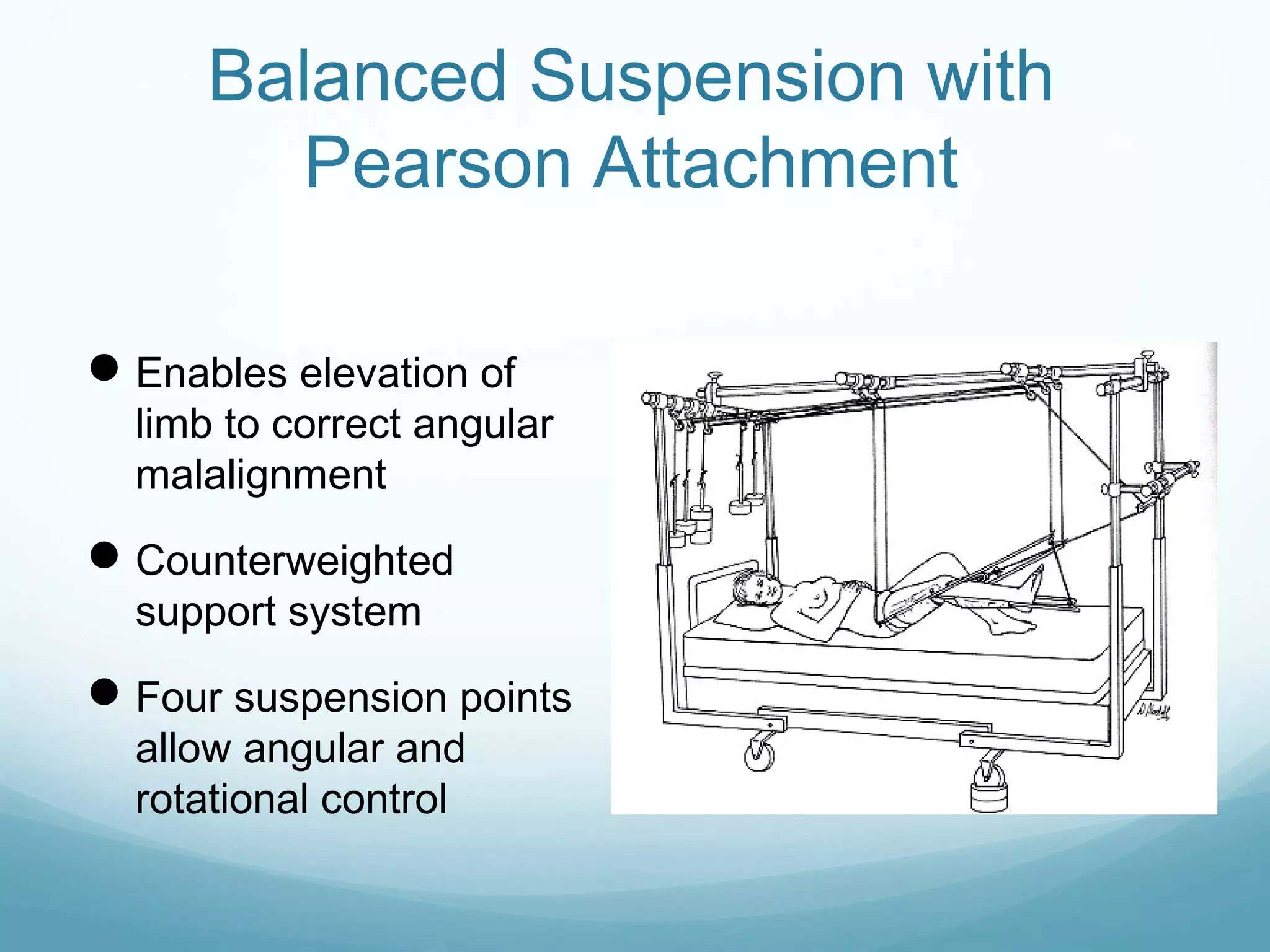
Balanced Suspension with
Pearson Attachment
 Enables elevation of

limb to correct angular
malalignment

 Counterweighted
support system

 Four suspension points
allow angular and
rotational control
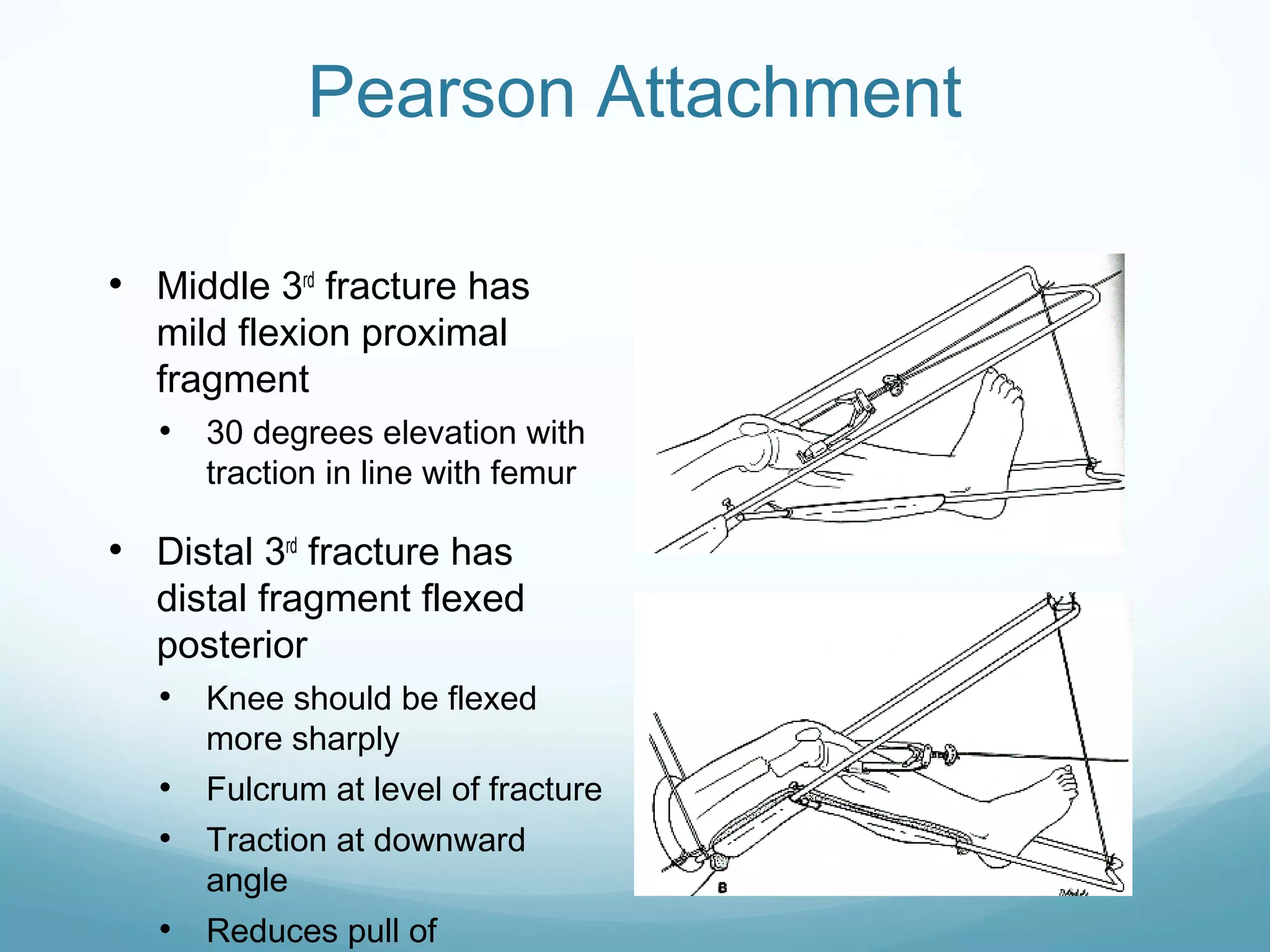
Pearson Attachment
• Middle 3rd fracture has
mild flexion proximal
fragment

• 30 degrees elevation with
traction in line with femur

• Distal 3rd fracture has

distal fragment flexed
posterior
• Knee should be flexed
more sharply

• Fulcrum at level of fracture
• Traction at downward
angle

• Reduces pull of
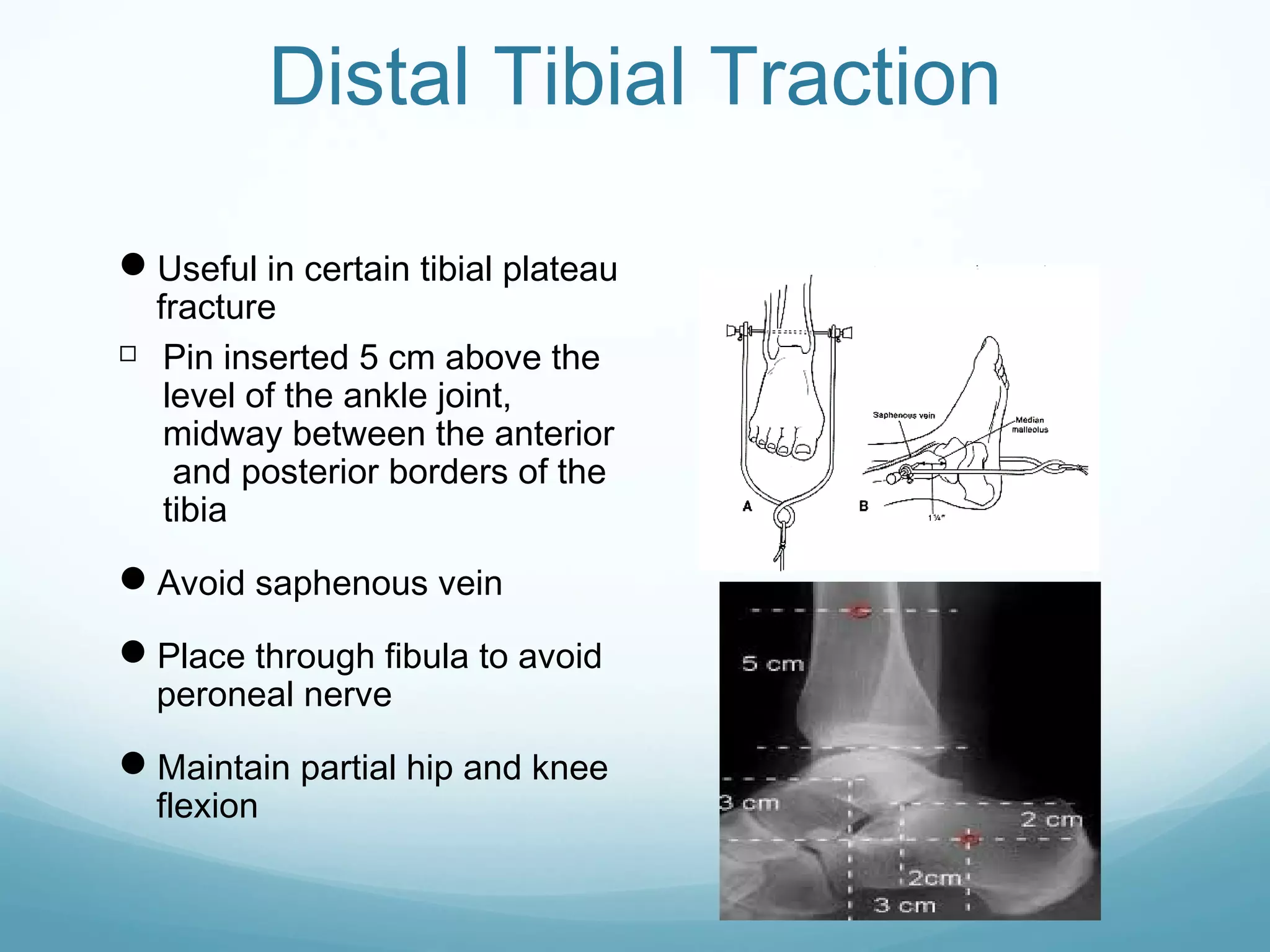
Distal Tibial Traction
Useful in certain tibial plateau


fracture
Pin inserted 5 cm above the
level of the ankle joint,
midway between the anterior
and posterior borders of the
tibia

Avoid saphenous vein
Place through fibula to avoid
peroneal nerve

Maintain partial hip and knee
flexion
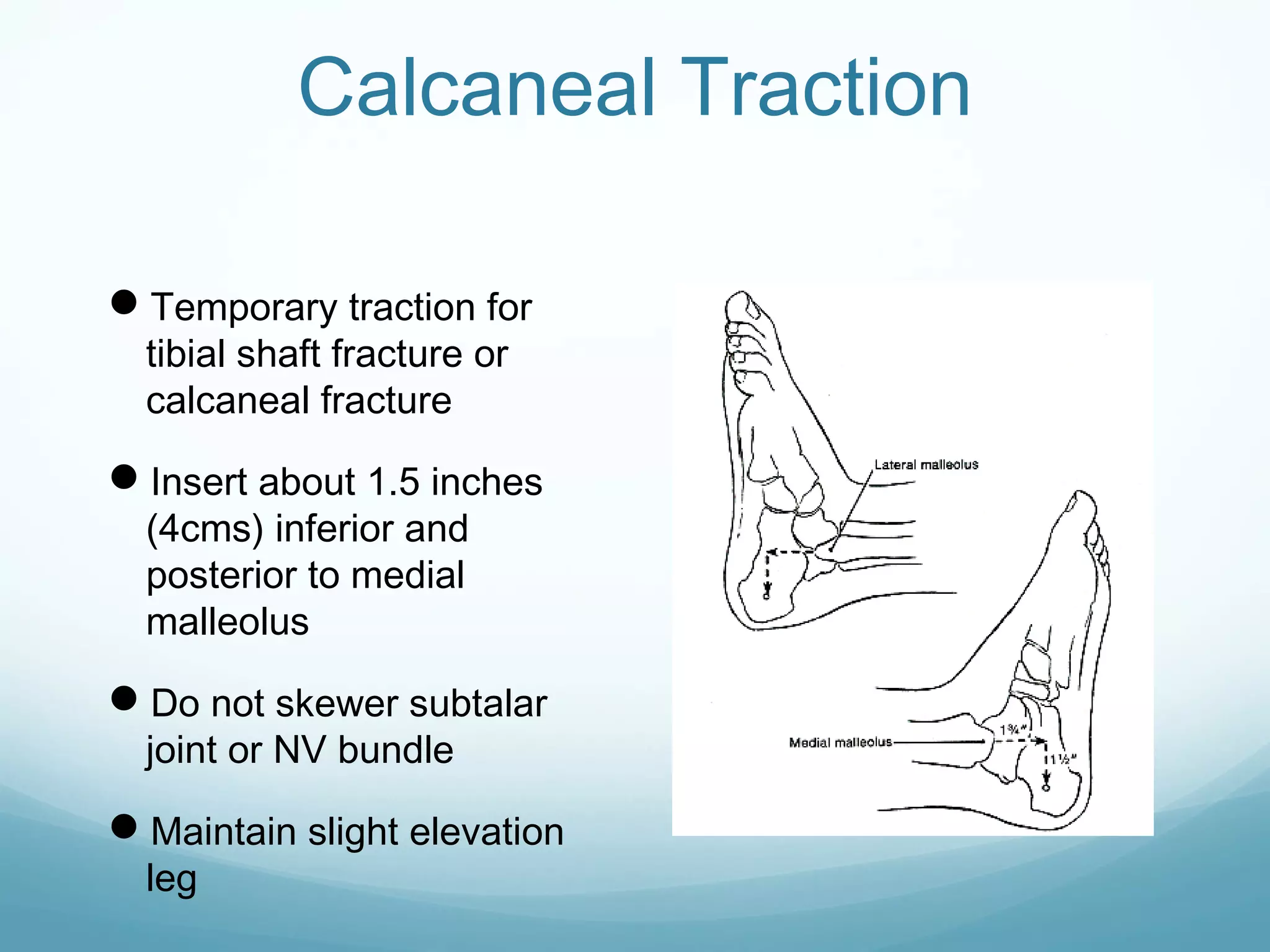
Calcaneal Traction
Temporary traction for
tibial shaft fracture or
calcaneal fracture

Insert about 1.5 inches
(4cms) inferior and
posterior to medial
malleolus

Do not skewer subtalar
joint or NV bundle

Maintain slight elevation
leg
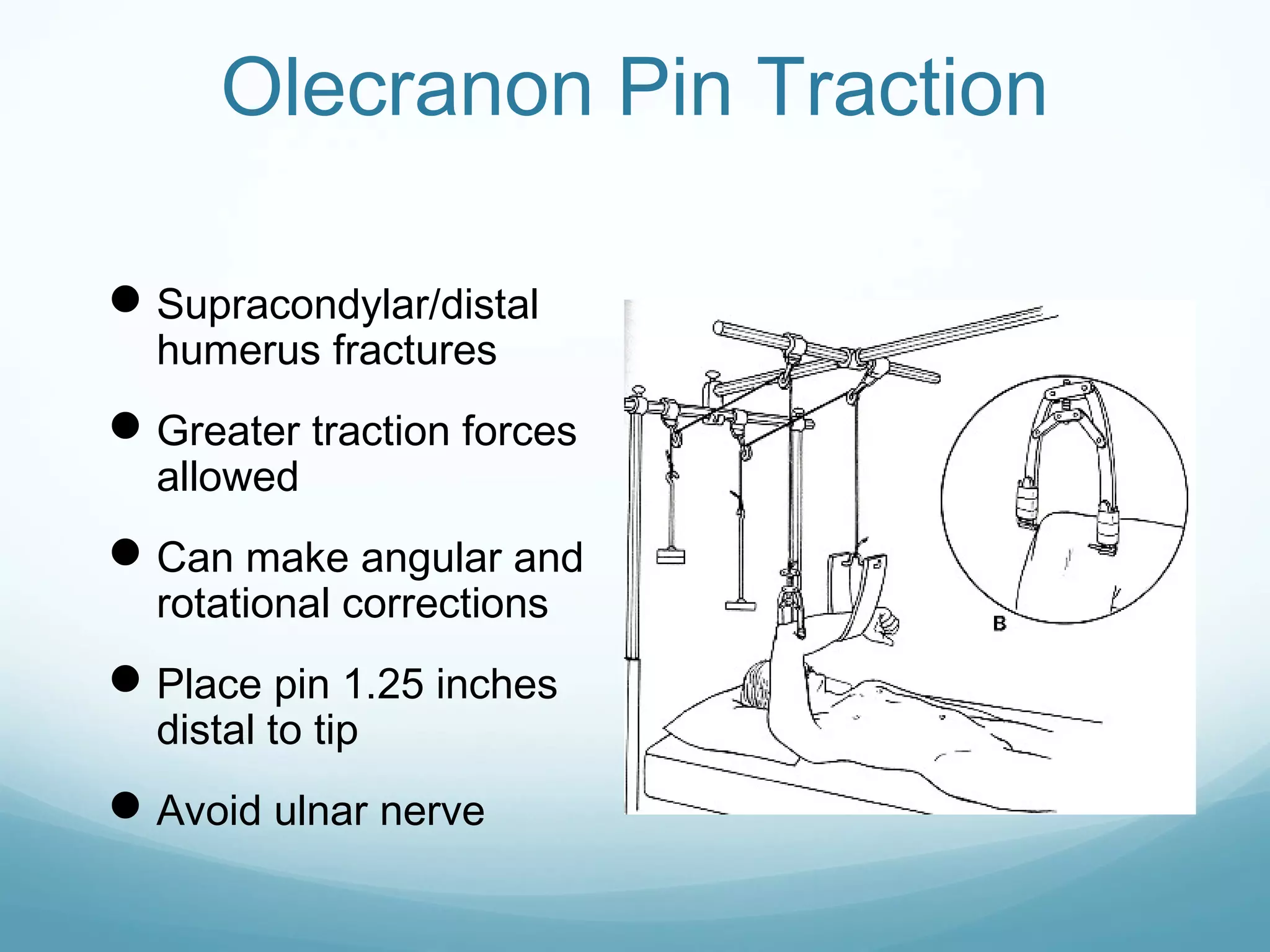
Olecranon Pin Traction
 Supracondylar/distal
humerus fractures

 Greater traction forces
allowed

 Can make angular and
rotational corrections

 Place pin 1.25 inches
distal to tip

 Avoid ulnar nerve
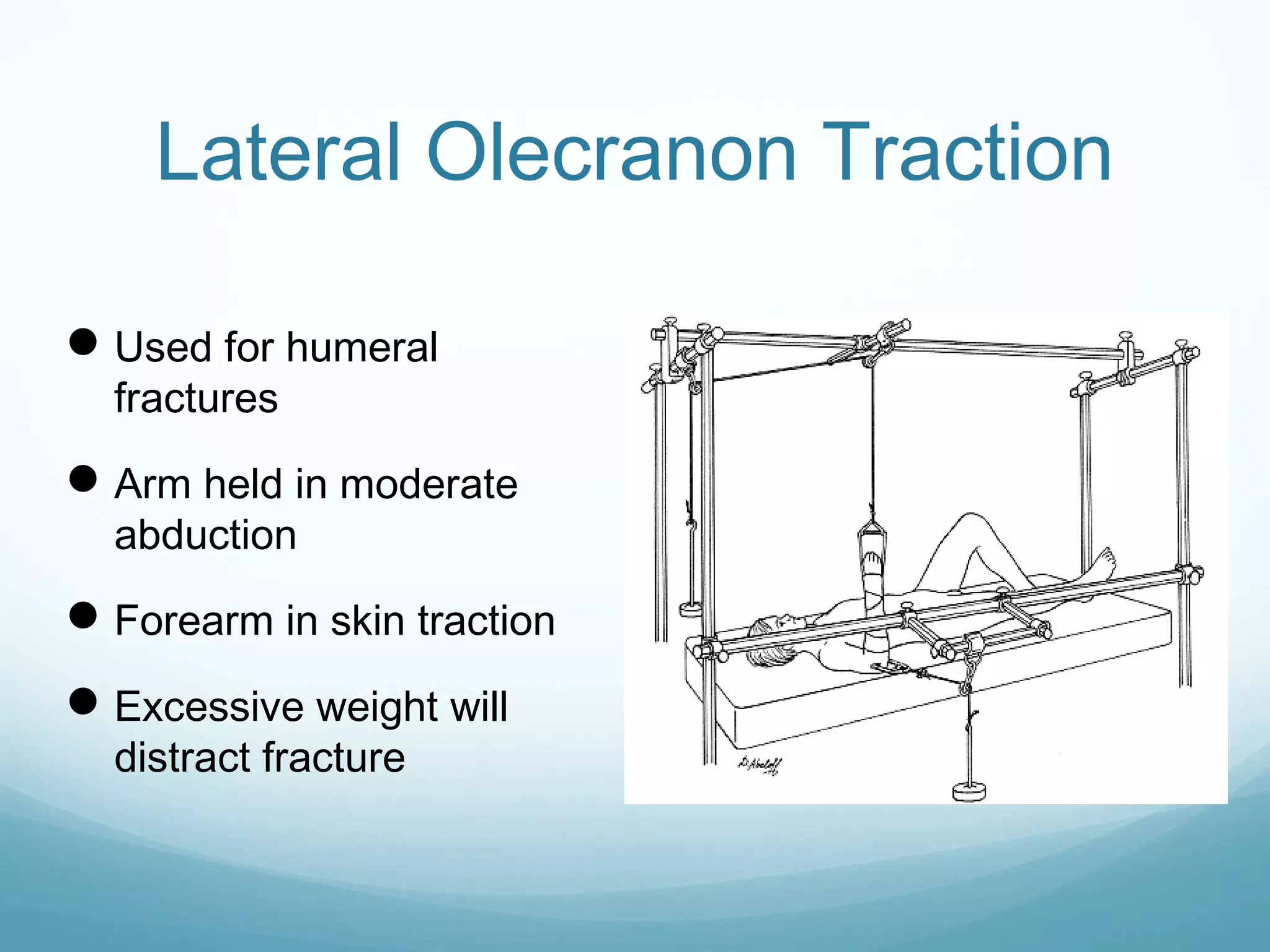
Lateral Olecranon Traction
 Used for humeral
fractures

 Arm held in moderate
abduction

 Forearm in skin traction
 Excessive weight will
distract fracture
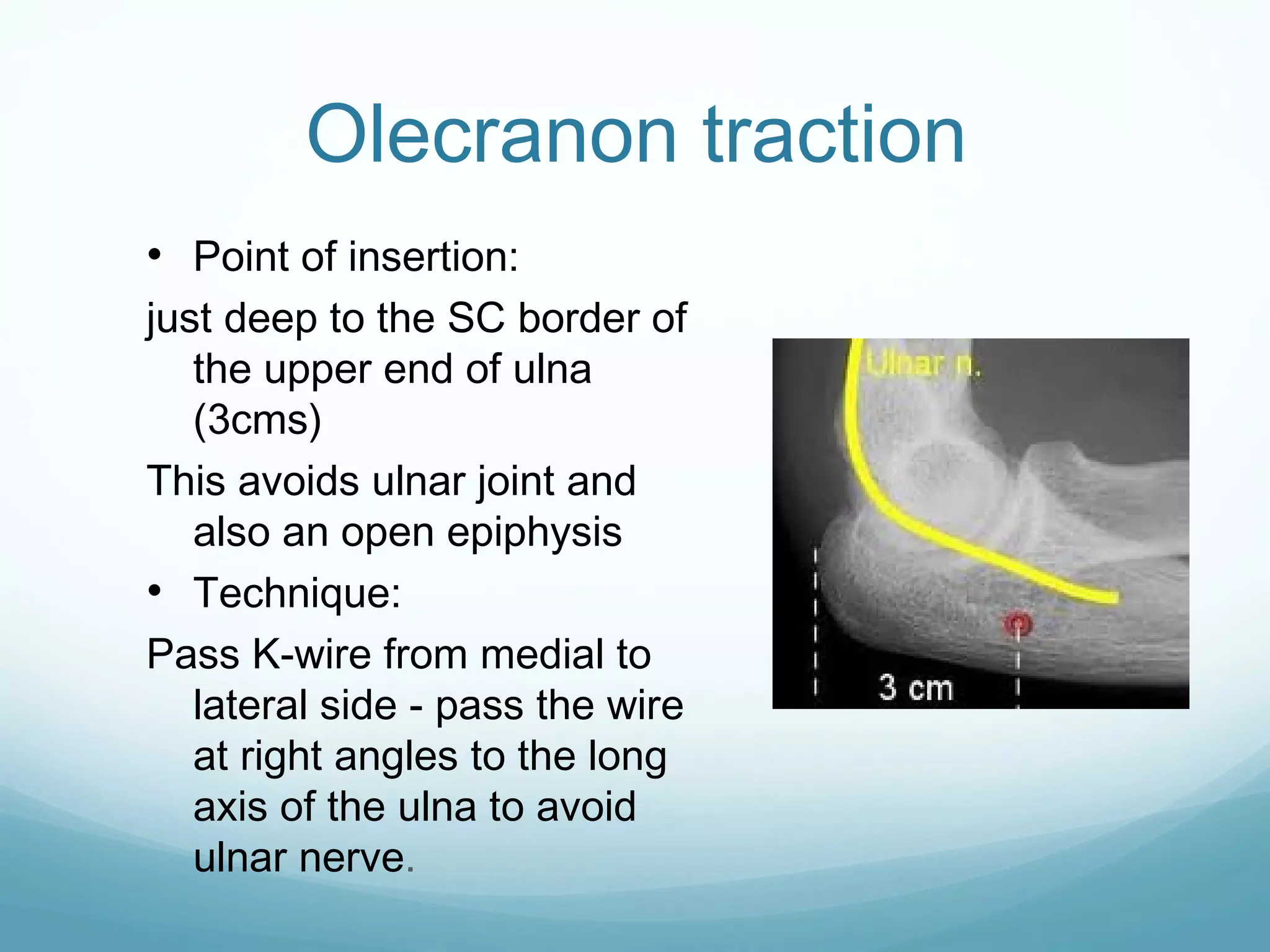
Olecranon traction
• Point of insertion:
just deep to the SC border of
the upper end of ulna
(3cms)
This avoids ulnar joint and
also an open epiphysis
• Technique:
Pass K-wire from medial to
lateral side - pass the wire
at right angles to the long
axis of the ulna to avoid
ulnar nerve.
Metacarpal Pin Traction
 Used for obtaining difficult
reduction forearm/distal
radius fracture

 Once reduction obtained,
pins can be incorporated
in cast

 Pin placed radial to ulnar
through base 2nd/3rd MC

 Stiffness of intrinsics is
common
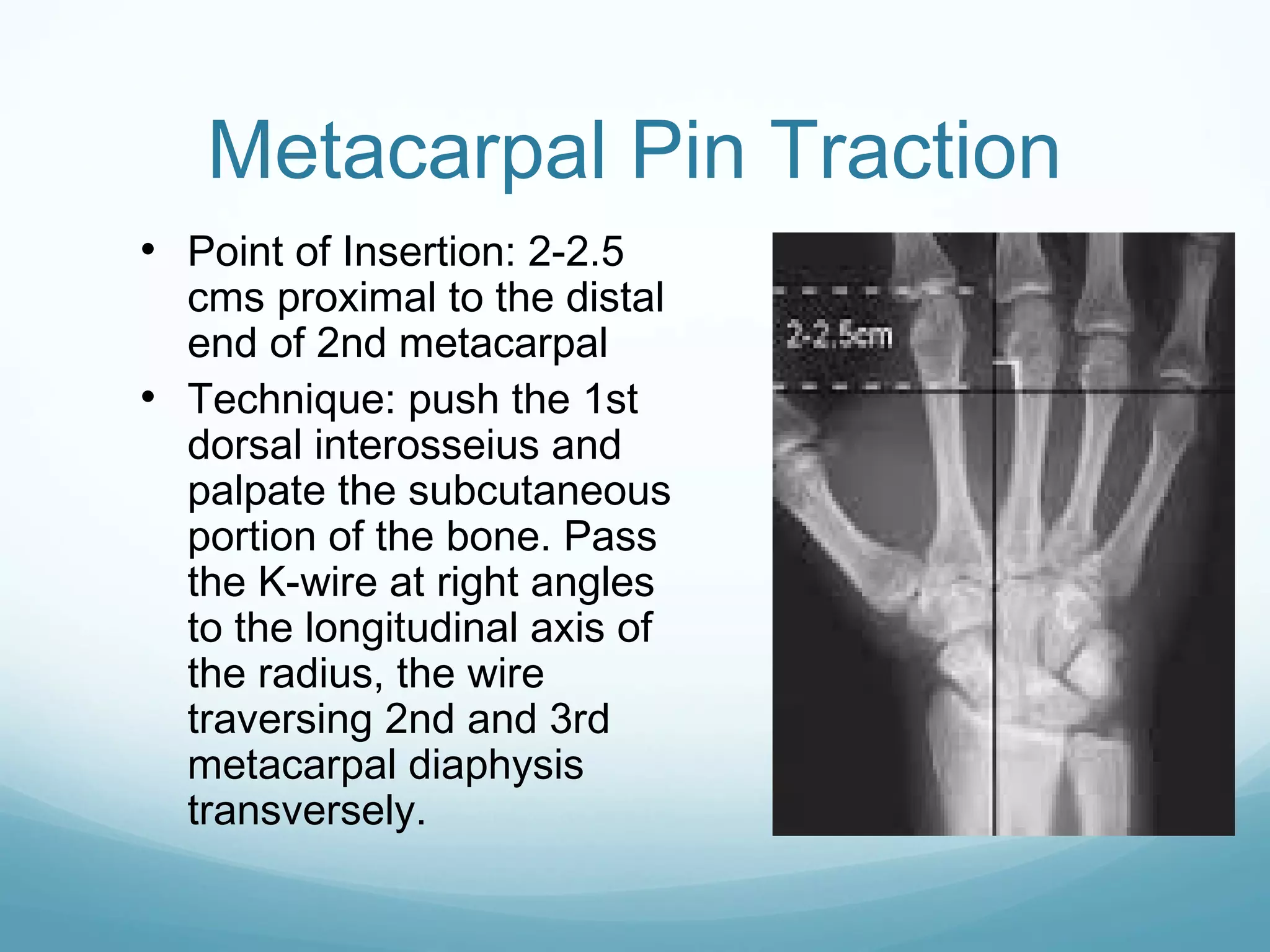
Metacarpal Pin Traction
• Point of Insertion: 2-2.5

cms proximal to the distal
end of 2nd metacarpal
• Technique: push the 1st
dorsal interosseius and
palpate the subcutaneous
portion of the bone. Pass
the K-wire at right angles
to the longitudinal axis of
the radius, the wire
traversing 2nd and 3rd
metacarpal diaphysis
transversely.
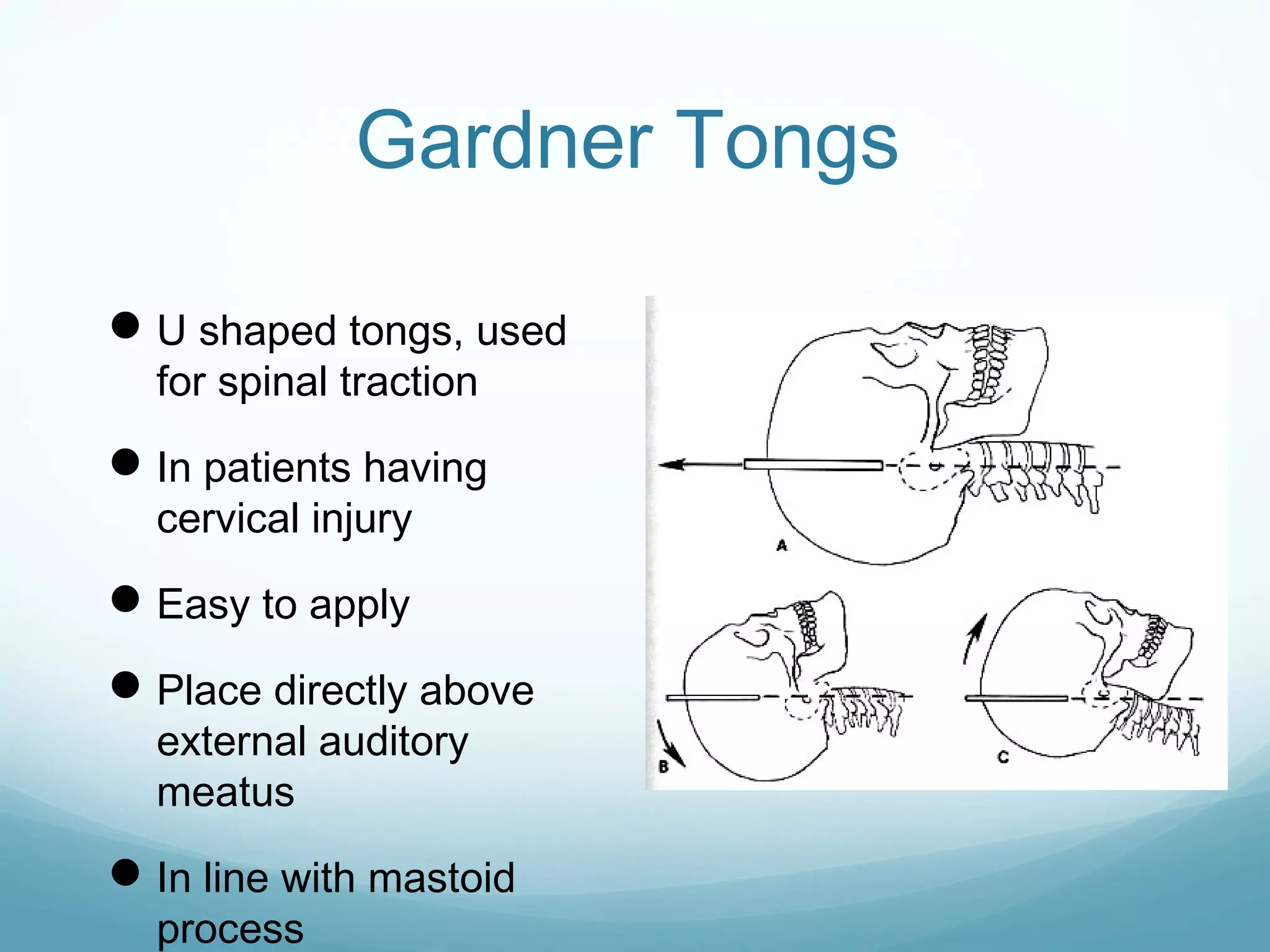
Gardner Tongs
 U shaped tongs, used
for spinal traction

 In patients having
cervical injury

 Easy to apply
 Place directly above
external auditory
meatus

 In line with mastoid
process
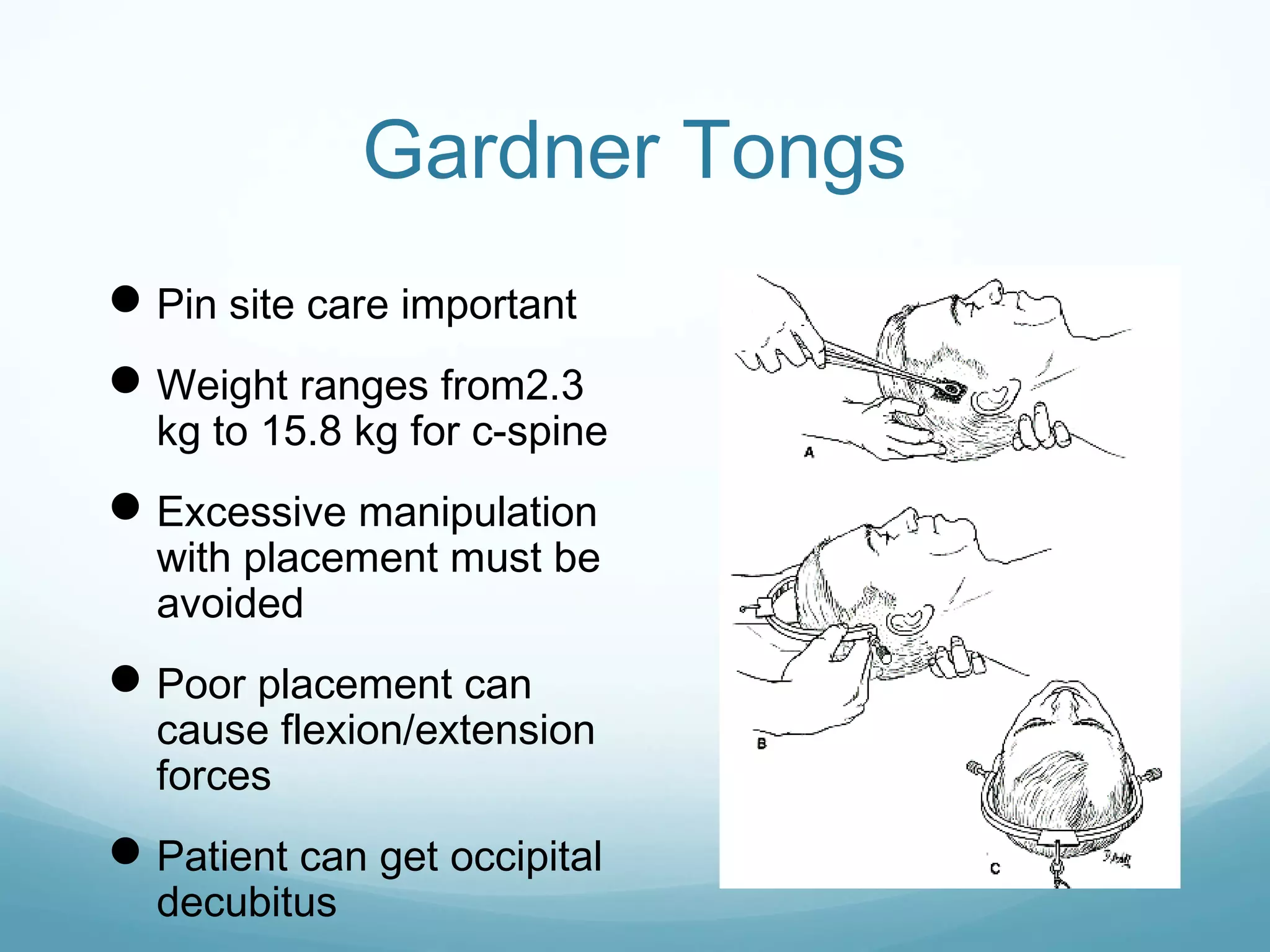
Gardner Tongs
 Pin site care important
 Weight ranges from2.3

kg to 15.8 kg for c-spine

 Excessive manipulation

with placement must be
avoided

 Poor placement can

cause flexion/extension
forces

 Patient can get occipital
decubitus
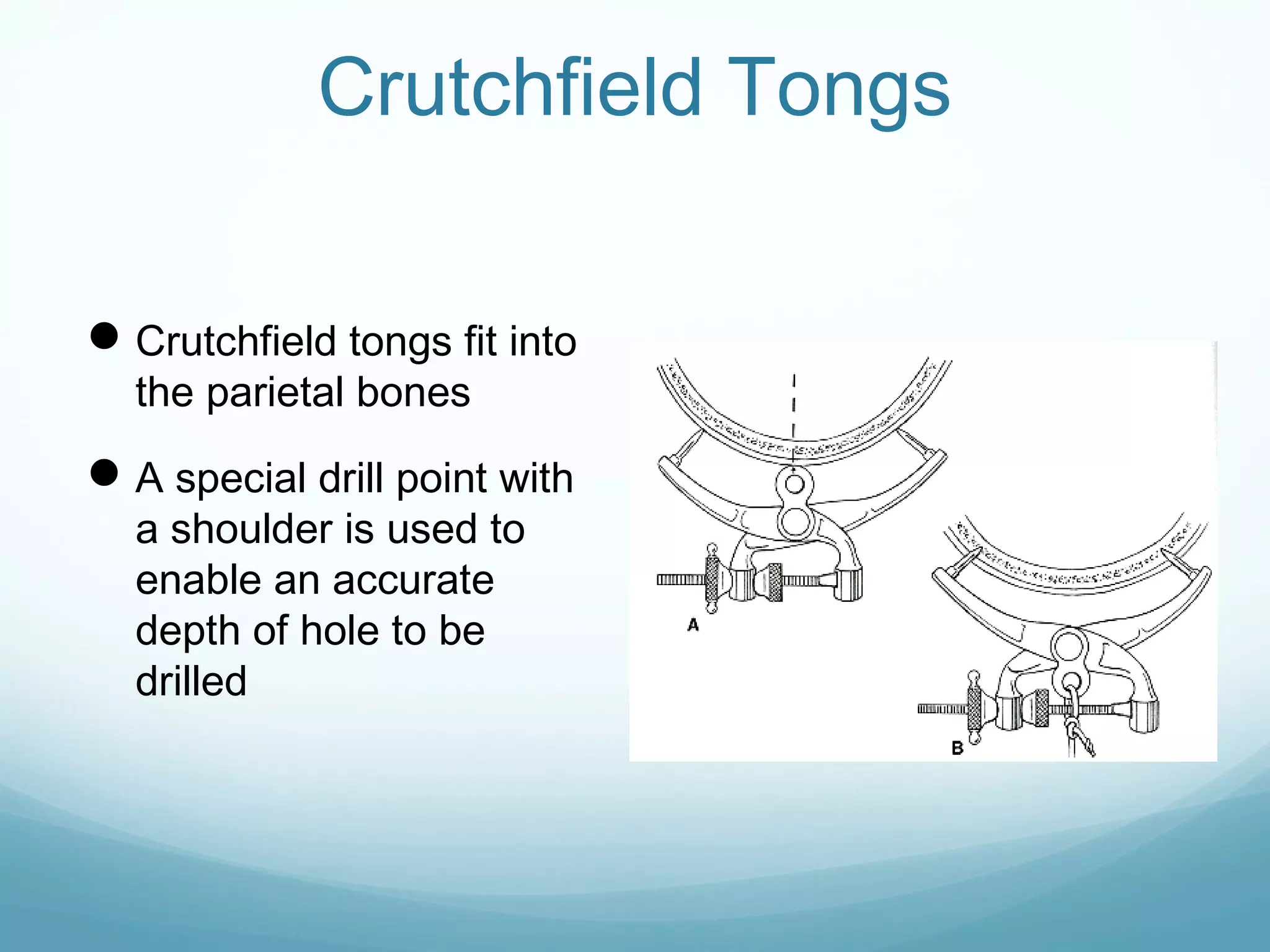
Crutchfield Tongs
 Crutchfield tongs fit into
the parietal bones

 A special drill point with
a shoulder is used to
enable an accurate
depth of hole to be
drilled
Application of Crutchfield
Tongs
 Sedate the patient
 Shave the scalp locally
 Draw a line on the scalp,
bisecting the skull from
front to back

 Draw a second line joining

the tips of the mastoid
processes which crosses
the first line at right angles

 Fully open out the tongs
Application of Crutchfield
Tongs
 With the fully open tongs lying equally on each side of the antero-

posterior line, press the points into the scalp making dimples on the
second line.

 Infiltrate the area of the dimples down to and including the periosteum,
with local anaesthetic solution.

 Make small stab wounds in the scalp at the dimples.
 Using the special drill point, drill through the outer table of the skull in a
direction parallel to the points of the tongs.

 Fit the points of the tongs into the drill holes.
 Tighten the adjustment screw until a firm grip is obtained, and repeat
daily for the first 3 to 4 days, and then tighten when necessary

 Attach a traction cord to the two lugs.
 Attach a weight to the traction cord.
 Raise the head end of the bed to provide counter traction
Recommended Weights in Cervical Traction
(Crutchfield)
Level

Minimum
Weight

Maximum
Weight

C1

2.3 KG

4.5 KG

C2

2.7 KG

4.5 – 5.4 KG

C3

3.6 KG

4.5 – 6.7 KG

C4

4.5 KG

6.7 – 9.0 KG

C5

5.4 KG

9.0 – 11.3 KG

C6

6.7 KG

9.0 – 13.5 KG

C7

8.2 KG

11.3 – 15.8 KG
Complications of Skeletal Traction
 Introduction of infection into the bone
 Incorrect placement of the pin or wire may Allow the pin or wire to cut out of the bone causing pain and the

failure of the traction system
 Make control of rotation of the limb difficult
 Make the application of splints difficult
 Result in uneven pull being applied to the ends of the pin or wire
and thus cause the pin or wire to move in the bone

 Distraction at the fracture site
 Ligamentous damage if a large traction force is applied through a joint
for a prolonged period of time

 Damage to epiphyseal growth plates when used in children
 Depressed Scars
Management of patients in
traction
 Care of the patient
 Care of the traction suspension system
 Radiographic examination
 Physiotherapy
 Removal of traction
In The Patient
Care of the injured limb-

• Pain
• Parasthesia or Numbness
• Skin irritation
• Swelling
• Weakness of ankle, toe, wrist or finger movement
Radiographic Examination
 2-3 times in first week
 Weekly for next 3 weeks
 Monthly until union occurs
 After each manipulation
 After each weight change
Removal Of Traction
 Elbow fracture with olecranon pin

- 3 weeks

 Tibial fracture with calcaneal pin

- 3-6 weeks

 Trochanteric fracture of femur

- 6 weeks

 Femoral shaft fracture
 with application of cast brace and
partial weight bearing
 without external support and
partial weight bearing

- 6 weeks
- 12 weeks
Thank You

Application of traction in orthopaedics

  • 1.
    Application of Tractionin Orthopaedics By- Prabhnoor Singh Hayer Moderated by- Dr. Rajesh Maheshwari
  • 2.
    Definition Traction is theapplication of a pulling force to a part of the body
  • 3.
    History  Hippocrates- treatedfracture shaft of femur and of leg with the leg straight in extension  Guy de chauliac- introduced continuous isotonic traction in the fracture of femur
  • 4.
    General Considerations  Safeand dependable way of treating fractures for more than 100 years  Bone reduced and held by soft tissue  Less risk of infection at fracture site  No devascularization  Allows more joint mobility than plaster
  • 5.
    Indications To reduce thefracture or dislocation To maintain the reduction To correct the deformity To reduce the muscle spasm
  • 6.
    Types Based OnMethod Of Application Skin traction The traction force is applied over a large area of skin • Adhesive • Non-adhesive skin tractions Skeletal traction Applied directly to the bone either by a pin or wire through the bone. (eg- Steinmann pin, Denham pin or Kirschner wire)
  • 7.
    Types Based OnMechanism  Fixed Traction By applying force against a fixed point of body.  Sliding Traction By tilting bed so that patient tends to slide in opposite direction to traction force
  • 8.
    Advantages of Traction Decrease pain  Minimize muscle spasms  Reduces, aligns, and immobilizes fractures  Reduce deformity  Increase space between opposing surfaces
  • 9.
    Disadvantages of Traction Costly in terms of hospital stay  Hazards of prolonged bed rest  Thromboembolism  Decubiti  Pneumonia  Requires meticulous nursing care  Can develop contractures
  • 10.
    The Traction Suspension System •Bed and Balkan beam • Splints- Thomas splint, Bohler-Braun frame, Fisk Splint • Slings and padding • Skin traction • Skeletal traction- Steinmann pin, Denham pin or Kirschner wire • Bohler Stirrup • Cord • Pulleys • Weights
  • 11.
    Knots Ideal knots canbe tied with one hand while holding weight Easy to tie and untie Overhand loop knot will not slip
  • 12.
    Knots A slip knottightens under tension Up and over, down and over, up and through
  • 13.
    Knots - types Clover hitch  Barrel hitch  Reef knot  Half hitch  Two half hitches
  • 14.
  • 15.
    Buck’s Traction orExtension  Used in temporary management of fractures of  Femoral neck  Femoral shaft in older children  Undisplaced fractures of the acetabulum  After reduction of a hip dislocation  To correct minor flexed deformities of the hip or knee  In place of pelvic traction in management of low back pain  Can use tape or pre- made boot  Not more than 4.5 kgs  Not used to obtain or hold reduction
  • 16.
    Hamilton Russell Traction Buck’s with sling  May be used in more distal femur fracture in children  Can be modified to hip and knee exerciser
  • 17.
    Bryant’s Traction  Usefulfor treatment of femoral shaft fracture in infant or small child  Combines gallows traction and Buck’s traction  Raise mattress for counter traction  Rarely used currently
  • 18.
    Forearm Skin Traction Adhesive strip with Ace wrap  Useful for elevation in any injury  Can treat difficult clavicle fractures with excellent cosmetic result  Risk is skin loss
  • 19.
    Double Skin Traction Used for greater tuberosity or proximal humeral shaft fracture  Arm abducted 30 degrees  Elbow flexed 90 degrees  Risk of ischemia at antecubital fossa a
  • 20.
    Dunlop’s Traction  Usedfor supracondylar and transcondylar fractures in children  Used when closed reduction difficult or traumatic  Forearm skin traction with weight on upper arm  Elbow flexed at 45 degrees
  • 21.
    Finger traps  Usedfor distal forearm reductions  Changing fingers imparts radial/ulnar angulation  Can get skin loss/necrosis  Recommend no more than 20 minutes
  • 22.
    Head Halter traction Simple type cervical traction  Management of neck pain  Weight should not exceed 2.3 kg  Can only be used a few hours at a time
  • 23.
    Contraindications  Abrasions andlacerations of skin in the area to which traction is to be applied  Impairment of circulation - Varicose veins, impending gangrene  Dermatitis  When there is marked shortening of the bony fragments, the traction weight required will be more then 6.7 kg which cannot be applied through the skin
  • 24.
    Complications  Allergic reactionsto adhesive  Excortication of skin  Pressure sores around the malleoli and over the tendo calcaneus  Common peroneal nerve palsy
  • 25.
  • 26.
    Indications  It shouldbe reserved for those cases in which skin traction is contraindicated  In patients with lacerated wounds  In patients with external fixator in situ  When the weight required for traction is more then 6.5 kgsObese patients
  • 27.
    Proximal Tibial Traction • Usedfor distal 2/3rd femoral shaft fractures • Tibial pin allows rotational moments • Easy to avoid joint and growth plate • 2cm distal and posterior to tibial tubercle • Pin should be driven from the lateral to the medial side to avoid damage to the common peroneal nerve.
  • 28.
    Upper Femoral Traction Lateral traction for fractures with medial or anterior force  Stretched capsule and ligamentum teres may reduce acetabular fragments
  • 29.
    Femoral Traction Pin • Lateralsurface of femur (2.5cm) below the most prominent part of GT midway between the anterior and posterior surface of femur • A coarse threaded cancellous screw is used. Must avoid NV structures and growth plate in children
  • 30.
    Distal Femoral Traction Alignment of traction along axis of femur  Used for superior force acetabular fracture and femoral shaft fracture  Used when strong force needed or knee pathology present
  • 31.
    Distal Femoral Traction •Draw 1st line from before backwards at the level of the upper pole of patella,2nd line from below upwards anterior to the head of the fibula, where these two lines intersect is the point of insertion of a Steinmann pin • Just proximal to lateral femoral condyle. In an average adult this point lies nearly 3 cm from the lateral knee joint line
  • 32.
    Ninety-Ninety Traction  Usefulfor subtrochantric and proximal 3rd femur fracture  Especially in young children  Matches flexion of proximal fragment  Can cause flexion contracture in adult
  • 33.
    Perkin’s traction Treatment offractures of tibia and of the femur from the subtrochantric region distally.  Basis of management is the use of skeletal traction coupled with active movements of the injured limb  By encouraging early muscular activity, the development of stiff joint is frequently prevented by both maintaining extensibility of muscles by reciprocal innervation, and preventing stagnation of tissue fluid
  • 34.
    Application of Perkin’straction  A Hadfield split bed is required  Under General anaesthesia and full aseptic conditions, a Denham pin is inserted through the upper end of tibia  A Simonis swivel is attached to end of each Denham pin  Two traction cords are connected to each of swivel  4.6 kg weight is attached to each traction cord making a total traction weight of 9.2 kg  Foot end of the bed is elevated by one inch for each 0.46 kg of traction weight  One or more pillow is placed under the thigh to maintain the anterior bowing of the femoral shaft  Length of the limb is checked with a tape measure and total traction weight is increased or decreased as necessary  Active Quadriceps exercises are started immediately and continued
  • 35.
  • 36.
    Balanced Suspension with PearsonAttachment  Enables elevation of limb to correct angular malalignment  Counterweighted support system  Four suspension points allow angular and rotational control
  • 37.
    Pearson Attachment • Middle3rd fracture has mild flexion proximal fragment • 30 degrees elevation with traction in line with femur • Distal 3rd fracture has distal fragment flexed posterior • Knee should be flexed more sharply • Fulcrum at level of fracture • Traction at downward angle • Reduces pull of
  • 38.
    Distal Tibial Traction Usefulin certain tibial plateau  fracture Pin inserted 5 cm above the level of the ankle joint, midway between the anterior and posterior borders of the tibia Avoid saphenous vein Place through fibula to avoid peroneal nerve Maintain partial hip and knee flexion
  • 39.
    Calcaneal Traction Temporary tractionfor tibial shaft fracture or calcaneal fracture Insert about 1.5 inches (4cms) inferior and posterior to medial malleolus Do not skewer subtalar joint or NV bundle Maintain slight elevation leg
  • 40.
    Olecranon Pin Traction Supracondylar/distal humerus fractures  Greater traction forces allowed  Can make angular and rotational corrections  Place pin 1.25 inches distal to tip  Avoid ulnar nerve
  • 41.
    Lateral Olecranon Traction Used for humeral fractures  Arm held in moderate abduction  Forearm in skin traction  Excessive weight will distract fracture
  • 42.
    Olecranon traction • Pointof insertion: just deep to the SC border of the upper end of ulna (3cms) This avoids ulnar joint and also an open epiphysis • Technique: Pass K-wire from medial to lateral side - pass the wire at right angles to the long axis of the ulna to avoid ulnar nerve.
  • 43.
    Metacarpal Pin Traction Used for obtaining difficult reduction forearm/distal radius fracture  Once reduction obtained, pins can be incorporated in cast  Pin placed radial to ulnar through base 2nd/3rd MC  Stiffness of intrinsics is common
  • 44.
    Metacarpal Pin Traction •Point of Insertion: 2-2.5 cms proximal to the distal end of 2nd metacarpal • Technique: push the 1st dorsal interosseius and palpate the subcutaneous portion of the bone. Pass the K-wire at right angles to the longitudinal axis of the radius, the wire traversing 2nd and 3rd metacarpal diaphysis transversely.
  • 45.
    Gardner Tongs  Ushaped tongs, used for spinal traction  In patients having cervical injury  Easy to apply  Place directly above external auditory meatus  In line with mastoid process
  • 46.
    Gardner Tongs  Pinsite care important  Weight ranges from2.3 kg to 15.8 kg for c-spine  Excessive manipulation with placement must be avoided  Poor placement can cause flexion/extension forces  Patient can get occipital decubitus
  • 47.
    Crutchfield Tongs  Crutchfieldtongs fit into the parietal bones  A special drill point with a shoulder is used to enable an accurate depth of hole to be drilled
  • 48.
    Application of Crutchfield Tongs Sedate the patient  Shave the scalp locally  Draw a line on the scalp, bisecting the skull from front to back  Draw a second line joining the tips of the mastoid processes which crosses the first line at right angles  Fully open out the tongs
  • 49.
    Application of Crutchfield Tongs With the fully open tongs lying equally on each side of the antero- posterior line, press the points into the scalp making dimples on the second line.  Infiltrate the area of the dimples down to and including the periosteum, with local anaesthetic solution.  Make small stab wounds in the scalp at the dimples.  Using the special drill point, drill through the outer table of the skull in a direction parallel to the points of the tongs.  Fit the points of the tongs into the drill holes.  Tighten the adjustment screw until a firm grip is obtained, and repeat daily for the first 3 to 4 days, and then tighten when necessary  Attach a traction cord to the two lugs.  Attach a weight to the traction cord.  Raise the head end of the bed to provide counter traction
  • 50.
    Recommended Weights inCervical Traction (Crutchfield) Level Minimum Weight Maximum Weight C1 2.3 KG 4.5 KG C2 2.7 KG 4.5 – 5.4 KG C3 3.6 KG 4.5 – 6.7 KG C4 4.5 KG 6.7 – 9.0 KG C5 5.4 KG 9.0 – 11.3 KG C6 6.7 KG 9.0 – 13.5 KG C7 8.2 KG 11.3 – 15.8 KG
  • 51.
    Complications of SkeletalTraction  Introduction of infection into the bone  Incorrect placement of the pin or wire may Allow the pin or wire to cut out of the bone causing pain and the failure of the traction system  Make control of rotation of the limb difficult  Make the application of splints difficult  Result in uneven pull being applied to the ends of the pin or wire and thus cause the pin or wire to move in the bone  Distraction at the fracture site  Ligamentous damage if a large traction force is applied through a joint for a prolonged period of time  Damage to epiphyseal growth plates when used in children  Depressed Scars
  • 52.
    Management of patientsin traction  Care of the patient  Care of the traction suspension system  Radiographic examination  Physiotherapy  Removal of traction
  • 53.
    In The Patient Careof the injured limb- • Pain • Parasthesia or Numbness • Skin irritation • Swelling • Weakness of ankle, toe, wrist or finger movement
  • 54.
    Radiographic Examination  2-3times in first week  Weekly for next 3 weeks  Monthly until union occurs  After each manipulation  After each weight change
  • 55.
    Removal Of Traction Elbow fracture with olecranon pin - 3 weeks  Tibial fracture with calcaneal pin - 3-6 weeks  Trochanteric fracture of femur - 6 weeks  Femoral shaft fracture  with application of cast brace and partial weight bearing  without external support and partial weight bearing - 6 weeks - 12 weeks
  • 56.