Orthopedic conference
By
Ext.chennisata ta.
Ext.chitpisuitn po.
1
× ผู้ป่วยชายไทย อายุ38ปี
× ภูมิลาเนา อ.ลาทะเมนชัย จ.นครราชสีมา
× อาชีพ ทาไร่
2
Chief complaint
ปวดไหล่ขวา 10 ชม. PTA
3
10 ชม. PTA ผู้ป่วยดื่มสุรา มีอาการมึนเมา ขับMC
ชนฟุตบาท ตัวผู้ป่วยกระเด็นตีลังกาตกลงกระแทกพื้นถนน ไม่ได้
สวมหมวกกันน็อค สลบ กู้ภัยนาส่งรพ.
ที่รพช. ผู้ป่วยตื่น จาเหตุการณ์ไม่ได้ มีรอยฟกช้าที่ศรีษะ
ด้านขวา แผลถลอกที่ใบหน้าและไหล่ขวา ปวดไหล่ขวามาก ขยับ
แขนขวาได้ลาบากเนื่องจากปวด
4
× ปฏิเสธโรคประจาตัว
× Chronic alcohol drinking
× Smoking 1 pack years
× ปฏิเสธประวัติแพ้ยา,แพ้อาหาร
× ปฏิเสธประวัติผ่าตัด
× ปฏิเสธประวัติการใช้ยาต้ม, ยาหม้อ, ยาลูกกลอน
5
× A: airway patent, C-spine not tender
× B: Clear & equals breath sound, CCT neg
× C: BP 120/80, PR80, cap refill < 2 sec, no external
bleeding
× D: E4V5M6 pupils 3 mm RTLBE
× E: AW at Face & Rt. Shoulder, Contusion at Rt.
Parietal area 5x5 cm.
6
× Vital sign: BP 120/80 mmHg, HR80bpm, T 36.7 C, RR 20/min, O2sat
98%
× GA: A thai man, good conciousness, well co-operative
× HEENT: not pale conjunctiva, anicteric sclera, no
lymphadenopathy
× Heart: bradycardia, regular rate 78 bpm, no heaving, no thrill, apex
at 5th ICSMCL, normal S1 S2, no murmur
× Lung: equal chest movement, tympanic on percussion, Clear and
equal breath sound both lungs, no adventitious sounds
7
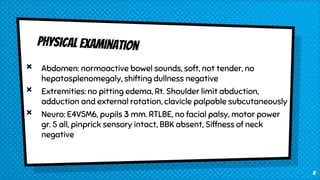
× Abdomen: normoactive bowel sounds, soft, not tender, no
hepatosplenomegaly, shifting dullness negative
× Extremities: no pitting edema, Rt. Shoulder limit abduction,
adduction and external rotation, clavicle palpable subcutaneously
× Neuro: E4V5M6, pupils 3 mm. RTLBE, no facial palsy, motor power
gr. 5 all, pinprick sensory intact, BBK absent, Siffness of neck
negative
8
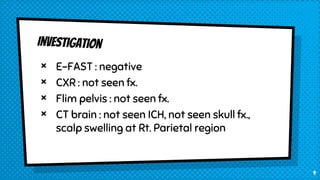
× E-FAST : negative
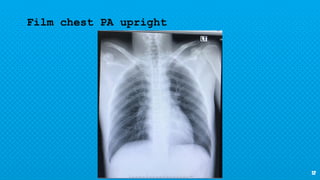
× CXR : not seen fx.
× Flim pelvis : not seen fx.
× CT brain : not seen ICH, not seen skull fx.,
scalp swelling at Rt. Parietal region
9
10
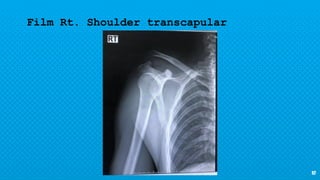
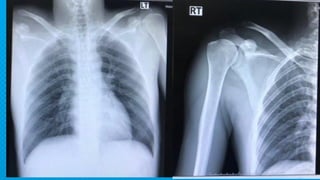
Film Rt. Shoulder transcapular
11
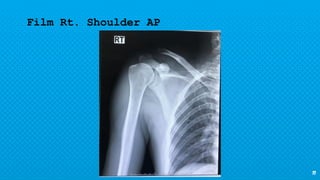
Film Rt. Shoulder AP
12
Film chest PA upright
13
14
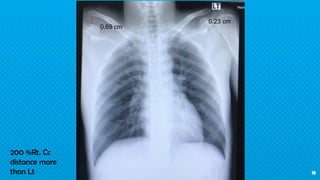
0.23 cm
0.69 cm
200 %Rt. Cc
distance more
than Lt
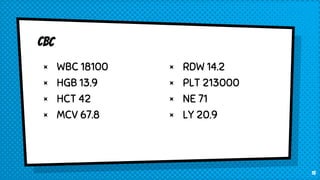
× WBC 18100
× HGB 13.9
× HCT 42
× MCV 67.8
× RDW 14.2
× PLT 213000
× NE 71
× LY 20.9
15
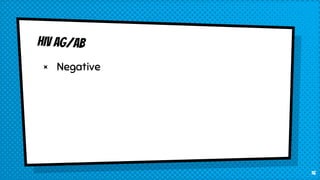
× Negative
16
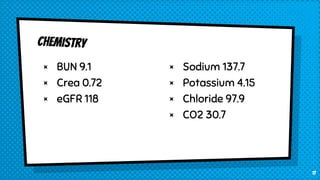
× BUN 9.1
× Crea 0.72
× eGFR 118
× Sodium 137.7
× Potassium 4.15
× Chloride 97.9
× CO2 30.7
17
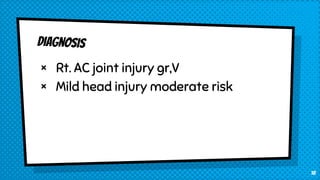
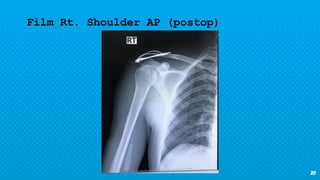
× Rt. AC joint injury gr,V
× Mild head injury moderate risk
18
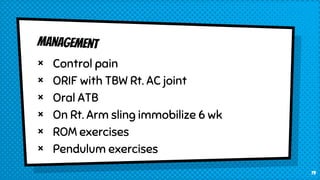
× Control pain
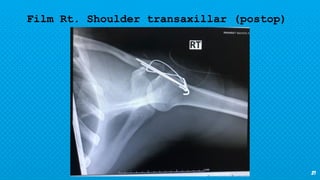
× ORIF with TBW Rt. AC joint
× Oral ATB
× On Rt. Arm sling immobilize 6 wk
× ROM exercises
× Pendulum exercises
19
20
Film Rt. Shoulder AP (postop)
21
Film Rt. Shoulder transaxillar (postop)
Acromio-
clavicular
injury
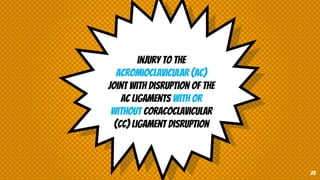
injury to the
acromioclavicular (AC)
joint with disruption of the
AC ligaments with or
without coracoclavicular
(CC) ligament disruption
23
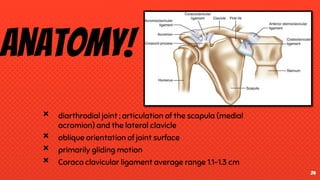
Anatomy!
× diarthrodial joint ; articulation of the scapula (medial
acromion) and the lateral clavicle
× oblique orientation of joint surface
× primarily gliding motion
× Coraco clavicular ligament average range 1.1-1.3 cm
24
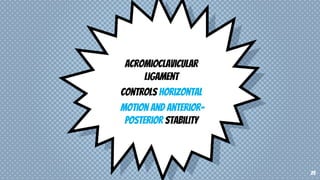
Acromioclavicular
ligament
controls horizontal
motion and anterior-
posterior stability
25
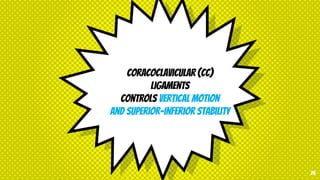
coracoclavicular (CC)
ligaments
controls vertical motion
and superior-inferior stability
26
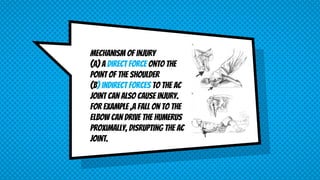
mechanism of injury
(A) a direct force onto the
point of the shoulder
(B) indirect forces to the AC
joint can also cause injury.
For example ,a fall on to the
elbow can drive the humerus
proximally, disrupting the AC
joint.
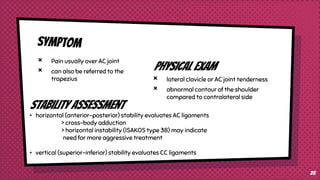
× Pain usually over AC joint
× can also be referred to the
trapezius
Physical exam
× lateral clavicle or AC joint tenderness
× abnormal contour of the shoulder
compared to contralateral side
28
stability assessment
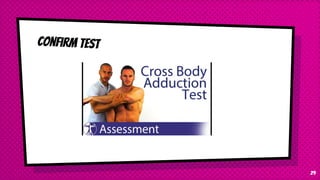
• horizontal (anterior-posterior) stability evaluates AC ligaments
> cross-body adduction
> horizontal instability (ISAKOS type 3B) may indicate
need for more aggressive treatment
• vertical (superior-inferior) stability evaluates CC ligaments
29
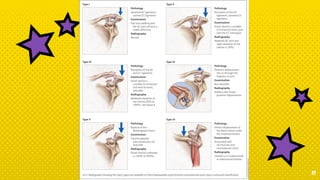
rockwood
AC joint injury
30
31
radiographic
AC joint injury
32
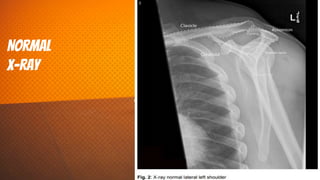
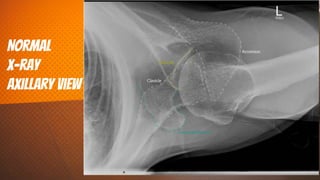
NorMal
x-ray (both)
clavicle AP view
33
NorMal
x-ray
34
NorMal
x-ray
axillary view
35
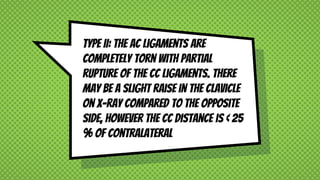
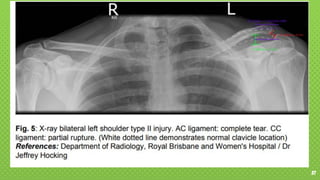
Type II: The AC ligaments are
completely torn with partial
rupture of the CC ligaments. There
may be a slight raise in the clavicle
on X-ray compared to the opposite
side, however the CC distance is < 25
% of contralateral
37
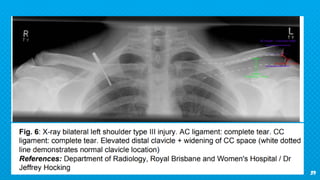
Type III: Both the AC and CC
ligaments are completely
ruptured. X-ray will show an
elevated distal clavicle with a
widening of the CC space by
approximately 25-100%
39
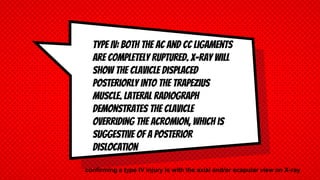
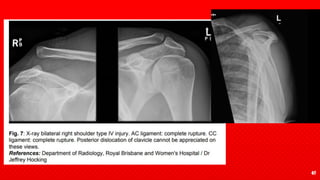
Type IV: Both the AC and CC ligaments
are completely ruptured. X-ray will
show the clavicle displaced
posteriorly into the trapezius
muscle. Lateral radiograph
demonstrates the clavicle
overriding the acromion, which is
suggestive of a posterior
dislocation
confirming a type IV injury is with the axial and/or scapular view on X-ray
41
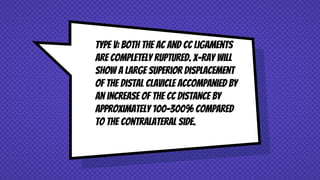
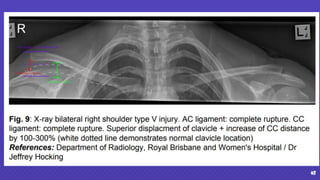
Type V: Both the AC and CC ligaments
are completely ruptured. X-ray will
show a large superior displacement
of the distal clavicle accompanied by
an increase of the CC distance by
approximately 100-300% compared
to the contralateral side.
43
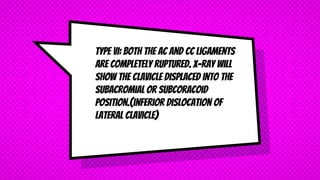
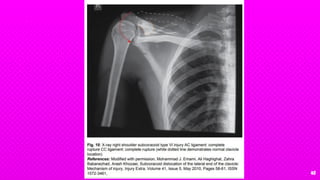
Type VI: Both the AC and CC ligaments
are completely ruptured. X-ray will
show the clavicle displaced into the
subacromial or subcoracoid
position.(inferior dislocation of
lateral clavicle)
45
MANAGEMENT
46
× brief sling immobilization, rest, ice, physical
therapy
× indications
× type I and II
× Acute type III in most individuals
× good results when clavicle displaced < 2cm
47
× On arm sling 7-10 days
× Control pain (NSAID , analgesic)
48
× On arm sling 10-14 days
× Control pain (NSAID , analgesic)
× Pendulum exercise
49
Rehab
× Passive and active ROM
× Once symmetrical and
painless ROM >
isometric shoulder
strengthening
50
× Avoid return to sport
and heavy lifting
8-10 weeks
× Regain functional
motion 6 weeks
× Return to normal
activity 12 weeks
51
× CC interval restoration (ORIF vs.
Ligament Reconstruction)
× indications
× acute type IV, V or VI injuries
× acute type III injuries in laborers, elite athletes,
patients with cosmetic concerns
× chronic type III injuries that failed non-op
treatment
52
complication
53
AC arthritis
× more common with surgical management than with
nonoperative treatment
Hardware failure
CC screw breakage/pullout
!
Residual pain at AC joint
× 30-50%
54
Coracoid fracture
× can occur with coracoid tunnel drilling
THANKS!Any questions?
55

Acinjury chitphisut-chennisata

  • 1.
  • 2.
    × ผู้ป่วยชายไทย อายุ38ปี ×ภูมิลาเนา อ.ลาทะเมนชัย จ.นครราชสีมา × อาชีพ ทาไร่ 2
  • 3.
  • 4.
    10 ชม. PTAผู้ป่วยดื่มสุรา มีอาการมึนเมา ขับMC ชนฟุตบาท ตัวผู้ป่วยกระเด็นตีลังกาตกลงกระแทกพื้นถนน ไม่ได้ สวมหมวกกันน็อค สลบ กู้ภัยนาส่งรพ. ที่รพช. ผู้ป่วยตื่น จาเหตุการณ์ไม่ได้ มีรอยฟกช้าที่ศรีษะ ด้านขวา แผลถลอกที่ใบหน้าและไหล่ขวา ปวดไหล่ขวามาก ขยับ แขนขวาได้ลาบากเนื่องจากปวด 4
  • 5.
    × ปฏิเสธโรคประจาตัว × Chronicalcohol drinking × Smoking 1 pack years × ปฏิเสธประวัติแพ้ยา,แพ้อาหาร × ปฏิเสธประวัติผ่าตัด × ปฏิเสธประวัติการใช้ยาต้ม, ยาหม้อ, ยาลูกกลอน 5
  • 6.
    × A: airwaypatent, C-spine not tender × B: Clear & equals breath sound, CCT neg × C: BP 120/80, PR80, cap refill < 2 sec, no external bleeding × D: E4V5M6 pupils 3 mm RTLBE × E: AW at Face & Rt. Shoulder, Contusion at Rt. Parietal area 5x5 cm. 6
  • 7.
    × Vital sign:BP 120/80 mmHg, HR80bpm, T 36.7 C, RR 20/min, O2sat 98% × GA: A thai man, good conciousness, well co-operative × HEENT: not pale conjunctiva, anicteric sclera, no lymphadenopathy × Heart: bradycardia, regular rate 78 bpm, no heaving, no thrill, apex at 5th ICSMCL, normal S1 S2, no murmur × Lung: equal chest movement, tympanic on percussion, Clear and equal breath sound both lungs, no adventitious sounds 7
  • 8.
    × Abdomen: normoactivebowel sounds, soft, not tender, no hepatosplenomegaly, shifting dullness negative × Extremities: no pitting edema, Rt. Shoulder limit abduction, adduction and external rotation, clavicle palpable subcutaneously × Neuro: E4V5M6, pupils 3 mm. RTLBE, no facial palsy, motor power gr. 5 all, pinprick sensory intact, BBK absent, Siffness of neck negative 8
  • 9.
    × E-FAST :negative × CXR : not seen fx. × Flim pelvis : not seen fx. × CT brain : not seen ICH, not seen skull fx., scalp swelling at Rt. Parietal region 9
  • 10.
  • 11.
  • 12.
  • 13.
  • 14.
    14 0.23 cm 0.69 cm 200%Rt. Cc distance more than Lt
  • 15.
    × WBC 18100 ×HGB 13.9 × HCT 42 × MCV 67.8 × RDW 14.2 × PLT 213000 × NE 71 × LY 20.9 15
  • 16.
  • 17.
    × BUN 9.1 ×Crea 0.72 × eGFR 118 × Sodium 137.7 × Potassium 4.15 × Chloride 97.9 × CO2 30.7 17
  • 18.
    × Rt. ACjoint injury gr,V × Mild head injury moderate risk 18
  • 19.
    × Control pain ×ORIF with TBW Rt. AC joint × Oral ATB × On Rt. Arm sling immobilize 6 wk × ROM exercises × Pendulum exercises 19
  • 20.
  • 21.
    21 Film Rt. Shouldertransaxillar (postop)
  • 22.
  • 23.
    injury to the acromioclavicular(AC) joint with disruption of the AC ligaments with or without coracoclavicular (CC) ligament disruption 23
  • 24.
    Anatomy! × diarthrodial joint; articulation of the scapula (medial acromion) and the lateral clavicle × oblique orientation of joint surface × primarily gliding motion × Coraco clavicular ligament average range 1.1-1.3 cm 24
  • 25.
  • 26.
    coracoclavicular (CC) ligaments controls verticalmotion and superior-inferior stability 26
  • 27.
    mechanism of injury (A)a direct force onto the point of the shoulder (B) indirect forces to the AC joint can also cause injury. For example ,a fall on to the elbow can drive the humerus proximally, disrupting the AC joint.
  • 28.
    × Pain usuallyover AC joint × can also be referred to the trapezius Physical exam × lateral clavicle or AC joint tenderness × abnormal contour of the shoulder compared to contralateral side 28 stability assessment • horizontal (anterior-posterior) stability evaluates AC ligaments > cross-body adduction > horizontal instability (ISAKOS type 3B) may indicate need for more aggressive treatment • vertical (superior-inferior) stability evaluates CC ligaments
  • 29.
  • 30.
  • 31.
  • 32.
  • 33.
  • 34.
  • 35.
  • 36.
    Type II: TheAC ligaments are completely torn with partial rupture of the CC ligaments. There may be a slight raise in the clavicle on X-ray compared to the opposite side, however the CC distance is < 25 % of contralateral
  • 37.
  • 38.
    Type III: Boththe AC and CC ligaments are completely ruptured. X-ray will show an elevated distal clavicle with a widening of the CC space by approximately 25-100%
  • 39.
  • 40.
    Type IV: Boththe AC and CC ligaments are completely ruptured. X-ray will show the clavicle displaced posteriorly into the trapezius muscle. Lateral radiograph demonstrates the clavicle overriding the acromion, which is suggestive of a posterior dislocation confirming a type IV injury is with the axial and/or scapular view on X-ray
  • 41.
  • 42.
    Type V: Boththe AC and CC ligaments are completely ruptured. X-ray will show a large superior displacement of the distal clavicle accompanied by an increase of the CC distance by approximately 100-300% compared to the contralateral side.
  • 43.
  • 44.
    Type VI: Boththe AC and CC ligaments are completely ruptured. X-ray will show the clavicle displaced into the subacromial or subcoracoid position.(inferior dislocation of lateral clavicle)
  • 45.
  • 46.
  • 47.
    × brief slingimmobilization, rest, ice, physical therapy × indications × type I and II × Acute type III in most individuals × good results when clavicle displaced < 2cm 47
  • 48.
    × On armsling 7-10 days × Control pain (NSAID , analgesic) 48
  • 49.
    × On armsling 10-14 days × Control pain (NSAID , analgesic) × Pendulum exercise 49
  • 50.
    Rehab × Passive andactive ROM × Once symmetrical and painless ROM > isometric shoulder strengthening 50
  • 51.
    × Avoid returnto sport and heavy lifting 8-10 weeks × Regain functional motion 6 weeks × Return to normal activity 12 weeks 51
  • 52.
    × CC intervalrestoration (ORIF vs. Ligament Reconstruction) × indications × acute type IV, V or VI injuries × acute type III injuries in laborers, elite athletes, patients with cosmetic concerns × chronic type III injuries that failed non-op treatment 52
  • 53.
  • 54.
    AC arthritis × morecommon with surgical management than with nonoperative treatment Hardware failure CC screw breakage/pullout ! Residual pain at AC joint × 30-50% 54 Coracoid fracture × can occur with coracoid tunnel drilling
  • 55.