Brief Introduction to
Protein Engineering
-PROF. SNEHAL B JADHAV
1
Protein Engineering
 Definition: It is an ā€˜ modification of Protein structure with recombinant DNA technology or
chemical treatment to get a desirable function for better use in medicine, industry and
agriculture’
 It is an one of the most exciting aspects of genetic engineering and consist of designing,
developing, and producing protein with improved operating characteristics.
 The techniques like site directed mutagenesis and gene cloning are utilized for these
purpose
2
Protein Engineering
OBJECTIVE:
 To create a superior enzyme to catalyze the production of high value specific chemicals
 To produce enzymes in large quantities
 To produce biological compounds (synthetic peptide, storage protein and synthetic drugs)
superior to natural one
3
Protein Engineering
SITE DIRECTED MUTAGENESIS
What is Mutation??
 In molecular biology and genetics, mutation are changes in a genomic sequence
 Mutations are caused by radiation, viruses, transposes and mutagenic chemicals as well as
errors that occur during meiosis and DNA replication
 Site Directed Mutagenesis: Also known as Site Specific Mutagenesis or Oligonucleotide
directed Mutagenesis is a molecular biology technique often used in bio molecular
engineering in which a mutation is created at a defined site in a DNA molecule known as
plasmid
4
Protein Engineering- SITE DIRECTED MUTAGENESIS
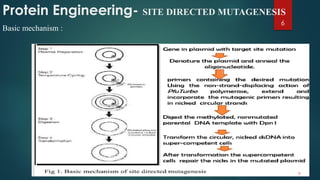
 It is the technique for generating amino acid coding changes in the DNA(gene). By this
approach, specific(i.e. ā€˜site-directed’)change (i.e. ā€˜mutation’) can be made in the base (or
bases) of the gene to produce a desired enzyme
 A large amount of experimental procedures have been developed for directed-mutagenesis of
cloned genes
 A synthetic oligonucleotide complimentary pair to the area of the gene interest, but has the
desired nucleotide change
 Oligonucleotide- short piece of DNA, usually 10-30 nucleotide long
 Site directed Mutagenesis is done by using: M3, plasmid DNA, PCR, Random primers,
degenerate primers, Nucleotide analogs, DNA shuffling
5
Protein Engineering- SITE DIRECTED MUTAGENESIS
Basic mechanism :
6
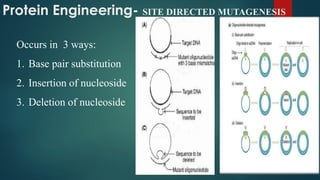
Occurs in 3 ways:
1. Base pair substitution
2. Insertion of nucleoside
3. Deletion of nucleoside
Protein Engineering- SITE DIRECTED MUTAGENESIS
7
Protein Engineering- SITE DIRECTED MUTAGENESIS
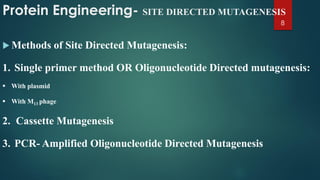
 Methods of Site Directed Mutagenesis:
1. Single primer method OR Oligonucleotide Directed mutagenesis:
ļ‚§ With plasmid
ļ‚§ With M13 phage
2. Cassette Mutagenesis
3. PCR- Amplified Oligonucleotide Directed Mutagenesis
8
Protein Engineering- SITE DIRECTED MUTAGENESIS
1. Single primer method OR Oligonucleotide Directed mutagenesis
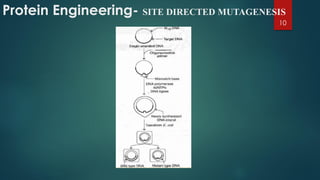
• The primer used in this method is a chemically synthesized oligonucleotide which is
normally 7- 20 nucleotide long
• It is complementary to a position of a gene around the site to be mutated. But it contains
mismatch of or the base to ne mutated
• The starting material is a single stranded DNA (to be mutated) carried in an M13 phage
vector
• Om mixing this DNA with primer, the oligonucleotide hybridizes with the complementary
sequences, except at the point of mismatched nucleotide
• Hybridization (beside a single base mismatch) is possible by mixing at low temperature
with excess of primer and in presence of high salt concentration
9
Protein Engineering- SITE DIRECTED MUTAGENESIS
10
Protein Engineering- SITE DIRECTED MUTAGENESIS
1. Single primer method OR Oligonucleotide Directed mutagenesis
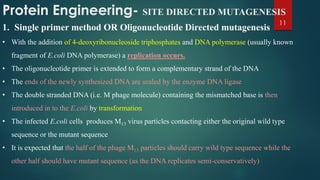
• With the addition of 4-deoxyribonucleoside triphosphates and DNA polymerase (usually known
fragment of E.coli DNA polymerase) a replication occurs.
• The oligonucleotide primer is extended to form a complementary strand of the DNA
• The ends of the newly synthesized DNA are sealed by the enzyme DNA ligase
• The double stranded DNA (i.e. M phage molecule) containing the mismatched base is then
introduced in to the E.coli by transformation
• The infected E.coli cells produces M13 virus particles contacting either the original wild type
sequence or the mutant sequence
• It is expected that the half of the phage M13 particles should carry wild type sequence while the
other half should have mutant sequence (as the DNA replicates semi-conservatively)
11
Protein Engineering- SITE DIRECTED MUTAGENESIS
2. Cassette Mutagenesis
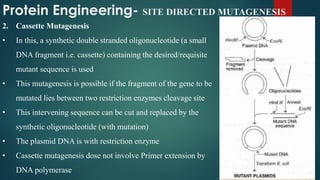
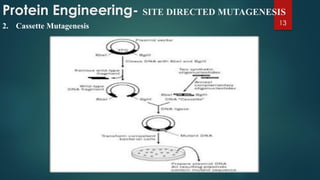
• In this, a synthetic double stranded oligonucleotide (a small
DNA fragment i.e. cassette) containing the desired/requisite
mutant sequence is used
• This mutagenesis is possible if the fragment of the gene to be
mutated lies between two restriction enzymes cleavage site
• This intervening sequence can be cut and replaced by the
synthetic oligonucleotide (with mutation)
• The plasmid DNA is with restriction enzyme
• Cassette mutagenesis dose not involve Primer extension by
DNA polymerase
12
Protein Engineering- SITE DIRECTED MUTAGENESIS
2. Cassette Mutagenesis 13
Protein Engineering- SITE DIRECTED MUTAGENESIS
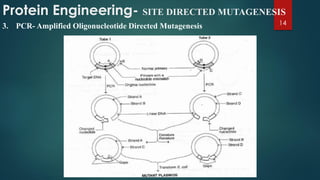
3. PCR- Amplified Oligonucleotide Directed Mutagenesis 14
Protein Engineering- SITE DIRECTED MUTAGENESIS
3. PCR- Amplified Oligonucleotide Directed Mutagenesis
• In this technique, first the target DNA is cloned on to a plasmid vector and distributed in to
two reaction tubes
• To each tube, primer is added
• One primer (A in tube 1 and C in tube 2) is complimentary to a region in one strand of the
cloned gene except for one nucleotide mismatch (i.e. the one targeted for a change)
• The other primer ( B in tube 1 and D in tube 2) is fully complementary of a sequence in the
other strand with in or adjacent to the cloned gene
• The placement of primers for hybridization (with DNA strands) in each tube is done in
opposite direction
• The PCR technique is carried out for amplification of the DNA molecule
15
Protein Engineering- SITE DIRECTED MUTAGENESIS
3. PCR- Amplified Oligonucleotide Directed Mutagenesis
• The products of PCR in two reaction tube are mixed
• The DNA molecule undergo denaturation and renaturation
• A Strand from one reaction tube (strand A) hybridizes with its complementary strand from
other reaction tube (strand C)
16
Protein Engineering
Applications:
• Used to generate mutation that may produce rationally designed protein that has improved or
special properties
• Investigative tool: specific mutation in DNA aloe the function and properties of a DNA
sequence or a protein to be investigated in a rational approach
• Commercial application: proteins may be engineered to produce proteins that are tailored for
a specific application
• Examples: in laundry industry- commonly used detergents may contain subtilize in whose
wild-type form has a methionine that can be oxidized by bleach, inactivating the protein in the
process
• This methionine may be replaced by alanine, thereby making the proteins active in the
presence of bleach
17
Protein Engineering
Approaches of Protein Engineering
I. Increasing Stability and Biological activity of Protein:
1. Addition of disulphide bond- increase thermostability of enzymes. E.g T4 lysozyme,
xylanase
2. Changing asparagine to other amino acids- thermostable enzyme with improved biological
activity. E.g triosephosphate isomerase- asparagine is replace by isoleucine or threonine to
have thermostable enzyme
3. Reduce free sulfahydryl group- to improve stability and activity. E.g. human interferon
4. Single amino acid changes: improved stability and activity. E.g alpha 1 trypsin- oxidative
resistance enzyme created
18
Protein Engineering
Approaches of Protein Engineering
II. Improving kinetic properties of enzymes- with the help of site directed mutagenesis.
E.g. Substilisin, asparginase RE
III. Protein engineering through chemical modification: protein cross linker glutaraldehyde
is used in stabilization of protein in solution. E.g insulin hemoglobin, lactate dehydrogenase
IV. Protein engineering using gene family: isolation of gene from known family –DNA
shuffling- creation of hybrid of different combination
19
Thank You!!!
20