VIGNAN PHARMACY COLLEGE
VADLAMUDI-522213, GUNTUR (Dt), ANDHRA PRADESH, INDIA
Dr. Sowjanya Pulipati
Professor & Head
Dept. of Pharm Biotechnology
I
N
T
R
O
D
U
C
T
I
O
N
3
PROTEIN ENGINEERING
Protein engineering is the process of
developing useful or valuable proteins.
Protein Engineering is a second
generation of recombinant DNA
technology.
It involves altering cloned DNA in vitro
by novel mutational technique so that
translated proteins have slightly altered
properties.
I
N
T
R
O
D
U
C
T
I
O
N 3
PROTEIN ENGINEERING
Protein engineering is merging of
several disciplines like molecular
biology, protein chemistry, enzymology,
structural chemistry to alter catalytic or
structural stability of protein, enzyme.
With the advances in genetic
engineering, genes can be isolated from
organism and used for the synthesis of
naturally occurring proteins. Some of
these serve as enzymes.
PROTEIN ENGINEERING
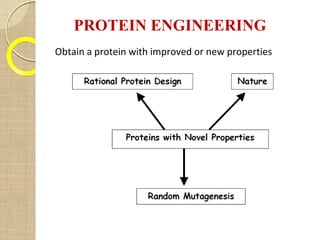
Obtain a protein with improved or new properties
PROTEIN ENGINEERING
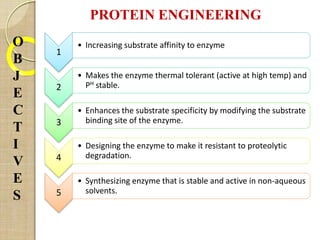
1
• Increasing substrate affinity to enzyme
2
• Makes the enzyme thermal tolerant (active at high temp) and
PH stable.
3
• Enhances the substrate specificity by modifying the substrate
binding site of the enzyme.
4
• Designing the enzyme to make it resistant to proteolytic
degradation.
5
• Synthesizing enzyme that is stable and active in non-aqueous
solvents.
O
B
J
E
C
T
I
V
E
S
PROTEIN ENGINEERING
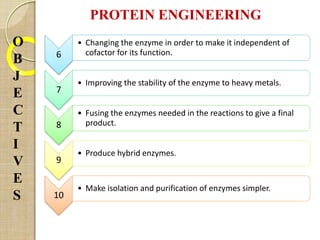
6
• Changing the enzyme in order to make it independent of
cofactor for its function.
7
• Improving the stability of the enzyme to heavy metals.
8
• Fusing the enzymes needed in the reactions to give a final
product.
9
• Produce hybrid enzymes.
10
• Make isolation and purification of enzymes simpler.
O
B
J
E
C
T
I
V
E
S
T
E
C
H
N
I
Q
U
E
S
3
PROTEIN ENGINEERING
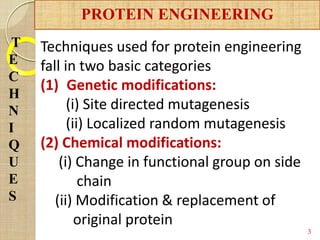
Techniques used for protein engineering
fall in two basic categories
(1) Genetic modifications:
(i) Site directed mutagenesis
(ii) Localized random mutagenesis
(2) Chemical modifications:
(i) Change in functional group on side
chain
(ii) Modification & replacement of
original protein
In molecular biology and genetics, mutations are
accidental changes in a genomic sequence of DNA.
Mutations can involve large sections of DNA
becoming duplicated, usually through genetic
recombination.
Mutation is defined as a change in the nucleic
sequence (bases) of an organism’s genetic material
(a change in the genetic material of an organism).
Site directed mutagenesis may be define as a change
in the nucleic acid sequence (or genetic material) of
an organism at a specific predetermined location.
SITE DIRECTED MUTAGENESIS
M
U
T
A
T
I
O
N
5
Site-directed mutagenesis is the technique for generating amino acid
coding changes in the DNA (gene). By this approach specific (site-
directed) change (mutagenesis) can be made in the base (or bases) of the
gene to produce a desired enzyme.
A large amount of experimental procedures have been developed for
directed mutagenesis of cloned genes.
A synthetic oligonucleotide complimentary to the area of the gene of
interestbut has the desired nucleotide change.
An oligonucleotide is a short piece of DNA usually 10-30 nucleotide
long.
Directed mutagenesis can be done using:
M13 Plasmid DNA, PCR, Random primers, Degenerate primers,
Nucleotide analogs
SITE DIRECTED MUTAGENESIS
D
I
R
E
C
T
E
D
M
U
T
A
G
E
N
A
S
I
S
6
Fig.No.2-single primer method
THE SINGLE PRIMER METHOD
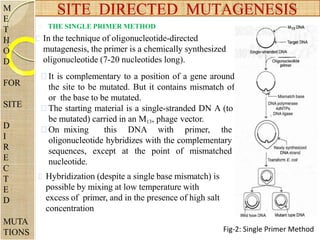
In the technique of oligonucleotide-directed
mutagenesis, the primer is a chemically synthesized
oligonucleotide (7-20 nucleotides long).
It is complementary to a position of a gene around
the site to be mutated. But it contains mismatch of
or the base to be mutated.
The starting material is a single-stranded DN A (to
be mutated) carried in an M13, phage vector.
On mixing this DNA with primer, the
oligonucleotide hybridizes with the complementary
sequences, except at the point of mismatched
nucleotide.
SITE DIRECTED MUTAGENESIS
M
E
T
H
O
D
FOR
SITE
D
I
R
E
C
T
E
D
MUTA
TIONS
Hybridization (despite a single base mismatch) is
possible by mixing at low temperature with
excess of primer, and in the presence of high salt
concentration
Fig-2: Single Primer Method
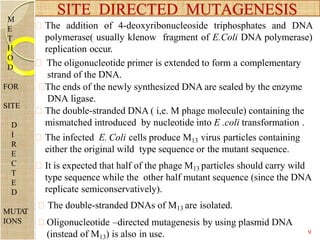
The addition of 4-deoxyribonucleoside triphosphates and DNA
polymerase( usually klenow fragment of E.Coli DNA polymerase)
replication occur.
The oligonucleotide primer is extended to form a complementary
strand of the DNA.
The ends of the newly synthesized DNA are sealed by the enzyme
DNA ligase.
The double-stranded DNA ( i,e. M phage molecule) containing the
mismatched introduced by nucleotide into E .coli transformation .
The infected E. Coli cells produce M13 virus particles containing
either the original wild type sequence or the mutant sequence.
It is expected that half of the phage M13 particles should carry wild
type sequence while the other half mutant sequence (since the DNA
replicate semiconservatively).
The double-stranded DNAs of M13 are isolated.
Oligonucleotide –directed mutagenesis by using plasmid DNA
(instead of M13) is also in use.
SITE DIRECTED MUTAGENESIS
M
E
T
H
O
D
FOR
SITE
D
I
R
E
C
T
E
D
MUTA
T
IONS
9
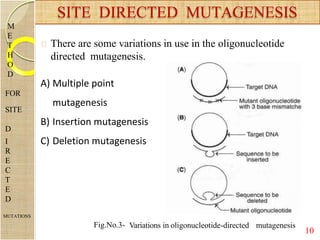
There are some variations in use in the oligonucleotide
directed mutagenesis.
SITE DIRECTED MUTAGENESIS
M
E
T
H
O
D
FOR
SITE
D
I
R
E
C
T
E
D
MUTATIONS
10
Fig.No.3- Variations in oligonucleotide-directed mutagenesis
A) Multiple point
mutagenesis
B) Insertion mutagenesis
C) Deletion mutagenesis
CASETTEE MUTAGENESIS
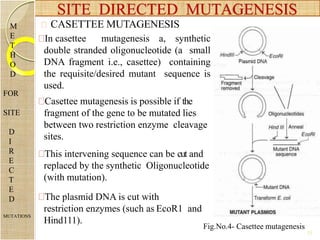
In casettee mutagenesis a, synthetic
double stranded oligonucleotide (a small
DNA fragment i.e., casettee) containing
the requisite/desired mutant sequence is
used.
Casettee mutagenesis is possible if the
fragment of the gene to be mutated lies
between two restriction enzyme cleavage
sites.
This intervening sequence can be cut and
replaced by the synthetic Oligonucleotide
(with mutation).
The plasmid DNA is cut with
restriction enzymes (such as EcoR1 and
Hind111).
SITE DIRECTED MUTAGENESIS
M
E
T
H
O
D
FOR
SITE
D
I
R
E
C
T
E
D
MUTATIONS
Fig.No.4- Casettee mutagenesis
11
12
SITE DIRECTED MUTAGENESIS
MUTATIONS
M
E
T
H
O
D
S
I
T
E
D
I
R
E
C
T
E
D
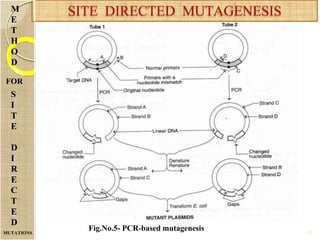
Fig.No.5- PCR-based mutagenesis
FOR
The PCR-based mutagenesis technique commonly employed is depicted in
First the target DNA (gene) is cloned on to a plasmid vector and distributed
in to two reaction tubes.
To each tube are added two primers ( oligonucleotides synthesized by
using PCR).
One primer ( A in tube1 and C in tube 2) is complementary to a region in
one strand of the cloned gene except for one nucleotide mismatch ( i.e. the
one targeted for a change).
The other primer (B in tube 1 and D in tube2 ) is fully complementary of a
sequence in the Other strand with in or adjacent to the cloned gene.
The placement of primers for hybridization (with the DNA strands) in each
tube is donein opposite direction.
The PCR technique is carried out for amplification of the DNAmolecule.
The products of PCR in the two reaction tubes are mixed.
The DNA molecules undergo denaturation and renaturation.
A Strand from one reaction tube (strand A) hybridizes with its
complementary strand from other reaction tube (strand C).
13
SITE DIRECTED MUTAGENESIS
M
E
T
H
O
D
FOR
SITE
D
I
R
E
C
T
E
D
MUTATIONS
13
CHEMICAL MODIFICATIONS
M
E
T
H
O
D
FOR
CHEMICAL
MODIFICATIONS
1. Functional group on side chain of natural enzyme may be
changed
2. Total chemical synthesis of an enzyme is only a theoretical
possibility. Practically it is expensive and knowledge also is
still insufficient.
Advantages:
1. Attachment of coenzyme to enzyme is possible.
2. It can be applied in conjunction with genetic methods.
Disadvantages:
1. It is applicable to amino acids that have reactive side chains
and only certain alterations can be made
2. Only amino acids at surface of protein are available for
modifications.
3. Little specificity. Modification of single amino acid is
difficult.
Investigative tools - specific mutations in DNA allow the
function and properties of a DNA sequence or a protein to be
investigated in a rational approach.
Commercial applications - proteins may be engineered to
produce proteins that are tailored for a specific application.
Example, commonly-used laundry detergents may contain
subtilise in whose wild-type form has a methionine that can be
oxidized by bleach, inactivating the protein in the process.
This methionine may be replaced by alanine, thereby making
the protein active in the presence of bleach.
A
P
P
L
I
C
A
T
I
O
N
S
A
P
P
L
I
C
A
T
I
O
N
S
Increasing the stability and Biological activity of proteins
Addition of Disulfide bonds: increases thermostability of
enzymes
T4 Lysozyme: By changing 2, 4, 6 aminoacids to cysteine
residues and forming 1, 2, 3, disulfide bonds makes it very
stable with good biological activity.
Xylanase: It is catalytically active at high temperature.
Introduction of disulfide bonds at 1, 2, 3 makes it thermostable
and substantially improves its functional efficiency.
A
P
P
L
I
C
A
T
I
O
N
S
Changing Asparagine to other Amino acids: At high
temperature, amino acids asparagine and glutamine undergoes
deamidation and form formic acid and glutamic acid – loss of
biological activity.
Reducing the free sulfhydryl groups: Sulfhydryl groups
reduces protein activity. The protein stability and its activity can
be increased by reducing the number of sulfhydryl groups.
Human β-interferon: It is produced by genetic engineering &
exist as dimer and oligomers which are inactive. This is due to
formation of cysteine. Replacing cysteine with serine reduces
free sulfhydryl groups and makes Human β-interferon more
stable.
A
P
P
L
I
C
A
T
I
O
N
S
Single amino acid changes: - improves stability and biological
activity
α1 Antitrypsin: Inhibits the action of neutrophil elastase (elastase
damages lung tissues). α1 Antitrypsin binds to elastase and prevents
its action. In this process it gets cleaved as serine & methionine and
makes α1 Antitrypsin a poor inhibitor of elastase.
Insulin: In the neutral solution, therapeutic insulin is present as zinc
containing hexamer. By introducing single amino acid substitution,
insulins were found to be in monomeric state with good stability and
biological activity.
Tissue plasminogen activator: Used to lyse blood clots. Due to its
shorter half-life tPA has to be repeatedly administered. By replacing
asparagine residue with glutamine, the half-life can be increased.
A
P
P
L
I
C
A
T
I
O
N
S
Hirudin: A protein secreted by leech salivary gland and is strong
thrombin inhibitor. By replacing asparagine with lysine, the potency
of hirudin can be increased several fold.
Dihydrofolate reductase: It catalyzes the conversion of 7,8-
dihydrofolate to 5,6,7,8-tetrahydrofolate. This results in synthesis of
nucleic acids and amino acids. The inhibition of DHFR by folate
analogue such as methotrexate will restrict the growth of tumor cells.
By employing site-directed mutagenesis, replacement of glycine by
alanine was found to produce DHFR inactive.
T4 Lysozyme: Replacement of glycine by any other amino acid in the
protein structure, decreases the stability. On the other hand, proline
residues increase protein stability.
17
T
H
A
N
K Y
O
U

Protein engineering

  • 1.
    VIGNAN PHARMACY COLLEGE VADLAMUDI-522213,GUNTUR (Dt), ANDHRA PRADESH, INDIA Dr. Sowjanya Pulipati Professor & Head Dept. of Pharm Biotechnology
  • 2.
    I N T R O D U C T I O N 3 PROTEIN ENGINEERING Protein engineeringis the process of developing useful or valuable proteins. Protein Engineering is a second generation of recombinant DNA technology. It involves altering cloned DNA in vitro by novel mutational technique so that translated proteins have slightly altered properties.
  • 3.
    I N T R O D U C T I O N 3 PROTEIN ENGINEERING Proteinengineering is merging of several disciplines like molecular biology, protein chemistry, enzymology, structural chemistry to alter catalytic or structural stability of protein, enzyme. With the advances in genetic engineering, genes can be isolated from organism and used for the synthesis of naturally occurring proteins. Some of these serve as enzymes.
  • 4.
    PROTEIN ENGINEERING Obtain aprotein with improved or new properties
  • 5.
    PROTEIN ENGINEERING 1 • Increasingsubstrate affinity to enzyme 2 • Makes the enzyme thermal tolerant (active at high temp) and PH stable. 3 • Enhances the substrate specificity by modifying the substrate binding site of the enzyme. 4 • Designing the enzyme to make it resistant to proteolytic degradation. 5 • Synthesizing enzyme that is stable and active in non-aqueous solvents. O B J E C T I V E S
  • 6.
    PROTEIN ENGINEERING 6 • Changingthe enzyme in order to make it independent of cofactor for its function. 7 • Improving the stability of the enzyme to heavy metals. 8 • Fusing the enzymes needed in the reactions to give a final product. 9 • Produce hybrid enzymes. 10 • Make isolation and purification of enzymes simpler. O B J E C T I V E S
  • 7.
    T E C H N I Q U E S 3 PROTEIN ENGINEERING Techniques usedfor protein engineering fall in two basic categories (1) Genetic modifications: (i) Site directed mutagenesis (ii) Localized random mutagenesis (2) Chemical modifications: (i) Change in functional group on side chain (ii) Modification & replacement of original protein
  • 8.
    In molecular biologyand genetics, mutations are accidental changes in a genomic sequence of DNA. Mutations can involve large sections of DNA becoming duplicated, usually through genetic recombination. Mutation is defined as a change in the nucleic sequence (bases) of an organism’s genetic material (a change in the genetic material of an organism). Site directed mutagenesis may be define as a change in the nucleic acid sequence (or genetic material) of an organism at a specific predetermined location. SITE DIRECTED MUTAGENESIS M U T A T I O N 5
  • 9.
    Site-directed mutagenesis isthe technique for generating amino acid coding changes in the DNA (gene). By this approach specific (site- directed) change (mutagenesis) can be made in the base (or bases) of the gene to produce a desired enzyme. A large amount of experimental procedures have been developed for directed mutagenesis of cloned genes. A synthetic oligonucleotide complimentary to the area of the gene of interestbut has the desired nucleotide change. An oligonucleotide is a short piece of DNA usually 10-30 nucleotide long. Directed mutagenesis can be done using: M13 Plasmid DNA, PCR, Random primers, Degenerate primers, Nucleotide analogs SITE DIRECTED MUTAGENESIS D I R E C T E D M U T A G E N A S I S 6
  • 10.
    Fig.No.2-single primer method THESINGLE PRIMER METHOD In the technique of oligonucleotide-directed mutagenesis, the primer is a chemically synthesized oligonucleotide (7-20 nucleotides long). It is complementary to a position of a gene around the site to be mutated. But it contains mismatch of or the base to be mutated. The starting material is a single-stranded DN A (to be mutated) carried in an M13, phage vector. On mixing this DNA with primer, the oligonucleotide hybridizes with the complementary sequences, except at the point of mismatched nucleotide. SITE DIRECTED MUTAGENESIS M E T H O D FOR SITE D I R E C T E D MUTA TIONS Hybridization (despite a single base mismatch) is possible by mixing at low temperature with excess of primer, and in the presence of high salt concentration Fig-2: Single Primer Method
  • 11.
    The addition of4-deoxyribonucleoside triphosphates and DNA polymerase( usually klenow fragment of E.Coli DNA polymerase) replication occur. The oligonucleotide primer is extended to form a complementary strand of the DNA. The ends of the newly synthesized DNA are sealed by the enzyme DNA ligase. The double-stranded DNA ( i,e. M phage molecule) containing the mismatched introduced by nucleotide into E .coli transformation . The infected E. Coli cells produce M13 virus particles containing either the original wild type sequence or the mutant sequence. It is expected that half of the phage M13 particles should carry wild type sequence while the other half mutant sequence (since the DNA replicate semiconservatively). The double-stranded DNAs of M13 are isolated. Oligonucleotide –directed mutagenesis by using plasmid DNA (instead of M13) is also in use. SITE DIRECTED MUTAGENESIS M E T H O D FOR SITE D I R E C T E D MUTA T IONS 9
  • 12.
    There are somevariations in use in the oligonucleotide directed mutagenesis. SITE DIRECTED MUTAGENESIS M E T H O D FOR SITE D I R E C T E D MUTATIONS 10 Fig.No.3- Variations in oligonucleotide-directed mutagenesis A) Multiple point mutagenesis B) Insertion mutagenesis C) Deletion mutagenesis
  • 13.
    CASETTEE MUTAGENESIS In casetteemutagenesis a, synthetic double stranded oligonucleotide (a small DNA fragment i.e., casettee) containing the requisite/desired mutant sequence is used. Casettee mutagenesis is possible if the fragment of the gene to be mutated lies between two restriction enzyme cleavage sites. This intervening sequence can be cut and replaced by the synthetic Oligonucleotide (with mutation). The plasmid DNA is cut with restriction enzymes (such as EcoR1 and Hind111). SITE DIRECTED MUTAGENESIS M E T H O D FOR SITE D I R E C T E D MUTATIONS Fig.No.4- Casettee mutagenesis 11
  • 14.
  • 15.
    The PCR-based mutagenesistechnique commonly employed is depicted in First the target DNA (gene) is cloned on to a plasmid vector and distributed in to two reaction tubes. To each tube are added two primers ( oligonucleotides synthesized by using PCR). One primer ( A in tube1 and C in tube 2) is complementary to a region in one strand of the cloned gene except for one nucleotide mismatch ( i.e. the one targeted for a change). The other primer (B in tube 1 and D in tube2 ) is fully complementary of a sequence in the Other strand with in or adjacent to the cloned gene. The placement of primers for hybridization (with the DNA strands) in each tube is donein opposite direction. The PCR technique is carried out for amplification of the DNAmolecule. The products of PCR in the two reaction tubes are mixed. The DNA molecules undergo denaturation and renaturation. A Strand from one reaction tube (strand A) hybridizes with its complementary strand from other reaction tube (strand C). 13 SITE DIRECTED MUTAGENESIS M E T H O D FOR SITE D I R E C T E D MUTATIONS
  • 16.
    13 CHEMICAL MODIFICATIONS M E T H O D FOR CHEMICAL MODIFICATIONS 1. Functionalgroup on side chain of natural enzyme may be changed 2. Total chemical synthesis of an enzyme is only a theoretical possibility. Practically it is expensive and knowledge also is still insufficient. Advantages: 1. Attachment of coenzyme to enzyme is possible. 2. It can be applied in conjunction with genetic methods. Disadvantages: 1. It is applicable to amino acids that have reactive side chains and only certain alterations can be made 2. Only amino acids at surface of protein are available for modifications. 3. Little specificity. Modification of single amino acid is difficult.
  • 17.
    Investigative tools -specific mutations in DNA allow the function and properties of a DNA sequence or a protein to be investigated in a rational approach. Commercial applications - proteins may be engineered to produce proteins that are tailored for a specific application. Example, commonly-used laundry detergents may contain subtilise in whose wild-type form has a methionine that can be oxidized by bleach, inactivating the protein in the process. This methionine may be replaced by alanine, thereby making the protein active in the presence of bleach. A P P L I C A T I O N S
  • 18.
    A P P L I C A T I O N S Increasing the stabilityand Biological activity of proteins Addition of Disulfide bonds: increases thermostability of enzymes T4 Lysozyme: By changing 2, 4, 6 aminoacids to cysteine residues and forming 1, 2, 3, disulfide bonds makes it very stable with good biological activity. Xylanase: It is catalytically active at high temperature. Introduction of disulfide bonds at 1, 2, 3 makes it thermostable and substantially improves its functional efficiency.
  • 19.
    A P P L I C A T I O N S Changing Asparagine toother Amino acids: At high temperature, amino acids asparagine and glutamine undergoes deamidation and form formic acid and glutamic acid – loss of biological activity. Reducing the free sulfhydryl groups: Sulfhydryl groups reduces protein activity. The protein stability and its activity can be increased by reducing the number of sulfhydryl groups. Human β-interferon: It is produced by genetic engineering & exist as dimer and oligomers which are inactive. This is due to formation of cysteine. Replacing cysteine with serine reduces free sulfhydryl groups and makes Human β-interferon more stable.
  • 20.
    A P P L I C A T I O N S Single amino acidchanges: - improves stability and biological activity α1 Antitrypsin: Inhibits the action of neutrophil elastase (elastase damages lung tissues). α1 Antitrypsin binds to elastase and prevents its action. In this process it gets cleaved as serine & methionine and makes α1 Antitrypsin a poor inhibitor of elastase. Insulin: In the neutral solution, therapeutic insulin is present as zinc containing hexamer. By introducing single amino acid substitution, insulins were found to be in monomeric state with good stability and biological activity. Tissue plasminogen activator: Used to lyse blood clots. Due to its shorter half-life tPA has to be repeatedly administered. By replacing asparagine residue with glutamine, the half-life can be increased.
  • 21.
    A P P L I C A T I O N S Hirudin: A proteinsecreted by leech salivary gland and is strong thrombin inhibitor. By replacing asparagine with lysine, the potency of hirudin can be increased several fold. Dihydrofolate reductase: It catalyzes the conversion of 7,8- dihydrofolate to 5,6,7,8-tetrahydrofolate. This results in synthesis of nucleic acids and amino acids. The inhibition of DHFR by folate analogue such as methotrexate will restrict the growth of tumor cells. By employing site-directed mutagenesis, replacement of glycine by alanine was found to produce DHFR inactive. T4 Lysozyme: Replacement of glycine by any other amino acid in the protein structure, decreases the stability. On the other hand, proline residues increase protein stability.
  • 22.