Assembling Your Computer
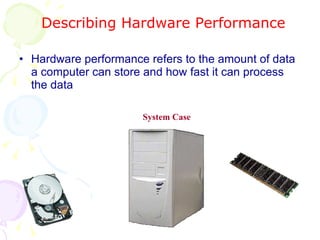
Describing Hardware Performance Hardware performance refers to the amount of data a computer can store and how fast it can process the data ON OFF System Case
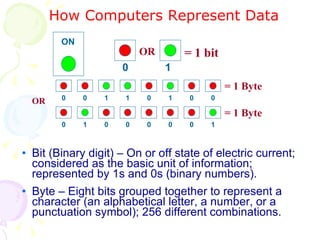
How Computers Represent Data Bit (Binary digit) – On or off state of electric current; considered as the basic unit of information; represented by 1s and 0s (binary numbers). Byte – Eight bits grouped together to represent a character (an alphabetical letter, a number, or a punctuation symbol); 256 different combinations. 0 1 OR = 1 bit OR = 1 Byte = 1 Byte OFF 1 0 0 0 0 0 1 1 0 0 0 0 1 1 0 0 ON
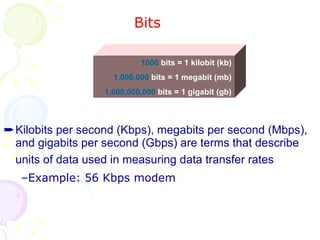
Bits Kilobits per second (Kbps), megabits per second (Mbps), and gigabits per second (Gbps) are terms that describe units of data used in measuring data transfer rates   Example: 56 Kbps modem 1000  bits = 1 kilobit (kb) 1,000,000   bits = 1 megabit (mb) 1,000,000,000  bits = 1 gigabit (gb)
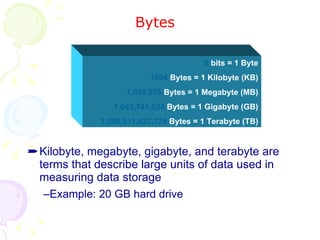
Bytes Kilobyte, megabyte, gigabyte, and terabyte are terms that describe large units of data used in measuring data storage  Example: 20 GB hard drive 8  bits = 1 Byte 1024  Bytes = 1 Kilobyte (KB) 1,048,576  Bytes = 1 Megabyte (MB) 1,043,741,824  Bytes = 1 Gigabyte (GB) 1,099,511,627,776  Bytes = 1 Terabyte (TB)
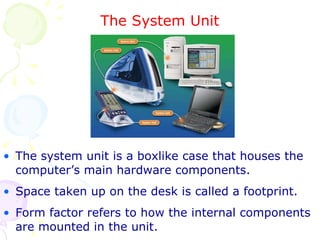
The System Unit The system unit is a boxlike case that houses the computer’s main hardware components. Space taken up on the desk is called a footprint. Form factor refers to how the internal components are mounted in the unit.
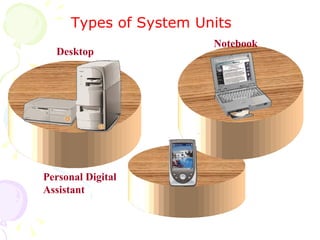
Types of System Units Desktop Notebook Personal Digital Assistant
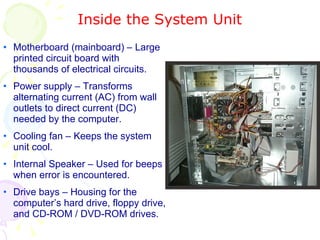
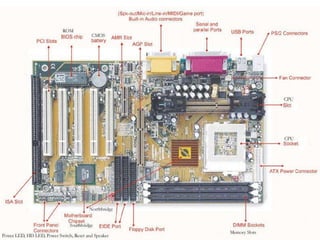
Inside the System Unit Motherboard (mainboard) – Large printed circuit board with thousands of electrical circuits. Power supply – Transforms alternating current (AC) from wall outlets to direct current (DC) needed by the computer. Cooling fan – Keeps the system unit cool. Internal Speaker – Used for beeps when error is encountered. Drive bays – Housing for the computer’s hard drive, floppy drive, and CD-ROM / DVD-ROM drives.
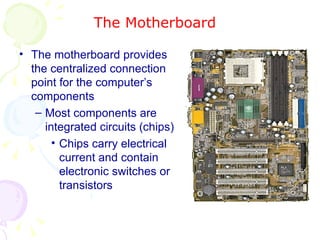
The Motherboard The motherboard provides the centralized connection point for the computer’s components Most components are integrated circuits (chips) Chips carry electrical current and contain electronic switches or transistors
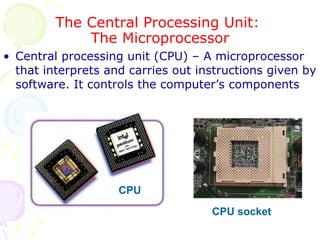
The Central Processing Unit:  The Microprocessor Central processing unit (CPU) – A microprocessor that interprets and carries out instructions given by software. It controls the computer’s components CPU CPU socket
Components of the CPU Control unit – Coordinates and controls all parts of the computer system. Arithmetic-Logic unit – Performs arithmetic or logical operations. Registers – Store the most frequently used instructions and data.
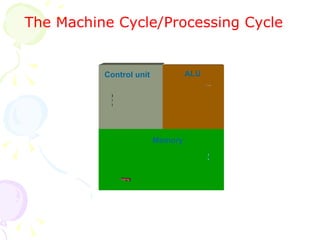
The Control Unit The control unit manages four basic operations (fetch, decode, execute, and write-back) The four-step process is known as the machine cycle or processing cycle The processing cycle consists of two phases: Instruction Cycle Fetch – Gets the next program instruction from the computer’s memory Decode – Figures out what the program is telling the computer to do Execution Cycle Execute – Performs the requested action Write-back (Store) – Writes (stores) the results to a register or to memory
The Machine Cycle/Processing Cycle Control unit ALU Memory
The Arithmetic-Logic Unit The arithmetic-logic unit (ALU) performs basic arithmetic and logic operations Adds, subtracts, multiplies, and divides Compares alphanumeric data
Microprocessor Performance Data bus width – The number of pathways within the CPU that transfer data (8, 16, 32, or 64). Word size – The maximum number of bits of data that the CPU can process at a time (8 bits, 16 bits, 32 bits, or 64 bits). Operations per cycle (clock speed) – The number of clock cycles per second measured in Megahertz (MHz) or Gigahertz (GHz). Superscalar – Carrying out more than one instruction per clock cycle. Pipelining – Feeding a new instruction into the CPU at every step of the processing cycle.
Parallel Processing Parallel processing involves using more than one CPU to improve performance. Complex instruction set computer (CISC) – A chip that includes special-purpose circuits that carry out instructions at high speeds. Reduced instruction set computer (RISC) – A chip with a bare-bones instruction set that results in a faster processing speed than CISC chips.
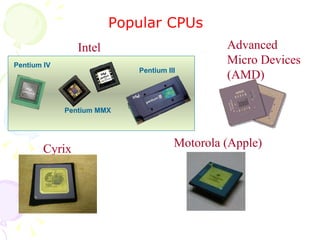
Popular CPUs Intel Advanced Micro Devices (AMD) Cyrix Motorola (Apple) Pentium IV Pentium MMX Pentium III
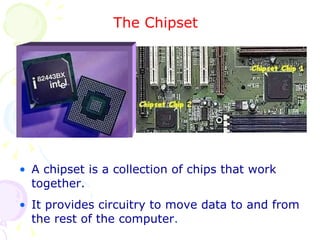
The Chipset A chipset is a collection of chips that work together. It provides circuitry to move data to and from the rest of the computer .
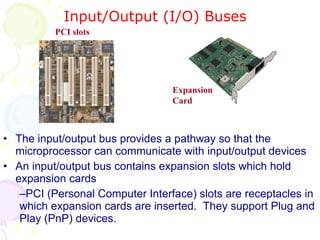
Input/Output (I/O) Buses The input/output bus provides a pathway so that the microprocessor can communicate with input/output devices An input/output bus contains expansion slots which hold expansion cards PCI (Personal Computer Interface) slots are receptacles in which expansion cards are   inserted.  They support Plug and Play (PnP) devices. PCI slots Expansion Card
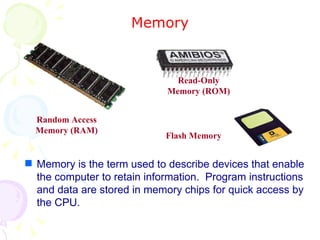
Memory Memory is the term used to describe devices that enable the computer to retain information.  Program instructions and data are stored in memory chips for quick access by the CPU. Random Access Memory (RAM) Read-Only Memory (ROM) Flash Memory
Memory Categories Volatile memory – Contents of memory are erased when power supply is turned off. It is temporary storage. RAM – Random Access Memory holds data in locations called memory addresses. Cache memory – Memory that the processor uses to store frequently used instructions and data. Virtual memory – The computer uses the hard disk as an extension of RAM. Nonvolatile memory – Contents of memory are not erased when power is turned off.  ROM – Read-Only Memory provides the instructions to start the computer. Flash memory – Memory that can be rewritten.
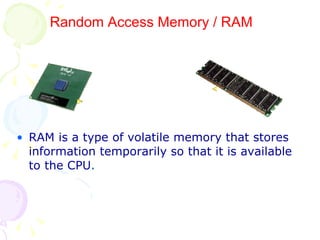
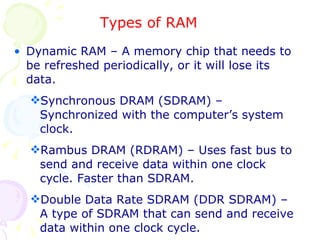
Random Access Memory / RAM RAM is a type of volatile memory that stores information temporarily so that it is available to the CPU .
Types of RAM Dynamic RAM – A memory chip that needs to be refreshed periodically, or it will lose its data. Synchronous DRAM (SDRAM) – Synchronized with the computer’s system clock. Rambus DRAM (RDRAM) – Uses fast bus to send and receive data within one clock cycle. Faster than SDRAM. Double Data Rate SDRAM (DDR SDRAM) – A type of SDRAM that can send and receive data within one clock cycle.
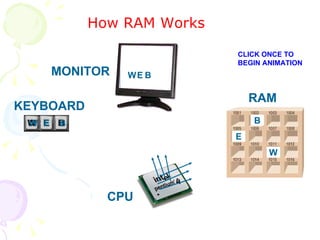
How RAM Works KEYBOARD CPU RAM MONITOR CLICK ONCE TO BEGIN ANIMATION W E B W W E W E E B B B
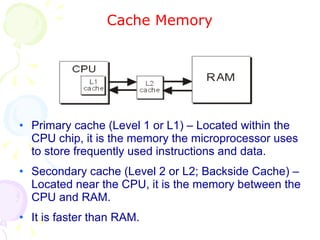
Cache Memory Primary cache (Level 1 or L1) – Located within the CPU chip, it is the memory the microprocessor uses to store frequently used instructions and data. Secondary cache (Level 2 or L2; Backside Cache) – Located near the CPU, it is the memory between the CPU and RAM. It is faster than RAM.
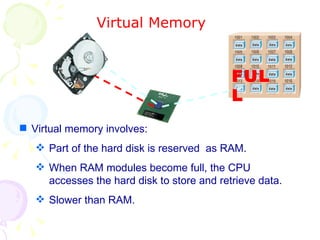
Virtual Memory Virtual memory involves: Part of the hard disk is reserved  as RAM. When RAM modules become full, the CPU accesses the hard disk to store and retrieve data. Slower than RAM. FULL
ROM: BIOS and CMOS BIOS – Basic Input/Output system is stored in ROM. Its instructions provide the boot sequence when starting the computer. The boot sequence includes: POST– Power-on self-test checks memory and configures video and other hardware. Locating the disk drive with the boot sector which contains the operating system.  CMOS – Complementary metal-oxide semiconductor is a type of memory which stores essential startup options. It stores the amount of memory installed and tracks date and time. It is volatile.
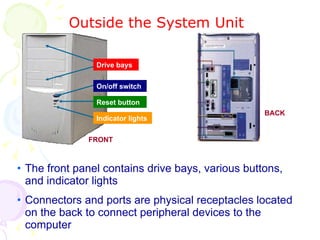
Outside the System Unit The front panel contains drive bays, various buttons, and indicator lights  Connectors and ports are physical receptacles located on the back to connect peripheral devices to the computer Drive bays On/off switch Reset button Indicator lights FRONT BACK
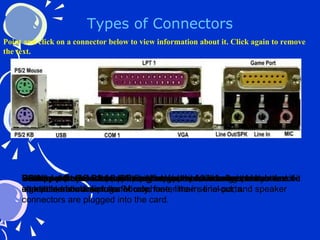
Types of Connectors PS/2 port  (keyboard port) – Special serial port to connect keyboard. Universal Serial Bus  (USB) – Allows up to 127 devices to be connected at a time. Serial port  – Data flows in a series of pulses, one after another one bit at a time; slow data transfer rate. Parallel port  – Data flows through eight wires allowing the transfer of eight bits of data simultaneously; faster than serial ports. VGA connector  – A 15 pin connector used for monitors Game port  – A connector for high speed access for graphics-intensive interaction. Sound card connectors – Also called jacks, sound card connectors accept stereo mini-plugs. Microphone, line-in, line-out, and speaker connectors are plugged into the card. Point and click on a connector below to view information about it. Click again to remove the text.
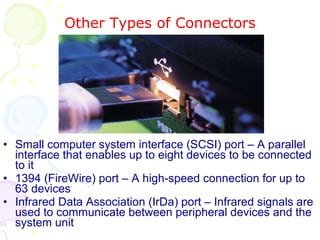
Other Types of Connectors Small computer system interface (SCSI) port – A parallel interface that enables up to eight devices to be connected to it 1394 (FireWire) port – A high-speed connection for up to 63 devices Infrared Data Association (IrDa) port – Infrared signals are used to communicate between peripheral devices and the system unit
Additional Ports and Connectors Telephone – modem interface Network – larger than telephone jack PC card slot – notebook computers have slot for PC cards Sound card connectors –  Mic – microphone input Line In – input from audio devices Line Out – output to another audio device Speaker – output to external speakers TV/sound capture – turns computer into a TV tuner
Power Supply Function to convert alternating current (AC) to Direct Current (DC) Many power supplies have universal input 110 VAC (volts alternating current) 60 Hz (US standard Power) 220 VAC , 50 Hz (European / Asian standard) Three thing to consider when replacing the power supply: Physical size  AT & ATX Wattage Maximum sustained Power(in watts) that they can produce General computer require 130 watts while running &  200-205 watts when booting. High performance workstation they often demand power supplies 35-500 watts
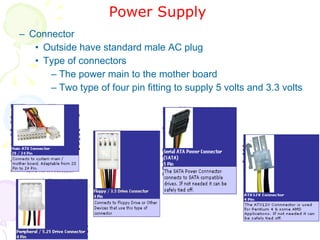
Power Supply Connector Outside have standard male AC plug Type of connectors  The power main to the mother board Two type of four pin fitting to supply 5 volts and 3.3 volts
 
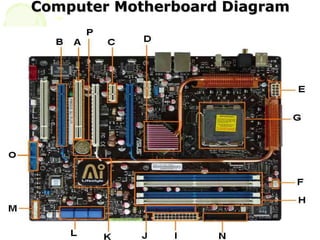
Computer Motherboard Diagram                                                                                                                                                                                                                                                                                                                                         
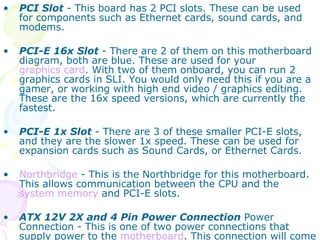
PCI Slot  - This board has 2 PCI slots. These can be used for components such as Ethernet cards, sound cards, and modems.  PCI-E 16x Slot  - There are 2 of them on this motherboard diagram, both are blue. These are used for your  graphics card . With two of them onboard, you can run 2 graphics cards in SLI. You would only need this if you are a gamer, or working with high end video / graphics editing. These are the 16x speed versions, which are currently the fastest.  PCI-E 1x Slot  - There are 3 of these smaller PCI-E slots, and they are the slower 1x speed. These can be used for expansion cards such as Sound Cards, or Ethernet Cards.  Northbridge  - This is the Northbridge for this motherboard. This allows communication between the CPU and the  system memory  and PCI-E slots.  ATX 12V 2X and 4 Pin Power Connection  Power Connection - This is one of two power connections that supply power to the  motherboard . This connection will come from your Power Supply.
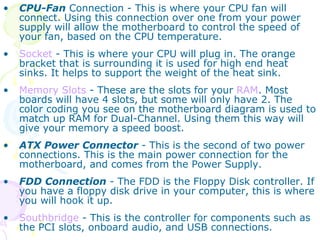
CPU-Fan  Connection - This is where your CPU fan will connect. Using this connection over one from your power supply will allow the motherboard to control the speed of your fan, based on the CPU temperature.  Socket  - This is where your CPU will plug in. The orange bracket that is surrounding it is used for high end heat sinks. It helps to support the weight of the heat sink.  Memory Slots  - These are the slots for your  RAM . Most boards will have 4 slots, but some will only have 2. The color coding you see on the motherboard diagram is used to match up RAM for Dual-Channel. Using them this way will give your memory a speed boost.  ATX Power Connector  - This is the second of two power connections. This is the main power connection for the motherboard, and comes from the Power Supply.  FDD Connection  -  The FDD is the Floppy Disk controller. If you have a floppy disk drive in your computer, this is where you will hook it up.  Southbridge  - This is the controller for components such as the PCI slots, onboard audio, and USB connections.
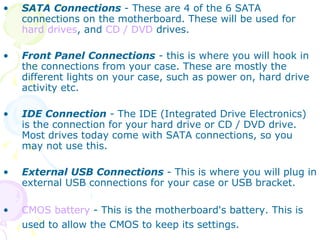
SATA Connections  - These are 4 of the 6 SATA connections on the motherboard. These will be used for  hard drives , and  CD / DVD  drives.  Front Panel Connections  - this is where you will hook in the connections from your case. These are mostly the different lights on your case, such as power on, hard drive activity etc.  IDE Connection  - The IDE (Integrated Drive Electronics) is the connection for your hard drive or CD / DVD drive. Most drives today come with SATA connections, so you may not use this.  External USB Connections  - This is where you will plug in external USB connections for your case or USB bracket.  CMOS battery  - This is the motherboard's battery. This is used to allow the CMOS to keep its settings.
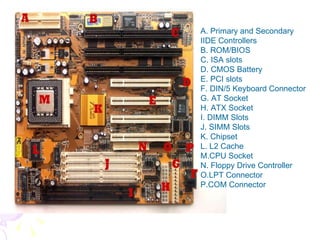
                                                                                                                                                                                A. Primary and Secondary IIDE Controllers B. ROM/BIOS C. ISA slots D. CMOS Battery E. PCI slots F. DIN/5 Keyboard Connector G. AT Socket H. ATX Socket I. DIMM Slots J. SIMM Slots K. Chipset L. L2 Cache M.CPU Socket N. Floppy Drive Controller O.LPT Connector P.COM Connector
 

PCT SLIDE3

  • 1.
  • 2.
    Describing Hardware PerformanceHardware performance refers to the amount of data a computer can store and how fast it can process the data ON OFF System Case
  • 3.
    How Computers RepresentData Bit (Binary digit) – On or off state of electric current; considered as the basic unit of information; represented by 1s and 0s (binary numbers). Byte – Eight bits grouped together to represent a character (an alphabetical letter, a number, or a punctuation symbol); 256 different combinations. 0 1 OR = 1 bit OR = 1 Byte = 1 Byte OFF 1 0 0 0 0 0 1 1 0 0 0 0 1 1 0 0 ON
  • 4.
    Bits Kilobits persecond (Kbps), megabits per second (Mbps), and gigabits per second (Gbps) are terms that describe units of data used in measuring data transfer rates Example: 56 Kbps modem 1000 bits = 1 kilobit (kb) 1,000,000 bits = 1 megabit (mb) 1,000,000,000 bits = 1 gigabit (gb)
  • 5.
    Bytes Kilobyte, megabyte,gigabyte, and terabyte are terms that describe large units of data used in measuring data storage Example: 20 GB hard drive 8 bits = 1 Byte 1024 Bytes = 1 Kilobyte (KB) 1,048,576 Bytes = 1 Megabyte (MB) 1,043,741,824 Bytes = 1 Gigabyte (GB) 1,099,511,627,776 Bytes = 1 Terabyte (TB)
  • 6.
    The System UnitThe system unit is a boxlike case that houses the computer’s main hardware components. Space taken up on the desk is called a footprint. Form factor refers to how the internal components are mounted in the unit.
  • 7.
    Types of SystemUnits Desktop Notebook Personal Digital Assistant
  • 8.
    Inside the SystemUnit Motherboard (mainboard) – Large printed circuit board with thousands of electrical circuits. Power supply – Transforms alternating current (AC) from wall outlets to direct current (DC) needed by the computer. Cooling fan – Keeps the system unit cool. Internal Speaker – Used for beeps when error is encountered. Drive bays – Housing for the computer’s hard drive, floppy drive, and CD-ROM / DVD-ROM drives.
  • 9.
    The Motherboard Themotherboard provides the centralized connection point for the computer’s components Most components are integrated circuits (chips) Chips carry electrical current and contain electronic switches or transistors
  • 10.
    The Central ProcessingUnit: The Microprocessor Central processing unit (CPU) – A microprocessor that interprets and carries out instructions given by software. It controls the computer’s components CPU CPU socket
  • 11.
    Components of theCPU Control unit – Coordinates and controls all parts of the computer system. Arithmetic-Logic unit – Performs arithmetic or logical operations. Registers – Store the most frequently used instructions and data.
  • 12.
    The Control UnitThe control unit manages four basic operations (fetch, decode, execute, and write-back) The four-step process is known as the machine cycle or processing cycle The processing cycle consists of two phases: Instruction Cycle Fetch – Gets the next program instruction from the computer’s memory Decode – Figures out what the program is telling the computer to do Execution Cycle Execute – Performs the requested action Write-back (Store) – Writes (stores) the results to a register or to memory
  • 13.
    The Machine Cycle/ProcessingCycle Control unit ALU Memory
  • 14.
    The Arithmetic-Logic UnitThe arithmetic-logic unit (ALU) performs basic arithmetic and logic operations Adds, subtracts, multiplies, and divides Compares alphanumeric data
  • 15.
    Microprocessor Performance Databus width – The number of pathways within the CPU that transfer data (8, 16, 32, or 64). Word size – The maximum number of bits of data that the CPU can process at a time (8 bits, 16 bits, 32 bits, or 64 bits). Operations per cycle (clock speed) – The number of clock cycles per second measured in Megahertz (MHz) or Gigahertz (GHz). Superscalar – Carrying out more than one instruction per clock cycle. Pipelining – Feeding a new instruction into the CPU at every step of the processing cycle.
  • 16.
    Parallel Processing Parallelprocessing involves using more than one CPU to improve performance. Complex instruction set computer (CISC) – A chip that includes special-purpose circuits that carry out instructions at high speeds. Reduced instruction set computer (RISC) – A chip with a bare-bones instruction set that results in a faster processing speed than CISC chips.
  • 17.
    Popular CPUs IntelAdvanced Micro Devices (AMD) Cyrix Motorola (Apple) Pentium IV Pentium MMX Pentium III
  • 18.
    The Chipset Achipset is a collection of chips that work together. It provides circuitry to move data to and from the rest of the computer .
  • 19.
    Input/Output (I/O) BusesThe input/output bus provides a pathway so that the microprocessor can communicate with input/output devices An input/output bus contains expansion slots which hold expansion cards PCI (Personal Computer Interface) slots are receptacles in which expansion cards are inserted. They support Plug and Play (PnP) devices. PCI slots Expansion Card
  • 20.
    Memory Memory isthe term used to describe devices that enable the computer to retain information. Program instructions and data are stored in memory chips for quick access by the CPU. Random Access Memory (RAM) Read-Only Memory (ROM) Flash Memory
  • 21.
    Memory Categories Volatilememory – Contents of memory are erased when power supply is turned off. It is temporary storage. RAM – Random Access Memory holds data in locations called memory addresses. Cache memory – Memory that the processor uses to store frequently used instructions and data. Virtual memory – The computer uses the hard disk as an extension of RAM. Nonvolatile memory – Contents of memory are not erased when power is turned off. ROM – Read-Only Memory provides the instructions to start the computer. Flash memory – Memory that can be rewritten.
  • 22.
    Random Access Memory/ RAM RAM is a type of volatile memory that stores information temporarily so that it is available to the CPU .
  • 23.
    Types of RAMDynamic RAM – A memory chip that needs to be refreshed periodically, or it will lose its data. Synchronous DRAM (SDRAM) – Synchronized with the computer’s system clock. Rambus DRAM (RDRAM) – Uses fast bus to send and receive data within one clock cycle. Faster than SDRAM. Double Data Rate SDRAM (DDR SDRAM) – A type of SDRAM that can send and receive data within one clock cycle.
  • 24.
    How RAM WorksKEYBOARD CPU RAM MONITOR CLICK ONCE TO BEGIN ANIMATION W E B W W E W E E B B B
  • 25.
    Cache Memory Primarycache (Level 1 or L1) – Located within the CPU chip, it is the memory the microprocessor uses to store frequently used instructions and data. Secondary cache (Level 2 or L2; Backside Cache) – Located near the CPU, it is the memory between the CPU and RAM. It is faster than RAM.
  • 26.
    Virtual Memory Virtualmemory involves: Part of the hard disk is reserved as RAM. When RAM modules become full, the CPU accesses the hard disk to store and retrieve data. Slower than RAM. FULL
  • 27.
    ROM: BIOS andCMOS BIOS – Basic Input/Output system is stored in ROM. Its instructions provide the boot sequence when starting the computer. The boot sequence includes: POST– Power-on self-test checks memory and configures video and other hardware. Locating the disk drive with the boot sector which contains the operating system. CMOS – Complementary metal-oxide semiconductor is a type of memory which stores essential startup options. It stores the amount of memory installed and tracks date and time. It is volatile.
  • 28.
    Outside the SystemUnit The front panel contains drive bays, various buttons, and indicator lights Connectors and ports are physical receptacles located on the back to connect peripheral devices to the computer Drive bays On/off switch Reset button Indicator lights FRONT BACK
  • 29.
    Types of ConnectorsPS/2 port (keyboard port) – Special serial port to connect keyboard. Universal Serial Bus (USB) – Allows up to 127 devices to be connected at a time. Serial port – Data flows in a series of pulses, one after another one bit at a time; slow data transfer rate. Parallel port – Data flows through eight wires allowing the transfer of eight bits of data simultaneously; faster than serial ports. VGA connector – A 15 pin connector used for monitors Game port – A connector for high speed access for graphics-intensive interaction. Sound card connectors – Also called jacks, sound card connectors accept stereo mini-plugs. Microphone, line-in, line-out, and speaker connectors are plugged into the card. Point and click on a connector below to view information about it. Click again to remove the text.
  • 30.
    Other Types ofConnectors Small computer system interface (SCSI) port – A parallel interface that enables up to eight devices to be connected to it 1394 (FireWire) port – A high-speed connection for up to 63 devices Infrared Data Association (IrDa) port – Infrared signals are used to communicate between peripheral devices and the system unit
  • 31.
    Additional Ports andConnectors Telephone – modem interface Network – larger than telephone jack PC card slot – notebook computers have slot for PC cards Sound card connectors – Mic – microphone input Line In – input from audio devices Line Out – output to another audio device Speaker – output to external speakers TV/sound capture – turns computer into a TV tuner
  • 32.
    Power Supply Functionto convert alternating current (AC) to Direct Current (DC) Many power supplies have universal input 110 VAC (volts alternating current) 60 Hz (US standard Power) 220 VAC , 50 Hz (European / Asian standard) Three thing to consider when replacing the power supply: Physical size AT & ATX Wattage Maximum sustained Power(in watts) that they can produce General computer require 130 watts while running & 200-205 watts when booting. High performance workstation they often demand power supplies 35-500 watts
  • 33.
    Power Supply ConnectorOutside have standard male AC plug Type of connectors The power main to the mother board Two type of four pin fitting to supply 5 volts and 3.3 volts
  • 34.
  • 35.
    Computer Motherboard Diagram                                                                                                                                                                                                                                                                                                                                        
  • 36.
    PCI Slot - This board has 2 PCI slots. These can be used for components such as Ethernet cards, sound cards, and modems. PCI-E 16x Slot - There are 2 of them on this motherboard diagram, both are blue. These are used for your graphics card . With two of them onboard, you can run 2 graphics cards in SLI. You would only need this if you are a gamer, or working with high end video / graphics editing. These are the 16x speed versions, which are currently the fastest. PCI-E 1x Slot - There are 3 of these smaller PCI-E slots, and they are the slower 1x speed. These can be used for expansion cards such as Sound Cards, or Ethernet Cards. Northbridge - This is the Northbridge for this motherboard. This allows communication between the CPU and the system memory and PCI-E slots. ATX 12V 2X and 4 Pin Power Connection Power Connection - This is one of two power connections that supply power to the motherboard . This connection will come from your Power Supply.
  • 37.
    CPU-Fan Connection- This is where your CPU fan will connect. Using this connection over one from your power supply will allow the motherboard to control the speed of your fan, based on the CPU temperature. Socket - This is where your CPU will plug in. The orange bracket that is surrounding it is used for high end heat sinks. It helps to support the weight of the heat sink. Memory Slots - These are the slots for your RAM . Most boards will have 4 slots, but some will only have 2. The color coding you see on the motherboard diagram is used to match up RAM for Dual-Channel. Using them this way will give your memory a speed boost. ATX Power Connector - This is the second of two power connections. This is the main power connection for the motherboard, and comes from the Power Supply. FDD Connection - The FDD is the Floppy Disk controller. If you have a floppy disk drive in your computer, this is where you will hook it up. Southbridge - This is the controller for components such as the PCI slots, onboard audio, and USB connections.
  • 38.
    SATA Connections - These are 4 of the 6 SATA connections on the motherboard. These will be used for hard drives , and CD / DVD drives. Front Panel Connections - this is where you will hook in the connections from your case. These are mostly the different lights on your case, such as power on, hard drive activity etc. IDE Connection - The IDE (Integrated Drive Electronics) is the connection for your hard drive or CD / DVD drive. Most drives today come with SATA connections, so you may not use this. External USB Connections - This is where you will plug in external USB connections for your case or USB bracket. CMOS battery - This is the motherboard's battery. This is used to allow the CMOS to keep its settings.
  • 39.
                                                                                                                                                                                    A.Primary and Secondary IIDE Controllers B. ROM/BIOS C. ISA slots D. CMOS Battery E. PCI slots F. DIN/5 Keyboard Connector G. AT Socket H. ATX Socket I. DIMM Slots J. SIMM Slots K. Chipset L. L2 Cache M.CPU Socket N. Floppy Drive Controller O.LPT Connector P.COM Connector
  • 40.