Introduction to Hardware
Computer Architecture
Abd El-Rahman Hosny Mohammed
Microsoft Student Partner.
4th Grade – Faculty of Computers and Information.
Computer Science Department.
Assiut University.
contact: abdelrahmanhosny.com
Agenda
- Life Before the Digital World.
- Logical Circuits.
- Integrated Circuits (ICs).
- Computer Hardware Components.
- Instruction Set Architecture level.
- Operating System Level.
- Higher-Order Language Level.
-2-abdelrahmanhosny.com
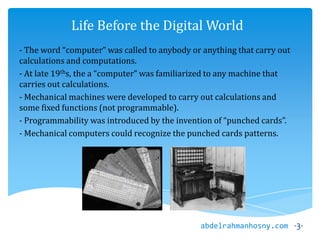
Life Before the Digital World
- The word “computer” was called to anybody or anything that carry out
calculations and computations.
- At late 19ths, the a “computer” was familiarized to any machine that
carries out calculations.
- Mechanical machines were developed to carry out calculations and
some fixed functions (not programmable).
- Programmability was introduced by the invention of “punched cards”.
- Mechanical computers could recognize the punched cards patterns.
-3-abdelrahmanhosny.com
- Punched cards as well as tapes were used to record data.
- This improvement was the foundation od modern information
processing industry.
- Scientific computing needs were met by analog and mechanical
computers. But they were inaccurate and not-programmable.
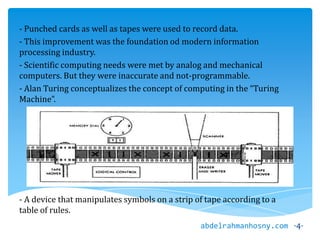
- Alan Turing conceptualizes the concept of computing in the “Turing
Machine”.
- A device that manipulates symbols on a strip of tape according to a
table of rules.
-4-abdelrahmanhosny.com
Turing Test
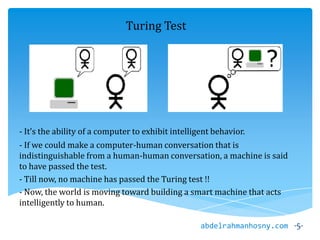
- It’s the ability of a computer to exhibit intelligent behavior.
- If we could make a computer-human conversation that is
indistinguishable from a human-human conversation, a machine is said
to have passed the test.
- Till now, no machine has passed the Turing test !!
- Now, the world is moving toward building a smart machine that acts
intelligently to human.
-5-abdelrahmanhosny.com
Logical Circuits
- With the invention of capacitors, the world began to become digital.
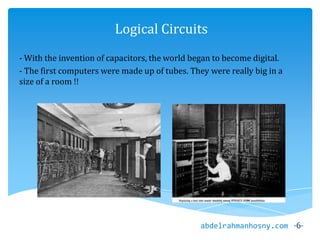
- The first computers were made up of tubes. They were really big in a
size of a room !!
-6-abdelrahmanhosny.com
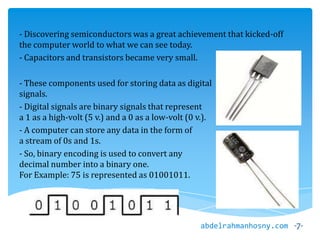
- Discovering semiconductors was a great achievement that kicked-off
the computer world to what we can see today.
- Capacitors and transistors became very small.
- These components used for storing data as digital
signals.
- Digital signals are binary signals that represent
a 1 as a high-volt (5 v.) and a 0 as a low-volt (0 v.).
- A computer can store any data in the form of
a stream of 0s and 1s.
- So, binary encoding is used to convert any
decimal number into a binary one.
For Example: 75 is represented as 01001011.
-7-abdelrahmanhosny.com
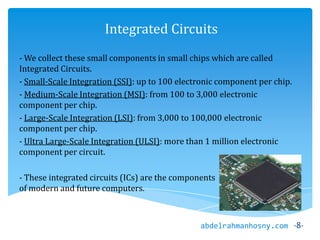
Integrated Circuits
- We collect these small components in small chips which are called
Integrated Circuits.
- Small-Scale Integration (SSI): up to 100 electronic component per chip.
- Medium-Scale Integration (MSI): from 100 to 3,000 electronic
component per chip.
- Large-Scale Integration (LSI): from 3,000 to 100,000 electronic
component per chip.
- Ultra Large-Scale Integration (ULSI): more than 1 million electronic
component per circuit.
- These integrated circuits (ICs) are the components
of modern and future computers.
-8-abdelrahmanhosny.com
Computer Hardware
- Computer hardware are the physical parts that constitutes the machine.
- Through years, hardware architecture has evolved.
- The most common hardware architecture is the Von Neumann model.
- Let’s investigate each part.
-9-abdelrahmanhosny.com
CPUInput Output
Memory
-10-abdelrahmanhosny.com
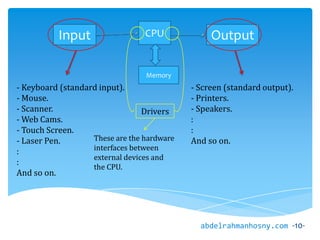
CPUInput Output
Memory
- Keyboard (standard input).
- Mouse.
- Scanner.
- Web Cams.
- Touch Screen.
- Laser Pen.
:
:
And so on.
- Screen (standard output).
- Printers.
- Speakers.
:
:
And so on.
Drivers
These are the hardware
interfaces between
external devices and
the CPU.
-11-abdelrahmanhosny.com
CPUInput
Memory
Output
Memory is the RAM used for program
code as well as data.
- Address Bus -
- Data Bus -
- Control Bus -
-12-abdelrahmanhosny.com
CPUInput
Memory
Output
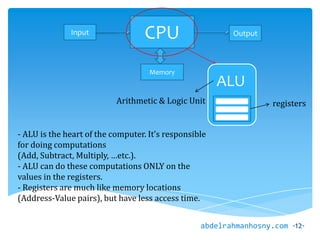
ALU
registersArithmetic & Logic Unit
- ALU is the heart of the computer. It’s responsible
for doing computations
(Add, Subtract, Multiply, …etc.).
- ALU can do these computations ONLY on the
values in the registers.
- Registers are much like memory locations
(Address-Value pairs), but have less access time.
-13-abdelrahmanhosny.com
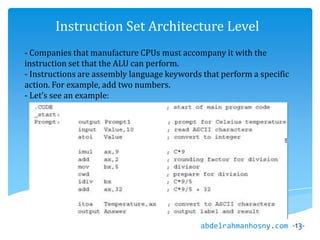
Instruction Set Architecture Level
- Companies that manufacture CPUs must accompany it with the
instruction set that the ALU can perform.
- Instructions are assembly language keywords that perform a specific
action. For example, add two numbers.
- Let’s see an example:
-14-abdelrahmanhosny.com
Operating System Level
- The operating system is the KING of the computer kingdom.
- It’s a software level that manage the different hardware resources
using the instructions provided by the manufacturer of every device.
- It has too many functionalities, some of them are:
- Usually operating systems are developed using C/C++ and assembly
programming languages.
 Program Execution
 IO operations
 File-System Manipulation.
 Communications.
 Error Detection.
 Security.
-15-abdelrahmanhosny.com
Higher-Order Language Level.
- There are many high-level language that make the programming
task easier for developers.
- Examples: C++, Java, C#, …etc.
Why there are too many programming
languages ?
Why there are new emerging languages ?
But …
-16-abdelrahmanhosny.com
-17-abdelrahmanhosny.com
- Introduction to Computer Science.
- Introduction to Computer Programming.
- Programming Languages.

1.0 Introduction to Hardware Computer Architecture

  • 1.
    Introduction to Hardware ComputerArchitecture Abd El-Rahman Hosny Mohammed Microsoft Student Partner. 4th Grade – Faculty of Computers and Information. Computer Science Department. Assiut University. contact: abdelrahmanhosny.com
  • 2.
    Agenda - Life Beforethe Digital World. - Logical Circuits. - Integrated Circuits (ICs). - Computer Hardware Components. - Instruction Set Architecture level. - Operating System Level. - Higher-Order Language Level. -2-abdelrahmanhosny.com
  • 3.
    Life Before theDigital World - The word “computer” was called to anybody or anything that carry out calculations and computations. - At late 19ths, the a “computer” was familiarized to any machine that carries out calculations. - Mechanical machines were developed to carry out calculations and some fixed functions (not programmable). - Programmability was introduced by the invention of “punched cards”. - Mechanical computers could recognize the punched cards patterns. -3-abdelrahmanhosny.com
  • 4.
    - Punched cardsas well as tapes were used to record data. - This improvement was the foundation od modern information processing industry. - Scientific computing needs were met by analog and mechanical computers. But they were inaccurate and not-programmable. - Alan Turing conceptualizes the concept of computing in the “Turing Machine”. - A device that manipulates symbols on a strip of tape according to a table of rules. -4-abdelrahmanhosny.com
  • 5.
    Turing Test - It’sthe ability of a computer to exhibit intelligent behavior. - If we could make a computer-human conversation that is indistinguishable from a human-human conversation, a machine is said to have passed the test. - Till now, no machine has passed the Turing test !! - Now, the world is moving toward building a smart machine that acts intelligently to human. -5-abdelrahmanhosny.com
  • 6.
    Logical Circuits - Withthe invention of capacitors, the world began to become digital. - The first computers were made up of tubes. They were really big in a size of a room !! -6-abdelrahmanhosny.com
  • 7.
    - Discovering semiconductorswas a great achievement that kicked-off the computer world to what we can see today. - Capacitors and transistors became very small. - These components used for storing data as digital signals. - Digital signals are binary signals that represent a 1 as a high-volt (5 v.) and a 0 as a low-volt (0 v.). - A computer can store any data in the form of a stream of 0s and 1s. - So, binary encoding is used to convert any decimal number into a binary one. For Example: 75 is represented as 01001011. -7-abdelrahmanhosny.com
  • 8.
    Integrated Circuits - Wecollect these small components in small chips which are called Integrated Circuits. - Small-Scale Integration (SSI): up to 100 electronic component per chip. - Medium-Scale Integration (MSI): from 100 to 3,000 electronic component per chip. - Large-Scale Integration (LSI): from 3,000 to 100,000 electronic component per chip. - Ultra Large-Scale Integration (ULSI): more than 1 million electronic component per circuit. - These integrated circuits (ICs) are the components of modern and future computers. -8-abdelrahmanhosny.com
  • 9.
    Computer Hardware - Computerhardware are the physical parts that constitutes the machine. - Through years, hardware architecture has evolved. - The most common hardware architecture is the Von Neumann model. - Let’s investigate each part. -9-abdelrahmanhosny.com CPUInput Output Memory
  • 10.
    -10-abdelrahmanhosny.com CPUInput Output Memory - Keyboard(standard input). - Mouse. - Scanner. - Web Cams. - Touch Screen. - Laser Pen. : : And so on. - Screen (standard output). - Printers. - Speakers. : : And so on. Drivers These are the hardware interfaces between external devices and the CPU.
  • 11.
    -11-abdelrahmanhosny.com CPUInput Memory Output Memory is theRAM used for program code as well as data. - Address Bus - - Data Bus - - Control Bus -
  • 12.
    -12-abdelrahmanhosny.com CPUInput Memory Output ALU registersArithmetic & LogicUnit - ALU is the heart of the computer. It’s responsible for doing computations (Add, Subtract, Multiply, …etc.). - ALU can do these computations ONLY on the values in the registers. - Registers are much like memory locations (Address-Value pairs), but have less access time.
  • 13.
    -13-abdelrahmanhosny.com Instruction Set ArchitectureLevel - Companies that manufacture CPUs must accompany it with the instruction set that the ALU can perform. - Instructions are assembly language keywords that perform a specific action. For example, add two numbers. - Let’s see an example:
  • 14.
    -14-abdelrahmanhosny.com Operating System Level -The operating system is the KING of the computer kingdom. - It’s a software level that manage the different hardware resources using the instructions provided by the manufacturer of every device. - It has too many functionalities, some of them are: - Usually operating systems are developed using C/C++ and assembly programming languages.  Program Execution  IO operations  File-System Manipulation.  Communications.  Error Detection.  Security.
  • 15.
    -15-abdelrahmanhosny.com Higher-Order Language Level. -There are many high-level language that make the programming task easier for developers. - Examples: C++, Java, C#, …etc. Why there are too many programming languages ? Why there are new emerging languages ? But …
  • 16.
  • 17.
    -17-abdelrahmanhosny.com - Introduction toComputer Science. - Introduction to Computer Programming. - Programming Languages.