Computer genrations:Computer genrations:
Past,Present & FuturePast,Present & Future
By
Vijay V. Gadade
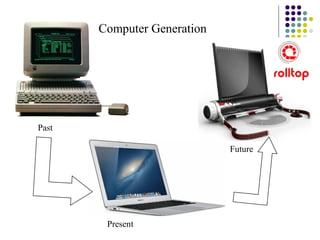
Past
Present
Future
Computer Generation
The History of
Computers
an electronic device which is capable of receiving
information (data) in a particular form and of performing a
sequence of operations in accordance with a
predetermined but variable set of procedural instructions
(program) to produce a result in the form of information or
signals.
What is computer
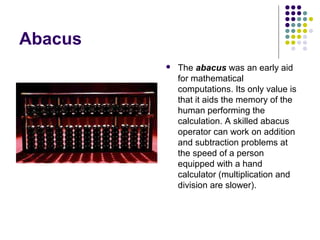
Abacus
 The abacus was an early aid
for mathematical
computations. Its only value is
that it aids the memory of the
human performing the
calculation. A skilled abacus
operator can work on addition
and subtraction problems at
the speed of a person
equipped with a hand
calculator (multiplication and
division are slower).
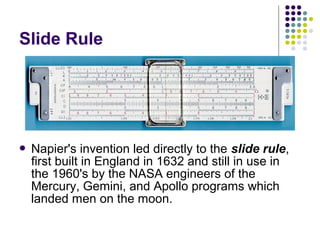
Slide Rule
 Napier's invention led directly to the slide rule,
first built in England in 1632 and still in use in
the 1960's by the NASA engineers of the
Mercury, Gemini, and Apollo programs which
landed men on the moon.
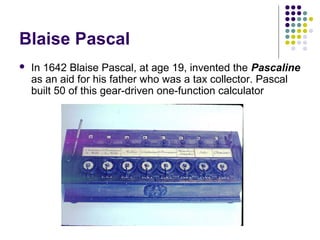
Blaise Pascal
 In 1642 Blaise Pascal, at age 19, invented the Pascaline
as an aid for his father who was a tax collector. Pascal
built 50 of this gear-driven one-function calculator
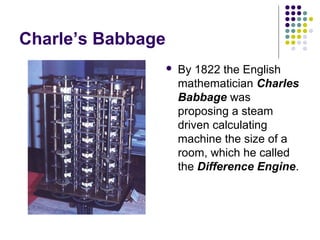
Charle’s Babbage
 By 1822 the English
mathematician Charles
Babbage was
proposing a steam
driven calculating
machine the size of a
room, which he called
the Difference Engine.
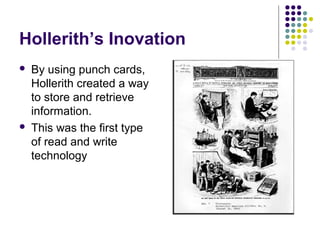
Hollerith’s Inovation
 By using punch cards,
Hollerith created a way
to store and retrieve
information.
 This was the first type
of read and write
technology
First Generation Computers
 The period of first generation was 1942-1954
The main features of First Generation are:
 Vacuum tube technology
 Unreliable
 Supported Machine language only
 Very costly
 Generate lot of heat
 Slow Input/Output device
 Huge size
 Need of A.C.
 Non portable
 Consumed lot of electricity
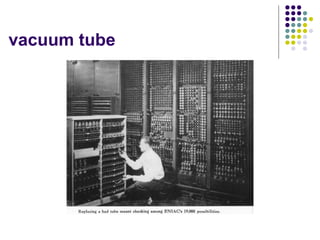
vacuum tube
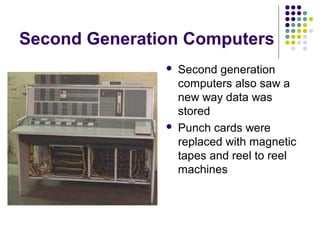
Second Generation Computers
 The period of second generation was 1952-
1964.
The main features of Second Generation are:
 Use of transistors
 Reliable as compared to First generation computers
 Smaller size as compared to First generation computers
 Generate less heat as compared to First generation computers
 Consumed less electricity as compared to First generation computers
 Faster than first generation computers
 Still very costly
 A.C. needed
 Support machine and assmebly languages
Second Generation Computers
 Second generation
computers also saw a
new way data was
stored
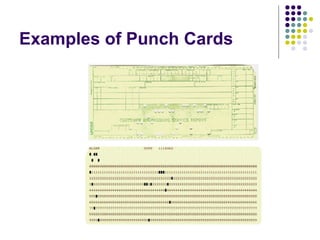
 Punch cards were
replaced with magnetic
tapes and reel to reel
machines
Examples of Punch Cards
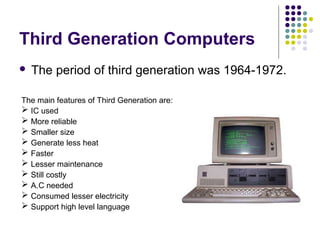
Third Generation Computers
 The period of third generation was 1964-1972.
The main features of Third Generation are:
 IC used
 More reliable
 Smaller size
 Generate less heat
 Faster
 Lesser maintenance
 Still costly
 A.C needed
 Consumed lesser electricity
 Support high level language
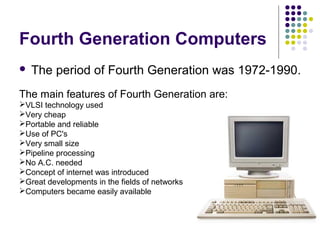
Fourth Generation Computers
 The period of Fourth Generation was 1972-1990.
The main features of Fourth Generation are:
VLSI technology used
Very cheap
Portable and reliable
Use of PC's
Very small size
Pipeline processing
No A.C. needed
Concept of internet was introduced
Great developments in the fields of networks
Computers became easily available
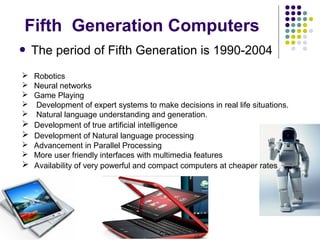
 The period of Fifth Generation is 1990-2004
 Robotics
 Neural networks
 Game Playing
 Development of expert systems to make decisions in real life situations.
 Natural language understanding and generation.
 Development of true artificial intelligence
 Development of Natural language processing
 Advancement in Parallel Processing
 More user friendly interfaces with multimedia features
 Availability of very powerful and compact computers at cheaper rates
Fifth Generation Computers
Sixth Generation Computers
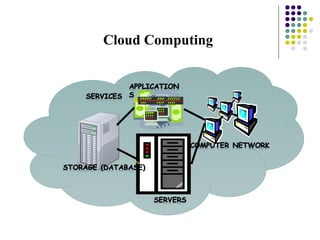
Cloud Computing is a general term used to describe a
new class of network based computing that takes place
over the Internet,
 basically a step on from Utility Computing
 a collection/group of integrated and networked
hardware, software and Internet infrastructure
(called a platform).
 general public, enterprises, corporations and
businesses markets
Cloud Computing
Seventh Generation Computers
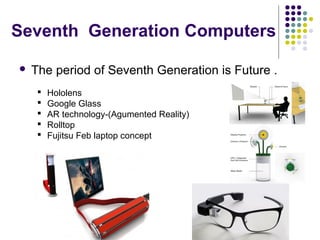
 The period of Seventh Generation is Future .
 Hololens
 Google Glass
 AR technology-(Agumented Reality)
 Rolltop
 Fujitsu Feb laptop concept
References
 Most of the information for this powerpoint
was obtained from the following web page:
 http://www.computersciencelab.com/Comput
erHistory/History.htm
 www.csc.com
 www.itechfuture.com
 www.tomsguide.com/US/augmented-reality-
future,news-19099.html
 www.cse.unr.edu
Computer (past,present&future)

Computer (past,present&future)

  • 1.
    Computer genrations:Computer genrations: Past,Present& FuturePast,Present & Future By Vijay V. Gadade
  • 2.
  • 3.
    The History of Computers anelectronic device which is capable of receiving information (data) in a particular form and of performing a sequence of operations in accordance with a predetermined but variable set of procedural instructions (program) to produce a result in the form of information or signals. What is computer
  • 4.
    Abacus  The abacuswas an early aid for mathematical computations. Its only value is that it aids the memory of the human performing the calculation. A skilled abacus operator can work on addition and subtraction problems at the speed of a person equipped with a hand calculator (multiplication and division are slower).
  • 5.
    Slide Rule  Napier'sinvention led directly to the slide rule, first built in England in 1632 and still in use in the 1960's by the NASA engineers of the Mercury, Gemini, and Apollo programs which landed men on the moon.
  • 6.
    Blaise Pascal  In1642 Blaise Pascal, at age 19, invented the Pascaline as an aid for his father who was a tax collector. Pascal built 50 of this gear-driven one-function calculator
  • 7.
    Charle’s Babbage  By1822 the English mathematician Charles Babbage was proposing a steam driven calculating machine the size of a room, which he called the Difference Engine.
  • 8.
    Hollerith’s Inovation  Byusing punch cards, Hollerith created a way to store and retrieve information.  This was the first type of read and write technology
  • 9.
    First Generation Computers The period of first generation was 1942-1954 The main features of First Generation are:  Vacuum tube technology  Unreliable  Supported Machine language only  Very costly  Generate lot of heat  Slow Input/Output device  Huge size  Need of A.C.  Non portable  Consumed lot of electricity
  • 10.
  • 11.
    Second Generation Computers The period of second generation was 1952- 1964. The main features of Second Generation are:  Use of transistors  Reliable as compared to First generation computers  Smaller size as compared to First generation computers  Generate less heat as compared to First generation computers  Consumed less electricity as compared to First generation computers  Faster than first generation computers  Still very costly  A.C. needed  Support machine and assmebly languages
  • 12.
    Second Generation Computers Second generation computers also saw a new way data was stored  Punch cards were replaced with magnetic tapes and reel to reel machines
  • 13.
  • 14.
    Third Generation Computers The period of third generation was 1964-1972. The main features of Third Generation are:  IC used  More reliable  Smaller size  Generate less heat  Faster  Lesser maintenance  Still costly  A.C needed  Consumed lesser electricity  Support high level language
  • 15.
    Fourth Generation Computers The period of Fourth Generation was 1972-1990. The main features of Fourth Generation are: VLSI technology used Very cheap Portable and reliable Use of PC's Very small size Pipeline processing No A.C. needed Concept of internet was introduced Great developments in the fields of networks Computers became easily available
  • 16.
     The periodof Fifth Generation is 1990-2004  Robotics  Neural networks  Game Playing  Development of expert systems to make decisions in real life situations.  Natural language understanding and generation.  Development of true artificial intelligence  Development of Natural language processing  Advancement in Parallel Processing  More user friendly interfaces with multimedia features  Availability of very powerful and compact computers at cheaper rates Fifth Generation Computers
  • 17.
    Sixth Generation Computers CloudComputing is a general term used to describe a new class of network based computing that takes place over the Internet,  basically a step on from Utility Computing  a collection/group of integrated and networked hardware, software and Internet infrastructure (called a platform).  general public, enterprises, corporations and businesses markets
  • 18.
  • 19.
    Seventh Generation Computers The period of Seventh Generation is Future .  Hololens  Google Glass  AR technology-(Agumented Reality)  Rolltop  Fujitsu Feb laptop concept
  • 20.
    References  Most ofthe information for this powerpoint was obtained from the following web page:  http://www.computersciencelab.com/Comput erHistory/History.htm  www.csc.com  www.itechfuture.com  www.tomsguide.com/US/augmented-reality- future,news-19099.html  www.cse.unr.edu