Computer-Stages of Development
Presented
by:
Amina
Rafique
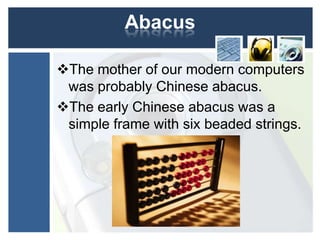
Abacus
The mother of our modern computers
was probably Chinese abacus.
The early Chinese abacus was a
simple frame with six beaded strings.
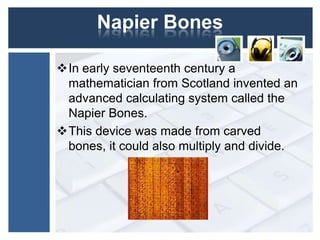
Napier Bones
In early seventeenth century a
mathematician from Scotland invented an
advanced calculating system called the
Napier Bones.
This device was made from carved
bones, it could also multiply and divide.
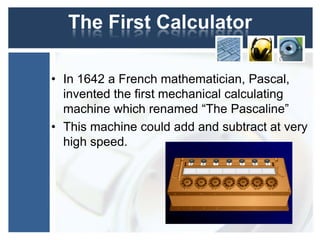
The First Calculator
• In 1642 a French mathematician, Pascal,
invented the first mechanical calculating
machine which renamed “The Pascaline”
• This machine could add and subtract at very
high speed.
Arithmetic Replica
• This calculating machine was
invented in Germany by a German
mathematician.
• This machine was a modified
version of Pascaline.
• This machine could divide and
multiply as well as add and subtract.
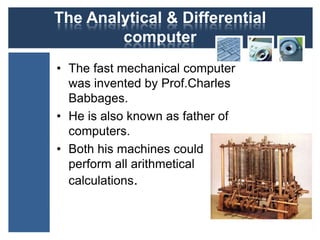
The Analytical & Differential
computer
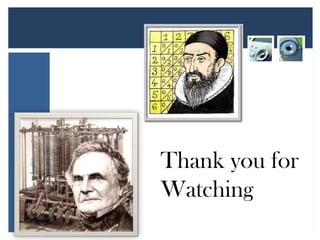
• The fast mechanical computer
was invented by Prof.Charles
Babbages.
• He is also known as father of
computers.
• Both his machines could
perform all arithmetical
calculations.
Thank you for
Watching

Computer stages of development

  • 1.
  • 2.
    Abacus The mother ofour modern computers was probably Chinese abacus. The early Chinese abacus was a simple frame with six beaded strings.
  • 3.
    Napier Bones In earlyseventeenth century a mathematician from Scotland invented an advanced calculating system called the Napier Bones. This device was made from carved bones, it could also multiply and divide.
  • 4.
    The First Calculator •In 1642 a French mathematician, Pascal, invented the first mechanical calculating machine which renamed “The Pascaline” • This machine could add and subtract at very high speed.
  • 5.
    Arithmetic Replica • Thiscalculating machine was invented in Germany by a German mathematician. • This machine was a modified version of Pascaline. • This machine could divide and multiply as well as add and subtract.
  • 6.
    The Analytical &Differential computer • The fast mechanical computer was invented by Prof.Charles Babbages. • He is also known as father of computers. • Both his machines could perform all arithmetical calculations.
  • 7.