Indroduction :
Modern word without computer is not possible. Today computers do
much
more than computing. For example computerized traffic control, supper
market scanners, ATM,social networking etc we are using computer in
every
aspect of our life. But where this all techno logy come from?It is very
important to also understand and appreciate the evolution and history
of computers .
The time when early machines and calculators which came
before electronic computers was evolution time later some basic ideas
were
taken from these machines to make computer. Development of computers
from early calculators to current generation can be broadly classified into
upcoming categories:
made by- Rohan Deshmukh

2
1. mechanical calculating devices
These can be further classified into two categories:
Manual Calculating Devices-

• Abacus The first manual calculating device(3500 BC) .
 Consist of rectangular frame carrying no. of rods with beads unequally

divided by a bar .
 The position of the beads on particular rod represents a digit In that
particular decimal position.

• Napier Bones Used in early 17th century for multiplication,division,powers,

square roots.
 Rectangular stripes of wood or bones with figures marked on one side.
 Invented by John Napier.
made by- Rohan Deshmukh

3
 Semi-automatic Calculating Devices
• Pascal’s Adding Machine - Pascaline (1642)

First semi-automatic mechanical device, developed by Baise Pascal.
Had eight movable dials to add sums up to eight digits.
Drawback-limitation to addition.

•

Leibnitz Machine(1673)-




German mathematician Gottfried Wilhem Von Leibniz improved
pascaline with this machine.
Was able to add,subtract,multiply and divide.

•

Joseph Jacquard’s Loom(1802-1804)-



Joseph Jacquard devised mechanical means of controlling the weaving
to make the complex pattern easy.
Used punch cards to control movements of threads and store
instructions.






made by- Rohan Deshmukh

4
• Difference Engine (1822) Charles Babbage proposed a machine to compile mathematical tables.
 Powered by steam ,it was so large as locomotive.
 Would store programm,perform calculation and print the result.
 Never completed because of mechanical difficulties.

• Analytical Engine (1832) During the making of difference engine Babbage was suddenly inspired to





make it.
First general purpose computer ,with over 5000 components.
had input devices,the main idea of input and output that is even today
comes from here.
Borrowed idea of punch cards from jacquard to encode instructions and
store 1000 numbers of 50 digits.
Not just perform one task but different types of calculation.

made by- Rohan Deshmukh

5
• Punch Card (1889) American inventor Herman Hollerith applied Jacquard loom concept to

computing.
 Used to store data information which was fed into the machine that
compiled the results mechanically.
 Each punch represented a number and combination of two represented one
letter.
 Could store 80 characters.
 Hollerith later brought punch-card reader in the market.
2.Electromechanical Calculating Devices
• Mark I[Harward Automatic Sequence Controlled Calculator] (1889) Invented by Howard H. Aiken with IBM.
 Was about half as long as football field and had 500 miles of wiring.
 Was an electronic relay computer and used electromagnetic signals to mave
mechanical parts.
 Was slow but could perform complex equation.
made by- Rohan Deshmukh

6
3.Electronic Computers
There were many other technological advancement ,whereby recording
devices,thermionic valves etc were invented which also contributed in
making
of first electronic computer.
Electronic computers are classified into various generations on the
basis of technological advancement.Each generation represents a major
improvement over its predecessor. And here starts the history of computer.

 ABC(1937-1938) or Atansoft Berry Computer was first fully electronic
computer.It used vacuum tubes and was special purpose computer.

 In 1941 Konard Zuse developed Z3 to design airplane and missiles.
 In 1943 British completed a secret code breaking computer named

Colossus.

made by- Rohan Deshmukh

7
First Generation Computers(1946-1958)
• ENIAC(1939-1946) Full name- Electronic Numerical Integrator and Computer.
 Developed by John Presper Eckert and John W. Mauchly.
 First fully electronic general purpose computer consisting 18000 vacuum

tubes,70000 resistor sand 5 million soldered joints.
 1000times faster than Mark I it could add two large numbers in 200
microseconds.

• EDSAC(1947-1949) Full name- Electronic Delay Storage Automatic Computer.
 Designed by M.Wilkes of Cambridge University.
 Slightely faster than ENIC and also used vacuum tubes.
 Not binary but the first stored program electronic computer.
 Program was fed by means of paper tape.
made by- Rohan Deshmukh

8
EDSAC (1949) Full name- Electronic Discrete Variable Automatic Computer.
 Designed by John Von Neumann.
 Hold both stored program as well as data.
 Key element control processing unit.
 The project to develop the EDVAC got delayed. This made EDSAC first

computer using stored program concept.

• UNIVAC I(1951) Full name-Universal Automatic Computer.
 Built by Remington Rand.
 Became one of the first commercially available computer .

made by- Rohan Deshmukh

9
oCharacteristics of First Generation Computers
 They used vacuum tubes and magnetic drum for storage.
 Operating instructions were made for specific task.
 Each computer had different binary coded program called machine

language.

 Some other examples of I generation Computer are;
 Mark I
 Mark II
 UNIVAC II
 BURROUGHS

made by- Rohan Deshmukh

10
Second Generation Computers(1959-63)
Second Generation computers used o Characteristics
transistors and magnetic core
memory.This led II generation
computers to become
smaller,faster,
more reliable and more energy
efficient.

 Examples:

 Replaced machine language with

assembly language.
 The also contained components we
associate with modern day computer:printers,tape storage,disk storage,
memory,operating systems and stored
programs.
 High-level languages such as COBOL and
FORTRAN came into use.

 UNIVAC III
 400 and 800 series
 B 5000 CDC1604

made by- Rohan Deshmukh

11
Third Generation Computers(1964-71)
Jack Kilby, an engineer with Texas
o
instruments,developed the

integrated circuit (IC) in 1958.The IC
combined three electronic

components onto a small silicon
disk
which was made from quartz.

Scientists later managed to fit even
more components on a single chip

called semiconductor.
 Example:
 System 360
 System 370
 UNIVAC 1100
 PDP-11
made by- Rohan Deshmukh

Characteristics
They used IC as aresult computers
became smaller as more components
were squeezed onto the chip.
They used an operating system that
allowed machines to run many
different programs at one time.
Capacity of main memories was greatly
enlarged.
New input and out put devices came in
market.

12
Fourth Generation Computers(1972-84)
 Present generation of computer.
 Large scale integration could fit hundreds of components onto one





chip.
Very large scale integration sqeezed hundreds of thousands of
components on chip,later millions by Ultra large scale integration.
Intel 4004 chip,assembled CPU,memoryand input/output controlon
single chip called microprocessor.
Size lessened, much greater computing power,extremely large
memories,storage device improved,cost lessened.
Computers became more powerful, they could be linked together or
networked to share memory space, software, information and
communicate with each other,Internet was a great advancement.

made by- Rohan Deshmukh

13
Fifth Generation Computers
The only drawback of present computers is lack of thinking power.
The fifth generation computers are expected to fill this gap and are
being referred to as Supercomputers.Such computers have very large
storage capacity, high speed, capacity to do highly sophisticated
operations, and the capability to make decisions of the right kind.
New technology is capable of implementing human thought precess is
called ‘artificial intelligence’.This refers to the use of computers in
such away that they perform various operations and at the same time
take decisions as human beings.these computers are still to be
introduced. Scientist are working hard on this project.

made by- Rohan Deshmukh

14
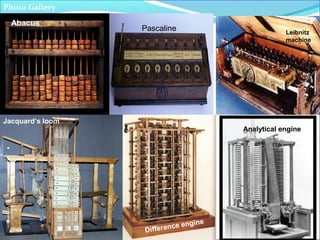
Photo Gallery
Abacus

Photo Gallery

Pascaline

Leibnitz
machine

Jacquard’s loom
Analytical engine

ce eng
Differen
made by- Rohan Deshmukh

ine
15
Photo Gallery
Photo Gallery
Punch Card

Mark 1

EDSAC
UNIVAC I

EDVAC
ENIAC

made by- Rohan Deshmukh

16
Photo Gallery
B5000

made by- Rohan Deshmukh

17
made by- Rohan Deshmukh

12

.

Evolution & History of Computers

  • 2.
    Indroduction : Modern wordwithout computer is not possible. Today computers do much more than computing. For example computerized traffic control, supper market scanners, ATM,social networking etc we are using computer in every aspect of our life. But where this all techno logy come from?It is very important to also understand and appreciate the evolution and history of computers . The time when early machines and calculators which came before electronic computers was evolution time later some basic ideas were taken from these machines to make computer. Development of computers from early calculators to current generation can be broadly classified into upcoming categories: made by- Rohan Deshmukh 2
  • 3.
    1. mechanical calculatingdevices These can be further classified into two categories: Manual Calculating Devices- • Abacus The first manual calculating device(3500 BC) .  Consist of rectangular frame carrying no. of rods with beads unequally divided by a bar .  The position of the beads on particular rod represents a digit In that particular decimal position. • Napier Bones Used in early 17th century for multiplication,division,powers, square roots.  Rectangular stripes of wood or bones with figures marked on one side.  Invented by John Napier. made by- Rohan Deshmukh 3
  • 4.
     Semi-automatic CalculatingDevices • Pascal’s Adding Machine - Pascaline (1642) First semi-automatic mechanical device, developed by Baise Pascal. Had eight movable dials to add sums up to eight digits. Drawback-limitation to addition. • Leibnitz Machine(1673)-   German mathematician Gottfried Wilhem Von Leibniz improved pascaline with this machine. Was able to add,subtract,multiply and divide. • Joseph Jacquard’s Loom(1802-1804)-  Joseph Jacquard devised mechanical means of controlling the weaving to make the complex pattern easy. Used punch cards to control movements of threads and store instructions.    made by- Rohan Deshmukh 4
  • 5.
    • Difference Engine(1822) Charles Babbage proposed a machine to compile mathematical tables.  Powered by steam ,it was so large as locomotive.  Would store programm,perform calculation and print the result.  Never completed because of mechanical difficulties. • Analytical Engine (1832) During the making of difference engine Babbage was suddenly inspired to     make it. First general purpose computer ,with over 5000 components. had input devices,the main idea of input and output that is even today comes from here. Borrowed idea of punch cards from jacquard to encode instructions and store 1000 numbers of 50 digits. Not just perform one task but different types of calculation. made by- Rohan Deshmukh 5
  • 6.
    • Punch Card(1889) American inventor Herman Hollerith applied Jacquard loom concept to computing.  Used to store data information which was fed into the machine that compiled the results mechanically.  Each punch represented a number and combination of two represented one letter.  Could store 80 characters.  Hollerith later brought punch-card reader in the market. 2.Electromechanical Calculating Devices • Mark I[Harward Automatic Sequence Controlled Calculator] (1889) Invented by Howard H. Aiken with IBM.  Was about half as long as football field and had 500 miles of wiring.  Was an electronic relay computer and used electromagnetic signals to mave mechanical parts.  Was slow but could perform complex equation. made by- Rohan Deshmukh 6
  • 7.
    3.Electronic Computers There weremany other technological advancement ,whereby recording devices,thermionic valves etc were invented which also contributed in making of first electronic computer. Electronic computers are classified into various generations on the basis of technological advancement.Each generation represents a major improvement over its predecessor. And here starts the history of computer.  ABC(1937-1938) or Atansoft Berry Computer was first fully electronic computer.It used vacuum tubes and was special purpose computer.  In 1941 Konard Zuse developed Z3 to design airplane and missiles.  In 1943 British completed a secret code breaking computer named Colossus. made by- Rohan Deshmukh 7
  • 8.
    First Generation Computers(1946-1958) •ENIAC(1939-1946) Full name- Electronic Numerical Integrator and Computer.  Developed by John Presper Eckert and John W. Mauchly.  First fully electronic general purpose computer consisting 18000 vacuum tubes,70000 resistor sand 5 million soldered joints.  1000times faster than Mark I it could add two large numbers in 200 microseconds. • EDSAC(1947-1949) Full name- Electronic Delay Storage Automatic Computer.  Designed by M.Wilkes of Cambridge University.  Slightely faster than ENIC and also used vacuum tubes.  Not binary but the first stored program electronic computer.  Program was fed by means of paper tape. made by- Rohan Deshmukh 8
  • 9.
    EDSAC (1949) Fullname- Electronic Discrete Variable Automatic Computer.  Designed by John Von Neumann.  Hold both stored program as well as data.  Key element control processing unit.  The project to develop the EDVAC got delayed. This made EDSAC first computer using stored program concept. • UNIVAC I(1951) Full name-Universal Automatic Computer.  Built by Remington Rand.  Became one of the first commercially available computer . made by- Rohan Deshmukh 9
  • 10.
    oCharacteristics of FirstGeneration Computers  They used vacuum tubes and magnetic drum for storage.  Operating instructions were made for specific task.  Each computer had different binary coded program called machine language.  Some other examples of I generation Computer are;  Mark I  Mark II  UNIVAC II  BURROUGHS made by- Rohan Deshmukh 10
  • 11.
    Second Generation Computers(1959-63) SecondGeneration computers used o Characteristics transistors and magnetic core memory.This led II generation computers to become smaller,faster, more reliable and more energy efficient.  Examples:  Replaced machine language with assembly language.  The also contained components we associate with modern day computer:printers,tape storage,disk storage, memory,operating systems and stored programs.  High-level languages such as COBOL and FORTRAN came into use.  UNIVAC III  400 and 800 series  B 5000 CDC1604 made by- Rohan Deshmukh 11
  • 12.
    Third Generation Computers(1964-71) JackKilby, an engineer with Texas o instruments,developed the  integrated circuit (IC) in 1958.The IC combined three electronic  components onto a small silicon disk which was made from quartz.  Scientists later managed to fit even more components on a single chip  called semiconductor.  Example:  System 360  System 370  UNIVAC 1100  PDP-11 made by- Rohan Deshmukh Characteristics They used IC as aresult computers became smaller as more components were squeezed onto the chip. They used an operating system that allowed machines to run many different programs at one time. Capacity of main memories was greatly enlarged. New input and out put devices came in market. 12
  • 13.
    Fourth Generation Computers(1972-84) Present generation of computer.  Large scale integration could fit hundreds of components onto one     chip. Very large scale integration sqeezed hundreds of thousands of components on chip,later millions by Ultra large scale integration. Intel 4004 chip,assembled CPU,memoryand input/output controlon single chip called microprocessor. Size lessened, much greater computing power,extremely large memories,storage device improved,cost lessened. Computers became more powerful, they could be linked together or networked to share memory space, software, information and communicate with each other,Internet was a great advancement. made by- Rohan Deshmukh 13
  • 14.
    Fifth Generation Computers Theonly drawback of present computers is lack of thinking power. The fifth generation computers are expected to fill this gap and are being referred to as Supercomputers.Such computers have very large storage capacity, high speed, capacity to do highly sophisticated operations, and the capability to make decisions of the right kind. New technology is capable of implementing human thought precess is called ‘artificial intelligence’.This refers to the use of computers in such away that they perform various operations and at the same time take decisions as human beings.these computers are still to be introduced. Scientist are working hard on this project. made by- Rohan Deshmukh 14
  • 15.
    Photo Gallery Abacus Photo Gallery Pascaline Leibnitz machine Jacquard’sloom Analytical engine ce eng Differen made by- Rohan Deshmukh ine 15
  • 16.
    Photo Gallery Photo Gallery PunchCard Mark 1 EDSAC UNIVAC I EDVAC ENIAC made by- Rohan Deshmukh 16
  • 17.
  • 18.
    made by- RohanDeshmukh 12 .