Computer NetworkComputer Network
ByBy
Dr. Pravin H. GhosekarDr. Pravin H. Ghosekar
M.Sc.(C/S), MCM, DBM, M.Phil(IT), M.Phil(Comm), MBA, BJ. Ph.D.M.Sc.(C/S), MCM, DBM, M.Phil(IT), M.Phil(Comm), MBA, BJ. Ph.D.
HOD Computer DepartmentHOD Computer Department
Dhanwate National CollegeDhanwate National College
NagpurNagpur
08/10/201008/10/2010
Network
• Computer networks is an interconnected collection of
autonomous computers.
• These computers are said to be interconnected if
they are able to exchange information
• A computer network is a network of computers that
are geographically distributed, but connected in such
a way that which enable meaningful transmission and
exchange of data among them.
• Sharing of information, resources (both hardware &
software including printer, fax, files, folders, etc.),
and processing load is main objective of computer
network.
Applications Network
• File Sharing
• Printer Sharing
• Communication & Collaboration
• Organisation
• Remote Access
• Data Protection
• Distributed Processing
Forms of Data Communication
• Analog eg. Telephone produce analog signals
• Digital eg. Computers produce digital signals
(0s and 1s)
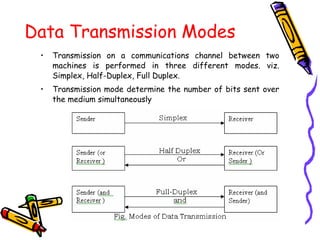
Data Transmission Modes
• Transmission on a communications channel between two
machines is performed in three different modes. viz.
Simplex, Half-Duplex, Full Duplex.
• Transmission mode determine the number of bits sent over
the medium simultaneously
Types of Network
• LAN (Local Area Network) upto 2 km
• WAN (Wide Area Network) more than 100 km
• MAN (Metropolitan Area Network) upto 100 km
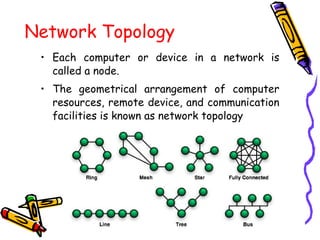
Network Topology
• Each computer or device in a network is
called a node.
• The geometrical arrangement of computer
resources, remote device, and communication
facilities is known as network topology
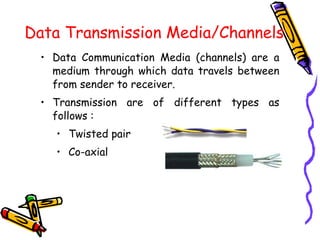
Data Transmission Media/Channels
• Data Communication Media (channels) are a
medium through which data travels between
from sender to receiver.
• Transmission are of different types as
follows :
• Twisted pair
• Co-axial
Data Transmission Media/Channels
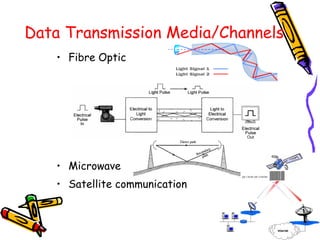
• Fibre Optic
• Microwave
• Satellite communication
Wireless Network
• Wireless networks are different types of computer network
that are wireless.
• Wireless telecommunications networks are generally
implemented using electromagnetic waves, such as radio
waves, microwave, short waves, etc
• Wireless network can be divided into three categories
• Wireless PAN :(interconnects devices within a relatively
small area)
• Wireless LAN :
• Wi-Fi: Wireless Fidelity
• Fixed Wireless Data:
• Wireless MAN : Wi-Max (Worldwide Interoperability
for Microwave Access )
Network Terminologies
• Bandwidth : the amount of data that can be
carried from one point to another in a given
time period (usually a second) which is
measured in bits (of data) per second (bps)
• Protocol : It is a set of rules and procedures
that govern transmission between the
components in a network
These rules provide a method for orderly
and efficient exchange of data between
sender and receiver
Network Terminologies
• Protocols :
• TCP/IP (Transmission Control Protocol /
Internet Protocol): TCP/IP is a protocol suite,
which consists of protocols for all 4 layers. It is
used for Intranet and Internet. The protocol
ensures error-free transmission.
• HTTP (HyperText Transmission Protocol) : is a
networking protocol for distributed,
collaborative, hypermedia information systems.
Network Terminologies
• Protocols :
• POP3 (Post Office Protocol) : It is used for E-
mail client to retrieve E-mail from server
• SMTP (Simple Mail Transfer Protocol) : used
for transmission of E-mail across Internet
• FTP (File Transfer Protocol) : It enables a host
to send and receive files over the network –
internet as well as intranet.
• DNS (Domain Name Service Protocol) :
Translates server address to IP address.
Network Terminologies
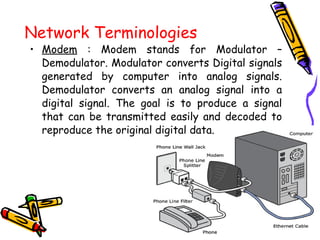
• Modem : Modem stands for Modulator –
Demodulator. Modulator converts Digital signals
generated by computer into analog signals.
Demodulator converts an analog signal into a
digital signal. The goal is to produce a signal
that can be transmitted easily and decoded to
reproduce the original digital data.
Network Terminologies
• Multiplexer : It is the process of combining
signals from multiple sources for transmission
across a single data link.
• Multiplexing a voice telephone call means that
two or more separate conversations are sent
simultaneously over one communication circuit
between two different cities..
• Types :
• Frequency Division Multiplexing (FDM)
• Time Division Multiplexing (TDM)
Network Terminologies
• Telnet : The telnet application enables a use on
one computer to log on to another computer on
the network.
• Baud rate : The maximum number of signal
pulses that a communication line can handle per
second. Higher baud rates indicate greater
transmission capacities.
• Bridge : An internetworking device that
connects two similar networks.
Network Terminologies
• BPS : Bits per second. A unit of measurement
for data transfer rates.
• Client : A network node that uses services
provided by a server
• Server: Which provides services to clients
• Data compression : A procedure that uses
mathematical techniques to encode data so that
it uses less space.
• Data encryption : A security procedure that
encodes data so that it cannot easily be
understood.
Network Terminologies
• Ethernet : A popular local area network that
uses a contention media-access method over a
bus topology of coaxial cable.
• Gateway : A computer that interconnects
different types of networks, translating
protocols as necessary. For example, a gateway
might connect personal computers on a LAN to
a mainframe computer
• Host : Computer that controls network
communication in a hierarchical network
• Hub :
• Switch :
Network Terminologies
• IEEE : Institute of Electrical and Electronics
Engineers. A standards organization
• OSI Open Systems Interconnection. : A proto-
type for network communication that promotes
interconnectivity.
• Peer-to-peer : Communication between two
network devices that have the same status on
the network
• Router A device that connects networks and
can determine the best path for data when
there are multiple paths
ThanksThanks

Computer Network

  • 1.
    Computer NetworkComputer Network ByBy Dr.Pravin H. GhosekarDr. Pravin H. Ghosekar M.Sc.(C/S), MCM, DBM, M.Phil(IT), M.Phil(Comm), MBA, BJ. Ph.D.M.Sc.(C/S), MCM, DBM, M.Phil(IT), M.Phil(Comm), MBA, BJ. Ph.D. HOD Computer DepartmentHOD Computer Department Dhanwate National CollegeDhanwate National College NagpurNagpur 08/10/201008/10/2010
  • 2.
    Network • Computer networksis an interconnected collection of autonomous computers. • These computers are said to be interconnected if they are able to exchange information • A computer network is a network of computers that are geographically distributed, but connected in such a way that which enable meaningful transmission and exchange of data among them. • Sharing of information, resources (both hardware & software including printer, fax, files, folders, etc.), and processing load is main objective of computer network.
  • 3.
    Applications Network • FileSharing • Printer Sharing • Communication & Collaboration • Organisation • Remote Access • Data Protection • Distributed Processing
  • 4.
    Forms of DataCommunication • Analog eg. Telephone produce analog signals • Digital eg. Computers produce digital signals (0s and 1s)
  • 5.
    Data Transmission Modes •Transmission on a communications channel between two machines is performed in three different modes. viz. Simplex, Half-Duplex, Full Duplex. • Transmission mode determine the number of bits sent over the medium simultaneously
  • 6.
    Types of Network •LAN (Local Area Network) upto 2 km • WAN (Wide Area Network) more than 100 km • MAN (Metropolitan Area Network) upto 100 km
  • 7.
    Network Topology • Eachcomputer or device in a network is called a node. • The geometrical arrangement of computer resources, remote device, and communication facilities is known as network topology
  • 8.
    Data Transmission Media/Channels •Data Communication Media (channels) are a medium through which data travels between from sender to receiver. • Transmission are of different types as follows : • Twisted pair • Co-axial
  • 9.
    Data Transmission Media/Channels •Fibre Optic • Microwave • Satellite communication
  • 10.
    Wireless Network • Wirelessnetworks are different types of computer network that are wireless. • Wireless telecommunications networks are generally implemented using electromagnetic waves, such as radio waves, microwave, short waves, etc • Wireless network can be divided into three categories • Wireless PAN :(interconnects devices within a relatively small area) • Wireless LAN : • Wi-Fi: Wireless Fidelity • Fixed Wireless Data: • Wireless MAN : Wi-Max (Worldwide Interoperability for Microwave Access )
  • 11.
    Network Terminologies • Bandwidth: the amount of data that can be carried from one point to another in a given time period (usually a second) which is measured in bits (of data) per second (bps) • Protocol : It is a set of rules and procedures that govern transmission between the components in a network These rules provide a method for orderly and efficient exchange of data between sender and receiver
  • 12.
    Network Terminologies • Protocols: • TCP/IP (Transmission Control Protocol / Internet Protocol): TCP/IP is a protocol suite, which consists of protocols for all 4 layers. It is used for Intranet and Internet. The protocol ensures error-free transmission. • HTTP (HyperText Transmission Protocol) : is a networking protocol for distributed, collaborative, hypermedia information systems.
  • 13.
    Network Terminologies • Protocols: • POP3 (Post Office Protocol) : It is used for E- mail client to retrieve E-mail from server • SMTP (Simple Mail Transfer Protocol) : used for transmission of E-mail across Internet • FTP (File Transfer Protocol) : It enables a host to send and receive files over the network – internet as well as intranet. • DNS (Domain Name Service Protocol) : Translates server address to IP address.
  • 14.
    Network Terminologies • Modem: Modem stands for Modulator – Demodulator. Modulator converts Digital signals generated by computer into analog signals. Demodulator converts an analog signal into a digital signal. The goal is to produce a signal that can be transmitted easily and decoded to reproduce the original digital data.
  • 15.
    Network Terminologies • Multiplexer: It is the process of combining signals from multiple sources for transmission across a single data link. • Multiplexing a voice telephone call means that two or more separate conversations are sent simultaneously over one communication circuit between two different cities.. • Types : • Frequency Division Multiplexing (FDM) • Time Division Multiplexing (TDM)
  • 16.
    Network Terminologies • Telnet: The telnet application enables a use on one computer to log on to another computer on the network. • Baud rate : The maximum number of signal pulses that a communication line can handle per second. Higher baud rates indicate greater transmission capacities. • Bridge : An internetworking device that connects two similar networks.
  • 17.
    Network Terminologies • BPS: Bits per second. A unit of measurement for data transfer rates. • Client : A network node that uses services provided by a server • Server: Which provides services to clients • Data compression : A procedure that uses mathematical techniques to encode data so that it uses less space. • Data encryption : A security procedure that encodes data so that it cannot easily be understood.
  • 18.
    Network Terminologies • Ethernet: A popular local area network that uses a contention media-access method over a bus topology of coaxial cable. • Gateway : A computer that interconnects different types of networks, translating protocols as necessary. For example, a gateway might connect personal computers on a LAN to a mainframe computer • Host : Computer that controls network communication in a hierarchical network • Hub : • Switch :
  • 19.
    Network Terminologies • IEEE: Institute of Electrical and Electronics Engineers. A standards organization • OSI Open Systems Interconnection. : A proto- type for network communication that promotes interconnectivity. • Peer-to-peer : Communication between two network devices that have the same status on the network • Router A device that connects networks and can determine the best path for data when there are multiple paths
  • 20.