DATABASE MANAGEMENT SYSTEM
Dr. Pravin Ghosekar
HOD, Computer Dept.
Dhanwate National College
Nagpur
DATABASE ENVIRONMENT
Information is much important in any of the business
organization also it is major corporate resource
which must be managed properly like assets.
It is an asset only if; it is accurate and available
whenever users want.
This can be occur only if an organization organizes
and manages its data properly.
A database is a shared collection of logically related
data, designed to fulfill requirement of the
information needs of multiple users in an
organization.
DATABASE
A database is an organized collection of
related information so that it can be easily
accessed, managed, and updated.
In other words, database is a collection of
records stored on a computer in a systematic
way.
For better retrieval and sorting, each record
is organized as a set of data elements or
facts.
DBMS (DATABASE MANAGEMENT SYSTEM)
 DBMS is a collection of interrelated data and set
of programs that enable users to create and
maintain database.
 The DBMS is software that facilitates the
process of defining, constructing & manipulating
databases for various applications.
 DBMS has set of rules and methods which are
used to define, create, read, maintain and
protect the database.
ADVANTAGES OF DBMS
 Data Independence : The data is stored in such a way that
changes to the structure of the database will not affects to any
programs which are used to access the data.
 Consistency of Data : Each item of data is stored only once
therefore no need to update on more than one system.
 Control Over Redundancy : In a non-database system, the same
information may be stored on several files. It wastes memory
space and uses more time to update. A database system
minimizes these effects.
 Integrity of Data : The DBMS can specify the constraints on data
such as making a field entry essential or using a validation
routine.
 Greater Security of Data : The DBMS can ensure only authorized
users are allowed access to the data.
ADVANTAGES OF DBMS
 Centralized Control of Data : The Database Administrator will
control who has access to what and will structure the database
with the needs of the whole department in mind.
 More information available to users : Users have access to a
wider range of data that was previously held in separate
departments and sometimes on incompatible systems.
 Increased Productivity : The DBMS provides an easy to use query
language that allows users to set immediate response from their
queries rather than having to use a specialist
 Application Program Development : DBMS software facilitate to
develop new application program.
RDBMS (RELATIONAL DBMS)
RDBMS data is structured in database
tables, fields and records. Each RDBMS
table consists of database table rows. Each
database table row consists of one or more
database table fields.
RDBMS store the data into collection of
tables, which might be related by common
fields (database table columns).
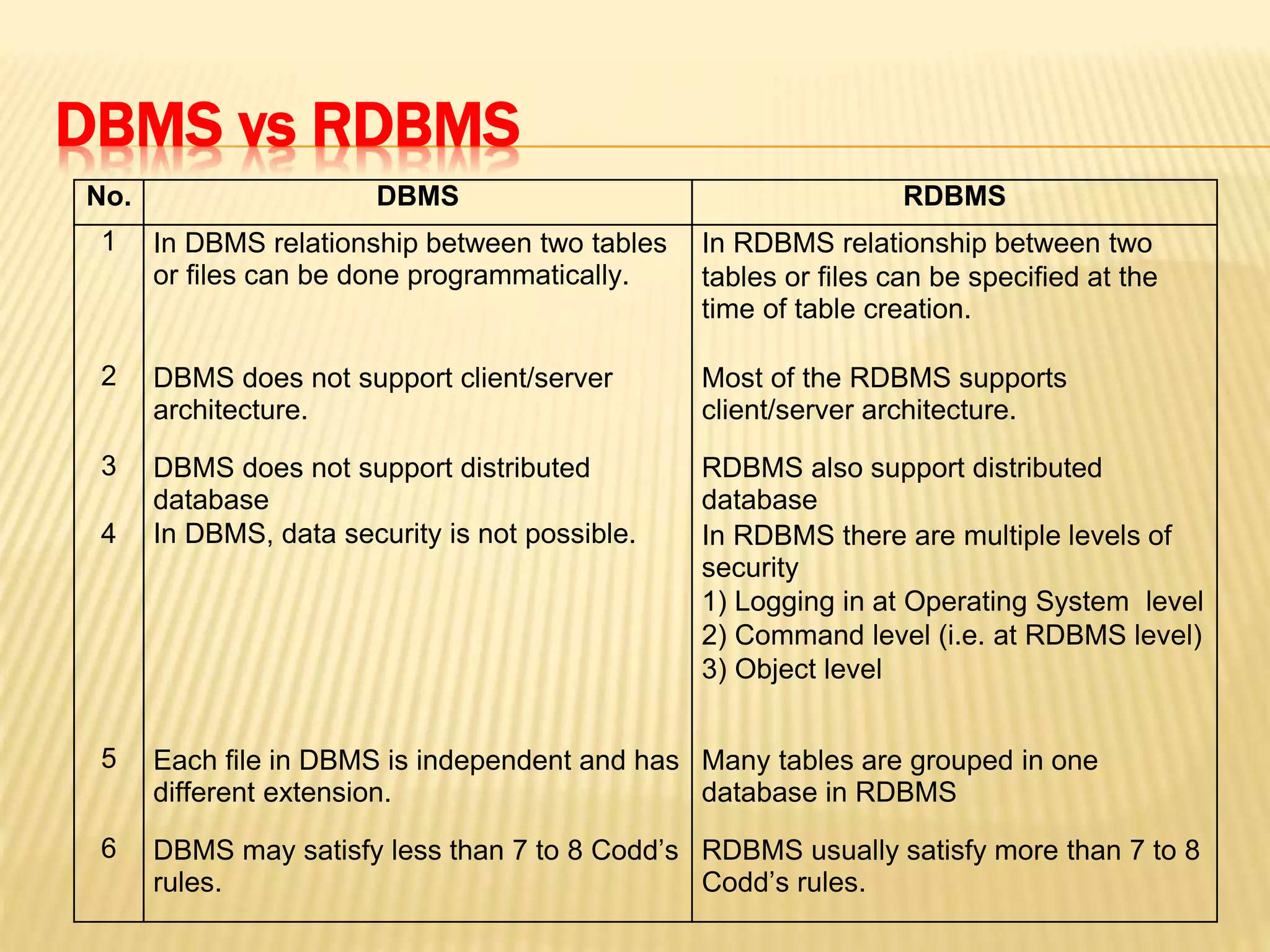
DBMS vs RDBMS
No. DBMS RDBMS
1 In DBMS relationship between two tables
or files can be done programmatically.
In RDBMS relationship between two
tables or files can be specified at the
time of table creation.
2 DBMS does not support client/server
architecture.
Most of the RDBMS supports
client/server architecture.
3 DBMS does not support distributed
database
RDBMS also support distributed
database
4 In DBMS, data security is not possible. In RDBMS there are multiple levels of
security
1) Logging in at Operating System level
2) Command level (i.e. at RDBMS level)
3) Object level
5 Each file in DBMS is independent and has
different extension.
Many tables are grouped in one
database in RDBMS
6 DBMS may satisfy less than 7 to 8 Codd’s
rules.
RDBMS usually satisfy more than 7 to 8
Codd’s rules.
DATABASE ADMINISTRATOR (DBA)
A database administrator (DBA) directs or
performs all activities related to maintaining a
successful database environment.
Responsibilities include designing,
implementing, and maintaining the database
system;
ROLE OF DBA
 Installation of new software
 Configuration of hardware and software with
the system administrator
 Security administration
 Data analysis
 Database design
 Data modeling and optimization
 Backing up, compacting and repairing
databases
DATA WAREHOUSING
&
DATA MINING
DATA WAREHOUSE
 Data warehouse is a repository of an
organization's electronically stored data.
 A data warehouse houses a standardized,
consistent, clean and integrated form of data
sourced from various operational systems in
use in the organization, structured in a way
to specifically address the reporting and
analytic requirements.
DATA MINING
 Data mining is the process of extracting
patterns from data. As more data are
gathered, with the amount of data doubling
every three years, data mining is becoming
an increasingly important tool to transform
these data into information. It is commonly
used in a wide range of profiling practices,
such as marketing, surveillance, fraud
detection and scientific discovery.
dbms

dbms

  • 1.
    DATABASE MANAGEMENT SYSTEM Dr.Pravin Ghosekar HOD, Computer Dept. Dhanwate National College Nagpur
  • 2.
    DATABASE ENVIRONMENT Information ismuch important in any of the business organization also it is major corporate resource which must be managed properly like assets. It is an asset only if; it is accurate and available whenever users want. This can be occur only if an organization organizes and manages its data properly. A database is a shared collection of logically related data, designed to fulfill requirement of the information needs of multiple users in an organization.
  • 3.
    DATABASE A database isan organized collection of related information so that it can be easily accessed, managed, and updated. In other words, database is a collection of records stored on a computer in a systematic way. For better retrieval and sorting, each record is organized as a set of data elements or facts.
  • 4.
    DBMS (DATABASE MANAGEMENTSYSTEM)  DBMS is a collection of interrelated data and set of programs that enable users to create and maintain database.  The DBMS is software that facilitates the process of defining, constructing & manipulating databases for various applications.  DBMS has set of rules and methods which are used to define, create, read, maintain and protect the database.
  • 5.
    ADVANTAGES OF DBMS Data Independence : The data is stored in such a way that changes to the structure of the database will not affects to any programs which are used to access the data.  Consistency of Data : Each item of data is stored only once therefore no need to update on more than one system.  Control Over Redundancy : In a non-database system, the same information may be stored on several files. It wastes memory space and uses more time to update. A database system minimizes these effects.  Integrity of Data : The DBMS can specify the constraints on data such as making a field entry essential or using a validation routine.  Greater Security of Data : The DBMS can ensure only authorized users are allowed access to the data.
  • 6.
    ADVANTAGES OF DBMS Centralized Control of Data : The Database Administrator will control who has access to what and will structure the database with the needs of the whole department in mind.  More information available to users : Users have access to a wider range of data that was previously held in separate departments and sometimes on incompatible systems.  Increased Productivity : The DBMS provides an easy to use query language that allows users to set immediate response from their queries rather than having to use a specialist  Application Program Development : DBMS software facilitate to develop new application program.
  • 7.
    RDBMS (RELATIONAL DBMS) RDBMSdata is structured in database tables, fields and records. Each RDBMS table consists of database table rows. Each database table row consists of one or more database table fields. RDBMS store the data into collection of tables, which might be related by common fields (database table columns).
  • 8.
    DBMS vs RDBMS No.DBMS RDBMS 1 In DBMS relationship between two tables or files can be done programmatically. In RDBMS relationship between two tables or files can be specified at the time of table creation. 2 DBMS does not support client/server architecture. Most of the RDBMS supports client/server architecture. 3 DBMS does not support distributed database RDBMS also support distributed database 4 In DBMS, data security is not possible. In RDBMS there are multiple levels of security 1) Logging in at Operating System level 2) Command level (i.e. at RDBMS level) 3) Object level 5 Each file in DBMS is independent and has different extension. Many tables are grouped in one database in RDBMS 6 DBMS may satisfy less than 7 to 8 Codd’s rules. RDBMS usually satisfy more than 7 to 8 Codd’s rules.
  • 9.
    DATABASE ADMINISTRATOR (DBA) Adatabase administrator (DBA) directs or performs all activities related to maintaining a successful database environment. Responsibilities include designing, implementing, and maintaining the database system;
  • 10.
    ROLE OF DBA Installation of new software  Configuration of hardware and software with the system administrator  Security administration  Data analysis  Database design  Data modeling and optimization  Backing up, compacting and repairing databases
  • 11.
  • 12.
    DATA WAREHOUSE  Datawarehouse is a repository of an organization's electronically stored data.  A data warehouse houses a standardized, consistent, clean and integrated form of data sourced from various operational systems in use in the organization, structured in a way to specifically address the reporting and analytic requirements.
  • 13.
    DATA MINING  Datamining is the process of extracting patterns from data. As more data are gathered, with the amount of data doubling every three years, data mining is becoming an increasingly important tool to transform these data into information. It is commonly used in a wide range of profiling practices, such as marketing, surveillance, fraud detection and scientific discovery.