SNMP
GENERAL SIR JOHN KOTELAWALA DEFENCE UNIVERSITY
SUBJECT: NETWORK AND COMMUNICATION
(LOG 2046)
Prepared and Narrated by : KDU/MEG/03/09 - W.M. Nilantha Piyasiri
MBA IN E-GOVERNANCE - Programme III
Submission Date : 27 November 2015
Agenda/Objective
Network Management.
What is SNMP?
What can it do?
Why SNMP?
More on SNMP.
Versions.
Parts of SNMP.
Network Management
Why Manage Network
Large networks with hundreds or thousands of nodes
are difficult to manage without a large staff to monitor
every computer.
Monitor and Control
Environment of usage is called Network management
systems (NMS) which monitor network-attached
devices.
Areas to Manage in a Network
Configuration Management
Fault Management
Performance Management
Security Management
Accounting Management
Asset Management
Planning Management
What is SNMP?
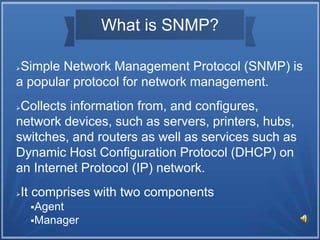
Simple Network Management Protocol (SNMP) is
a popular protocol for network management.
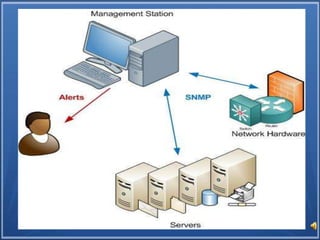
Collects information from, and configures,
network devices, such as servers, printers, hubs,
switches, and routers as well as services such as
Dynamic Host Configuration Protocol (DHCP) on
an Internet Protocol (IP) network.
It comprises with two components
Agent
Manager
What Can SNMP Do?
Provide Read/Write abilities.
Collect information on how much bandwidth is
being used.
Collect error reports into a log.
Email an alert.
Monitor your servers’ CPU and Memory use.
Page or send an SMS text-message.
Can perform active polling.
Passive SNMP.
Why SNMP?
Standardized
universally supported
extendible
portable
allows distributed management access
lightweight protocol
More on SNMP
Client Pull & Server Push.
SNMP resides at Application Layer.
Port and Firewall
UDP 161: Used when management stations
communicate with agents, e.g. Polling.
UDP 162: Used when agents send unsolicited Traps
to the management station.
Versions
V1 - Version 1 is the simplest and most basic of
the versions, and there may be times where it’s
required to support older hardware.
V2c - Version 2c adds several enhancements to
the protocol, such as support for “Informs”. Most
widely used.
V3 - SNMPv3 provides security features, such
as message integrity to verify that packet contents
have not been altered, authentication to verify that
packets came from an authorized source and
confidentiality.
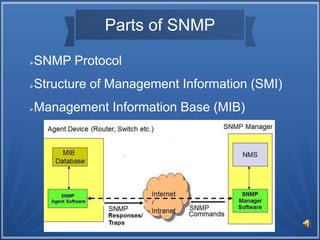
Parts of SNMP
SNMP Protocol
Structure of Management Information (SMI)
Management Information Base (MIB)
Thank you
 https://technet.microsoft.com/en-
us/library/cc776379%28v=ws.10%29.aspx
http://www.networkmanagementsoftware.co
m/snmp-tutorial-part-2-rounding-out-the-basics
http://www.moxa.com/Event/Net/2012/SNMP
_solutions/itfriendly.htm
http://www.slideshare.net/anshumanbiswal/s
nmp-15866756

Simple Network Management Protocol