- A Revolution in the Financial Sector
By – Pravin
Ghosekar
H.O.D.
Computer Department
Dhanwate National College,
The account
that travels
with you…
Wireless Banking is needed
in today's fast business
environment with unending
requirements of the customers,
the deadlines of appointments
and meetings to attend.
With mobile banking facilities,
one can bank -
 from anywhere
 at anytime and
 in any condition or anyhow.
Some customers uses, two SIM
Card in mobile phones.
One for the telephonic purpose
and
the other for banking.
As internet penetration and use
of internet in India is relatively
low
mobile phone penetration is
much higher and growing
rapidly.
There are over 200 million mobile
phone subscribers in India and the
number continues to explode.
That means every third person in
India is having mobile.
And the gap between wireless and
landline users is narrowing fast
In past two years, mobile
banking users has increased
three times.
Moveover 85-90% mobile users
do not own credit cards.
Account Information
1. Mini-statements and checking of account history
2. Alerts on account activity
3. Monitoring of term deposits
4. Access to loan statements
5. Access to card statements
6. Mutual funds / equity statements
7. Insurance policy management
8. Pension plan management
9. Status on cheque, stop payment on cheque
10.Ordering check books
11. Balance checking in the account
12.Recent transactions
13. Due date of payment
14.PIN provision, Change of PIN
15. Blocking of (lost, stolen) cards
Using Wireless Banking we can avail following services
Payments, Deposits, Withdrawals, and Transfers
1. Domestic and international fund transfers
2. Micro-payment handling
3. Mobile recharging
4. Commercial payment processing
5. Bill payment processing
6. Peer to Peer payments
7. Withdrawal at banking agent
8. Deposit at banking agent
Using Wireless Banking we can avail following services
 Handset operability :
There are a large number of different mobile phone devices and it is a big
challenge for banks to offer mobile banking solution on any type of device
 Security :
Security of financial transactions, being executed from some remote location
and transmission of financial information over the air, are the most
complicated challenges
 Scalability & Reliability
Banks unable to meet the performance and reliability expectations may lose
customer confidence.
 Application distribution
Due to the nature of the connectivity between bank and its customers, it would
be impractical to expect customers to regularly visit banks or connect to a web
site for regular upgrade of their mobile banking application.
 Personalization :
Preferred Language , Date / Time format , Amount format , Alerts
Challenges for a Wireless Banking
Mobile banking uses the same
infrastructure like the ATM
solution. But it is extremely easy
and inexpensive to implement.
It reduces the cost of operation
for bankers in comparison to the
use of ATMs.
The system is either through
SMS or
through WAP.
Wireless Application Protocol (WAP) is
an open international standard for
application-layer network
communications in a wireless-
communication environment.
Most use of WAP involves accessing the
mobile web from a mobile phone or from
a PDA.
WAP
A WAP browser provides all of the basic
services of a computer-based web
browser but simplified to operate within
the restrictions of a mobile phone, such
as its smaller view screen. Users can
connect to WAP sites: websites written
in, or dynamically converted to, WML
(Wireless Markup Language) and
accessed via the WAP browser.
WAP
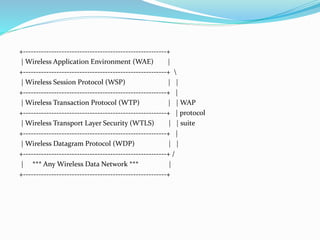
The WAP standard describes a protocol
suite that allows the interoperability of
WAP equipment and software with
many different network technologies,
thus allowing the building of a single
platform for competing network
technologies such as GSM and IS-95
(also known as CDMA) networks.
+--------------------------------------------------------+
| Wireless Application Environment (WAE) |
+--------------------------------------------------------+ 
| Wireless Session Protocol (WSP) | |
+--------------------------------------------------------+ |
| Wireless Transaction Protocol (WTP) | | WAP
+--------------------------------------------------------+ | protocol
| Wireless Transport Layer Security (WTLS) | | suite
+--------------------------------------------------------+ |
| Wireless Datagram Protocol (WDP) | |
+--------------------------------------------------------+ /
| *** Any Wireless Data Network *** |
+--------------------------------------------------------+
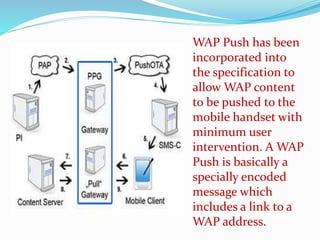
WAP Push has been
incorporated into
the specification to
allow WAP content
to be pushed to the
mobile handset with
minimum user
intervention. A WAP
Push is basically a
specially encoded
message which
includes a link to a
WAP address.
SMS banking is a technology-enabled
service offering from banks to its
customers, permitting them to operate
selected banking services over their
mobile phones using SMS messaging.
SMS banking services are operated using
both push and pull messages.
SMS banking
Push messages are those that the bank
chooses to send out to a customer's mobile
phone, without the customer initiating a
request for the information. For ex. Mobile
marketing messages or messages alerting an
event which happens in the customer's bank
account, such as a large withdrawal of funds
from the ATM or a large payment using the
customer's credit card, etc.
Push messages
 Periodic account balance reporting
 Reporting of salary and other credits to the bank account;
 Successful or un-successful execution of a standing order;
 Successful payment of a cheque issued on the account;
 Insufficient funds;
 Large value withdrawals on an account;
 Large value withdrawals on the ATM or EFTPOS on a debit
card;
 Large value payment on a credit card or out of country
activity on a credit card.
 One-time password and authentication
Typical Push Services :
Pull messages are those that are initiated by
the customer, using a mobile phone, for
obtaining information or performing a
transaction in the bank account. Examples :
account balance enquiry, or requests for
current information like currency exchange
rates and deposit interest rates, as published
and updated by the bank.
Pull messages
 Account balance enquiry;
 Mini statement request;
 Electronic bill payment;
 Transfers between customer's own accounts, like moving
money from a savings account to a current account to fund
a cheque;
 Stop payment instruction on a cheque;
 Requesting for an ATM card or credit card to be suspended;
 De-activating a credit or debit card when it is lost or the
PIN is known to be compromised;
 Foreign currency exchange rates enquiry;
 Fixed deposit interest rates enquiry.
Typical Pull Services :
 Wireless banking is revolutionizing the
financial industry. It's radically transforming
both services and customer expectations in
societies around the globe. End users are
demanding access to their money and financial
information anytime, anywhere. Financial
institutions know they need to move quickly to
capitalize on this new trend.
 Thus both wireless banking is helpful for the
customer & vendor and bank.
Conclusion
Thank
you…

Wireless Banking

  • 1.
    - A Revolutionin the Financial Sector By – Pravin Ghosekar H.O.D. Computer Department Dhanwate National College,
  • 2.
  • 3.
    Wireless Banking isneeded in today's fast business environment with unending requirements of the customers, the deadlines of appointments and meetings to attend.
  • 4.
    With mobile bankingfacilities, one can bank -  from anywhere  at anytime and  in any condition or anyhow.
  • 5.
    Some customers uses,two SIM Card in mobile phones. One for the telephonic purpose and the other for banking.
  • 6.
    As internet penetrationand use of internet in India is relatively low mobile phone penetration is much higher and growing rapidly.
  • 7.
    There are over200 million mobile phone subscribers in India and the number continues to explode. That means every third person in India is having mobile. And the gap between wireless and landline users is narrowing fast
  • 8.
    In past twoyears, mobile banking users has increased three times. Moveover 85-90% mobile users do not own credit cards.
  • 9.
    Account Information 1. Mini-statementsand checking of account history 2. Alerts on account activity 3. Monitoring of term deposits 4. Access to loan statements 5. Access to card statements 6. Mutual funds / equity statements 7. Insurance policy management 8. Pension plan management 9. Status on cheque, stop payment on cheque 10.Ordering check books 11. Balance checking in the account 12.Recent transactions 13. Due date of payment 14.PIN provision, Change of PIN 15. Blocking of (lost, stolen) cards Using Wireless Banking we can avail following services
  • 10.
    Payments, Deposits, Withdrawals,and Transfers 1. Domestic and international fund transfers 2. Micro-payment handling 3. Mobile recharging 4. Commercial payment processing 5. Bill payment processing 6. Peer to Peer payments 7. Withdrawal at banking agent 8. Deposit at banking agent Using Wireless Banking we can avail following services
  • 11.
     Handset operability: There are a large number of different mobile phone devices and it is a big challenge for banks to offer mobile banking solution on any type of device  Security : Security of financial transactions, being executed from some remote location and transmission of financial information over the air, are the most complicated challenges  Scalability & Reliability Banks unable to meet the performance and reliability expectations may lose customer confidence.  Application distribution Due to the nature of the connectivity between bank and its customers, it would be impractical to expect customers to regularly visit banks or connect to a web site for regular upgrade of their mobile banking application.  Personalization : Preferred Language , Date / Time format , Amount format , Alerts Challenges for a Wireless Banking
  • 12.
    Mobile banking usesthe same infrastructure like the ATM solution. But it is extremely easy and inexpensive to implement. It reduces the cost of operation for bankers in comparison to the use of ATMs.
  • 13.
    The system iseither through SMS or through WAP.
  • 14.
    Wireless Application Protocol(WAP) is an open international standard for application-layer network communications in a wireless- communication environment. Most use of WAP involves accessing the mobile web from a mobile phone or from a PDA. WAP
  • 15.
    A WAP browserprovides all of the basic services of a computer-based web browser but simplified to operate within the restrictions of a mobile phone, such as its smaller view screen. Users can connect to WAP sites: websites written in, or dynamically converted to, WML (Wireless Markup Language) and accessed via the WAP browser. WAP
  • 16.
    The WAP standarddescribes a protocol suite that allows the interoperability of WAP equipment and software with many different network technologies, thus allowing the building of a single platform for competing network technologies such as GSM and IS-95 (also known as CDMA) networks.
  • 17.
    +--------------------------------------------------------+ | Wireless ApplicationEnvironment (WAE) | +--------------------------------------------------------+ | Wireless Session Protocol (WSP) | | +--------------------------------------------------------+ | | Wireless Transaction Protocol (WTP) | | WAP +--------------------------------------------------------+ | protocol | Wireless Transport Layer Security (WTLS) | | suite +--------------------------------------------------------+ | | Wireless Datagram Protocol (WDP) | | +--------------------------------------------------------+ / | *** Any Wireless Data Network *** | +--------------------------------------------------------+
  • 18.
    WAP Push hasbeen incorporated into the specification to allow WAP content to be pushed to the mobile handset with minimum user intervention. A WAP Push is basically a specially encoded message which includes a link to a WAP address.
  • 19.
    SMS banking isa technology-enabled service offering from banks to its customers, permitting them to operate selected banking services over their mobile phones using SMS messaging. SMS banking services are operated using both push and pull messages. SMS banking
  • 20.
    Push messages arethose that the bank chooses to send out to a customer's mobile phone, without the customer initiating a request for the information. For ex. Mobile marketing messages or messages alerting an event which happens in the customer's bank account, such as a large withdrawal of funds from the ATM or a large payment using the customer's credit card, etc. Push messages
  • 21.
     Periodic accountbalance reporting  Reporting of salary and other credits to the bank account;  Successful or un-successful execution of a standing order;  Successful payment of a cheque issued on the account;  Insufficient funds;  Large value withdrawals on an account;  Large value withdrawals on the ATM or EFTPOS on a debit card;  Large value payment on a credit card or out of country activity on a credit card.  One-time password and authentication Typical Push Services :
  • 22.
    Pull messages arethose that are initiated by the customer, using a mobile phone, for obtaining information or performing a transaction in the bank account. Examples : account balance enquiry, or requests for current information like currency exchange rates and deposit interest rates, as published and updated by the bank. Pull messages
  • 23.
     Account balanceenquiry;  Mini statement request;  Electronic bill payment;  Transfers between customer's own accounts, like moving money from a savings account to a current account to fund a cheque;  Stop payment instruction on a cheque;  Requesting for an ATM card or credit card to be suspended;  De-activating a credit or debit card when it is lost or the PIN is known to be compromised;  Foreign currency exchange rates enquiry;  Fixed deposit interest rates enquiry. Typical Pull Services :
  • 24.
     Wireless bankingis revolutionizing the financial industry. It's radically transforming both services and customer expectations in societies around the globe. End users are demanding access to their money and financial information anytime, anywhere. Financial institutions know they need to move quickly to capitalize on this new trend.  Thus both wireless banking is helpful for the customer & vendor and bank. Conclusion
  • 25.