GURU HARKRISHAN
PUBLIC SCHOOL
NETWORKING
CONCEPTS
CLASS .
VIII
LEARNING IN THIS
MODULE:
1. Introduction of
computer network.
2. Advantages of
networking
3. Networking Media
4. Types Of Network
5. Networking Devices
6. Networking Terminology
7. Protocols
A computer network can
be defined as a group of
networks and other
peripheral devices that
are linked together for
the purpose of sharing
data and hardware
resources.
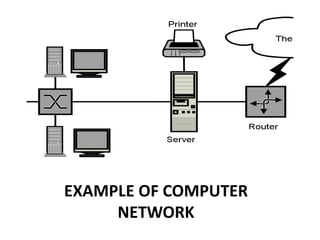
EXAMPLE OF COMPUTER
NETWORK
The computers in a network can
communicate with each other as well
as work independently. Each
computer in a network is called a
Node. One of these nodes acts as a
Sender that transmits the information
to other nodes in a network known as
Receivers.
These computers are linked with
each other through some medium
such as cables, telephone lines,
radio waves etc.
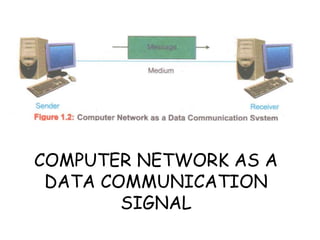
COMPUTER NETWORK AS A
DATA COMMUNICATION
SIGNAL
It consists of the following parts:
1. Message – It is the information to be
communicated.
2. Sender – Sender is a device that sends message.
3. Receiver – Receiver is a device that receives
message.
4. Transmission Medium – It is the physical path
through which the message travels from the sender to
receiver.
5. Protocol – A protocol specifies a set of rules that
governs the data communication.
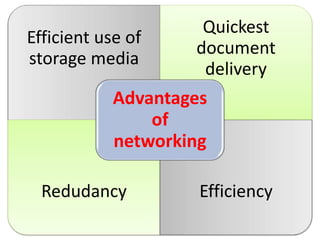
ADVANTAGES OF
NETWORKING
Efficient use of
storage media
Quickest
document
delivery
Redudancy Efficiency
Advantages
of
networking
NETWORKING MEDIA
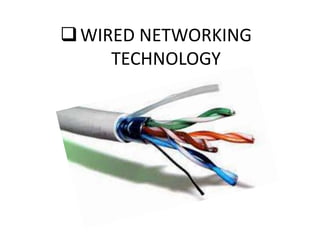
WIRED NETWORKING
TECHNOLOGY
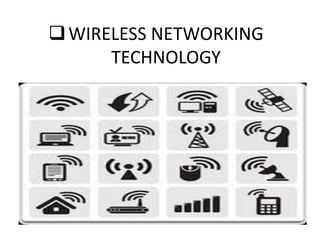
WIRELESS NETWORKING
TECHNOLOGY
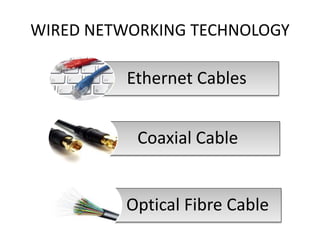
WIRED NETWORKING TECHNOLOGY
Ethernet Cables
Coaxial Cable
Optical Fibre Cable
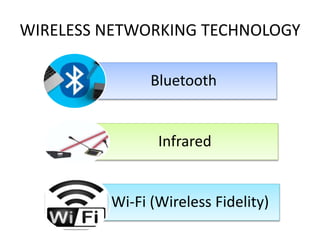
WIRELESS NETWORKING TECHNOLOGY
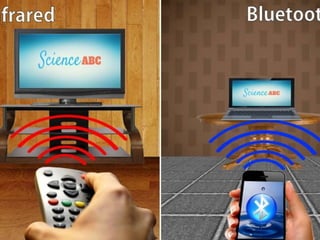
Bluetooth
Infrared
Wi-Fi (Wireless Fidelity)
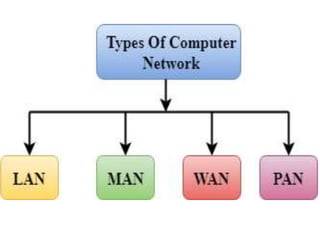
TYPES OF NETWORKS
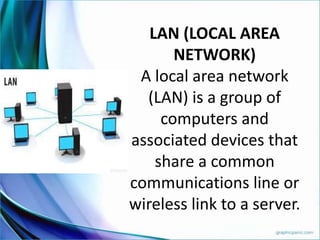
LAN (LOCAL AREA
NETWORK)
A local area network
(LAN) is a group of
computers and
associated devices that
share a common
communications line or
wireless link to a server.
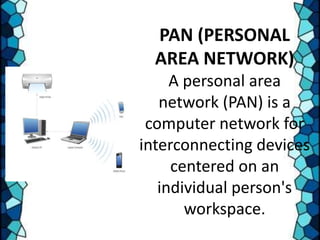
PAN (PERSONAL
AREA NETWORK)
A personal area
network (PAN) is a
computer network for
interconnecting devices
centered on an
individual person's
workspace.
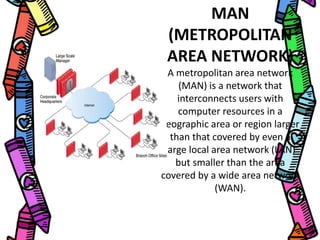
MAN
(METROPOLITAN
AREA NETWORK)
A metropolitan area network
(MAN) is a network that
interconnects users with
computer resources in a
geographic area or region larger
than that covered by even a
large local area network (LAN)
but smaller than the area
covered by a wide area network
(WAN).
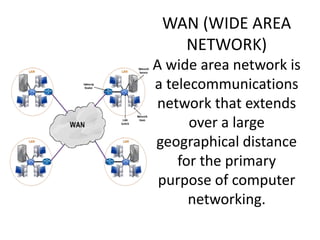
WAN (WIDE AREA
NETWORK)
A wide area network is
a telecommunications
network that extends
over a large
geographical distance
for the primary
purpose of computer
networking.
Networking devices are the
hardware devices used to
connect computers or other
electronic devices together in
order to share files or
resources like printers or fax
machine.
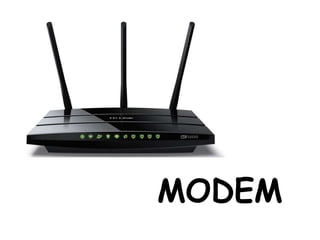
MODEM
A modem enables you to connect your
computer to the available computer
connection over the existing telephone
lines. It cpnverts the digital signals of a
computer into analog signals to enable
their transmission via phone lines.
Modems are available in two categories:
Internal Modem and External Modem.
MODEM
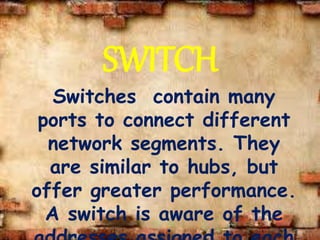
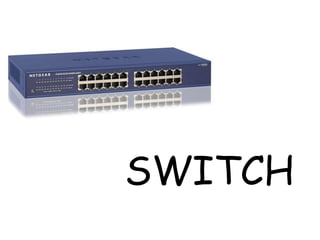
SWITCH
Switches contain many
ports to connect different
network segments. They
are similar to hubs, but
offer greater performance.
A switch is aware of the
SWITCH
cont
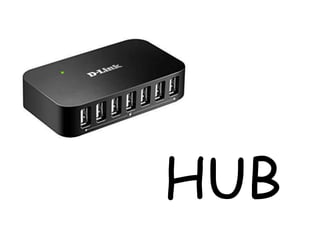
HUB
A hub is the networking device that is
used to connect multiple computers
and computing devices directly to the
network by using cables. Each
connection is called a port. A hub
sends all the data it receive to all the
connected ports.
HUB
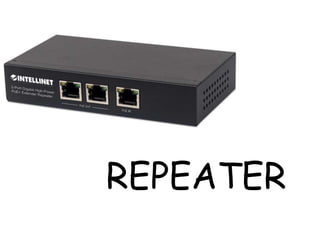
REPEATER
A repeater is a communication
device used to regenerate a signal. It
receives electronic signals, cleans
them and retransmits them.
Repeaters are needed so that the
signals can travel distances with the
same strength or even at a higher
strength.
REPEATER
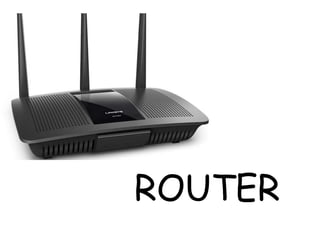
ROUTER
A router is a communication
device that is used to connect
two different networks, such as
two LANs, or a LAN and a
WAN. It plays a vital role in
controlling the traffic and
keeping the network efficient.
ROUTER
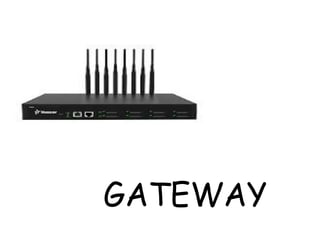
GATEWAY
A gateway is a network point that acts as an entrance to
another network using different protocols. It allows us
to cvarryout various online activities such as sending e-
mail, buying things onine etc. It is a shared connection
between LAN and WAN.
GATEWAY
NETWORKING
TERMINOLOGY
INTERNET
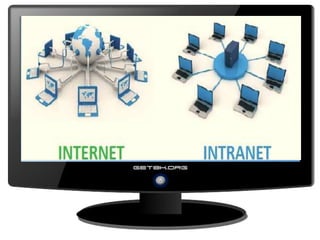
The internet is the global wide
area network that connects
computer system across the
world. It provides a variety of
information and communication
facilities.
BANDWIDTH
Bandwidth is the amount of
data that can be transmitted
in a fixed amount of time. The
bandwidth is usually expressed
in bits per second(bps) or
bytes per second or a higher
units like kilobytes(kbps) and
megabyte per second(mbps).
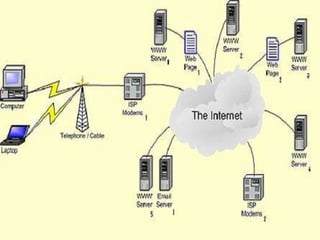
INTERNET SERVICE PROVIDER
(ISP)
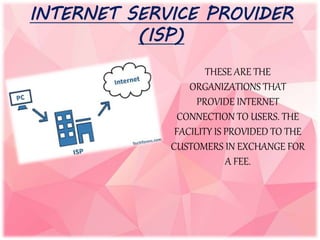
THESE ARE THE
ORGANIZATIONS THAT
PROVIDE INTERNET
CONNECTION TO USERS. THE
FACILITY IS PROVIDED TO THE
CUSTOMERS IN EXCHANGE FOR
A FEE.
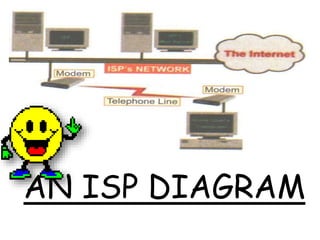
AN ISP DIAGRAM
COMMON ISP PROVIDER
IN INDIA
www.pinterest.com
www.quora.com
www.wikipedia.org
www.mycbseguide.com
www.amazon.in
Etc.
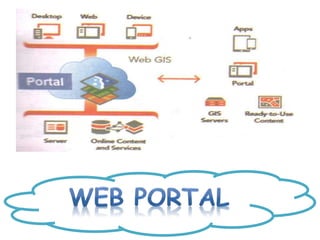
WEB PORTAL
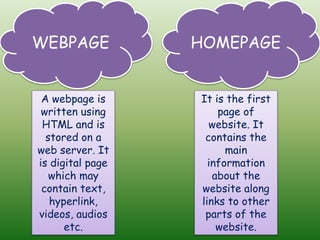
WEBPAGE HOMEPAGE
A webpage is
written using
HTML and is
stored on a
web server. It
is digital page
which may
contain text,
hyperlink,
videos, audios
etc.
It is the first
page of
website. It
contains the
main
information
about the
website along
links to other
parts of the
website.
LINK – In data communication, a link
is a line or channel that connects two
devices. Data is transmitted between
the connected devices through this
channel.
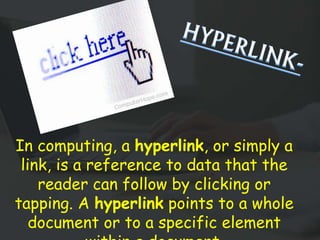
In computing, a hyperlink, or simply a
link, is a reference to data that the
reader can follow by clicking or
tapping. A hyperlink points to a whole
document or to a specific element
HYPERTEXT-
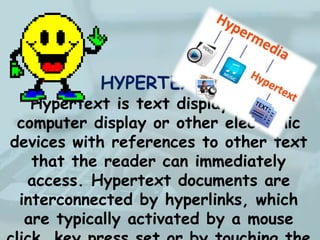
Hypertext is text displayed on a
computer display or other electronic
devices with references to other text
that the reader can immediately
access. Hypertext documents are
interconnected by hyperlinks, which
are typically activated by a mouse
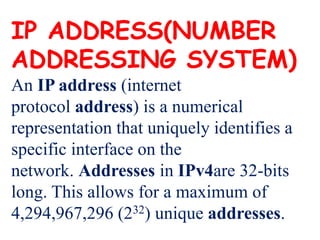
IP ADDRESS(NUMBER
ADDRESSING SYSTEM)
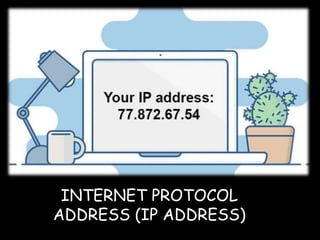
An IP address (internet
protocol address) is a numerical
representation that uniquely identifies a
specific interface on the
network. Addresses in IPv4are 32-bits
long. This allows for a maximum of
4,294,967,296 (232) unique addresses.
INTERNET PROTOCOL
ADDRESS (IP ADDRESS)
Domain name is a unique name given to
each website or resource connected to the
internet. Domain names are easier to
remember than IP address.
TCP/IP( TRANSMISSION
CONTROL/INTERNET PROTOCOL
Internet protocol is a suite of
communication protocols used to
connect various computers on the
Internet. It provides end-to-end data
communication specifying how data
should be broken into pieces called
packets, transmitted and routed from
one network to another.
HTTP or Hyper Text Transfer Control
determines how different forms of information
get transferred to your screen over the Internet.
This protocol also defines what action web
servers and browsers should take in response to
various commands.
HYPER TEXT TRANSFER
PROTOCOL
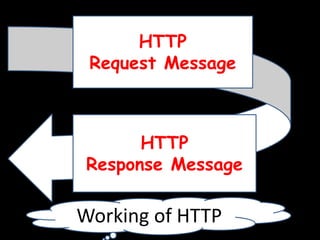
HTTP
Request Message
HTTP
Response Message
Working of HTTP
FTP or File Transfer Protocol is a
standard Internet protocol. It is
one of the simplest and easiest way
two exchange files between two or
more computers on the Internet,
using FTP client and FTP server
softwre.
THE FILE TRANSFER
PROTOCOL WAS
ORIGINALLY DESIGNED
BY ABHAY BHUSHAN AND
PUBLISHED IN 1971.
IMAP AND POP
IMAP (INTERNET MESSAGE ACCESS PROTOCOL) and POP
(POST POFFICE PROTOCOL) are the two most popular Internet
standard protocols for retrieving e-mails. SMTP is the sending
protocol and POP are the receiving protocol.
Computer network

Computer network

  • 1.
  • 2.
  • 3.
    LEARNING IN THIS MODULE: 1.Introduction of computer network. 2. Advantages of networking 3. Networking Media 4. Types Of Network 5. Networking Devices 6. Networking Terminology 7. Protocols
  • 4.
    A computer networkcan be defined as a group of networks and other peripheral devices that are linked together for the purpose of sharing data and hardware resources.
  • 5.
  • 6.
    The computers ina network can communicate with each other as well as work independently. Each computer in a network is called a Node. One of these nodes acts as a Sender that transmits the information to other nodes in a network known as Receivers.
  • 7.
    These computers arelinked with each other through some medium such as cables, telephone lines, radio waves etc.
  • 8.
    COMPUTER NETWORK ASA DATA COMMUNICATION SIGNAL
  • 9.
    It consists ofthe following parts: 1. Message – It is the information to be communicated. 2. Sender – Sender is a device that sends message. 3. Receiver – Receiver is a device that receives message. 4. Transmission Medium – It is the physical path through which the message travels from the sender to receiver. 5. Protocol – A protocol specifies a set of rules that governs the data communication.
  • 10.
  • 11.
    Efficient use of storagemedia Quickest document delivery Redudancy Efficiency Advantages of networking
  • 12.
  • 13.
  • 14.
  • 15.
    WIRED NETWORKING TECHNOLOGY EthernetCables Coaxial Cable Optical Fibre Cable
  • 16.
  • 18.
  • 20.
    LAN (LOCAL AREA NETWORK) Alocal area network (LAN) is a group of computers and associated devices that share a common communications line or wireless link to a server.
  • 21.
    PAN (PERSONAL AREA NETWORK) Apersonal area network (PAN) is a computer network for interconnecting devices centered on an individual person's workspace.
  • 22.
    MAN (METROPOLITAN AREA NETWORK) A metropolitanarea network (MAN) is a network that interconnects users with computer resources in a geographic area or region larger than that covered by even a large local area network (LAN) but smaller than the area covered by a wide area network (WAN).
  • 23.
    WAN (WIDE AREA NETWORK) Awide area network is a telecommunications network that extends over a large geographical distance for the primary purpose of computer networking.
  • 25.
    Networking devices arethe hardware devices used to connect computers or other electronic devices together in order to share files or resources like printers or fax machine.
  • 26.
    MODEM A modem enablesyou to connect your computer to the available computer connection over the existing telephone lines. It cpnverts the digital signals of a computer into analog signals to enable their transmission via phone lines. Modems are available in two categories: Internal Modem and External Modem.
  • 27.
  • 28.
    SWITCH Switches contain many portsto connect different network segments. They are similar to hubs, but offer greater performance. A switch is aware of the
  • 29.
  • 30.
    cont HUB A hub isthe networking device that is used to connect multiple computers and computing devices directly to the network by using cables. Each connection is called a port. A hub sends all the data it receive to all the connected ports.
  • 31.
  • 32.
    REPEATER A repeater isa communication device used to regenerate a signal. It receives electronic signals, cleans them and retransmits them. Repeaters are needed so that the signals can travel distances with the same strength or even at a higher strength.
  • 33.
  • 34.
    ROUTER A router isa communication device that is used to connect two different networks, such as two LANs, or a LAN and a WAN. It plays a vital role in controlling the traffic and keeping the network efficient.
  • 35.
  • 36.
    GATEWAY A gateway isa network point that acts as an entrance to another network using different protocols. It allows us to cvarryout various online activities such as sending e- mail, buying things onine etc. It is a shared connection between LAN and WAN.
  • 37.
  • 38.
  • 39.
    INTERNET The internet isthe global wide area network that connects computer system across the world. It provides a variety of information and communication facilities.
  • 42.
    BANDWIDTH Bandwidth is theamount of data that can be transmitted in a fixed amount of time. The bandwidth is usually expressed in bits per second(bps) or bytes per second or a higher units like kilobytes(kbps) and megabyte per second(mbps).
  • 43.
    INTERNET SERVICE PROVIDER (ISP) THESEARE THE ORGANIZATIONS THAT PROVIDE INTERNET CONNECTION TO USERS. THE FACILITY IS PROVIDED TO THE CUSTOMERS IN EXCHANGE FOR A FEE.
  • 44.
  • 45.
  • 47.
  • 48.
  • 50.
    WEBPAGE HOMEPAGE A webpageis written using HTML and is stored on a web server. It is digital page which may contain text, hyperlink, videos, audios etc. It is the first page of website. It contains the main information about the website along links to other parts of the website.
  • 51.
    LINK – Indata communication, a link is a line or channel that connects two devices. Data is transmitted between the connected devices through this channel.
  • 52.
    In computing, ahyperlink, or simply a link, is a reference to data that the reader can follow by clicking or tapping. A hyperlink points to a whole document or to a specific element
  • 53.
    HYPERTEXT- Hypertext is textdisplayed on a computer display or other electronic devices with references to other text that the reader can immediately access. Hypertext documents are interconnected by hyperlinks, which are typically activated by a mouse
  • 57.
    IP ADDRESS(NUMBER ADDRESSING SYSTEM) AnIP address (internet protocol address) is a numerical representation that uniquely identifies a specific interface on the network. Addresses in IPv4are 32-bits long. This allows for a maximum of 4,294,967,296 (232) unique addresses.
  • 58.
  • 59.
    Domain name isa unique name given to each website or resource connected to the internet. Domain names are easier to remember than IP address.
  • 62.
    TCP/IP( TRANSMISSION CONTROL/INTERNET PROTOCOL Internetprotocol is a suite of communication protocols used to connect various computers on the Internet. It provides end-to-end data communication specifying how data should be broken into pieces called packets, transmitted and routed from one network to another.
  • 63.
    HTTP or HyperText Transfer Control determines how different forms of information get transferred to your screen over the Internet. This protocol also defines what action web servers and browsers should take in response to various commands.
  • 64.
  • 65.
  • 66.
    FTP or FileTransfer Protocol is a standard Internet protocol. It is one of the simplest and easiest way two exchange files between two or more computers on the Internet, using FTP client and FTP server softwre.
  • 67.
    THE FILE TRANSFER PROTOCOLWAS ORIGINALLY DESIGNED BY ABHAY BHUSHAN AND PUBLISHED IN 1971.
  • 69.
    IMAP AND POP IMAP(INTERNET MESSAGE ACCESS PROTOCOL) and POP (POST POFFICE PROTOCOL) are the two most popular Internet standard protocols for retrieving e-mails. SMTP is the sending protocol and POP are the receiving protocol.