DATA COMMUNICATIONS AND
COMPUTER NETWORKS
Obaid-ur-Rehman
LEARNING OBJECTIVES
 Data Communications
 Basic elements of a communication system
 Computer Networks
 Types of computer networks
 Network Topologies
 Communication protocols and their use in computer
networks
DATA COMMUNICATION
 Communication means the exchange of information
or messages
 The process of transferring data from one location
to another is called data communication
 Data is transmitted electronically from one location
to another by using standard methods
 Computer networks are commonly used for data
communication
BASIC ELEMENTS OF A COMMUNICATION
SYSTEM
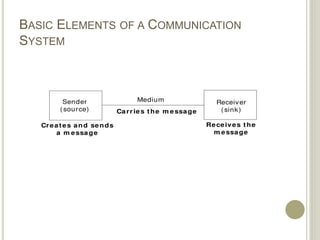
BASIC ELEMENTS OF A COMMUNICATION
SYSTEM
 Message:
 It is the information or data that is to be communicated
 It may be in any format
 Sender:
 A device that is used to send or transmit messages to
another device
 Also called transmitter or source
 A sender may be a computer, telephone handset, workstation,
video camera & mobile phone
 Medium:
 The path through which data is transmitted
 Also called communication channel
 May be a wired or wireless
BASIC ELEMENTS OF A COMMUNICATION
SYSTEM
 Receiver:
 A device that is used to receive messages from another
device
 Also called Sink
 A receiver can be of any device
 Protocol:
 A set of rules that guides data communication
 It represents an agreement between communicating
devices
 Without protocol, the devices may be connected but not
communicate with each other
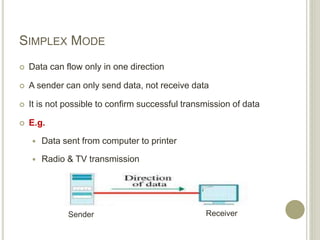
SIMPLEX MODE
 Data can flow only in one direction
 A sender can only send data, not receive data
 It is not possible to confirm successful transmission of data
 E.g.
 Data sent from computer to printer
 Radio & TV transmission
Sender Receiver
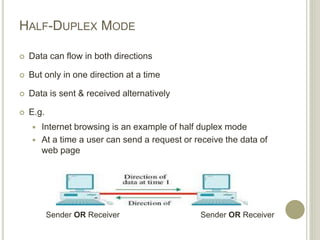
HALF-DUPLEX MODE
 Data can flow in both directions
 But only in one direction at a time
 Data is sent & received alternatively
 E.g.
 Internet browsing is an example of half duplex mode
 At a time a user can send a request or receive the data of
web page
Sender OR Receiver Sender OR Receiver
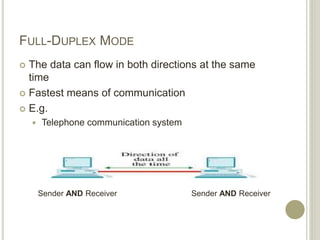
FULL-DUPLEX MODE
 The data can flow in both directions at the same
time
 Fastest means of communication
 E.g.
 Telephone communication system
Sender AND Receiver Sender AND Receiver
COMPUTER NETWORKS/TYPES
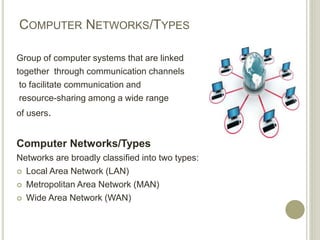
Group of computer systems that are linked
together through communication channels
to facilitate communication and
resource-sharing among a wide range
of users.
Computer Networks/Types
Networks are broadly classified into two types:
 Local Area Network (LAN)
 Metropolitan Area Network (MAN)
 Wide Area Network (WAN)
LOCAL AREA NETWORK (LAN)
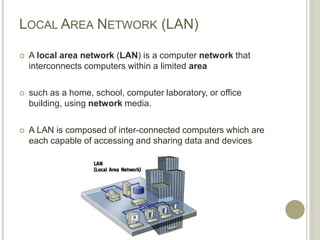
 A local area network (LAN) is a computer network that
interconnects computers within a limited area
 such as a home, school, computer laboratory, or office
building, using network media.
 A LAN is composed of inter-connected computers which are
each capable of accessing and sharing data and devices
METROPOLITAN AREA NETWORK (MAN)
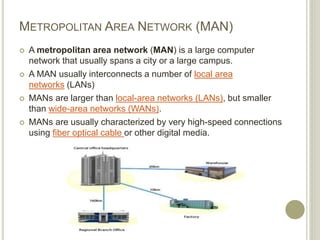
 A metropolitan area network (MAN) is a large computer
network that usually spans a city or a large campus.
 A MAN usually interconnects a number of local area
networks (LANs)
 MANs are larger than local-area networks (LANs), but smaller
than wide-area networks (WANs).
 MANs are usually characterized by very high-speed connections
using fiber optical cable or other digital media.
WIDE AREA NETWORK (WAN)
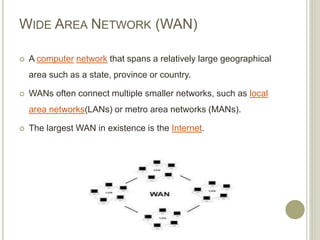
 A computer network that spans a relatively large geographical
area such as a state, province or country.
 WANs often connect multiple smaller networks, such as local
area networks(LANs) or metro area networks (MANs).
 The largest WAN in existence is the Internet.
NETWORK TOPOLOGIES/TYPES
 Term network topology refers to the way in which
the nodes of a network are linked together
 The three topologies that are commonly used
 Bus Topology
 Ring topology
 Star topology
BUS TOPOLOGY
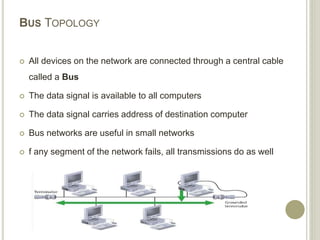
 All devices on the network are connected through a central cable
called a Bus
 The data signal is available to all computers
 The data signal carries address of destination computer
 Bus networks are useful in small networks
 f any segment of the network fails, all transmissions do as well
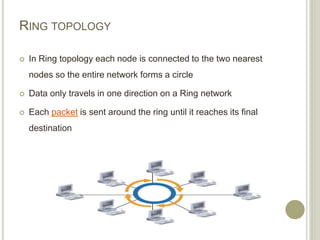
RING TOPOLOGY
 In Ring topology each node is connected to the two nearest
nodes so the entire network forms a circle
 Data only travels in one direction on a Ring network
 Each packet is sent around the ring until it reaches its final
destination
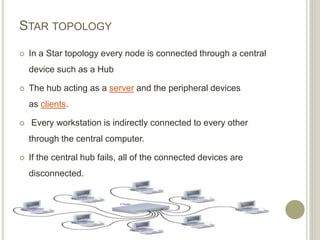
STAR TOPOLOGY
 In a Star topology every node is connected through a central
device such as a Hub
 The hub acting as a server and the peripheral devices
as clients.
 Every workstation is indirectly connected to every other
through the central computer.
 If the central hub fails, all of the connected devices are
disconnected.
DATA COMMUNICATION PROTOCOL
 The rules to send or receive data is called protocol
 These rules are defined in the network server
 A protocol defines:
 Which is communicated?
 How it is communicated?
 When it is communicated?
1. ETHERNET
 Most popular & commonly used LAN protocol
 Mostly used in bus & star topology
 It uses cable to transmit data
 Easy to install and maintain
 If the network does not follow the set of rules, the data may loss
 Fast Ethernet is 10 times faster than original Ethernet
 Gigabit Ethernet is 10 times faster than Fast Ethernet
TOKEN RING
 Another widely used LAN protocol
 It uses ring topology
 A computer in the network must get a token to transfer data
 Only one token is available on the network
 Only one device is able to access the network at a time
 No collision can occur
 It has slow data transfer rate
TCP/IP
 Transmission Control protocol/ Internet protocol is used to
access the internet
 Every computer to access the internet must be installed
TCP/IP
 Provides connectivity between browsers & server
 Defines a mechanism through which every computer on the
internet is identified separately
 Data is transmit in the form of packets
WIRELESS APPLICATION PROTOCOL
 WAP is used by mobile users to access the internet & email
services
 In WAP, client server architecture is used
 Mobile devices that support WAP are called WAP enabled
devices

Data communications and computer networks

  • 1.
    DATA COMMUNICATIONS AND COMPUTERNETWORKS Obaid-ur-Rehman
  • 2.
    LEARNING OBJECTIVES  DataCommunications  Basic elements of a communication system  Computer Networks  Types of computer networks  Network Topologies  Communication protocols and their use in computer networks
  • 3.
    DATA COMMUNICATION  Communicationmeans the exchange of information or messages  The process of transferring data from one location to another is called data communication  Data is transmitted electronically from one location to another by using standard methods  Computer networks are commonly used for data communication
  • 4.
    BASIC ELEMENTS OFA COMMUNICATION SYSTEM
  • 5.
    BASIC ELEMENTS OFA COMMUNICATION SYSTEM  Message:  It is the information or data that is to be communicated  It may be in any format  Sender:  A device that is used to send or transmit messages to another device  Also called transmitter or source  A sender may be a computer, telephone handset, workstation, video camera & mobile phone  Medium:  The path through which data is transmitted  Also called communication channel  May be a wired or wireless
  • 6.
    BASIC ELEMENTS OFA COMMUNICATION SYSTEM  Receiver:  A device that is used to receive messages from another device  Also called Sink  A receiver can be of any device  Protocol:  A set of rules that guides data communication  It represents an agreement between communicating devices  Without protocol, the devices may be connected but not communicate with each other
  • 7.
    SIMPLEX MODE  Datacan flow only in one direction  A sender can only send data, not receive data  It is not possible to confirm successful transmission of data  E.g.  Data sent from computer to printer  Radio & TV transmission Sender Receiver
  • 8.
    HALF-DUPLEX MODE  Datacan flow in both directions  But only in one direction at a time  Data is sent & received alternatively  E.g.  Internet browsing is an example of half duplex mode  At a time a user can send a request or receive the data of web page Sender OR Receiver Sender OR Receiver
  • 9.
    FULL-DUPLEX MODE  Thedata can flow in both directions at the same time  Fastest means of communication  E.g.  Telephone communication system Sender AND Receiver Sender AND Receiver
  • 10.
    COMPUTER NETWORKS/TYPES Group ofcomputer systems that are linked together through communication channels to facilitate communication and resource-sharing among a wide range of users. Computer Networks/Types Networks are broadly classified into two types:  Local Area Network (LAN)  Metropolitan Area Network (MAN)  Wide Area Network (WAN)
  • 11.
    LOCAL AREA NETWORK(LAN)  A local area network (LAN) is a computer network that interconnects computers within a limited area  such as a home, school, computer laboratory, or office building, using network media.  A LAN is composed of inter-connected computers which are each capable of accessing and sharing data and devices
  • 12.
    METROPOLITAN AREA NETWORK(MAN)  A metropolitan area network (MAN) is a large computer network that usually spans a city or a large campus.  A MAN usually interconnects a number of local area networks (LANs)  MANs are larger than local-area networks (LANs), but smaller than wide-area networks (WANs).  MANs are usually characterized by very high-speed connections using fiber optical cable or other digital media.
  • 13.
    WIDE AREA NETWORK(WAN)  A computer network that spans a relatively large geographical area such as a state, province or country.  WANs often connect multiple smaller networks, such as local area networks(LANs) or metro area networks (MANs).  The largest WAN in existence is the Internet.
  • 14.
    NETWORK TOPOLOGIES/TYPES  Termnetwork topology refers to the way in which the nodes of a network are linked together  The three topologies that are commonly used  Bus Topology  Ring topology  Star topology
  • 15.
    BUS TOPOLOGY  Alldevices on the network are connected through a central cable called a Bus  The data signal is available to all computers  The data signal carries address of destination computer  Bus networks are useful in small networks  f any segment of the network fails, all transmissions do as well
  • 16.
    RING TOPOLOGY  InRing topology each node is connected to the two nearest nodes so the entire network forms a circle  Data only travels in one direction on a Ring network  Each packet is sent around the ring until it reaches its final destination
  • 17.
    STAR TOPOLOGY  Ina Star topology every node is connected through a central device such as a Hub  The hub acting as a server and the peripheral devices as clients.  Every workstation is indirectly connected to every other through the central computer.  If the central hub fails, all of the connected devices are disconnected.
  • 18.
    DATA COMMUNICATION PROTOCOL The rules to send or receive data is called protocol  These rules are defined in the network server  A protocol defines:  Which is communicated?  How it is communicated?  When it is communicated?
  • 19.
    1. ETHERNET  Mostpopular & commonly used LAN protocol  Mostly used in bus & star topology  It uses cable to transmit data  Easy to install and maintain  If the network does not follow the set of rules, the data may loss  Fast Ethernet is 10 times faster than original Ethernet  Gigabit Ethernet is 10 times faster than Fast Ethernet
  • 20.
    TOKEN RING  Anotherwidely used LAN protocol  It uses ring topology  A computer in the network must get a token to transfer data  Only one token is available on the network  Only one device is able to access the network at a time  No collision can occur  It has slow data transfer rate
  • 21.
    TCP/IP  Transmission Controlprotocol/ Internet protocol is used to access the internet  Every computer to access the internet must be installed TCP/IP  Provides connectivity between browsers & server  Defines a mechanism through which every computer on the internet is identified separately  Data is transmit in the form of packets
  • 22.
    WIRELESS APPLICATION PROTOCOL WAP is used by mobile users to access the internet & email services  In WAP, client server architecture is used  Mobile devices that support WAP are called WAP enabled devices