Network
Virtualization
Mustufa Sir
Index
1. VIRTUAL LANS
2. OPENFLOW VLAN SUPPORT
3. VIRTUAL PRIVATE NETWORKS
4. NETWORK VIRTUALIZATION
5. OPENDAYLIGHT’S VIRTUAL TENANT NETWORK
6. SOFTWARE-DEFINED INFRASTRUCTURE
Mustufa Sir
Mustufa Sir
Mustufa Sir
1. VIRTUAL LANS
Mustufa Sir
Virtual Local Area Network
(VLAN)
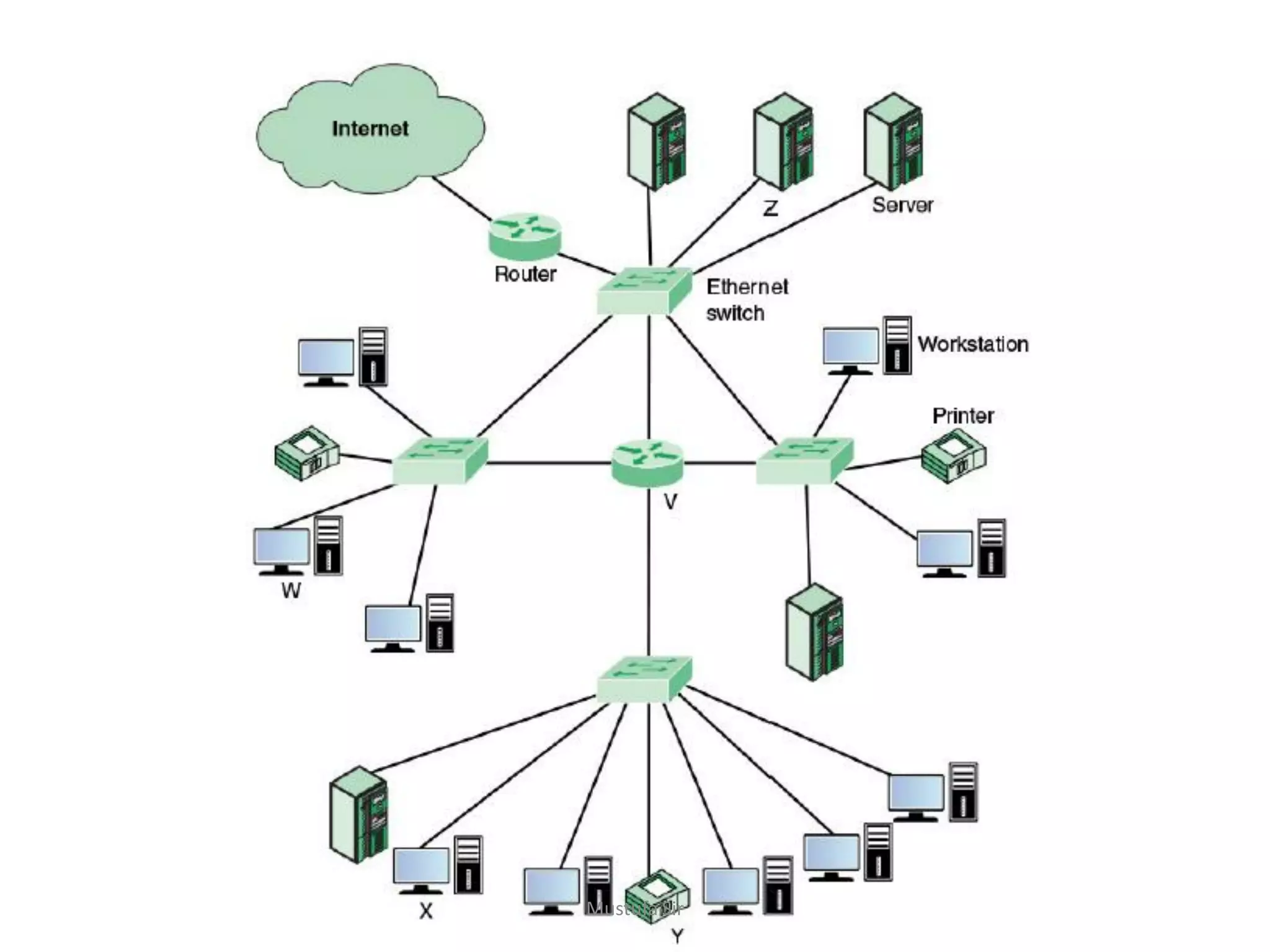
• A virtual network abstraction
on top of a physical packet-
switched network.
• A VLAN is essentially a
broadcast domain for a
specified set of switches.
• These switches are required
to be aware of the existence
of VLANs and configured
accordingly, to perform
switching of packets between
devices belonging to the
same VLAN.
Mustufa Sir
Defining VLANs
1. Membership by port group
2. Membership by MAC address
3. Membership based on protocol
Mustufa Sir
IEEE 802.1Q VLAN Standard
• VLAN is an administratively configured broadcast
domain, consisting of a subset of end stations
attached to a LAN.
• A VLAN is not limited to one switch but can span
multiple interconnected switches.
• In that case, traffic between switches must
indicate VLAN membership.
• This is accomplished in 802.1Q by inserting a tag
with a VLAN identifier (VID) with a value in the
range from 1 to 4094. Each VLAN in a LAN
configuration is assigned a globally unique VID.
Mustufa Sir
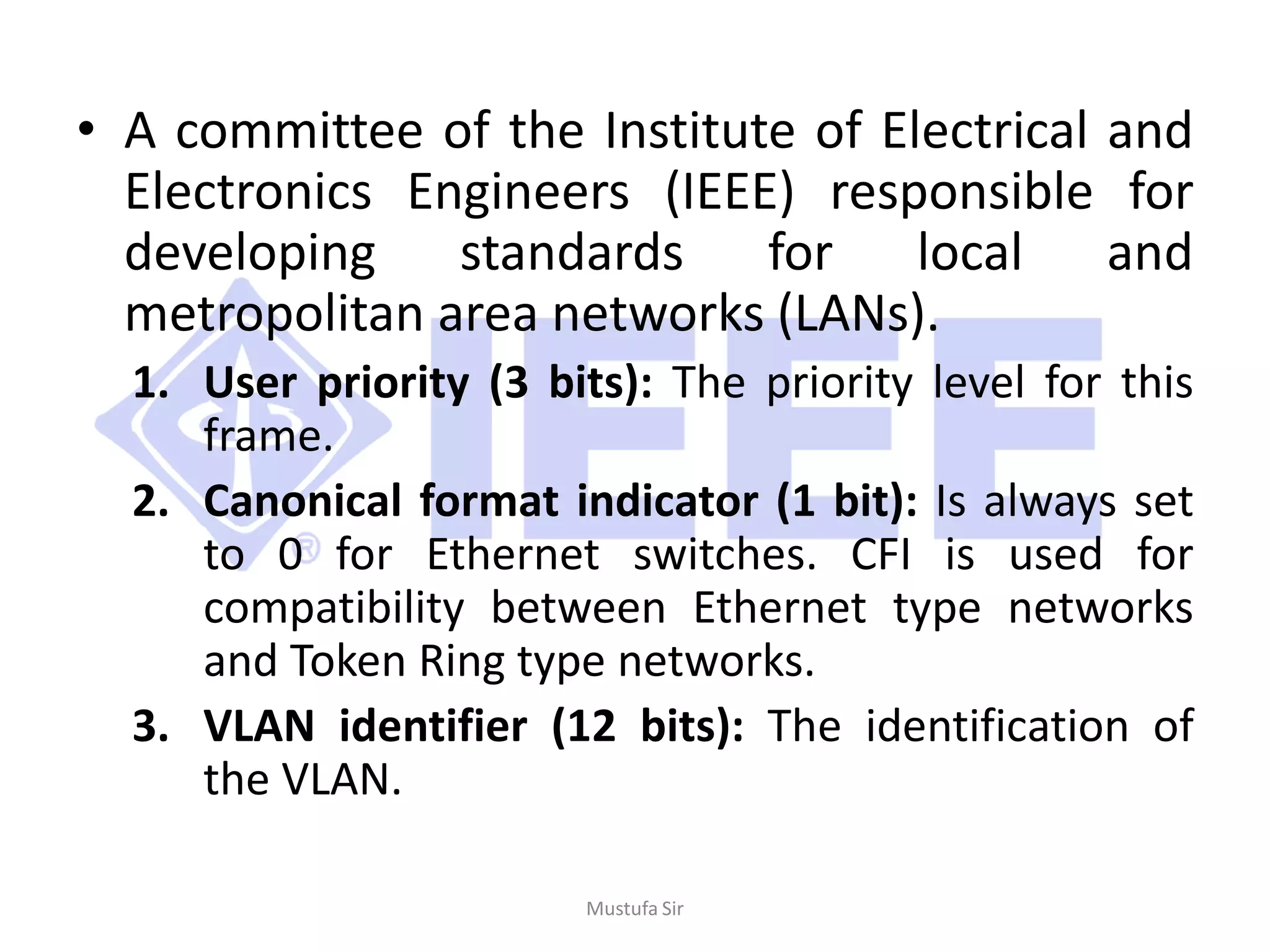
• A committee of the Institute of Electrical and
Electronics Engineers (IEEE) responsible for
developing standards for local and
metropolitan area networks (LANs).
1. User priority (3 bits): The priority level for this
frame.
2. Canonical format indicator (1 bit): Is always set
to 0 for Ethernet switches. CFI is used for
compatibility between Ethernet type networks
and Token Ring type networks.
3. VLAN identifier (12 bits): The identification of
the VLAN.
Mustufa Sir
2. OPENFLOW VLAN SUPPORT
• OpenFlow, allows for much more flexible
management and control of VLANs.
• It should be clear how OpenFlow can set up
flow table entries for forwarding based on one
or both VLAN tags.
Mustufa Sir
3. VIRTUAL PRIVATE NETWORKS
• A VPN is a private network that is configured
within a public network (a carrier’s network or
the Internet) to take advantage of the
economies of scale and management facilities
of large networks.
Mustufa Sir
• IP security (IPsec)
– The principal feature of IPsec that enables it to
support these varied applications is that it can
encrypt/authenticate traffic at the IP level.
– Therefore, all distributed applications, including
remote logon, client/server, e-mail, file transfer,
web access, and so on, can be secured.
Mustufa Sir
Mustufa Sir
Mustufa Sir
• Using IPsec to construct a
VPN has the following
benefits:
1. When IPsec is implemented
in a firewall or router, it
provides strong security that
can be applied to all traffic
crossing the perimeter.
2. IPsec in a firewall is resistant
to bypass if all traffic from
the outside must use IP and
the firewall is the only
means of entrance.
3. IPsec is below the transport
layer (TCP, UDP) and so is
transparent to applications.
Mustufa Sir
• MPLS
– Multiprotocol Label Switching (MPLS) is a set of (IETF)
specifications for including routing and traffic
engineering information in packets.
– MPLS comprises a number of interrelated protocols.
– It can be used in IP networks but also in other types of
packet-switching networks.
– MPLS is used to ensure that all packets in a particular
flow take the same route over a backbone.
Mustufa Sir
• In an MPLS network, a fixed-length label
encapsulates an IP packet or a data link frame.
• The MPLS label contains all the information
needed by an MPLS-enabled router to
perform routing, delivery, QoS, and traffic
management functions.
• An MPLS network or internet consists of a set
of nodes, called label switching routers (LSRs)
capable of switching and routing packets on
the basis of a label appended to each packet.
Mustufa Sir
• Labels define a flow of packets between two
endpoints or, in the case of multicast,
between a source endpoint and a multicast
group of destination endpoints.
• For each distinct flow, called a forwarding
equivalence class (FEC), a specific path
through the network of LSRs is defined, called
a label switched path (LSP).
Mustufa Sir
Key VPN terms
1. Attachment circuit (AC)
2. Customer edge (CE)
3. Layer 2 VPN (L2VPN)
4. Layer 3 VPN (L3VPN)
5. Packet switched network (PSN)
6. Provider edge (PE)
7. Tunnel
8. Tunnel multiplexer
9. Virtual channel (VC)
Mustufa Sir
Layer 2 MPLS VPN
Mustufa Sir
Layer 3 MPLS VPN
• Whereas L2VPNs are constructed based on link-
level addresses (for example, MAC addresses),
L3VPNs are based on VPN routes between CEs
based on IP addresses.
• An MPLS-based L3VPN typically uses a stack of
two labels. The inner label identifies a specific
VPN instance; the outer label identifies a tunnel
or route through the MPLS provider network.
Mustufa Sir
4. NETWORK VIRTUALIZATION
1. Physical resource
2. Logical resource
3. Virtual resource
4. Virtual network
5. Network virtualization (NV)
Mustufa Sir
Mustufa Sir
Mustufa Sir
Mustufa Sir
Mustufa Sir
Benefits of Network Virtualization
Mustufa Sir
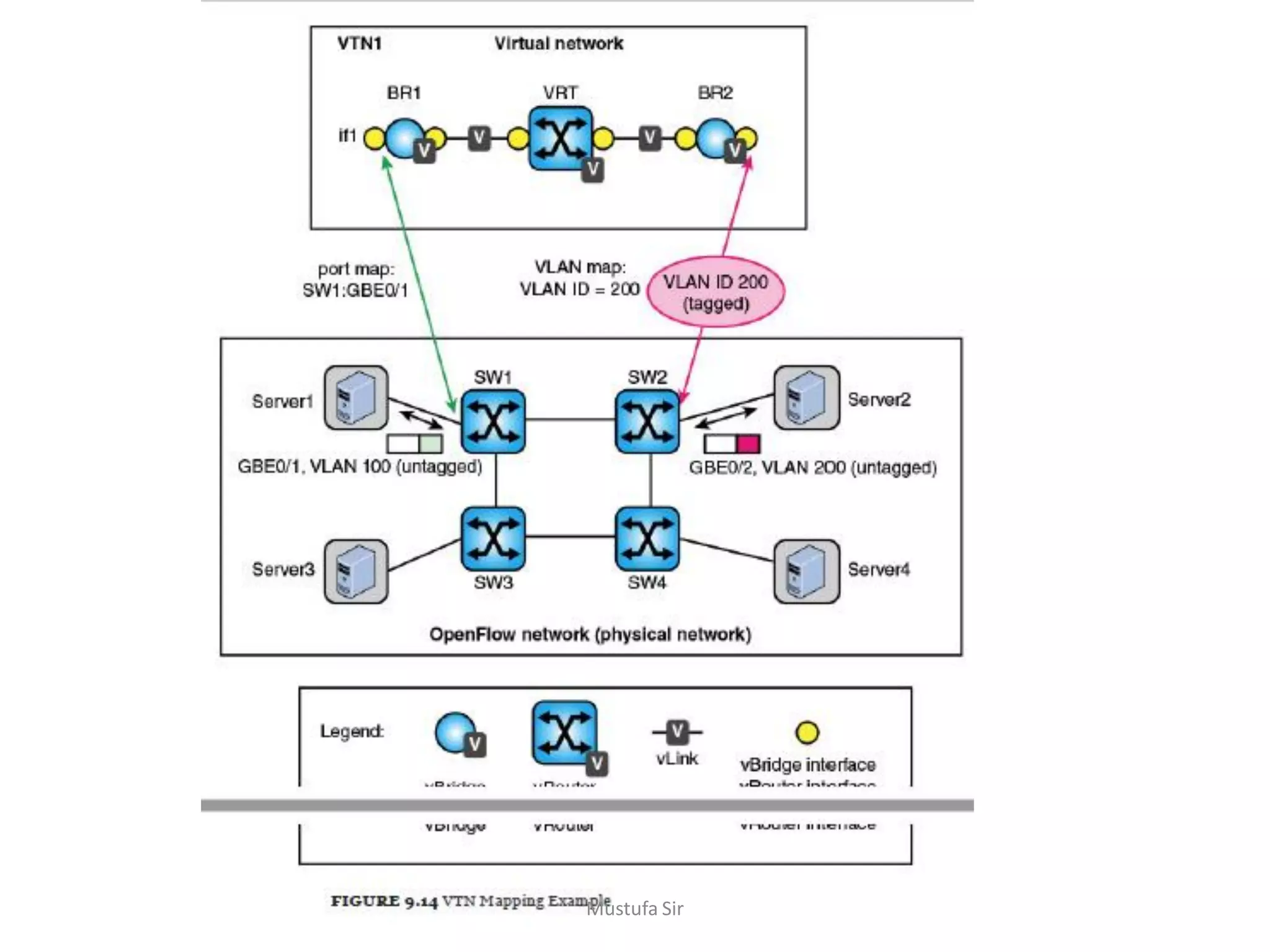
5. OPENDAYLIGHT’S VIRTUAL TENANT
NETWORK
• Virtual Tenant Network (VTN) is an
OpenDaylight (ODL) plug-in developed by NEC.
• It provides multitenant virtual networks on an
SDN, using VLAN technology.
• The VTN abstraction functionality enables
users to design and deploy a virtual network
without knowing the physical network
topology or bandwidth restrictions.
Mustufa Sir
• VTN consists of two components
– VTN Manager
– VTN Coordinator
Mustufa Sir
Mustufa Sir
6. SOFTWARE-DEFINED INFRASTRUCTURE
Mustufa Sir
Reference
Foundations of Modern Networking: SDN,
NFV, QoE, IoT, and Cloud
by William Stallings
Mustufa Sir
Thank you
Mustufa Sir

Network Virtualization

  • 1.
  • 2.
    Index 1. VIRTUAL LANS 2.OPENFLOW VLAN SUPPORT 3. VIRTUAL PRIVATE NETWORKS 4. NETWORK VIRTUALIZATION 5. OPENDAYLIGHT’S VIRTUAL TENANT NETWORK 6. SOFTWARE-DEFINED INFRASTRUCTURE Mustufa Sir
  • 3.
  • 4.
  • 5.
  • 6.
    Virtual Local AreaNetwork (VLAN) • A virtual network abstraction on top of a physical packet- switched network. • A VLAN is essentially a broadcast domain for a specified set of switches. • These switches are required to be aware of the existence of VLANs and configured accordingly, to perform switching of packets between devices belonging to the same VLAN. Mustufa Sir
  • 7.
    Defining VLANs 1. Membershipby port group 2. Membership by MAC address 3. Membership based on protocol Mustufa Sir
  • 8.
    IEEE 802.1Q VLANStandard • VLAN is an administratively configured broadcast domain, consisting of a subset of end stations attached to a LAN. • A VLAN is not limited to one switch but can span multiple interconnected switches. • In that case, traffic between switches must indicate VLAN membership. • This is accomplished in 802.1Q by inserting a tag with a VLAN identifier (VID) with a value in the range from 1 to 4094. Each VLAN in a LAN configuration is assigned a globally unique VID. Mustufa Sir
  • 9.
    • A committeeof the Institute of Electrical and Electronics Engineers (IEEE) responsible for developing standards for local and metropolitan area networks (LANs). 1. User priority (3 bits): The priority level for this frame. 2. Canonical format indicator (1 bit): Is always set to 0 for Ethernet switches. CFI is used for compatibility between Ethernet type networks and Token Ring type networks. 3. VLAN identifier (12 bits): The identification of the VLAN. Mustufa Sir
  • 10.
    2. OPENFLOW VLANSUPPORT • OpenFlow, allows for much more flexible management and control of VLANs. • It should be clear how OpenFlow can set up flow table entries for forwarding based on one or both VLAN tags. Mustufa Sir
  • 11.
    3. VIRTUAL PRIVATENETWORKS • A VPN is a private network that is configured within a public network (a carrier’s network or the Internet) to take advantage of the economies of scale and management facilities of large networks. Mustufa Sir
  • 12.
    • IP security(IPsec) – The principal feature of IPsec that enables it to support these varied applications is that it can encrypt/authenticate traffic at the IP level. – Therefore, all distributed applications, including remote logon, client/server, e-mail, file transfer, web access, and so on, can be secured. Mustufa Sir
  • 13.
  • 14.
  • 15.
    • Using IPsecto construct a VPN has the following benefits: 1. When IPsec is implemented in a firewall or router, it provides strong security that can be applied to all traffic crossing the perimeter. 2. IPsec in a firewall is resistant to bypass if all traffic from the outside must use IP and the firewall is the only means of entrance. 3. IPsec is below the transport layer (TCP, UDP) and so is transparent to applications. Mustufa Sir
  • 16.
    • MPLS – MultiprotocolLabel Switching (MPLS) is a set of (IETF) specifications for including routing and traffic engineering information in packets. – MPLS comprises a number of interrelated protocols. – It can be used in IP networks but also in other types of packet-switching networks. – MPLS is used to ensure that all packets in a particular flow take the same route over a backbone. Mustufa Sir
  • 17.
    • In anMPLS network, a fixed-length label encapsulates an IP packet or a data link frame. • The MPLS label contains all the information needed by an MPLS-enabled router to perform routing, delivery, QoS, and traffic management functions. • An MPLS network or internet consists of a set of nodes, called label switching routers (LSRs) capable of switching and routing packets on the basis of a label appended to each packet. Mustufa Sir
  • 18.
    • Labels definea flow of packets between two endpoints or, in the case of multicast, between a source endpoint and a multicast group of destination endpoints. • For each distinct flow, called a forwarding equivalence class (FEC), a specific path through the network of LSRs is defined, called a label switched path (LSP). Mustufa Sir
  • 19.
    Key VPN terms 1.Attachment circuit (AC) 2. Customer edge (CE) 3. Layer 2 VPN (L2VPN) 4. Layer 3 VPN (L3VPN) 5. Packet switched network (PSN) 6. Provider edge (PE) 7. Tunnel 8. Tunnel multiplexer 9. Virtual channel (VC) Mustufa Sir
  • 20.
    Layer 2 MPLSVPN Mustufa Sir
  • 21.
    Layer 3 MPLSVPN • Whereas L2VPNs are constructed based on link- level addresses (for example, MAC addresses), L3VPNs are based on VPN routes between CEs based on IP addresses. • An MPLS-based L3VPN typically uses a stack of two labels. The inner label identifies a specific VPN instance; the outer label identifies a tunnel or route through the MPLS provider network. Mustufa Sir
  • 22.
    4. NETWORK VIRTUALIZATION 1.Physical resource 2. Logical resource 3. Virtual resource 4. Virtual network 5. Network virtualization (NV) Mustufa Sir
  • 23.
  • 24.
  • 25.
  • 26.
  • 27.
    Benefits of NetworkVirtualization Mustufa Sir
  • 28.
    5. OPENDAYLIGHT’S VIRTUALTENANT NETWORK • Virtual Tenant Network (VTN) is an OpenDaylight (ODL) plug-in developed by NEC. • It provides multitenant virtual networks on an SDN, using VLAN technology. • The VTN abstraction functionality enables users to design and deploy a virtual network without knowing the physical network topology or bandwidth restrictions. Mustufa Sir
  • 29.
    • VTN consistsof two components – VTN Manager – VTN Coordinator Mustufa Sir
  • 30.
  • 31.
  • 32.
    Reference Foundations of ModernNetworking: SDN, NFV, QoE, IoT, and Cloud by William Stallings Mustufa Sir
  • 33.