Computer Networking
Topics covered:
• WHAT IS COMPUTER NETWORK?
• WHAT DO COMPUTER NETWORKS DO?
• COMPONENTS OF COMPUTER NETWORKS.
• ADVANTAGES OF COMPUTER NETWORKS.
• NETWORK TERMINOLOGIES
• DEVICES REQUIRED FOR A NETWORK
• TYPES OF COMPUTER NETWORKS.
• NETWORK TOPOLOGY.
• NETWORKING ARCHITECTURE.
• PROTOCOL IN NETWORKING.
• WIRELESS NETWORKS.
What is Computer Network?
Computer networks are the basis of communication in IT. They
are used in a huge variety of ways and can include many
different types of network.
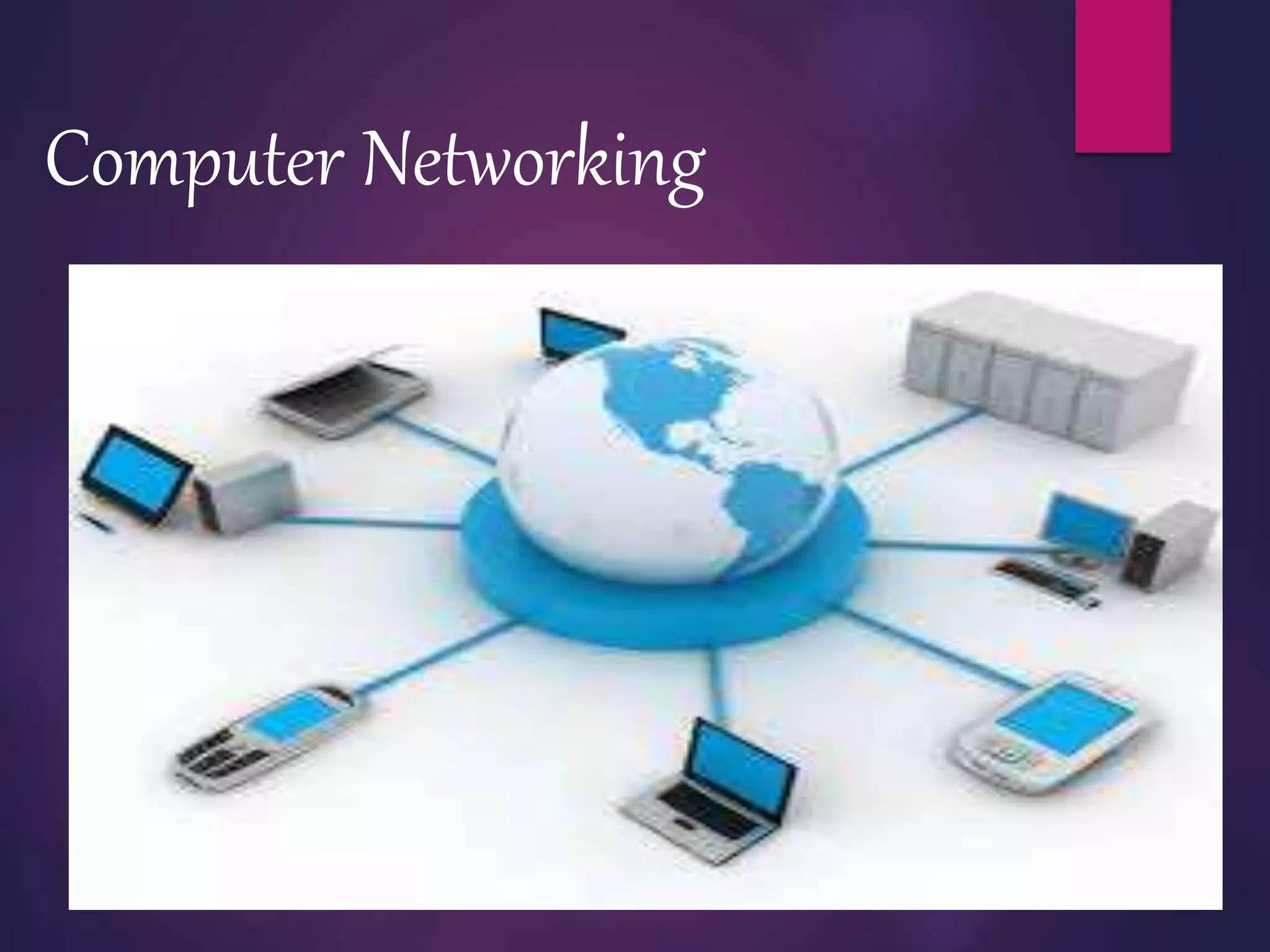
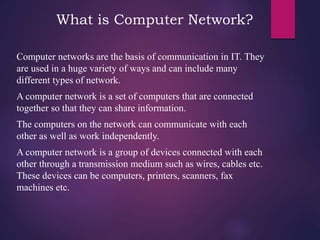
A computer network is a set of computers that are connected
together so that they can share information.
The computers on the network can communicate with each
other as well as work independently.
A computer network is a group of devices connected with each
other through a transmission medium such as wires, cables etc.
These devices can be computers, printers, scanners, fax
machines etc.
What do Computer Networks do?
• Computer networks are used to carry out a large
number of tasks through the sharing of
information.
• We can communicate using email, video, instant
messaging and other methods through computer
networks.
• We can share devices such as printers, scanners
and photocopiers.
• We can share different files.
• It helps us share software and operating programs
on remote systems.
• It allows network users to easily access and
maintain information.
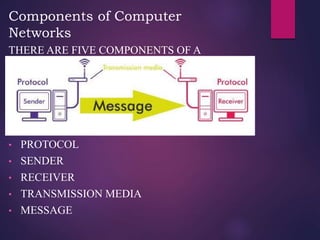
Components of Computer
Networks
THERE ARE FIVE COMPONENTS OF A
COMPUTER NETWORK:
• PROTOCOL
• SENDER
• RECEIVER
• TRANSMISSION MEDIA
• MESSAGE
Advantages of Computer Networks
• Computer networks help us with information security.
• It reduces the hardware cost.
• Installation cost is reduced.
• Computer networks make it easy to share information.
• Computer networks can transfer huge file sizes in
seconds.
• Computer networks can share a single internet
connection.
• Anybody can use a computer to create networking
experiences.
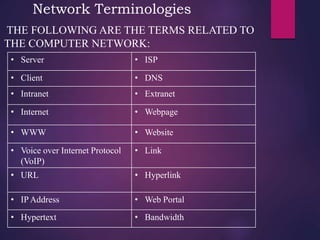
Network Terminologies
THE FOLLOWING ARE THE TERMS RELATED TO
THE COMPUTER NETWORK:
• Server • ISP
• Client • DNS
• Intranet • Extranet
• Internet • Webpage
• WWW • Website
• Voice over Internet Protocol
(VoIP)
• Link
• URL • Hyperlink
• IP Address • Web Portal
• Hypertext • Bandwidth
Devices required for a Network
A computer network is build up from several
devices. This together makes it possible to transfer
data from one device to another and makes smooth
communication between two different devices.
The following are the main devices that are
required to build a network.
• ROUTER
• HUB
• SWITCH
• GATEWAY
• NIC
• MODEM
• NETWORKING CABLES
Router
 A router is a device that connects two or more IP
networks or subnetworks.
 It serves two primary functions: managing traffic
between these networks by forwarding data
packets to their intended ip addresses, and
allowing
 Multiple devices to use the same Internet
connection.
Hub
 A hub is the connection point in a
computer device where data from many
directions converge and are then sent out in
many directions to respective devices. A
hub may also act as a switch by preventing
specific data packets from proceeding to a
destination.
Switch
A switch is a device in a
computer network that connects
other devices together. Multiple
data cables are plugged into a
switch to enable communication
between different networked
devices.
Gateway
 A gateway is a network node used in
telecommunications that connects
two networks with different
transmission protocols together.
Gateways serve as an entry and exit
point for a network as all data must
pass through or communicate with
the gateway prior to being routed.
NIC
 Network interface card (NIC) is
a hardware component that is present
on the computer. It is used to connect
different networking devices such as
computers and servers to share data
over the connected network.
Modem
 A modulator-demodulator or modem is
a compurer hardware device that converts
data from a digital format into a format
suitable for an analog transmission
medium such as telephone or radio.
Networking Cables
 Networking cables are networking hardware used
to connect two or more computers
 They are also known as Ethernet cable.
 Types of cables are
 Twisted pair
 Coaxial cable
 Fiber optics cable
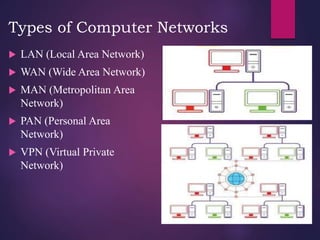
Types of Computer Networks
 LAN (Local Area Network)
 WAN (Wide Area Network)
 MAN (Metropolitan Area
Network)
 PAN (Personal Area
Network)
 VPN (Virtual Private
Network)
LAN
A local area network (LAN) is a data
communication network connecting
various terminals or computers within a
building or limited geographical area.
The connection among the devices
could be wired or wireless.
WAN
A wide area network (WAN) is a computer
network that covers a large geographical area
comprising a region, a country, a continent or
even the whole world.
MAN
A metropolitan area network (MAN) is a
computer network that connects computers
within a metropolitan area, which could be
a single large city, multiple cities and
towns, or any given large area with
multiple buildings. A MAN is larger than a
local area network (LAN) but smaller than
a wide area network (WAN).
PAN
A personal area network (PAN) is a
computer network for interconnecting
electronic devices within an
individual person's workspace.
VPN
VPN stands for "virtual private network"
and describes the opportunity to establish a
protected network connection when using
public networks. Vpns encrypt your
internet traffic and disguise your online
identity. This makes it more difficult for
third parties to track your activities online
and steal data.
Network Topology
The arrangement or connection patterns of computers or
nodes or devices used in the network is known as
network topology. There are six types of common
network topology.
• Bus Topology • Star Topology
• Mesh Topology
• Hybrid Topology
• Ring Topology
• Hybrid Topology
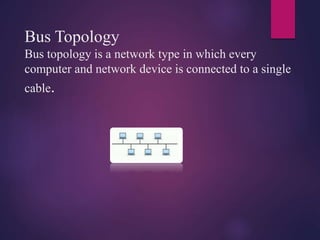
Bus Topology
Bus topology is a network type in which every
computer and network device is connected to a single
cable.
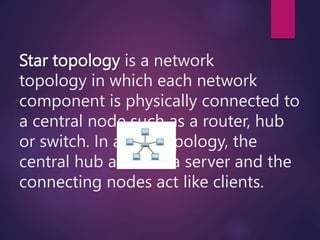
Star topology is a network
topology in which each network
component is physically connected to
a central node such as a router, hub
or switch. In a star topology, the
central hub acts like a server and the
connecting nodes act like clients.
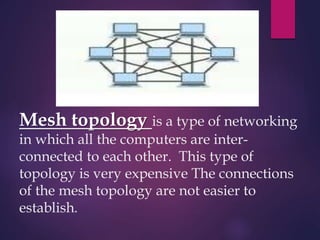
Mesh topology is a type of networking
in which all the computers are inter-
connected to each other. This type of
topology is very expensive The connections
of the mesh topology are not easier to
establish.
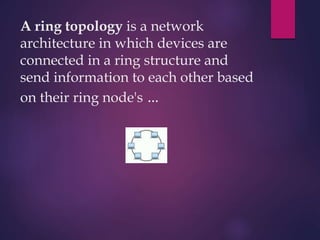
A ring topology is a network
architecture in which devices are
connected in a ring structure and
send information to each other based
on their ring node's ...
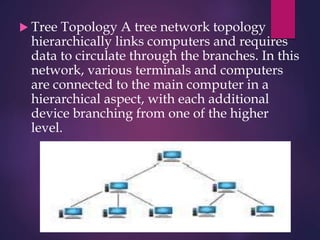
 Tree Topology A tree network topology
hierarchically links computers and requires
data to circulate through the branches. In this
network, various terminals and computers
are connected to the main computer in a
hierarchical aspect, with each additional
device branching from one of the higher
level.
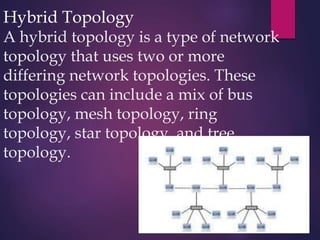
Hybrid Topology
A hybrid topology is a type of network
topology that uses two or more
differing network topologies. These
topologies can include a mix of bus
topology, mesh topology, ring
topology, star topology, and tree
topology.
Networking Architecture
There are two types of widely used network architectures,
namely P2P i.e. Peer to Peer and client-server i.e. tiered.
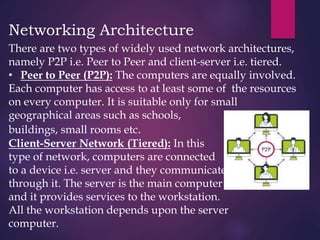
• Peer to Peer (P2P): The computers are equally involved.
Each computer has access to at least some of the resources
on every computer. It is suitable only for small
geographical areas such as schools,
buildings, small rooms etc.
Client-Server Network (Tiered): In this
type of network, computers are connected
to a device i.e. server and they communicate
through it. The server is the main computer
and it provides services to the workstation.
All the workstation depends upon the server
computer.
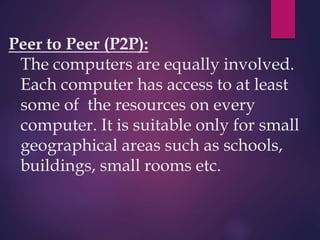
Peer to Peer (P2P):
The computers are equally involved.
Each computer has access to at least
some of the resources on every
computer. It is suitable only for small
geographical areas such as schools,
buildings, small rooms etc.
Protocol in Networking
Network protocols are a set of rules, conventions, and data
structures that explains how devices exchange data across
networks. They can be defined as a language that two
devices must understand for perfect communication of
information, regardless of their infrastructure.
• DHCP (dynamic host configuration protocol)
• FTP (file transfer protocol)
• HTTP (hypertext transfer protocol)
• HTTPS (hypertext transfer protocol secure)
• SMTP (simple mail transfer protocol)
• TCP (transmission control protocol)
Wireless Networks
A wireless network is one that uses wireless data
connections between the networks. Wireless
networks are convenient and less expensive.
• Wifi
• GPS
Global Positioning System
• Bluetooth
THANK YOU
Prepared by Mrs. Ankita A Shirke
IT Educater

Computer Networking.pptx

  • 1.
  • 2.
    Topics covered: • WHATIS COMPUTER NETWORK? • WHAT DO COMPUTER NETWORKS DO? • COMPONENTS OF COMPUTER NETWORKS. • ADVANTAGES OF COMPUTER NETWORKS. • NETWORK TERMINOLOGIES • DEVICES REQUIRED FOR A NETWORK • TYPES OF COMPUTER NETWORKS. • NETWORK TOPOLOGY. • NETWORKING ARCHITECTURE. • PROTOCOL IN NETWORKING. • WIRELESS NETWORKS.
  • 3.
    What is ComputerNetwork? Computer networks are the basis of communication in IT. They are used in a huge variety of ways and can include many different types of network. A computer network is a set of computers that are connected together so that they can share information. The computers on the network can communicate with each other as well as work independently. A computer network is a group of devices connected with each other through a transmission medium such as wires, cables etc. These devices can be computers, printers, scanners, fax machines etc.
  • 4.
    What do ComputerNetworks do? • Computer networks are used to carry out a large number of tasks through the sharing of information. • We can communicate using email, video, instant messaging and other methods through computer networks. • We can share devices such as printers, scanners and photocopiers. • We can share different files. • It helps us share software and operating programs on remote systems. • It allows network users to easily access and maintain information.
  • 5.
    Components of Computer Networks THEREARE FIVE COMPONENTS OF A COMPUTER NETWORK: • PROTOCOL • SENDER • RECEIVER • TRANSMISSION MEDIA • MESSAGE
  • 6.
    Advantages of ComputerNetworks • Computer networks help us with information security. • It reduces the hardware cost. • Installation cost is reduced. • Computer networks make it easy to share information. • Computer networks can transfer huge file sizes in seconds. • Computer networks can share a single internet connection. • Anybody can use a computer to create networking experiences.
  • 7.
    Network Terminologies THE FOLLOWINGARE THE TERMS RELATED TO THE COMPUTER NETWORK: • Server • ISP • Client • DNS • Intranet • Extranet • Internet • Webpage • WWW • Website • Voice over Internet Protocol (VoIP) • Link • URL • Hyperlink • IP Address • Web Portal • Hypertext • Bandwidth
  • 8.
    Devices required fora Network A computer network is build up from several devices. This together makes it possible to transfer data from one device to another and makes smooth communication between two different devices. The following are the main devices that are required to build a network. • ROUTER • HUB • SWITCH • GATEWAY • NIC • MODEM • NETWORKING CABLES
  • 9.
    Router  A routeris a device that connects two or more IP networks or subnetworks.  It serves two primary functions: managing traffic between these networks by forwarding data packets to their intended ip addresses, and allowing  Multiple devices to use the same Internet connection.
  • 10.
    Hub  A hubis the connection point in a computer device where data from many directions converge and are then sent out in many directions to respective devices. A hub may also act as a switch by preventing specific data packets from proceeding to a destination.
  • 11.
    Switch A switch isa device in a computer network that connects other devices together. Multiple data cables are plugged into a switch to enable communication between different networked devices.
  • 12.
    Gateway  A gatewayis a network node used in telecommunications that connects two networks with different transmission protocols together. Gateways serve as an entry and exit point for a network as all data must pass through or communicate with the gateway prior to being routed.
  • 13.
    NIC  Network interfacecard (NIC) is a hardware component that is present on the computer. It is used to connect different networking devices such as computers and servers to share data over the connected network.
  • 14.
    Modem  A modulator-demodulatoror modem is a compurer hardware device that converts data from a digital format into a format suitable for an analog transmission medium such as telephone or radio.
  • 15.
    Networking Cables  Networkingcables are networking hardware used to connect two or more computers  They are also known as Ethernet cable.  Types of cables are  Twisted pair  Coaxial cable  Fiber optics cable
  • 16.
    Types of ComputerNetworks  LAN (Local Area Network)  WAN (Wide Area Network)  MAN (Metropolitan Area Network)  PAN (Personal Area Network)  VPN (Virtual Private Network)
  • 17.
    LAN A local areanetwork (LAN) is a data communication network connecting various terminals or computers within a building or limited geographical area. The connection among the devices could be wired or wireless.
  • 18.
    WAN A wide areanetwork (WAN) is a computer network that covers a large geographical area comprising a region, a country, a continent or even the whole world.
  • 19.
    MAN A metropolitan areanetwork (MAN) is a computer network that connects computers within a metropolitan area, which could be a single large city, multiple cities and towns, or any given large area with multiple buildings. A MAN is larger than a local area network (LAN) but smaller than a wide area network (WAN).
  • 20.
    PAN A personal areanetwork (PAN) is a computer network for interconnecting electronic devices within an individual person's workspace.
  • 21.
    VPN VPN stands for"virtual private network" and describes the opportunity to establish a protected network connection when using public networks. Vpns encrypt your internet traffic and disguise your online identity. This makes it more difficult for third parties to track your activities online and steal data.
  • 22.
    Network Topology The arrangementor connection patterns of computers or nodes or devices used in the network is known as network topology. There are six types of common network topology. • Bus Topology • Star Topology • Mesh Topology • Hybrid Topology • Ring Topology • Hybrid Topology
  • 23.
    Bus Topology Bus topologyis a network type in which every computer and network device is connected to a single cable.
  • 24.
    Star topology isa network topology in which each network component is physically connected to a central node such as a router, hub or switch. In a star topology, the central hub acts like a server and the connecting nodes act like clients.
  • 25.
    Mesh topology isa type of networking in which all the computers are inter- connected to each other. This type of topology is very expensive The connections of the mesh topology are not easier to establish.
  • 26.
    A ring topologyis a network architecture in which devices are connected in a ring structure and send information to each other based on their ring node's ...
  • 27.
     Tree TopologyA tree network topology hierarchically links computers and requires data to circulate through the branches. In this network, various terminals and computers are connected to the main computer in a hierarchical aspect, with each additional device branching from one of the higher level.
  • 28.
    Hybrid Topology A hybridtopology is a type of network topology that uses two or more differing network topologies. These topologies can include a mix of bus topology, mesh topology, ring topology, star topology, and tree topology.
  • 29.
    Networking Architecture There aretwo types of widely used network architectures, namely P2P i.e. Peer to Peer and client-server i.e. tiered. • Peer to Peer (P2P): The computers are equally involved. Each computer has access to at least some of the resources on every computer. It is suitable only for small geographical areas such as schools, buildings, small rooms etc. Client-Server Network (Tiered): In this type of network, computers are connected to a device i.e. server and they communicate through it. The server is the main computer and it provides services to the workstation. All the workstation depends upon the server computer.
  • 30.
    Peer to Peer(P2P): The computers are equally involved. Each computer has access to at least some of the resources on every computer. It is suitable only for small geographical areas such as schools, buildings, small rooms etc.
  • 31.
    Protocol in Networking Networkprotocols are a set of rules, conventions, and data structures that explains how devices exchange data across networks. They can be defined as a language that two devices must understand for perfect communication of information, regardless of their infrastructure. • DHCP (dynamic host configuration protocol) • FTP (file transfer protocol) • HTTP (hypertext transfer protocol) • HTTPS (hypertext transfer protocol secure) • SMTP (simple mail transfer protocol) • TCP (transmission control protocol)
  • 32.
    Wireless Networks A wirelessnetwork is one that uses wireless data connections between the networks. Wireless networks are convenient and less expensive. • Wifi • GPS Global Positioning System • Bluetooth
  • 33.
    THANK YOU Prepared byMrs. Ankita A Shirke IT Educater