Role of ICT in TeachingRole of ICT in Teaching
Learning ProcessLearning Process
ByBy
Dr. Pravin H. GhosekarDr. Pravin H. Ghosekar
M.Sc.(C/S), MCM, DBM,, MBA, BJ., M.Com., M.Phil(IT), M.Phil(Comm), Ph.D.M.Sc.(C/S), MCM, DBM,, MBA, BJ., M.Com., M.Phil(IT), M.Phil(Comm), Ph.D.
HOD Department Computer EducationHOD Department Computer Education
Dhanwate National CollegeDhanwate National College
NagpurNagpur
10/05/201510/05/2015
Information Technology
The word Data is the plural of Datum. It is defined as raw facts or
observations, or business transactions .
Information :
Data :
• The processed data is known as information. It is an finished
product.
• The information must be received by the recipient on time & it
should be correct.
• The Technology plays an important role in delivering timely and
accurate information to its recipient.
• Technology includes H/W, S/W, database, communication system.
Information Technology
Information Technology means
the collection, storage,
processing, disseminations and use
of information using Technology.
Communication
Communication is a process in which
information is transferred from sender to
receiver using some medium/channel.
Information and Communication
Technology ( ICT )
ICT is effective use of communications (telephone
lines and wireless signals) in modern information
technology.
ICT consists of all technical means used to handle
information and communication aid , including both
computer and network hardware as well as necessary
software.
In other words, ICT consists of IT as well as
telephony, broadcast media, and all types of audio
& video processing and transmission.
Role of ICT in
Teaching & Learning
Role of Teacher
• Teachers remain central to the learning
process.
– teachers to serve as leaders in the classroom
• Lesson planning is crucial when using ICTs
– Teacher lesson planning is vital when using ICTs; where
little planning has occurred
Pedagogy
• Introducing technology alone will not
change the teaching and learning process
– Teachers’ pedagogical practices and reasoning influence
their use of ICT and it will impact on student learning.
• ICTs help teachers to create more
'learner-centric' learning environments
– support the move from traditional 'teacher-centric'
teaching styles to more 'learner-centric' methods
Pedagogy
• ICTs can be used to support change and to
extend existing teaching practices
– ICTs can be used to reinforce existing pedagogical
practices as well as to change the way teachers and
students interact.
• Better understanding of difficult concept
– it may promote class understanding of and discussion
about difficult concepts (especially through the display
of simulations)
How we can use ICT in Teaching-
Learning
• Teachers can use ICT for administrative
tasks
– record keeping, lesson plan development, information
presentation, basic information searches on the
Internet
• Use of overhead & LCD/LED Projectors
• Television
• Preparing Presentation
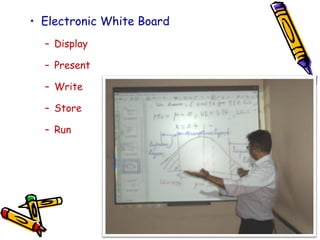
• Electronic White Board
– Display
– Present
– Write
– Store
– Run
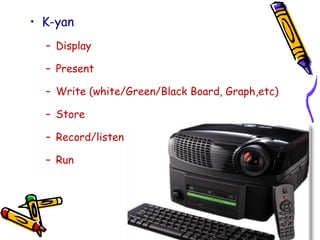
• K-yan
– Display
– Present
– Write (white/Green/Black Board, Graph,etc)
– Store
– Record/listen
– Run
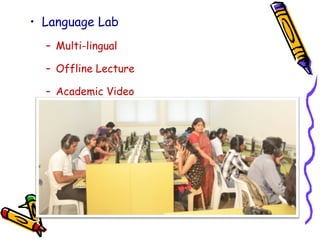
• Language Lab
– Multi-lingual
– Offline Lecture
– Academic Video
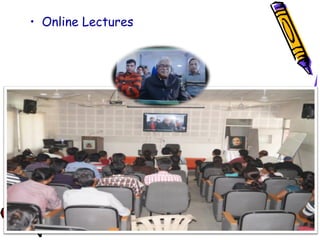
• Online Lectures
• Web resources
– nlist.inflibnet.ac.in (6000+ ejournals & 97000+ ebooks)
– Youtube
– E-gyankosh
– onlinevideolecture.com
– freevideolectures.com
– nptel.ac.in (IIT & IISc)
– academicearth.org
• Research Papers
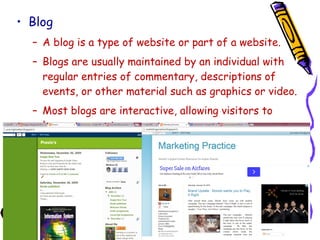
• Blog
– A blog is a type of website or part of a website.
– Blogs are usually maintained by an individual with
regular entries of commentary, descriptions of
events, or other material such as graphics or video.
– Most blogs are interactive, allowing visitors to
leave comments.
• Learning Management System
– LMS or Interactive Learning Module is a online
courseware where students can practice,
browse, examine, check progress
– Teacher can evaluate and monitor the
progress.
Role of ICT in Teaching Learning

Role of ICT in Teaching Learning

  • 1.
    Role of ICTin TeachingRole of ICT in Teaching Learning ProcessLearning Process ByBy Dr. Pravin H. GhosekarDr. Pravin H. Ghosekar M.Sc.(C/S), MCM, DBM,, MBA, BJ., M.Com., M.Phil(IT), M.Phil(Comm), Ph.D.M.Sc.(C/S), MCM, DBM,, MBA, BJ., M.Com., M.Phil(IT), M.Phil(Comm), Ph.D. HOD Department Computer EducationHOD Department Computer Education Dhanwate National CollegeDhanwate National College NagpurNagpur 10/05/201510/05/2015
  • 2.
    Information Technology The wordData is the plural of Datum. It is defined as raw facts or observations, or business transactions . Information : Data : • The processed data is known as information. It is an finished product. • The information must be received by the recipient on time & it should be correct. • The Technology plays an important role in delivering timely and accurate information to its recipient. • Technology includes H/W, S/W, database, communication system.
  • 3.
    Information Technology Information Technologymeans the collection, storage, processing, disseminations and use of information using Technology.
  • 4.
    Communication Communication is a processin which information is transferred from sender to receiver using some medium/channel.
  • 5.
    Information and Communication Technology( ICT ) ICT is effective use of communications (telephone lines and wireless signals) in modern information technology. ICT consists of all technical means used to handle information and communication aid , including both computer and network hardware as well as necessary software. In other words, ICT consists of IT as well as telephony, broadcast media, and all types of audio & video processing and transmission.
  • 6.
    Role of ICTin Teaching & Learning
  • 7.
    Role of Teacher •Teachers remain central to the learning process. – teachers to serve as leaders in the classroom • Lesson planning is crucial when using ICTs – Teacher lesson planning is vital when using ICTs; where little planning has occurred
  • 8.
    Pedagogy • Introducing technologyalone will not change the teaching and learning process – Teachers’ pedagogical practices and reasoning influence their use of ICT and it will impact on student learning. • ICTs help teachers to create more 'learner-centric' learning environments – support the move from traditional 'teacher-centric' teaching styles to more 'learner-centric' methods
  • 9.
    Pedagogy • ICTs canbe used to support change and to extend existing teaching practices – ICTs can be used to reinforce existing pedagogical practices as well as to change the way teachers and students interact. • Better understanding of difficult concept – it may promote class understanding of and discussion about difficult concepts (especially through the display of simulations)
  • 10.
    How we canuse ICT in Teaching- Learning • Teachers can use ICT for administrative tasks – record keeping, lesson plan development, information presentation, basic information searches on the Internet • Use of overhead & LCD/LED Projectors • Television • Preparing Presentation
  • 11.
    • Electronic WhiteBoard – Display – Present – Write – Store – Run
  • 12.
    • K-yan – Display –Present – Write (white/Green/Black Board, Graph,etc) – Store – Record/listen – Run
  • 13.
    • Language Lab –Multi-lingual – Offline Lecture – Academic Video
  • 14.
  • 15.
    • Web resources –nlist.inflibnet.ac.in (6000+ ejournals & 97000+ ebooks) – Youtube – E-gyankosh – onlinevideolecture.com – freevideolectures.com – nptel.ac.in (IIT & IISc) – academicearth.org • Research Papers
  • 16.
    • Blog – Ablog is a type of website or part of a website. – Blogs are usually maintained by an individual with regular entries of commentary, descriptions of events, or other material such as graphics or video. – Most blogs are interactive, allowing visitors to leave comments.
  • 17.
    • Learning ManagementSystem – LMS or Interactive Learning Module is a online courseware where students can practice, browse, examine, check progress – Teacher can evaluate and monitor the progress.