LUMBINI ENGINNERING COLLEGE
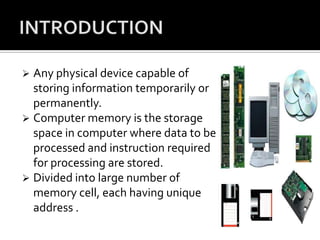
 Any physical device capable of
storing information temporarily or
permanently.
 Computer memory is the storage
space in computer where data to be
processed and instruction required
for processing are stored.
 Divided into large number of
memory cell, each having unique
address .
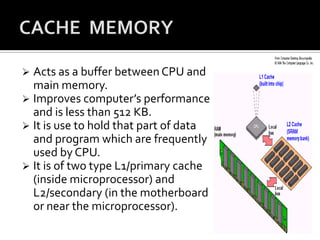
 Acts as a buffer between CPU and
main memory.
 Improves computer’s performance
and is less than 512 KB.
 It is use to hold that part of data
and program which are frequently
used by CPU.
 It is of two type L1/primary cache
(inside microprocessor) and
L2/secondary (in the motherboard
or near the microprocessor).
 These are semiconductor memories.
 It is known as main memory.
 Usually volatile memory.
 Holds only those data and instruction on which
computer is working.
 Data is lost in case of power failure or power turn off.
 Faster than secondary memory.
 A computer cannot run with out primary memory.
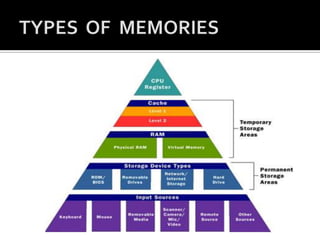
 It is of two type.
• Random Access Memory(RAM).
• Read Only Memory(ROM).
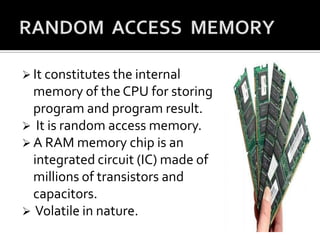
 It constitutes the internal
memory of the CPU for storing
program and program result.
 It is random access memory.
 A RAM memory chip is an
integrated circuit (IC) made of
millions of transistors and
capacitors.
 Volatile in nature.
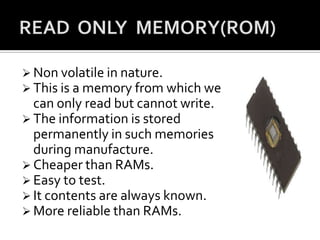
 Non volatile in nature.
 This is a memory from which we
can only read but cannot write.
 The information is stored
permanently in such memories
during manufacture.
 Cheaper than RAMs.
 Easy to test.
 It contents are always known.
 More reliable than RAMs.
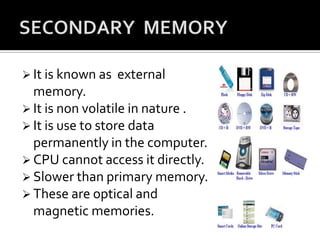
 It is known as external
memory.
 It is non volatile in nature .
 It is use to store data
permanently in the computer.
 CPU cannot access it directly.
 Slower than primary memory.
 These are optical and
magnetic memories.
Thank you for your cooperation.

Computer Memory

  • 1.
  • 2.
     Any physicaldevice capable of storing information temporarily or permanently.  Computer memory is the storage space in computer where data to be processed and instruction required for processing are stored.  Divided into large number of memory cell, each having unique address .
  • 4.
     Acts asa buffer between CPU and main memory.  Improves computer’s performance and is less than 512 KB.  It is use to hold that part of data and program which are frequently used by CPU.  It is of two type L1/primary cache (inside microprocessor) and L2/secondary (in the motherboard or near the microprocessor).
  • 5.
     These aresemiconductor memories.  It is known as main memory.  Usually volatile memory.  Holds only those data and instruction on which computer is working.  Data is lost in case of power failure or power turn off.  Faster than secondary memory.  A computer cannot run with out primary memory.  It is of two type. • Random Access Memory(RAM). • Read Only Memory(ROM).
  • 6.
     It constitutesthe internal memory of the CPU for storing program and program result.  It is random access memory.  A RAM memory chip is an integrated circuit (IC) made of millions of transistors and capacitors.  Volatile in nature.
  • 7.
     Non volatilein nature.  This is a memory from which we can only read but cannot write.  The information is stored permanently in such memories during manufacture.  Cheaper than RAMs.  Easy to test.  It contents are always known.  More reliable than RAMs.
  • 8.
     It isknown as external memory.  It is non volatile in nature .  It is use to store data permanently in the computer.  CPU cannot access it directly.  Slower than primary memory.  These are optical and magnetic memories.
  • 9.
    Thank you foryour cooperation.