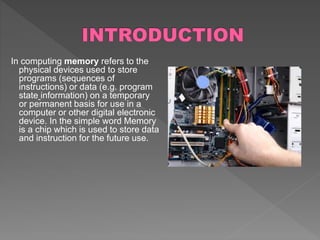
In computing memory refers to the
physical devices used to store
programs (sequences of
instructions) or data (e.g. program
state information) on a temporary
or permanent basis for use in a
computer or other digital electronic
device. In the simple word Memory
is a chip which is used to store data
and instruction for the future use.
 Main memory is divided into two parts :Main
memory is a primary memory which is used
to store data and instruction temporarily and
it store those data and instruction which are
currently executed. For example RAM.
 Random Access memory (RAM), should be
better known as Read Write Memory (RWM).
 Read Only Memory (ROM) .
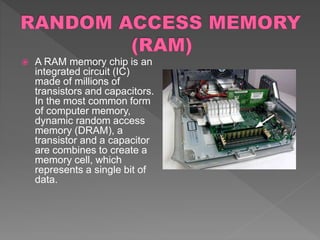
 A RAM memory chip is an
integrated circuit (IC)
made of millions of
transistors and capacitors.
In the most common form
of computer memory,
dynamic random access
memory (DRAM), a
transistor and a capacitor
are combines to create a
memory cell, which
represents a single bit of
data.
 STATIC RAM
 Semi conductor memory
 Uses flip flop to store each bit of memory so
does not need to be periodically refreshed
 Fast and consumes low power
 Expensive and has complex structure(6
transistors) so not used for high capacity
applications
 DYNAMIC RAM
 Stores each bit of memory in capacitor in an
intrgrated circuit
 Real capacitors leak charge so capacitors
need to be refreshed periodically
 Simple structure (1 capacitor and 1 transistor
per bit) so it has very high density
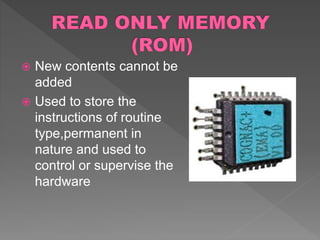
 New contents cannot be
added
 Used to store the
instructions of routine
type,permanent in
nature and used to
control or supervise the
hardware
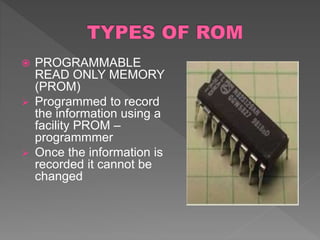
 PROGRAMMABLE
READ ONLY MEMORY
(PROM)
 Programmed to record
the information using a
facility PROM –
programmmer
 Once the information is
recorded it cannot be
changed
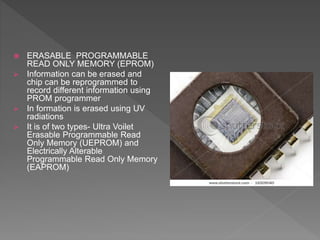
 ERASABLE PROGRAMMABLE
READ ONLY MEMORY (EPROM)
 Information can be erased and
chip can be reprogrammed to
record different information using
PROM programmer
 In formation is erased using UV
radiations
 It is of two types- Ultra Voilet
Erasable Programmable Read
Only Memory (UEPROM) and
Electrically Alterable
Programmable Read Only Memory
(EAPROM)
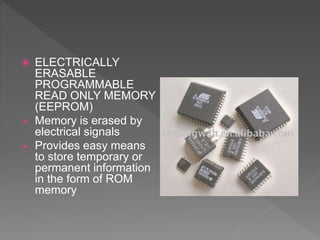
 ELECTRICALLY
ERASABLE
PROGRAMMABLE
READ ONLY MEMORY
(EEPROM)
 Memory is erased by
electrical signals
 Provides easy means
to store temporary or
permanent information
in the form of ROM
memory
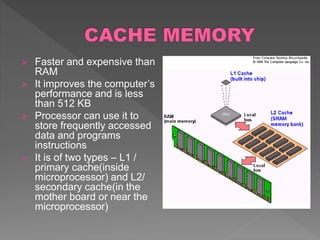
 Faster and expensive than
RAM
 It improves the computer’s
performance and is less
than 512 KB
 Processor can use it to
store frequently accessed
data and programs
instructions
 It is of two types – L1 /
primary cache(inside
microprocessor) and L2/
secondary cache(in the
mother board or near the
microprocessor)
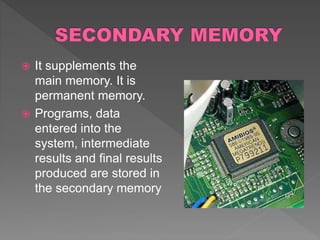
 It supplements the
main memory. It is
permanent memory.
 Programs, data
entered into the
system, intermediate
results and final results
produced are stored in
the secondary memory
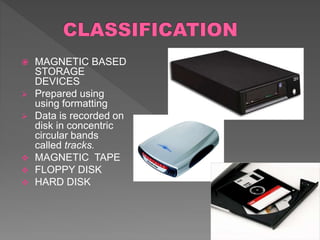
 MAGNETIC BASED
STORAGE
DEVICES
 Prepared using
using formatting
 Data is recorded on
disk in concentric
circular bands
called tracks.
 MAGNETIC TAPE
 FLOPPY DISK
 HARD DISK
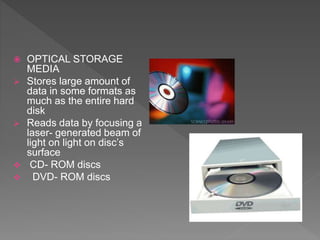
 OPTICAL STORAGE
MEDIA
 Stores large amount of
data in some formats as
much as the entire hard
disk
 Reads data by focusing a
laser- generated beam of
light on light on disc’s
surface
 CD- ROM discs
 DVD- ROM discs
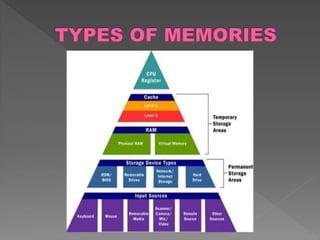
 Ranking of computer
memory devices, with
devices having the
fastest access time at
the top of hierarchy,
and devices with
slower access time
but larger capacity
and lower cost at
lower levels
THANKS

Computer memory & Memory Storage Devices.

  • 2.
    In computing memoryrefers to the physical devices used to store programs (sequences of instructions) or data (e.g. program state information) on a temporary or permanent basis for use in a computer or other digital electronic device. In the simple word Memory is a chip which is used to store data and instruction for the future use.
  • 4.
     Main memoryis divided into two parts :Main memory is a primary memory which is used to store data and instruction temporarily and it store those data and instruction which are currently executed. For example RAM.  Random Access memory (RAM), should be better known as Read Write Memory (RWM).  Read Only Memory (ROM) .
  • 5.
     A RAMmemory chip is an integrated circuit (IC) made of millions of transistors and capacitors. In the most common form of computer memory, dynamic random access memory (DRAM), a transistor and a capacitor are combines to create a memory cell, which represents a single bit of data.
  • 6.
     STATIC RAM Semi conductor memory  Uses flip flop to store each bit of memory so does not need to be periodically refreshed  Fast and consumes low power  Expensive and has complex structure(6 transistors) so not used for high capacity applications
  • 7.
     DYNAMIC RAM Stores each bit of memory in capacitor in an intrgrated circuit  Real capacitors leak charge so capacitors need to be refreshed periodically  Simple structure (1 capacitor and 1 transistor per bit) so it has very high density
  • 8.
     New contentscannot be added  Used to store the instructions of routine type,permanent in nature and used to control or supervise the hardware
  • 9.
     PROGRAMMABLE READ ONLYMEMORY (PROM)  Programmed to record the information using a facility PROM – programmmer  Once the information is recorded it cannot be changed
  • 10.
     ERASABLE PROGRAMMABLE READONLY MEMORY (EPROM)  Information can be erased and chip can be reprogrammed to record different information using PROM programmer  In formation is erased using UV radiations  It is of two types- Ultra Voilet Erasable Programmable Read Only Memory (UEPROM) and Electrically Alterable Programmable Read Only Memory (EAPROM)
  • 11.
     ELECTRICALLY ERASABLE PROGRAMMABLE READ ONLYMEMORY (EEPROM)  Memory is erased by electrical signals  Provides easy means to store temporary or permanent information in the form of ROM memory
  • 12.
     Faster andexpensive than RAM  It improves the computer’s performance and is less than 512 KB  Processor can use it to store frequently accessed data and programs instructions  It is of two types – L1 / primary cache(inside microprocessor) and L2/ secondary cache(in the mother board or near the microprocessor)
  • 13.
     It supplementsthe main memory. It is permanent memory.  Programs, data entered into the system, intermediate results and final results produced are stored in the secondary memory
  • 14.
     MAGNETIC BASED STORAGE DEVICES Prepared using using formatting  Data is recorded on disk in concentric circular bands called tracks.  MAGNETIC TAPE  FLOPPY DISK  HARD DISK
  • 15.
     OPTICAL STORAGE MEDIA Stores large amount of data in some formats as much as the entire hard disk  Reads data by focusing a laser- generated beam of light on light on disc’s surface  CD- ROM discs  DVD- ROM discs
  • 16.
     Ranking ofcomputer memory devices, with devices having the fastest access time at the top of hierarchy, and devices with slower access time but larger capacity and lower cost at lower levels
  • 17.

Editor's Notes

  • #2 Master in business management