Prof. Indrani sen MCA,MPhil
computer science
 The physical material that actually holds data
is called a storage medium.
 The hardware that writes data to or reads
data from a storage medium is called a
storage device.
 The two primary storage technologies are
 Magnetic
 optical.
Prof. Indrani sen MCA,MPhil
computer science
 Diskettes (floppy disks)
 Hard disks
 High-capacity floppy disks
 Disk cartridges
 Magnetic tape
Prof. Indrani sen MCA,MPhil
computer science
 Compact Disk Read-Only Memory (CD-ROM)
 Digital Video Disk Read-Only Memory
 (DVD-ROM)
 CD-Recordable (CD-R)
 CD-Rewritable (CD-RW)
 PhotoCD
Prof. Indrani sen MCA,MPhil
computer science
 A magnetic disk's medium contains iron
particles,
 which can be polarized—given a magnetic
charge—in one of two directions.
 Each particle's direction represents a 1 (on) or 0
(off),
 representing each bit of data that the CPU can
 recognize.
 A disk drive uses read/write heads containing
 electromagnets
 to create magnetic charges on the medium.
Prof. Indrani sen MCA,MPhil
computer science
Prof. Indrani sen MCA,MPhil
computer science
 Before a magnetic disk can be used, it must be
 formatted—
 a process that maps the disk's surface and
determines how data will be stored.
 During formatting, the drive creates circular
tracks
 around the disk's surface,
 then divides each track into sectors.
 The OS organizes sectors into groups, called
clusters,
 then tracks each file's location according to the
clusters it occupies.
Prof. Indrani sen MCA,MPhil
computer science
Prof. Indrani sen MCA,MPhil
computer science
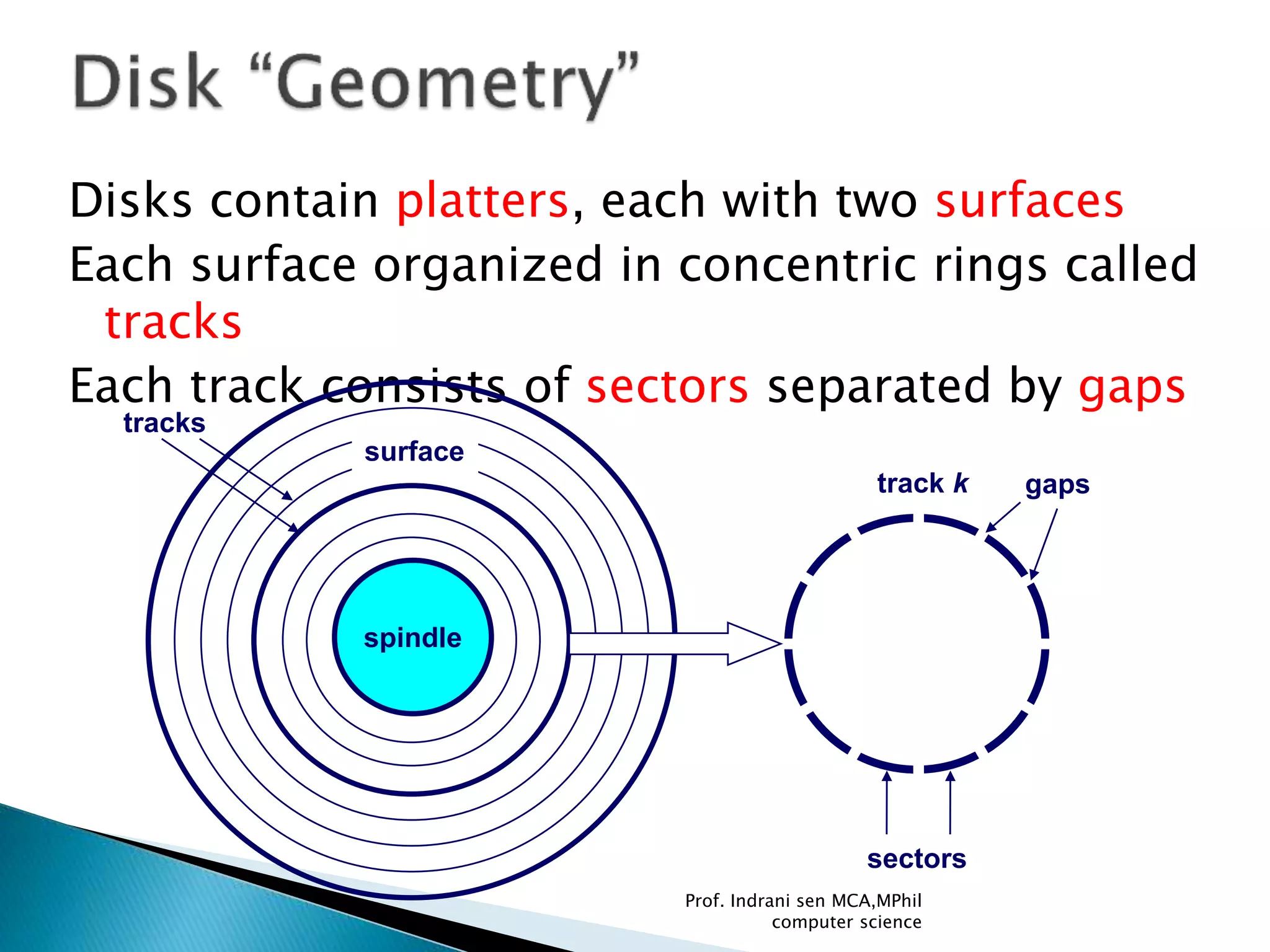
Disks contain platters, each with two surfaces
Each surface organized in concentric rings called
tracks
Each track consists of sectors separated by gaps
spindle
surface
tracks
track k
sectors
gaps
Prof. Indrani sen MCA,MPhil
computer science
Aligned tracks form a cylinder
surface 0
surface 1
surface 2
surface 3
surface 4
surface 5
cylinder k
spindle
platter 0
platter 1
platter 2
Prof. Indrani sen MCA,MPhil
computer science
Read/Write Head
Upper Surface
Platter
Lower Surface
Cylinder
Track
Sector
Arm
Actuator
Prof. Indrani sen MCA,MPhil
computer science
The disk
surface
spins at a fixed
rotational rate
spindle
By moving radially, the arm
can position the read/write
head over any track
The read/write head
is attached to the end
of the arm and flies over
the disk surface on
a thin cushion of air
spindle
spindle
spindle
spindle
Prof. Indrani sen MCA,MPhil
computer science
arm
read/write heads
move in unison
from cylinder to cylinder
spindle
Prof. Indrani sen MCA,MPhil
computer science
 When a disk is formatted, the OS creates four
 areas on its surface:
 Boot sector – stores the master boot record,
 a small program that runs when you first start
(boot) the computer.
 File allocation table (FAT) – a log that records each
 file's location and each sector's status
 Root folder – enables the user to store data on the
disk in a logical way
 Data area – the portion of the disk that actually
holds data.
Prof. Indrani sen MCA,MPhil
computer science
Prof. Indrani sen MCA,MPhil
computer science
 Diskette drives, also known as floppy disk drives,
 read and write to diskettes (called floppy disks or
floppies).
 Diskettes are used to transfer files between
 computers, as a means for distributing software,
and as a backup medium.
 Diskettes come in two sizes: 5.25-inch and 3.5-
inch
 Diskettes are available in different capacities, but
 the most common store 1.44 MB.
Prof. Indrani sen MCA,MPhil
computer science
Prof. Indrani sen MCA,MPhil
computer science
 How Optical Storage Works
 CD-ROM
 CD-ROM Speeds and Uses
 DVD-ROM
 Other Optical Storage Devices
Prof. Indrani sen MCA,MPhil
computer science
 In PCs, the most commonly used
 optical storage technology is called
 Compact Disk Read-Only Memory (CD-ROM).
 A standard CD-ROM disk can store up to
650MB of data, or about 70 minutes of audio.
 Once data is written to a standard CD-ROM
 disk, the data cannot be altered or
overwritten.
Prof. Indrani sen MCA,MPhil
computer science
Prof. Indrani sen MCA,MPhil
computer science
 An optical disk is a high-capacity storage
medium.
 An optical drive uses reflected light to read data.
 To store data, the disk's metal surface is covered
with tiny dents (pits) and flat spots (lands), which
cause light to be reflected differently.
 When an optical drive shines light into a pit, the
light cannot be reflected back.
 This represents a bit value of 0 (off). A land
reflects light back to its source, representing a
bit value of 1 (on).
Prof. Indrani sen MCA,MPhil
computer science
 Early CD-ROM drives were called single speed, and
 read data at a rate of 150 KBps. (Hard disks transfer
 data at rates of 5 – 15 MBps).
 CD-ROM drives now can transfer data at speeds of
 up to 7800 KBps. Data transfer speeds are getting
 faster.
 CD-ROM is typically used to store software
 programs. CDs can store audio and video data, as
 well as text and program instructions
Prof. Indrani sen MCA,MPhil
computer science
 A variation of CD-ROM is called Digital Video
Disk
 Read-Only Memory (DVD-ROM), and is being
used
 in place of CD-ROM in many newer PCs.
 Standard DVD disks store up to 9.4 GB of data—
 enough to store an entire movie. Dual-layer DVD
 disks can store up to 17 GB.
 DVD disks can store so much data because both
sides of the disk are used, along with
sophisticated data compression technologies.
Prof. Indrani sen MCA,MPhil
computer science
 A CD-Recordable (CD-R) drive lets you record
your
 own CDs, but data cannot be overwritten
once it is recorded to the disk.
 A CD-Rewritable (CD-RW) drive lets you
record and, then write new data over the
already recorded data.
 PhotoCD technology is used to store digital
 photographs.
Prof. Indrani sen MCA,MPhil
computer science
 Blu-ray Disc (BD) is an optical disc storage medium designed
to supersede the DVD format.
 The plastic disc is 120 mm in diameter and 1.2 mm thick, the
same size as DVDs and CDs.
 Conventional Blu-ray Discs contain 25 GB per layer, with dual
layer discs (50 GB) being the industry standard for feature-
length video discs.
 The major application of Blu-ray Discs is as a medium for
video material such as feature films.
 Besides the hardware specifications, Blu-ray Disc is
associated with a set of multimedia formats.
 Generally these formats allow for the video and audio to be
stored with greater definition than on DVD.
Prof. Indrani sen MCA,MPhil
computer science
 The name Blu-ray Disc refers to the blue laser
used to read the disc, which allows
 information to be stored at a greater density
than is possible with the longer-wavelength
red laser used for DVDs.
Prof. Indrani sen MCA,MPhil
computer science
 A solid-state drive (SSD) sometimes
improperly referred to as a "solid-state disk"
or "electronic disk“
 is a data storage device that uses integrated
circuita ssemblies as memory to store data .
Prof. Indrani sen MCA,MPhil
computer science
 Flash memory is a non-volatile computer storage chip
 that can be electrically erased and reprogrammed.
 It was developed from EEPROM (electrically erasable
programmable read-only memory)
 and must be erased in fairly large blocks before these can be
rewritten with new data.
 Flash memory differs from regular EEPROM in that EEPROM
erases its content one byte at a time.
 This makes it slow to update.
 Flash memory can erase its data in entire blocks
Prof. Indrani sen MCA,MPhil
computer science
 Example applications of both types of flash
memory include
 personal computers,
 PDAs,
 digital audio players,
 digital cameras,
 mobile phones,
 synthesizers,
 video games,
Prof. Indrani sen MCA,MPhil
computer science
Prof. Indrani sen MCA,MPhil
computer science
 A smart card, chip card, or integrated circuit
card (ICC) is any pocket-sized card with
embedded integrated circuits(IC)
 Smart cards are made of plastic.
 Smart cards can provide identification,
authentication, data storage and application
processing.
Prof. Indrani sen MCA,MPhil
computer science
Prof. Indrani sen MCA,MPhil
computer science
 A smart card, typically a type of chip card,
 is a plastic card that contains an embedded
computer chip–either a memory or
microprocessor type–
 that stores and transacts data.
 The card data is transacted via a reader that
is part of a computing system.
Prof. Indrani sen MCA,MPhil
computer science
Prof. Indrani sen MCA,MPhil
computer science
 The most prominent application of smart card
technology is in
 Subscriber Identity Modules (SIM), required
for all phone systems
 Each phone utilizes the unique identifier,
stored in the SIM,
 to manage the rights and privileges of each
subscriber on various networks.
Prof. Indrani sen MCA,MPhil
computer science
Prof. Indrani sen MCA,MPhil
computer science
 A USB flash drive is a data storage device that includes
flash memory with an integrated Universal Serial Bus
(USB) interface.
 USB flash drives are typically removable and rewritable,
and physically much smaller than a floppy disk.
 As of September 2011 drives of 256 (GB) are available.
 Storage capacities as large as 2 terabytes are planned,
 USB flash drives are often used for the same purposes
for which floppy disks or CD-ROMs were used.
Prof. Indrani sen MCA,MPhil
computer science
Prof. Indrani sen MCA,MPhil
computer science
 Radio-frequency identification (RFID) is the use of a
wireless system that uses radio-frequency to transfer
data from a tag attached to an object.
 A radio-frequency identification system uses tags, or
labels attached to the objects to be identified.
 Two-way radio transmitter-receivers called readers
send a signal to the tag and read its response.
 The tag's information is stored electronically in a non-
volatile memory. The RFID tag includes a small RF
transmitter and receiver.
 An RFID tag attached to an automobile during
production can be used to track its progress through
the assembly line.
 Pharmaceuticals can be tracked through warehouses.
 Livestock and pets may have tags injected, allowing
positive identification of the animal.
 RFID tags can be attached to clothing, possessions, or
even implanted within people to identify and read
critical information.
 Payment by mobile phones:When inserted into a mobile
phone, a user's phone can be linked to bank accounts
and used in mobile payment.
RFID chip next to a grain of rice.
 In computing, a printer is a peripheral which
produces a text or graphics of documents
stored in electronic form,
 usually on physical print media such as paper
or transparencies.
 Many printers are primarily used as local
peripherals, and are attached by a printer
cable or,
 in most new printers, a USB cable to a
computer which serves as a document
source.
 A dot matrix printer or impact matrix printer is a
type of computer printer with a print head
 that runs back and forth, or in an up and down
motion, on the page and prints by impact,
striking an ink-soaked cloth ribbon against the
paper,
 much like the print mechanism on a typewriter.
 However, unlike a typewriter letters drawn out of
a dot matrix, have varied fonts and arbitrary
graphics which can be produced.
 Because the printing involves mechanical
pressure, these printers can create carbon
copies.
 Each dot is produced by a tiny metal rod, also
called a "wire" or "pin", which is driven
forward by the power of a tiny electromagnet.
 Facing the ribbon and the paper is a small
guide plate (often made of an artificial jewel
such as sapphire or ruby) pierced with holes
to serve as guides for the pins.
 The moving portion of the printer is called
the print head,
 and when running the printer generally prints
one line of text at a time.
Epson VP-500 Printer (Cover removed)
Typical output from a dot matrix
printer operating in draft mode
 Inkjet printers operate by spraying variably-
sized droplets of liquid ink onto almost any
sized page.
 They are the most common type of computer
printer used by consumers.
 Today's photo-quality ink jet printers can
typically print with a resolution of 1200 to
4800 dots per inch.
 They will give acceptable quality photo prints
of images with 140-200 (PPI) resolution.
 A laser printer is a common computer peripheral
that rapidly produces high quality text and
graphics on plain paper.
 As with digital photocopiers, laser printers employ
a xerographic printing process,
 but differ from analog photocopiers in that the
image is produced by the direct scanning of a laser
beam across the printer's photoreceptor.
 A laser beam projects an image of the page
to be printed onto an
 electrically charged rotating drum coated with
selenium or, more common in modern
printers, organic photoconductors.
 The drum then prints the image onto paper
by direct contact and heat, which fuses the
ink to the paper.
 The plotter is a computer printer for printing
vector graphics.
 In the past, plotters were used in
applications such as computer-aided design,
though they have
 generally been replaced with wide-format
conventional printers.
 Pen plotters print by moving a pen or other
instrument across the surface of a piece of
paper.
 This means that plotters are restricted to line
art, rather than raster graphics as with other
printers.
 Pen plotters can draw complex line art,
including text, but do so slowly because of
the mechanical movement of the pens.
 They are often incapable of efficiently
creating a solid region of color,
 CRT
 Flat Panel
 LCD
 Video cards
 TFT screen
Prof. Indrani sen MCA,MPhil
computer science
 Abbreviation of cathode-ray tube, the technology
used in most televisions and computer display
screens.
 A CRT works by moving an electron beam back
and forth across the back of the screen.
 Each time the beam makes a pass across the
screen, it lights up phosphor dots on the inside
of the glass tube
 , thereby illuminating the active portions of the
screen.
 By drawing many such lines from the top to the
bottom of the screen, it creates an entire image.
Prof. Indrani sen MCA,MPhil
computer science
Prof. Indrani sen MCA,MPhil
computer science
 Flat panel display is a very thin display screen
used in portable computers.
 Nearly all modern flat-panel displays use LCD
technologies.
 Most LCD screens are backlit to make them
easier to read in bright environments.
 A flat display apparatus is smaller and lighter
than the display apparatus having the
cathode ray tube (CRT).
Prof. Indrani sen MCA,MPhil
computer science
Prof. Indrani sen MCA,MPhil
computer science
 LCD
 Video cards
 TFTs
Prof. Indrani sen MCA,MPhil
computer science
 Liquid-crystal display televisions (LCD TV) are
television sets that use LCD display
technology to produce images.
 LCD televisions are thinner and lighter than
cathode ray tube (CRTs) of similar display
size,
 and are available in much larger sizes.
 When manufacturing costs fell, this
combination of features made LCDs practical
for television receivers.
Prof. Indrani sen MCA,MPhil
computer science
Prof. Indrani sen MCA,MPhil
computer science
 What is a Video Card?:
 The video card is an expansion card that allows
the computer to send graphical information
 to a video display device such as a monitor or
projector.
 The Video Card is Also Known As:
 graphics card, graphics adapter, video adapter.
 The video card installs in an expansion slot on
the motherboard.
 Today's best GPUs come from Nvidia and ATI
Prof. Indrani sen MCA,MPhil
computer science
Prof. Indrani sen MCA,MPhil
computer science
 The images you see on your monitor are made of tiny dots
called pixels.
 At most common resolution settings, a screen displays over
a million pixels, and the computer has to decide what to do
with every one in order to create an image.
 To do this, it needs a translator -- something to take binary
data from the CPU and turn it into a picture you can see.
 A computer has graphics capability built into the
motherboard so that translation takes place on the graphics
card.
Prof. Indrani sen MCA,MPhil
computer science
Prof. Indrani sen MCA,MPhil
computer science
 Thin film transistor liquid crystal display (TFT-
LCD) is a variant of liquid crystal display (LCD)
which uses
 thin-film transistor(TFT) technology to improve
image quality (e.g., addressability, contrast).
 TFT LCDs are used in
 television sets
 computer monitors
 mobile phones
 handheld video game systems
 personal digital assistants
 navigation systems
 Projectors etc
Prof. Indrani sen MCA,MPhil
computer science
Prof. Indrani sen MCA,MPhil
computer science

Magnetic storage (1)

  • 1.
    Prof. Indrani senMCA,MPhil computer science
  • 2.
     The physicalmaterial that actually holds data is called a storage medium.  The hardware that writes data to or reads data from a storage medium is called a storage device.  The two primary storage technologies are  Magnetic  optical. Prof. Indrani sen MCA,MPhil computer science
  • 3.
     Diskettes (floppydisks)  Hard disks  High-capacity floppy disks  Disk cartridges  Magnetic tape Prof. Indrani sen MCA,MPhil computer science
  • 4.
     Compact DiskRead-Only Memory (CD-ROM)  Digital Video Disk Read-Only Memory  (DVD-ROM)  CD-Recordable (CD-R)  CD-Rewritable (CD-RW)  PhotoCD Prof. Indrani sen MCA,MPhil computer science
  • 5.
     A magneticdisk's medium contains iron particles,  which can be polarized—given a magnetic charge—in one of two directions.  Each particle's direction represents a 1 (on) or 0 (off),  representing each bit of data that the CPU can  recognize.  A disk drive uses read/write heads containing  electromagnets  to create magnetic charges on the medium. Prof. Indrani sen MCA,MPhil computer science
  • 6.
    Prof. Indrani senMCA,MPhil computer science
  • 7.
     Before amagnetic disk can be used, it must be  formatted—  a process that maps the disk's surface and determines how data will be stored.  During formatting, the drive creates circular tracks  around the disk's surface,  then divides each track into sectors.  The OS organizes sectors into groups, called clusters,  then tracks each file's location according to the clusters it occupies. Prof. Indrani sen MCA,MPhil computer science
  • 8.
    Prof. Indrani senMCA,MPhil computer science
  • 9.
    Disks contain platters,each with two surfaces Each surface organized in concentric rings called tracks Each track consists of sectors separated by gaps spindle surface tracks track k sectors gaps Prof. Indrani sen MCA,MPhil computer science
  • 10.
    Aligned tracks forma cylinder surface 0 surface 1 surface 2 surface 3 surface 4 surface 5 cylinder k spindle platter 0 platter 1 platter 2 Prof. Indrani sen MCA,MPhil computer science
  • 11.
    Read/Write Head Upper Surface Platter LowerSurface Cylinder Track Sector Arm Actuator Prof. Indrani sen MCA,MPhil computer science
  • 12.
    The disk surface spins ata fixed rotational rate spindle By moving radially, the arm can position the read/write head over any track The read/write head is attached to the end of the arm and flies over the disk surface on a thin cushion of air spindle spindle spindle spindle Prof. Indrani sen MCA,MPhil computer science
  • 13.
    arm read/write heads move inunison from cylinder to cylinder spindle Prof. Indrani sen MCA,MPhil computer science
  • 14.
     When adisk is formatted, the OS creates four  areas on its surface:  Boot sector – stores the master boot record,  a small program that runs when you first start (boot) the computer.  File allocation table (FAT) – a log that records each  file's location and each sector's status  Root folder – enables the user to store data on the disk in a logical way  Data area – the portion of the disk that actually holds data. Prof. Indrani sen MCA,MPhil computer science
  • 15.
    Prof. Indrani senMCA,MPhil computer science
  • 16.
     Diskette drives,also known as floppy disk drives,  read and write to diskettes (called floppy disks or floppies).  Diskettes are used to transfer files between  computers, as a means for distributing software, and as a backup medium.  Diskettes come in two sizes: 5.25-inch and 3.5- inch  Diskettes are available in different capacities, but  the most common store 1.44 MB. Prof. Indrani sen MCA,MPhil computer science
  • 17.
    Prof. Indrani senMCA,MPhil computer science
  • 18.
     How OpticalStorage Works  CD-ROM  CD-ROM Speeds and Uses  DVD-ROM  Other Optical Storage Devices Prof. Indrani sen MCA,MPhil computer science
  • 19.
     In PCs,the most commonly used  optical storage technology is called  Compact Disk Read-Only Memory (CD-ROM).  A standard CD-ROM disk can store up to 650MB of data, or about 70 minutes of audio.  Once data is written to a standard CD-ROM  disk, the data cannot be altered or overwritten. Prof. Indrani sen MCA,MPhil computer science
  • 20.
    Prof. Indrani senMCA,MPhil computer science
  • 21.
     An opticaldisk is a high-capacity storage medium.  An optical drive uses reflected light to read data.  To store data, the disk's metal surface is covered with tiny dents (pits) and flat spots (lands), which cause light to be reflected differently.  When an optical drive shines light into a pit, the light cannot be reflected back.  This represents a bit value of 0 (off). A land reflects light back to its source, representing a bit value of 1 (on). Prof. Indrani sen MCA,MPhil computer science
  • 22.
     Early CD-ROMdrives were called single speed, and  read data at a rate of 150 KBps. (Hard disks transfer  data at rates of 5 – 15 MBps).  CD-ROM drives now can transfer data at speeds of  up to 7800 KBps. Data transfer speeds are getting  faster.  CD-ROM is typically used to store software  programs. CDs can store audio and video data, as  well as text and program instructions Prof. Indrani sen MCA,MPhil computer science
  • 23.
     A variationof CD-ROM is called Digital Video Disk  Read-Only Memory (DVD-ROM), and is being used  in place of CD-ROM in many newer PCs.  Standard DVD disks store up to 9.4 GB of data—  enough to store an entire movie. Dual-layer DVD  disks can store up to 17 GB.  DVD disks can store so much data because both sides of the disk are used, along with sophisticated data compression technologies. Prof. Indrani sen MCA,MPhil computer science
  • 24.
     A CD-Recordable(CD-R) drive lets you record your  own CDs, but data cannot be overwritten once it is recorded to the disk.  A CD-Rewritable (CD-RW) drive lets you record and, then write new data over the already recorded data.  PhotoCD technology is used to store digital  photographs. Prof. Indrani sen MCA,MPhil computer science
  • 25.
     Blu-ray Disc(BD) is an optical disc storage medium designed to supersede the DVD format.  The plastic disc is 120 mm in diameter and 1.2 mm thick, the same size as DVDs and CDs.  Conventional Blu-ray Discs contain 25 GB per layer, with dual layer discs (50 GB) being the industry standard for feature- length video discs.  The major application of Blu-ray Discs is as a medium for video material such as feature films.  Besides the hardware specifications, Blu-ray Disc is associated with a set of multimedia formats.  Generally these formats allow for the video and audio to be stored with greater definition than on DVD. Prof. Indrani sen MCA,MPhil computer science
  • 26.
     The nameBlu-ray Disc refers to the blue laser used to read the disc, which allows  information to be stored at a greater density than is possible with the longer-wavelength red laser used for DVDs. Prof. Indrani sen MCA,MPhil computer science
  • 27.
     A solid-statedrive (SSD) sometimes improperly referred to as a "solid-state disk" or "electronic disk“  is a data storage device that uses integrated circuita ssemblies as memory to store data . Prof. Indrani sen MCA,MPhil computer science
  • 28.
     Flash memoryis a non-volatile computer storage chip  that can be electrically erased and reprogrammed.  It was developed from EEPROM (electrically erasable programmable read-only memory)  and must be erased in fairly large blocks before these can be rewritten with new data.  Flash memory differs from regular EEPROM in that EEPROM erases its content one byte at a time.  This makes it slow to update.  Flash memory can erase its data in entire blocks Prof. Indrani sen MCA,MPhil computer science
  • 29.
     Example applicationsof both types of flash memory include  personal computers,  PDAs,  digital audio players,  digital cameras,  mobile phones,  synthesizers,  video games, Prof. Indrani sen MCA,MPhil computer science
  • 30.
    Prof. Indrani senMCA,MPhil computer science
  • 31.
     A smartcard, chip card, or integrated circuit card (ICC) is any pocket-sized card with embedded integrated circuits(IC)  Smart cards are made of plastic.  Smart cards can provide identification, authentication, data storage and application processing. Prof. Indrani sen MCA,MPhil computer science
  • 32.
    Prof. Indrani senMCA,MPhil computer science
  • 33.
     A smartcard, typically a type of chip card,  is a plastic card that contains an embedded computer chip–either a memory or microprocessor type–  that stores and transacts data.  The card data is transacted via a reader that is part of a computing system. Prof. Indrani sen MCA,MPhil computer science
  • 34.
    Prof. Indrani senMCA,MPhil computer science
  • 35.
     The mostprominent application of smart card technology is in  Subscriber Identity Modules (SIM), required for all phone systems  Each phone utilizes the unique identifier, stored in the SIM,  to manage the rights and privileges of each subscriber on various networks. Prof. Indrani sen MCA,MPhil computer science
  • 36.
    Prof. Indrani senMCA,MPhil computer science
  • 37.
     A USBflash drive is a data storage device that includes flash memory with an integrated Universal Serial Bus (USB) interface.  USB flash drives are typically removable and rewritable, and physically much smaller than a floppy disk.  As of September 2011 drives of 256 (GB) are available.  Storage capacities as large as 2 terabytes are planned,  USB flash drives are often used for the same purposes for which floppy disks or CD-ROMs were used. Prof. Indrani sen MCA,MPhil computer science
  • 38.
    Prof. Indrani senMCA,MPhil computer science
  • 39.
     Radio-frequency identification(RFID) is the use of a wireless system that uses radio-frequency to transfer data from a tag attached to an object.  A radio-frequency identification system uses tags, or labels attached to the objects to be identified.  Two-way radio transmitter-receivers called readers send a signal to the tag and read its response.  The tag's information is stored electronically in a non- volatile memory. The RFID tag includes a small RF transmitter and receiver.
  • 40.
     An RFIDtag attached to an automobile during production can be used to track its progress through the assembly line.  Pharmaceuticals can be tracked through warehouses.  Livestock and pets may have tags injected, allowing positive identification of the animal.  RFID tags can be attached to clothing, possessions, or even implanted within people to identify and read critical information.  Payment by mobile phones:When inserted into a mobile phone, a user's phone can be linked to bank accounts and used in mobile payment.
  • 41.
    RFID chip nextto a grain of rice.
  • 42.
     In computing,a printer is a peripheral which produces a text or graphics of documents stored in electronic form,  usually on physical print media such as paper or transparencies.  Many printers are primarily used as local peripherals, and are attached by a printer cable or,  in most new printers, a USB cable to a computer which serves as a document source.
  • 44.
     A dotmatrix printer or impact matrix printer is a type of computer printer with a print head  that runs back and forth, or in an up and down motion, on the page and prints by impact, striking an ink-soaked cloth ribbon against the paper,  much like the print mechanism on a typewriter.  However, unlike a typewriter letters drawn out of a dot matrix, have varied fonts and arbitrary graphics which can be produced.  Because the printing involves mechanical pressure, these printers can create carbon copies.
  • 45.
     Each dotis produced by a tiny metal rod, also called a "wire" or "pin", which is driven forward by the power of a tiny electromagnet.  Facing the ribbon and the paper is a small guide plate (often made of an artificial jewel such as sapphire or ruby) pierced with holes to serve as guides for the pins.  The moving portion of the printer is called the print head,  and when running the printer generally prints one line of text at a time.
  • 46.
    Epson VP-500 Printer(Cover removed) Typical output from a dot matrix printer operating in draft mode
  • 47.
     Inkjet printersoperate by spraying variably- sized droplets of liquid ink onto almost any sized page.  They are the most common type of computer printer used by consumers.  Today's photo-quality ink jet printers can typically print with a resolution of 1200 to 4800 dots per inch.  They will give acceptable quality photo prints of images with 140-200 (PPI) resolution.
  • 49.
     A laserprinter is a common computer peripheral that rapidly produces high quality text and graphics on plain paper.  As with digital photocopiers, laser printers employ a xerographic printing process,  but differ from analog photocopiers in that the image is produced by the direct scanning of a laser beam across the printer's photoreceptor.
  • 50.
     A laserbeam projects an image of the page to be printed onto an  electrically charged rotating drum coated with selenium or, more common in modern printers, organic photoconductors.  The drum then prints the image onto paper by direct contact and heat, which fuses the ink to the paper.
  • 52.
     The plotteris a computer printer for printing vector graphics.  In the past, plotters were used in applications such as computer-aided design, though they have  generally been replaced with wide-format conventional printers.
  • 53.
     Pen plottersprint by moving a pen or other instrument across the surface of a piece of paper.  This means that plotters are restricted to line art, rather than raster graphics as with other printers.  Pen plotters can draw complex line art, including text, but do so slowly because of the mechanical movement of the pens.  They are often incapable of efficiently creating a solid region of color,
  • 55.
     CRT  FlatPanel  LCD  Video cards  TFT screen Prof. Indrani sen MCA,MPhil computer science
  • 56.
     Abbreviation ofcathode-ray tube, the technology used in most televisions and computer display screens.  A CRT works by moving an electron beam back and forth across the back of the screen.  Each time the beam makes a pass across the screen, it lights up phosphor dots on the inside of the glass tube  , thereby illuminating the active portions of the screen.  By drawing many such lines from the top to the bottom of the screen, it creates an entire image. Prof. Indrani sen MCA,MPhil computer science
  • 57.
    Prof. Indrani senMCA,MPhil computer science
  • 58.
     Flat paneldisplay is a very thin display screen used in portable computers.  Nearly all modern flat-panel displays use LCD technologies.  Most LCD screens are backlit to make them easier to read in bright environments.  A flat display apparatus is smaller and lighter than the display apparatus having the cathode ray tube (CRT). Prof. Indrani sen MCA,MPhil computer science
  • 59.
    Prof. Indrani senMCA,MPhil computer science
  • 60.
     LCD  Videocards  TFTs Prof. Indrani sen MCA,MPhil computer science
  • 61.
     Liquid-crystal displaytelevisions (LCD TV) are television sets that use LCD display technology to produce images.  LCD televisions are thinner and lighter than cathode ray tube (CRTs) of similar display size,  and are available in much larger sizes.  When manufacturing costs fell, this combination of features made LCDs practical for television receivers. Prof. Indrani sen MCA,MPhil computer science
  • 62.
    Prof. Indrani senMCA,MPhil computer science
  • 63.
     What isa Video Card?:  The video card is an expansion card that allows the computer to send graphical information  to a video display device such as a monitor or projector.  The Video Card is Also Known As:  graphics card, graphics adapter, video adapter.  The video card installs in an expansion slot on the motherboard.  Today's best GPUs come from Nvidia and ATI Prof. Indrani sen MCA,MPhil computer science
  • 64.
    Prof. Indrani senMCA,MPhil computer science
  • 65.
     The imagesyou see on your monitor are made of tiny dots called pixels.  At most common resolution settings, a screen displays over a million pixels, and the computer has to decide what to do with every one in order to create an image.  To do this, it needs a translator -- something to take binary data from the CPU and turn it into a picture you can see.  A computer has graphics capability built into the motherboard so that translation takes place on the graphics card. Prof. Indrani sen MCA,MPhil computer science
  • 66.
    Prof. Indrani senMCA,MPhil computer science
  • 67.
     Thin filmtransistor liquid crystal display (TFT- LCD) is a variant of liquid crystal display (LCD) which uses  thin-film transistor(TFT) technology to improve image quality (e.g., addressability, contrast).  TFT LCDs are used in  television sets  computer monitors  mobile phones  handheld video game systems  personal digital assistants  navigation systems  Projectors etc Prof. Indrani sen MCA,MPhil computer science
  • 68.
    Prof. Indrani senMCA,MPhil computer science