Memory and Its types
Memory
• define as the internal storage media of a
Computer is called as “Memory”
• User can save information, data and programs
etc.
• These instructions we can save in memory
with the help of CPU
Memory
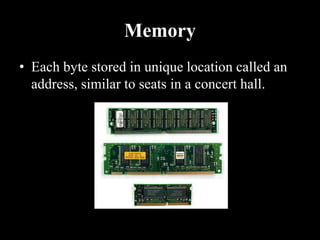
• Each byte stored in unique location called an
address, similar to seats in a concert hall.
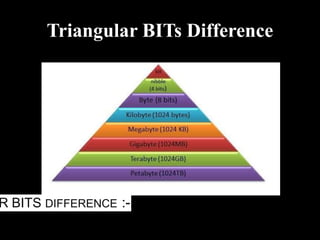
Triangular BITs Difference
R BITS DIFFERENCE :-
Importance of Memory
• Memory is important part of computer
• Without memory there would be no computer
• It is used for storing both data and instruction
execution
• The CPU accesses each location in the
memory by using technique number called
memory address
• Memory helps to save the data.
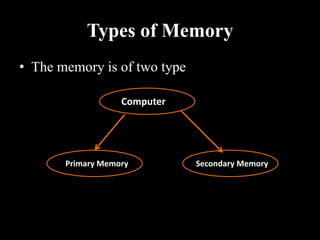
Types of Memory
• The memory is of two type
Computer
Primary Memory Secondary Memory
Primary Memory
• Primary memory is also known as “Main
Memory” or “Internal Memory”
• Which located in the mother board of system
• Or which is directly connected to the CPU
• It is the place where only little bit of data are
stored either by manufacturer or by user
• Is also called volatile memory
• It is a temporary memory
• In Primary memory data is lost when we turn
off the computer.
• We never store our data permanently in it
• Select the part of memory to store data but
doesn’t store data permanently
Types
• This is further divided into two parts
• RAM
• ROM
RAM
• Ram also known as “Random Access
Memory”
• It store the data which the user currently used
or it store the data temporary in it.
• RAM needs power on electricity to work when
the computer power is turned off then all the
data in it will be erased automatically.
RAM
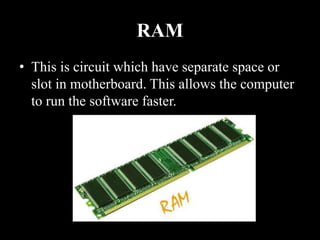
• This is circuit which have separate space or
slot in motherboard. This allows the computer
to run the software faster.
RAM Types
• Is classified into two parts
• SRAM(Static Random Access Memory)
• DRAM(Dynamic Random Access Memory)
SRAM
• Is known as Static Random Access Memory
• “Static” refers that the memory retains its
content as long as the power is supplied so
that’s why we can say this is volatile in nature.
• SRAM doesn’t need to be refreshed
periodically (as we known there are so many
programs runs in background).
• SRAM is faster but more expensive than
DRAM.
DRAM
• Known as Dynamic Random Access Memory
• It also contains data only when electricity is
available.
• DRAM need to refreshed periodically
• DRAM works slower than SRAM
• PC uses this RAM because it is much cheaper
than SRAM and requires less space.
ROM
• Known as Read Only Memory
• It can only read the data which in stored in it.
• This is mainly used by our computer when we
just turn on the computers,
• It contain BIOS of the system.
Type of ROM
• PROM
Programmable Read Only Memory
• EPROM
Erasable Programmable Read Only Memory
• EEPROM
Electrically Erasable Programmable Read Only
Memory
PROM
• Programmable Read Only Memory
• When data is stored then we have no right to
change or alter to it.
• In this data is written by manufacturer company,
even you can also purchase blank PROM chip but
it can programmed by special tool such as PROM
programmers.
• In general PC’s mainly PROM is used because we
don’t have to alter any data to it
EPROM
• Known as “Erasable PROM”.
• The word refer “erasable” means we can
change or erase the data.
• In EPROM we have right to change the data
• In this we can change the data with the help of
ultra violet rays.
• EPROM is much expensive than PROM.
EEPROM
• Known as “Elactrically Erasable PROM”
• The type of ROM which can be erased by
electrical charges.
• EEPROM can be erased one byte at anytime
rater than erasing the entire chip by ultra violet
rays.
Secondary Memory
• Store data in computer system through some
devices is known as SM.
• In this we can store the data so that when the
Data is needed we can easily retrieve it
• It is non volatile in nature so that we can not
loose the data when power supply is off
Cache Memory
• Cache memory is a small, high speed RAM
buffer located between the CPU and main
memory.
• Cache memory holds a copy of the instructions
or data currently being used by the CPU.
• The main purpose of a cache is to accelerate
your computer while keeping price of the
computer low.
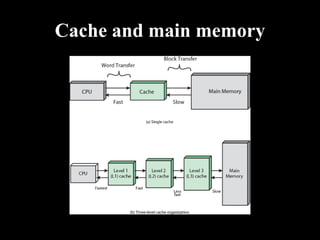
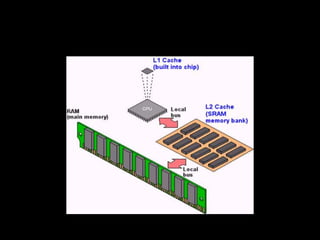
Cache and main memory
Levels of Cache
❖Level 1(L1) Cache: This cache is inbuilt in the processor and is made of SRAM(Static RAM)
Each time the processor requests information from memory, the cache controller on the chip uses
special circuitry to first check if the memory data is already in the cache. If it is present, then the
system is spared from time consuming access to the main memory. In a typical CPU, primary cache
ranges in size from 8 to 64 KB, with larger amounts on the newer processors. This type of Cache
Memory is very fast because it runs at the speed of the processor since it is integrated into it.
❖Level 2(L2) Cache: The L2 cache is larger but slower in speed than L1 cache. It is used to
see recent accesses that is not picked by L1 cache and is usually 64 to 2 MB in size. A L2 cache is
also found on the CPU. If L1 and L2 cache are used together, then the missing information that is
not present in L1 cache can be retrieved quickly from the L2 cache. Like L1 caches, L2 caches are
composed of SRAM but they are much larger. L2 is usually a separate static RAM (SRAM) chip
and it is placed between the CPU & DRAM(Main Memory)
❖Level 3(L3) Cache: L3 Cache memory is an enhanced form of memory present on the
motherboard of the computer. It is an extra cache built into the motherboard between the processor
and main memory to speed up the processing operations. It reduces the time gap between request
and retrieving of the data and instructions much more quickly than a main memory. L3 cache are
being used with processors nowadays, having more than 3 MB of storage in it.
cache memory and cloud computing technology

cache memory and cloud computing technology

  • 1.
  • 2.
    Memory • define asthe internal storage media of a Computer is called as “Memory” • User can save information, data and programs etc. • These instructions we can save in memory with the help of CPU
  • 3.
    Memory • Each bytestored in unique location called an address, similar to seats in a concert hall.
  • 4.
    Triangular BITs Difference RBITS DIFFERENCE :-
  • 5.
    Importance of Memory •Memory is important part of computer • Without memory there would be no computer • It is used for storing both data and instruction execution • The CPU accesses each location in the memory by using technique number called memory address • Memory helps to save the data.
  • 6.
    Types of Memory •The memory is of two type Computer Primary Memory Secondary Memory
  • 7.
    Primary Memory • Primarymemory is also known as “Main Memory” or “Internal Memory” • Which located in the mother board of system • Or which is directly connected to the CPU • It is the place where only little bit of data are stored either by manufacturer or by user
  • 8.
    • Is alsocalled volatile memory • It is a temporary memory • In Primary memory data is lost when we turn off the computer. • We never store our data permanently in it • Select the part of memory to store data but doesn’t store data permanently
  • 9.
    Types • This isfurther divided into two parts • RAM • ROM
  • 10.
    RAM • Ram alsoknown as “Random Access Memory” • It store the data which the user currently used or it store the data temporary in it. • RAM needs power on electricity to work when the computer power is turned off then all the data in it will be erased automatically.
  • 11.
    RAM • This iscircuit which have separate space or slot in motherboard. This allows the computer to run the software faster.
  • 12.
    RAM Types • Isclassified into two parts • SRAM(Static Random Access Memory) • DRAM(Dynamic Random Access Memory)
  • 13.
    SRAM • Is knownas Static Random Access Memory • “Static” refers that the memory retains its content as long as the power is supplied so that’s why we can say this is volatile in nature. • SRAM doesn’t need to be refreshed periodically (as we known there are so many programs runs in background). • SRAM is faster but more expensive than DRAM.
  • 14.
    DRAM • Known asDynamic Random Access Memory • It also contains data only when electricity is available. • DRAM need to refreshed periodically • DRAM works slower than SRAM • PC uses this RAM because it is much cheaper than SRAM and requires less space.
  • 15.
    ROM • Known asRead Only Memory • It can only read the data which in stored in it. • This is mainly used by our computer when we just turn on the computers, • It contain BIOS of the system.
  • 16.
    Type of ROM •PROM Programmable Read Only Memory • EPROM Erasable Programmable Read Only Memory • EEPROM Electrically Erasable Programmable Read Only Memory
  • 17.
    PROM • Programmable ReadOnly Memory • When data is stored then we have no right to change or alter to it. • In this data is written by manufacturer company, even you can also purchase blank PROM chip but it can programmed by special tool such as PROM programmers. • In general PC’s mainly PROM is used because we don’t have to alter any data to it
  • 18.
    EPROM • Known as“Erasable PROM”. • The word refer “erasable” means we can change or erase the data. • In EPROM we have right to change the data • In this we can change the data with the help of ultra violet rays. • EPROM is much expensive than PROM.
  • 19.
    EEPROM • Known as“Elactrically Erasable PROM” • The type of ROM which can be erased by electrical charges. • EEPROM can be erased one byte at anytime rater than erasing the entire chip by ultra violet rays.
  • 20.
    Secondary Memory • Storedata in computer system through some devices is known as SM. • In this we can store the data so that when the Data is needed we can easily retrieve it • It is non volatile in nature so that we can not loose the data when power supply is off
  • 21.
    Cache Memory • Cachememory is a small, high speed RAM buffer located between the CPU and main memory. • Cache memory holds a copy of the instructions or data currently being used by the CPU. • The main purpose of a cache is to accelerate your computer while keeping price of the computer low.
  • 22.
  • 23.
    Levels of Cache ❖Level1(L1) Cache: This cache is inbuilt in the processor and is made of SRAM(Static RAM) Each time the processor requests information from memory, the cache controller on the chip uses special circuitry to first check if the memory data is already in the cache. If it is present, then the system is spared from time consuming access to the main memory. In a typical CPU, primary cache ranges in size from 8 to 64 KB, with larger amounts on the newer processors. This type of Cache Memory is very fast because it runs at the speed of the processor since it is integrated into it. ❖Level 2(L2) Cache: The L2 cache is larger but slower in speed than L1 cache. It is used to see recent accesses that is not picked by L1 cache and is usually 64 to 2 MB in size. A L2 cache is also found on the CPU. If L1 and L2 cache are used together, then the missing information that is not present in L1 cache can be retrieved quickly from the L2 cache. Like L1 caches, L2 caches are composed of SRAM but they are much larger. L2 is usually a separate static RAM (SRAM) chip and it is placed between the CPU & DRAM(Main Memory) ❖Level 3(L3) Cache: L3 Cache memory is an enhanced form of memory present on the motherboard of the computer. It is an extra cache built into the motherboard between the processor and main memory to speed up the processing operations. It reduces the time gap between request and retrieving of the data and instructions much more quickly than a main memory. L3 cache are being used with processors nowadays, having more than 3 MB of storage in it.