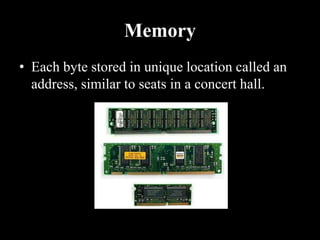
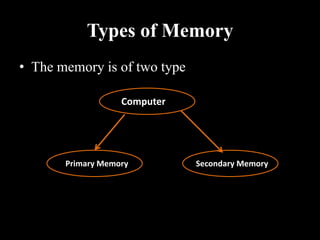
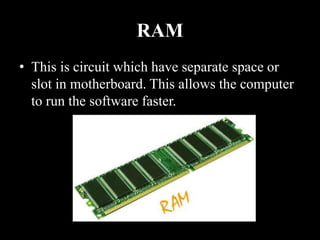
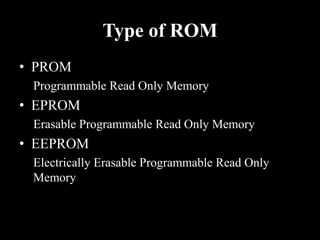
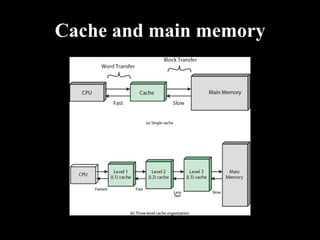
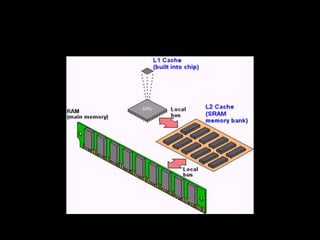
Memory can be either primary (main) memory or secondary memory. Primary memory, like RAM, is directly accessible by the CPU and volatile, meaning it loses data when powered off. It includes RAM (random access memory) and ROM (read only memory). RAM is used for temporary storage and comes in DRAM and SRAM types, while ROM stores permanent, unalterable data like the BIOS. Secondary memory, like hard disks, is non-volatile and used for long-term storage. Caches like L1, L2, and L3 caches improve performance by storing frequently used data and instructions between the CPU and main memory.