The Generation of Computers
Presented by:-
Introduction
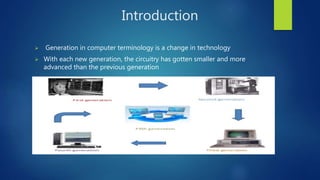
 Generation in computer terminology is a change in technology
 With each new generation, the circuitry has gotten smaller and more
advanced than the previous generation
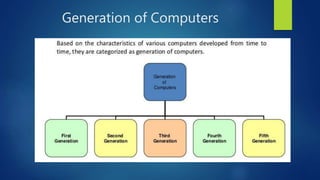
Generation of Computers
First Generation Computers
(1940-1956)
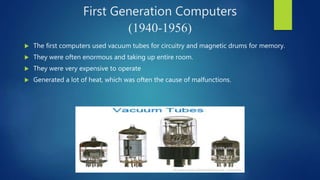
 The first computers used vacuum tubes for circuitry and magnetic drums for memory.
 They were often enormous and taking up entire room.
 They were very expensive to operate
 Generated a lot of heat, which was often the cause of malfunctions.
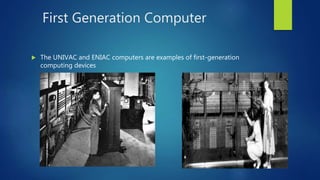
First Generation Computer
 The UNIVAC and ENIAC computers are examples of first-generation
computing devices
Second generation computers
(1956-1963)
 Transistors replaced vacuum tubes
 The transistor made computers smaller, less expensive and increased
calculating speeds.
 Consumed less electricity as compared to first generation computers
 High-level programming languages were also being developed at this time
 Second generation computers also saw a new way data was stored
 Some computers of this generation were −IBM 1620,IBM 7094,CDC 1604
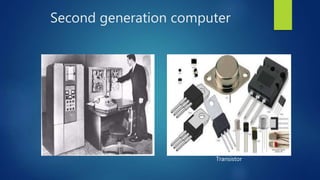
Second generation computer
Transistor
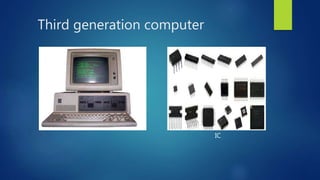
Third generation computers
(1963-1971)
 Transistors were replaced by integrated circuits(IC)
 One IC could replace hundreds of transistors
 This made computers even smaller and faster.
 Allowed the device to run many different applications at one time.
 Some computers of this generation were −IBM-360 series, PDP (Personal
Data Processor),IBM-370/168,TDC-316
Third generation computer
IC
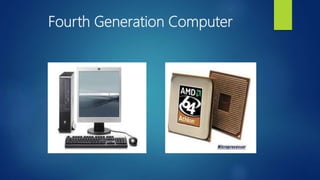
Fourth Generation Computer
(1971-1980)
 The microprocessor brought the fourth generation of computers
 thousands of integrated circuits were built onto a single silicon chip
 VLSI technology used
 Concept of internet was introduced
 Great developments in the fields of networks
 Some computers of this generation were −DEC 10, STAR 1000,PDP
11,CRAY-1(Super Computer),CRAY-X-MP(Super Computer)
Fourth Generation Computer
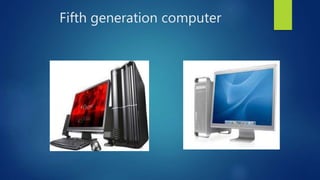
Fifth generation computers
(1980-present)
 VLSI technology became ULSI (Ultra Large Scale Integration) technology
 High performance, lower cost and very compact.
 Computers based on artificial intelligence are available.
 Portable note book computers introduced .
 Memory chips up to 1 GB, hard disk drives up to 180 GB and optical disks
up to 27 GB are available
 New brands and models would come out the market almost every other
month.
Fifth generation computer
Conclusion
 Computers became more affordable
 Computers can now be found in homes, schools, offices etc.
 There has been a tremendous improvement in software technology
 Computer subjects are now being offered not just to college students but
even to high school and elementary.
 Computers are now used as an aid in teaching math, science etc.
Thank You

Computer generation

  • 1.
    The Generation ofComputers Presented by:-
  • 2.
    Introduction  Generation incomputer terminology is a change in technology  With each new generation, the circuitry has gotten smaller and more advanced than the previous generation
  • 3.
  • 4.
    First Generation Computers (1940-1956) The first computers used vacuum tubes for circuitry and magnetic drums for memory.  They were often enormous and taking up entire room.  They were very expensive to operate  Generated a lot of heat, which was often the cause of malfunctions.
  • 5.
    First Generation Computer The UNIVAC and ENIAC computers are examples of first-generation computing devices
  • 6.
    Second generation computers (1956-1963) Transistors replaced vacuum tubes  The transistor made computers smaller, less expensive and increased calculating speeds.  Consumed less electricity as compared to first generation computers  High-level programming languages were also being developed at this time  Second generation computers also saw a new way data was stored  Some computers of this generation were −IBM 1620,IBM 7094,CDC 1604
  • 7.
  • 8.
    Third generation computers (1963-1971) Transistors were replaced by integrated circuits(IC)  One IC could replace hundreds of transistors  This made computers even smaller and faster.  Allowed the device to run many different applications at one time.  Some computers of this generation were −IBM-360 series, PDP (Personal Data Processor),IBM-370/168,TDC-316
  • 9.
  • 10.
    Fourth Generation Computer (1971-1980) The microprocessor brought the fourth generation of computers  thousands of integrated circuits were built onto a single silicon chip  VLSI technology used  Concept of internet was introduced  Great developments in the fields of networks  Some computers of this generation were −DEC 10, STAR 1000,PDP 11,CRAY-1(Super Computer),CRAY-X-MP(Super Computer)
  • 11.
  • 12.
    Fifth generation computers (1980-present) VLSI technology became ULSI (Ultra Large Scale Integration) technology  High performance, lower cost and very compact.  Computers based on artificial intelligence are available.  Portable note book computers introduced .  Memory chips up to 1 GB, hard disk drives up to 180 GB and optical disks up to 27 GB are available  New brands and models would come out the market almost every other month.
  • 13.
  • 14.
    Conclusion  Computers becamemore affordable  Computers can now be found in homes, schools, offices etc.  There has been a tremendous improvement in software technology  Computer subjects are now being offered not just to college students but even to high school and elementary.  Computers are now used as an aid in teaching math, science etc.
  • 15.