GENERATION OF COMPUTER
PRESENTED BY
Divyesh Anakiya
BCA 3RD
SEM
Enroll no:- 0060
CONTENTS
1. INTRODUCTION
2. GENERATION OF COMPUTER
3. TABLE
4. FIRST GENERATION OF COMPUTER
5. SECOND GENERATION OF COMPUTER
6. THIRD GENERATION OF COMPUTER
7. FOURTH GENERATION OF COMPUTER
8. FIFTH GENERATION OF COMPUTER
9. CONCLUSION
INTRODUCTION
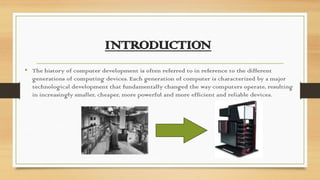
• The history of computer development is often referred to in reference to the different
generations of computing devices. Each generation of computer is characterized by a major
technological development that fundamentally changed the way computers operate, resulting
in increasingly smaller, cheaper, more powerful and more efficient and reliable devices.
GENERATION OF COMPUTER
• Since the evolution of IST computer in 1944, the size of computer has
decreased whereas the speed, capacity and reliability have increased
with the passage of time. Some notable landmarks in technology
responsible for this development are given below.
• Invention of Transistor
• Invention of IC’s
• Development of Microprocessor
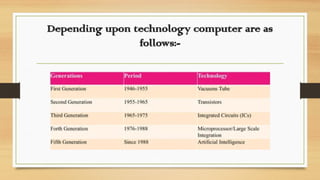
Depending upon technology computer are as
follows:-
First Generation
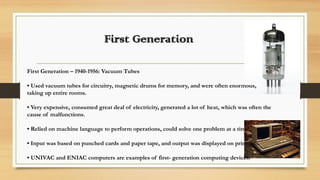
First Generation – 1940-1956: Vacuum Tubes
• Used vacuum tubes for circuitry, magnetic drums for memory, and were often enormous,
taking up entire rooms.
• Very expensive, consumed great deal of electricity, generated a lot of heat, which was often the
cause of malfunctions.
• Relied on machine language to perform operations, could solve one problem at a time.
• Input was based on punched cards and paper tape, and output was displayed on printouts.
• UNIVAC and ENIAC computers are examples of first- generation computing devices.
SECOND GENERATION
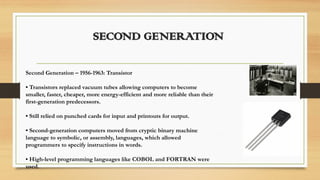
Second Generation – 1956-1963: Transistor
• Transistors replaced vacuum tubes allowing computers to become
smaller, faster, cheaper, more energy-efficient and more reliable than their
first-generation predecessors.
• Still relied on punched cards for input and printouts for output.
• Second-generation computers moved from cryptic binary machine
language to symbolic, or assembly, languages, which allowed
programmers to specify instructions in words.
• High-level programming languages like COBOL and FORTRAN were
used.
THIRD GENERATION
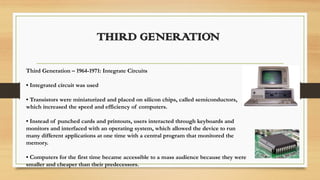
Third Generation – 1964-1971: Integrate Circuits
• Integrated circuit was used
• Transistors were miniaturized and placed on silicon chips, called semiconductors,
which increased the speed and efficiency of computers.
• Instead of punched cards and printouts, users interacted through keyboards and
monitors and interfaced with an operating system, which allowed the device to run
many different applications at one time with a central program that monitored the
memory.
• Computers for the first time became accessible to a mass audience because they were
smaller and cheaper than their predecessors.
FOURTH GENERATION
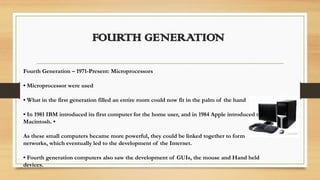
Fourth Generation – 1971-Present: Microprocessors
• Microprocessor were used
• What in the first generation filled an entire room could now fit in the palm of the hand
• In 1981 IBM introduced its first computer for the home user, and in 1984 Apple introduced the
Macintosh. •
As these small computers became more powerful, they could be linked together to form
networks, which eventually led to the development of the Internet.
• Fourth generation computers also saw the development of GUIs, the mouse and Hand held
devices.
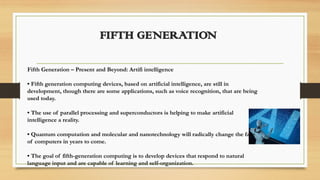
FIFTH GENERATION
Fifth Generation – Present and Beyond: Artifi intelligence
• Fifth generation computing devices, based on artificial intelligence, are still in
development, though there are some applications, such as voice recognition, that are being
used today.
• The use of parallel processing and superconductors is helping to make artificial
intelligence a reality.
• Quantum computation and molecular and nanotechnology will radically change the face
of computers in years to come.
• The goal of fifth-generation computing is to develop devices that respond to natural
language input and are capable of learning and self-organization.
CONCLUSION
• The evolution of the generations of computers has been a remarkable
journey marked by significant advancements and innovations. Each
generation has contributed to the modern computing landscape, from
the bulky yet revolutionary first generation to the highly sophisticated
fifth generation.
THANK YOU

Different Generation Of Computers .pptx

  • 1.
    GENERATION OF COMPUTER PRESENTEDBY Divyesh Anakiya BCA 3RD SEM Enroll no:- 0060
  • 2.
    CONTENTS 1. INTRODUCTION 2. GENERATIONOF COMPUTER 3. TABLE 4. FIRST GENERATION OF COMPUTER 5. SECOND GENERATION OF COMPUTER 6. THIRD GENERATION OF COMPUTER 7. FOURTH GENERATION OF COMPUTER 8. FIFTH GENERATION OF COMPUTER 9. CONCLUSION
  • 3.
    INTRODUCTION • The historyof computer development is often referred to in reference to the different generations of computing devices. Each generation of computer is characterized by a major technological development that fundamentally changed the way computers operate, resulting in increasingly smaller, cheaper, more powerful and more efficient and reliable devices.
  • 4.
    GENERATION OF COMPUTER •Since the evolution of IST computer in 1944, the size of computer has decreased whereas the speed, capacity and reliability have increased with the passage of time. Some notable landmarks in technology responsible for this development are given below. • Invention of Transistor • Invention of IC’s • Development of Microprocessor
  • 5.
    Depending upon technologycomputer are as follows:-
  • 6.
    First Generation First Generation– 1940-1956: Vacuum Tubes • Used vacuum tubes for circuitry, magnetic drums for memory, and were often enormous, taking up entire rooms. • Very expensive, consumed great deal of electricity, generated a lot of heat, which was often the cause of malfunctions. • Relied on machine language to perform operations, could solve one problem at a time. • Input was based on punched cards and paper tape, and output was displayed on printouts. • UNIVAC and ENIAC computers are examples of first- generation computing devices.
  • 7.
    SECOND GENERATION Second Generation– 1956-1963: Transistor • Transistors replaced vacuum tubes allowing computers to become smaller, faster, cheaper, more energy-efficient and more reliable than their first-generation predecessors. • Still relied on punched cards for input and printouts for output. • Second-generation computers moved from cryptic binary machine language to symbolic, or assembly, languages, which allowed programmers to specify instructions in words. • High-level programming languages like COBOL and FORTRAN were used.
  • 8.
    THIRD GENERATION Third Generation– 1964-1971: Integrate Circuits • Integrated circuit was used • Transistors were miniaturized and placed on silicon chips, called semiconductors, which increased the speed and efficiency of computers. • Instead of punched cards and printouts, users interacted through keyboards and monitors and interfaced with an operating system, which allowed the device to run many different applications at one time with a central program that monitored the memory. • Computers for the first time became accessible to a mass audience because they were smaller and cheaper than their predecessors.
  • 9.
    FOURTH GENERATION Fourth Generation– 1971-Present: Microprocessors • Microprocessor were used • What in the first generation filled an entire room could now fit in the palm of the hand • In 1981 IBM introduced its first computer for the home user, and in 1984 Apple introduced the Macintosh. • As these small computers became more powerful, they could be linked together to form networks, which eventually led to the development of the Internet. • Fourth generation computers also saw the development of GUIs, the mouse and Hand held devices.
  • 10.
    FIFTH GENERATION Fifth Generation– Present and Beyond: Artifi intelligence • Fifth generation computing devices, based on artificial intelligence, are still in development, though there are some applications, such as voice recognition, that are being used today. • The use of parallel processing and superconductors is helping to make artificial intelligence a reality. • Quantum computation and molecular and nanotechnology will radically change the face of computers in years to come. • The goal of fifth-generation computing is to develop devices that respond to natural language input and are capable of learning and self-organization.
  • 11.
    CONCLUSION • The evolutionof the generations of computers has been a remarkable journey marked by significant advancements and innovations. Each generation has contributed to the modern computing landscape, from the bulky yet revolutionary first generation to the highly sophisticated fifth generation.
  • 12.