INFORMATION TECHNOLOGY
GENERATION OF COMPUTERS
GRADE 7
Created By. A. Edwards-Williams
Computers can be broadly classified into five (5 )
generations. These generations are based mainly
on the basic electronic component that was used
to build the computer
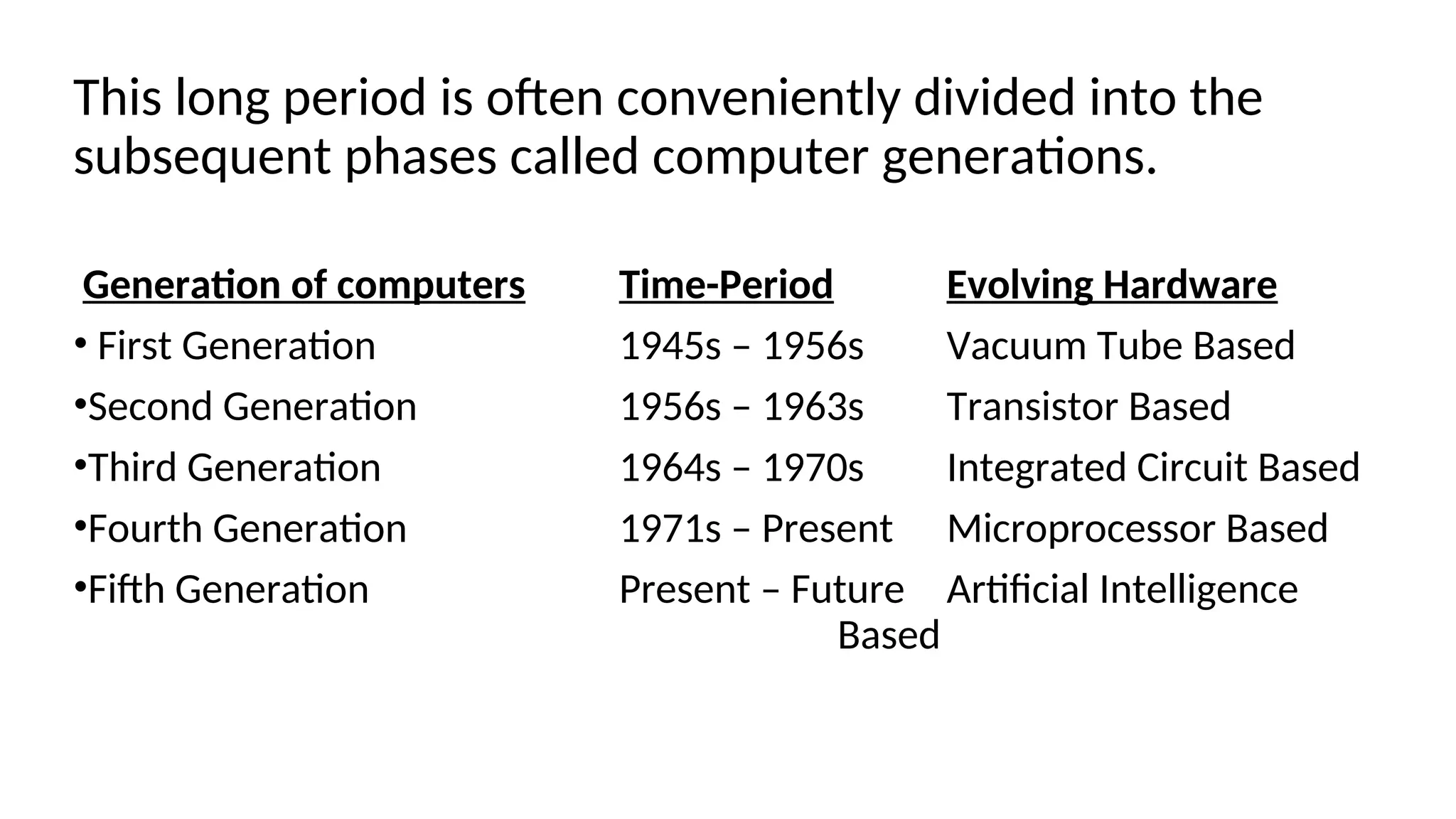
This long period is often conveniently divided into the
subsequent phases called computer generations.
Generation of computers Time-Period Evolving Hardware
• First Generation 1945s – 1956s Vacuum Tube Based
•Second Generation 1956s – 1963s Transistor Based
•Third Generation 1964s – 1970s Integrated Circuit Based
•Fourth Generation 1971s – Present Microprocessor Based
•Fifth Generation Present – Future Artificial Intelligence
Based
First Generation Computers
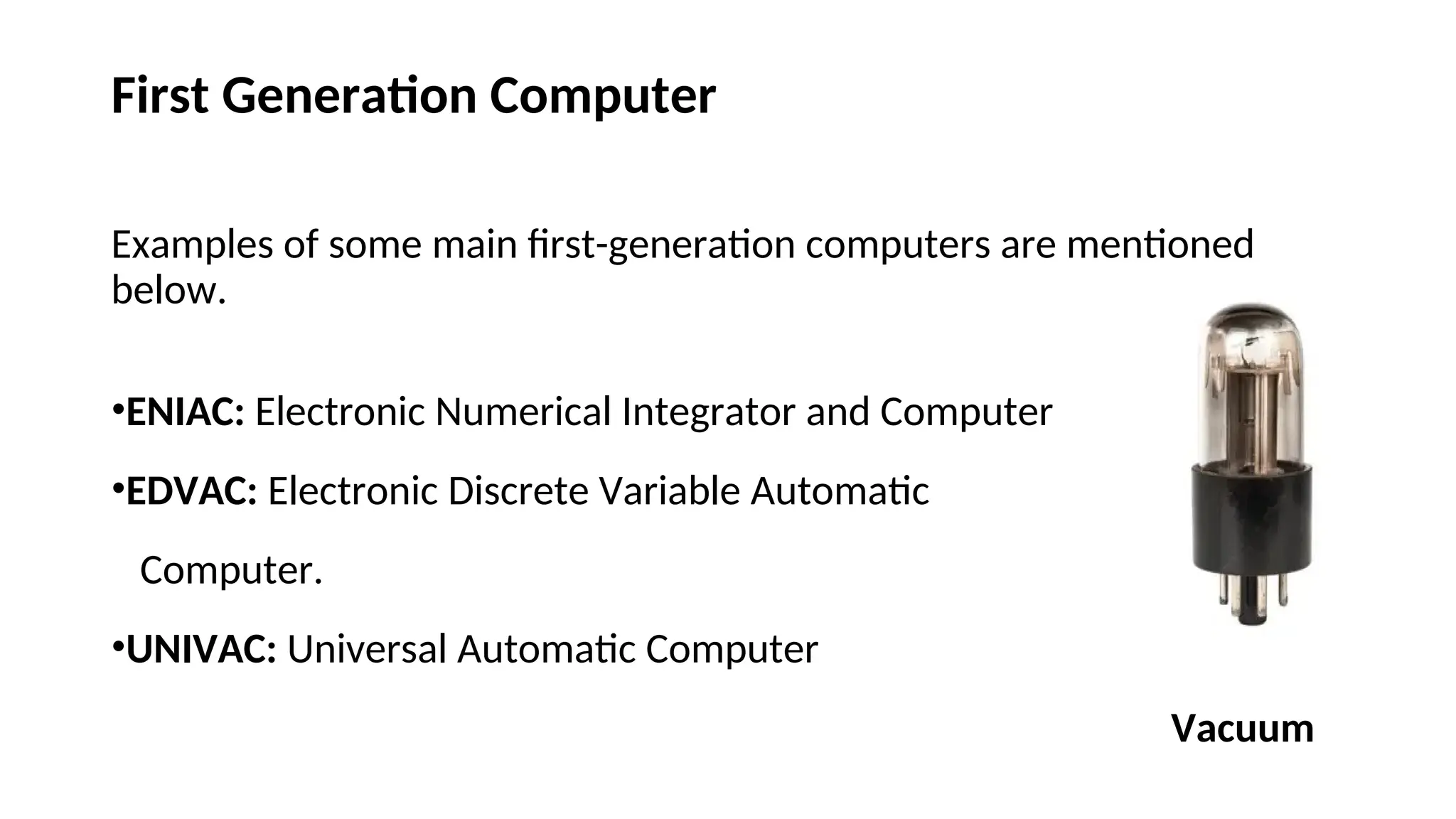
The technology behind the primary generation computers was
a fragile glass device, which was called a vacuum tube.
These computers were very heavy and really large.
First-generation computers were used for calculation, storage,
and control purpose.
They were too bulky and large that they needed a full room and
consume a lot of electricity.
First Generation Computer
Examples of some main first-generation computers are mentioned
below.
•ENIAC: Electronic Numerical Integrator and Computer
•EDVAC: Electronic Discrete Variable Automatic
Computer.
•UNIVAC: Universal Automatic Computer
Vacuum
The main features of the First Generation
• Vacuum tube technology
• Unreliable
• Supported machine language only
• Very costly
• Generated a lot of heat
• Slow input and output devices
• Huge size
• Need of AC
• Non-portable
• Consumed a lot of electricity
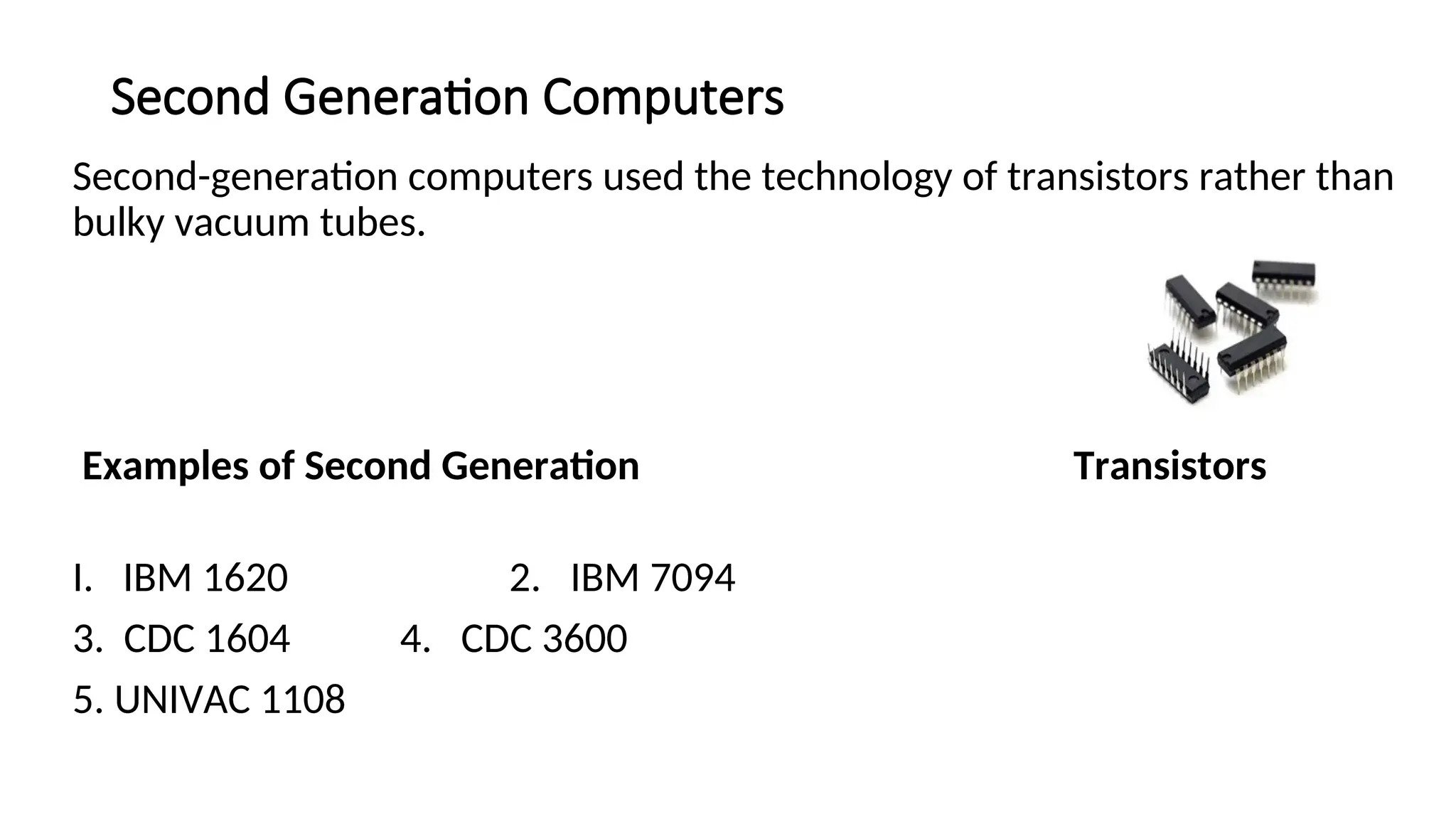
Second Generation Computers
Second-generation computers used the technology of transistors rather than
bulky vacuum tubes.
Examples of Second Generation Transistors
I. IBM 1620 2. IBM 7094
3. CDC 1604 4. CDC 3600
5. UNIVAC 1108
The main features of Second Generation
• Use of transistors
• Reliable in comparison to first generation computers
• Smaller size as compared to first generation computers
• Generated less heat as compared to first generation computers
• Consumed less electricity as compared to first generation
computers
• Faster than first generation computers
• Still very costly
• AC required
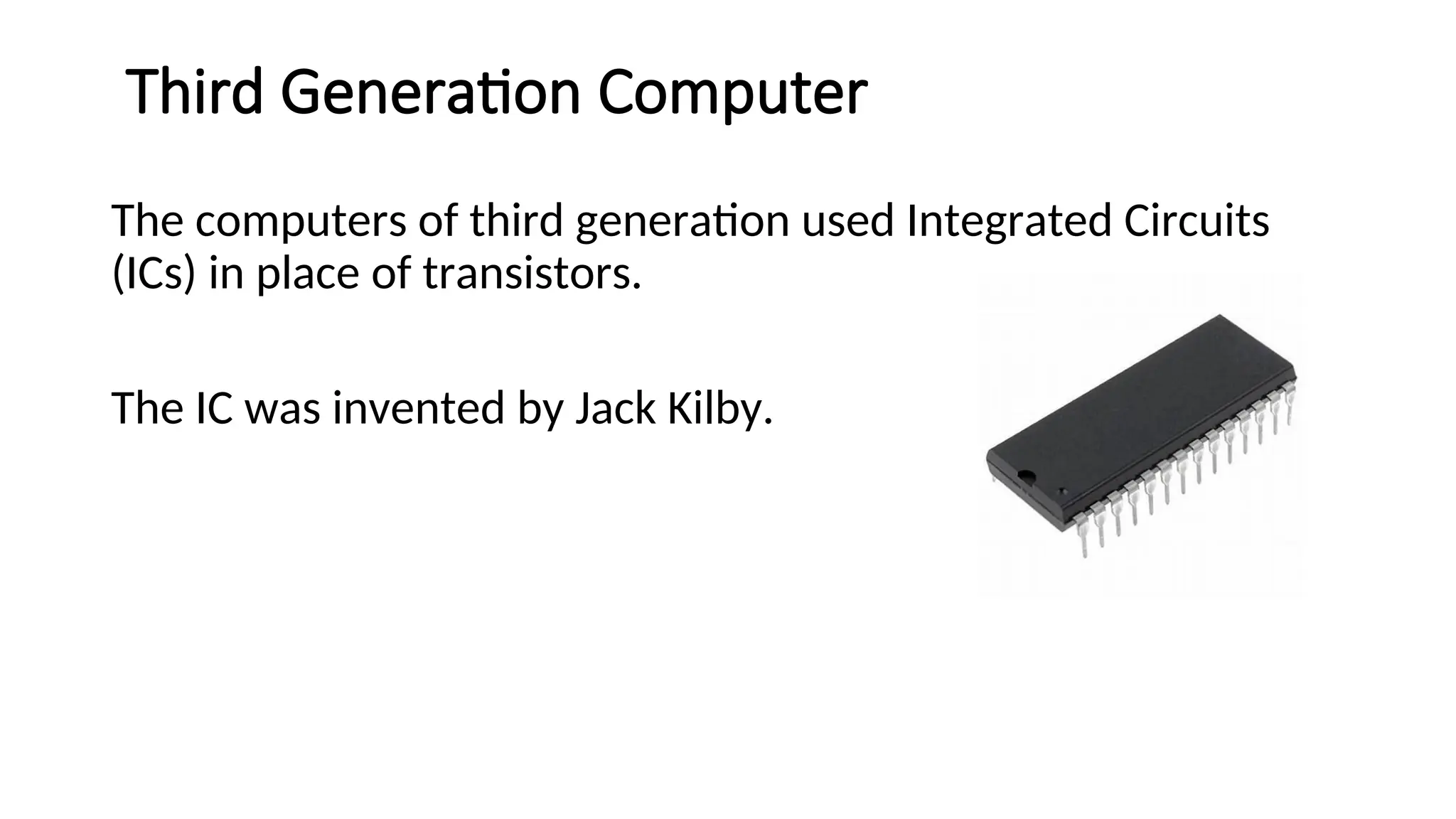
Third Generation Computer
The computers of third generation used Integrated Circuits
(ICs) in place of transistors.
The IC was invented by Jack Kilby.
The main features of Third Generation
• More reliable in comparison to previous two generations
• Smaller size
• Generated less heat
• Faster
• Lesser maintenance
• Costly
• AC required
• Consumed lesser electricity
Some computers of this generation
•IBM-360 series
•Honeywell-6000 series
•PDP (Personal Data Processor)
•IBM-370/168
•TDC-316
Fourth Generation Computer
The fourth generation generation used Very Large Scale
Integrated (VLSI) circuits.
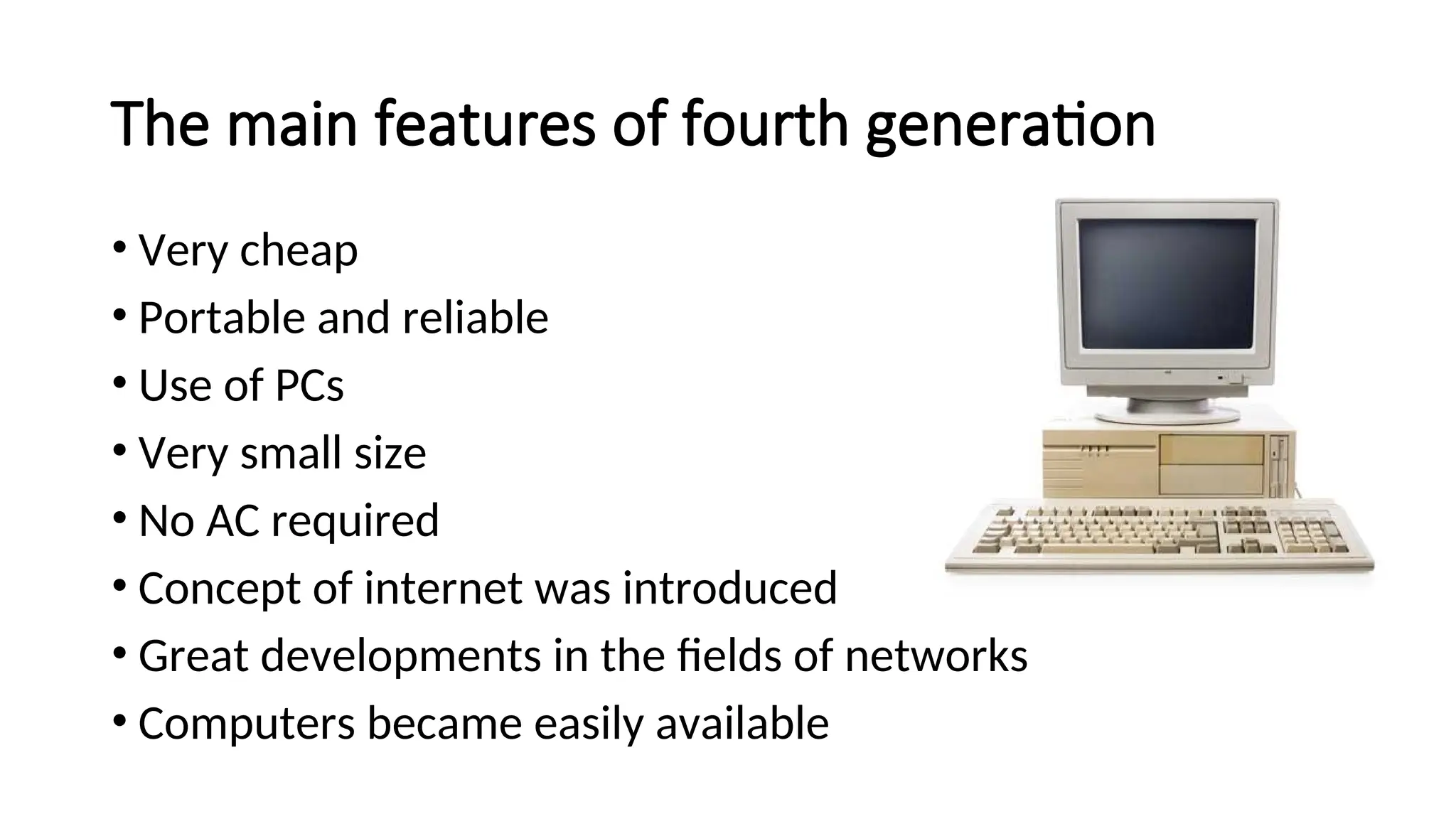
The main features of fourth generation
• Very cheap
• Portable and reliable
• Use of PCs
• Very small size
• No AC required
• Concept of internet was introduced
• Great developments in the fields of networks
• Computers became easily available
Some computers of this generation
• DEC 10
• STAR 1000
• PDP 11
• CRAY-1(Super Computer)
• CRAY-X-MP(Super Computer)
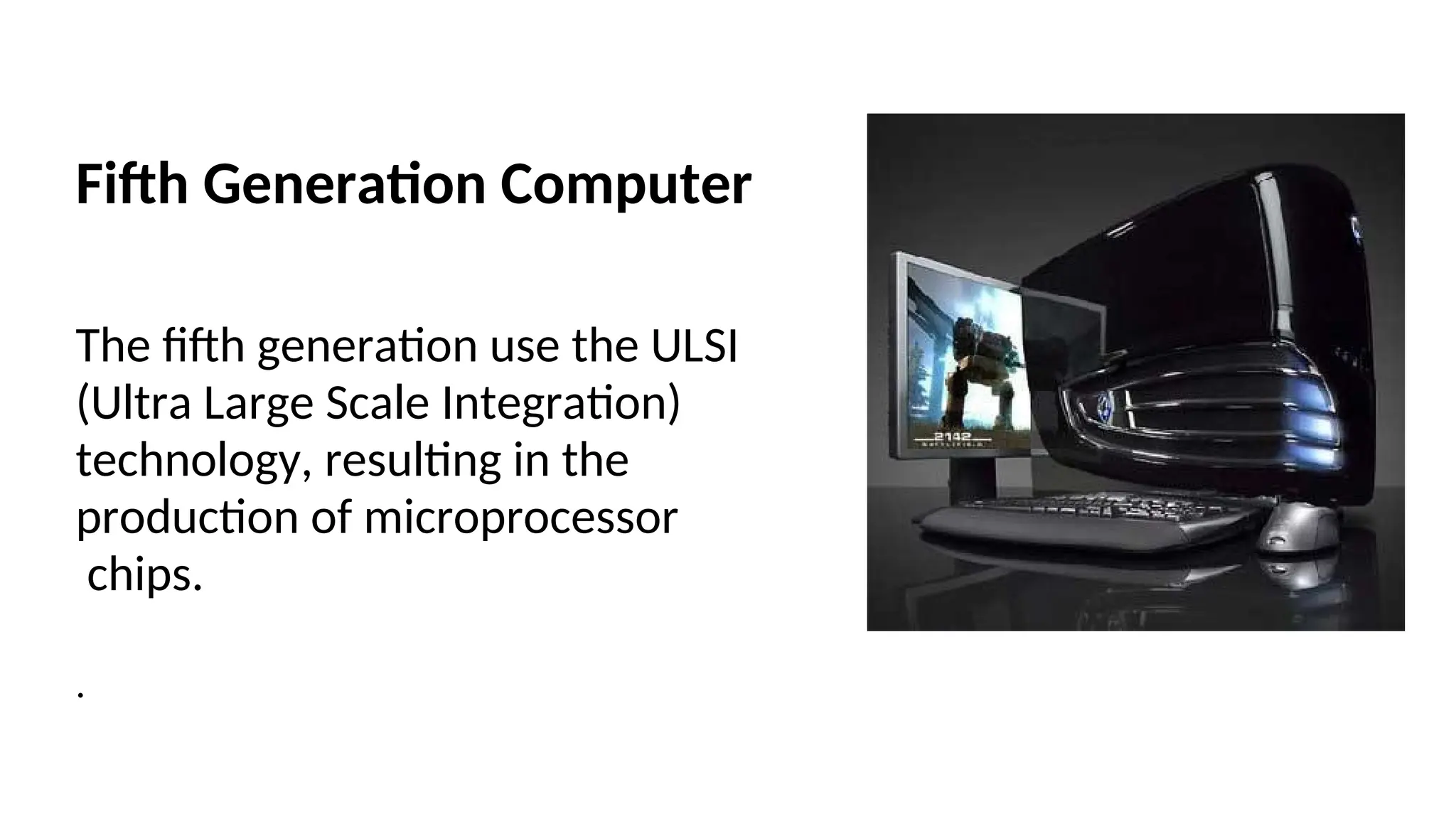
Fifth Generation Computer
The fifth generation use the ULSI
(Ultra Large Scale Integration)
technology, resulting in the
production of microprocessor
chips.
.
This generation is based on parallel processing
hardware and AI (Artificial Intelligence) software. AI is
an emerging branch in computer science, which
interprets the means and method of making computers
think like human beings.
All the high-level languages like C and C++, Java, etc are
used in this generation
AI includes:
• Robotics
•Networks
•Game Playing
•Development of expert systems to make decisions in
real-life situations
•Natural language
The main features of fifth generation
•Development of true artificial intelligence
•Development of Natural language processing
•Advancement in Parallel Processing
•More user-friendly interfaces with multimedia
features
•Availability of very powerful and compact computers
at cheaper rates
Some computer types of this generation
•Desktop
•Laptop
•Note Book
•Ultra Book
•Chrome Book
Class Work
1 (a) Which type of chip is used in fifth-generation computers?
(1 mark)
(b) State Two (2) features of fifth-generation computers? (2 marks)
2. List the component that formed the basis of the first to fourth
generations of computers (4 marks)
Reference
https://www.tutorialspoint.com/computer_fundamentals/computer_fi
rst_generation.htm

GENERATION OF COMPUTERS: ALL 5 GENERATIONS.ppt

  • 1.
    INFORMATION TECHNOLOGY GENERATION OFCOMPUTERS GRADE 7 Created By. A. Edwards-Williams
  • 2.
    Computers can bebroadly classified into five (5 ) generations. These generations are based mainly on the basic electronic component that was used to build the computer
  • 3.
    This long periodis often conveniently divided into the subsequent phases called computer generations. Generation of computers Time-Period Evolving Hardware • First Generation 1945s – 1956s Vacuum Tube Based •Second Generation 1956s – 1963s Transistor Based •Third Generation 1964s – 1970s Integrated Circuit Based •Fourth Generation 1971s – Present Microprocessor Based •Fifth Generation Present – Future Artificial Intelligence Based
  • 4.
    First Generation Computers Thetechnology behind the primary generation computers was a fragile glass device, which was called a vacuum tube. These computers were very heavy and really large. First-generation computers were used for calculation, storage, and control purpose. They were too bulky and large that they needed a full room and consume a lot of electricity.
  • 5.
    First Generation Computer Examplesof some main first-generation computers are mentioned below. •ENIAC: Electronic Numerical Integrator and Computer •EDVAC: Electronic Discrete Variable Automatic Computer. •UNIVAC: Universal Automatic Computer Vacuum
  • 6.
    The main featuresof the First Generation • Vacuum tube technology • Unreliable • Supported machine language only • Very costly • Generated a lot of heat • Slow input and output devices • Huge size • Need of AC • Non-portable • Consumed a lot of electricity
  • 7.
    Second Generation Computers Second-generationcomputers used the technology of transistors rather than bulky vacuum tubes. Examples of Second Generation Transistors I. IBM 1620 2. IBM 7094 3. CDC 1604 4. CDC 3600 5. UNIVAC 1108
  • 8.
    The main featuresof Second Generation • Use of transistors • Reliable in comparison to first generation computers • Smaller size as compared to first generation computers • Generated less heat as compared to first generation computers • Consumed less electricity as compared to first generation computers • Faster than first generation computers • Still very costly • AC required
  • 9.
    Third Generation Computer Thecomputers of third generation used Integrated Circuits (ICs) in place of transistors. The IC was invented by Jack Kilby.
  • 10.
    The main featuresof Third Generation • More reliable in comparison to previous two generations • Smaller size • Generated less heat • Faster • Lesser maintenance • Costly • AC required • Consumed lesser electricity
  • 11.
    Some computers ofthis generation •IBM-360 series •Honeywell-6000 series •PDP (Personal Data Processor) •IBM-370/168 •TDC-316
  • 12.
    Fourth Generation Computer Thefourth generation generation used Very Large Scale Integrated (VLSI) circuits.
  • 13.
    The main featuresof fourth generation • Very cheap • Portable and reliable • Use of PCs • Very small size • No AC required • Concept of internet was introduced • Great developments in the fields of networks • Computers became easily available
  • 14.
    Some computers ofthis generation • DEC 10 • STAR 1000 • PDP 11 • CRAY-1(Super Computer) • CRAY-X-MP(Super Computer)
  • 15.
    Fifth Generation Computer Thefifth generation use the ULSI (Ultra Large Scale Integration) technology, resulting in the production of microprocessor chips. .
  • 16.
    This generation isbased on parallel processing hardware and AI (Artificial Intelligence) software. AI is an emerging branch in computer science, which interprets the means and method of making computers think like human beings. All the high-level languages like C and C++, Java, etc are used in this generation
  • 17.
    AI includes: • Robotics •Networks •GamePlaying •Development of expert systems to make decisions in real-life situations •Natural language
  • 18.
    The main featuresof fifth generation •Development of true artificial intelligence •Development of Natural language processing •Advancement in Parallel Processing •More user-friendly interfaces with multimedia features •Availability of very powerful and compact computers at cheaper rates
  • 19.
    Some computer typesof this generation •Desktop •Laptop •Note Book •Ultra Book •Chrome Book
  • 20.
    Class Work 1 (a)Which type of chip is used in fifth-generation computers? (1 mark) (b) State Two (2) features of fifth-generation computers? (2 marks) 2. List the component that formed the basis of the first to fourth generations of computers (4 marks)
  • 21.