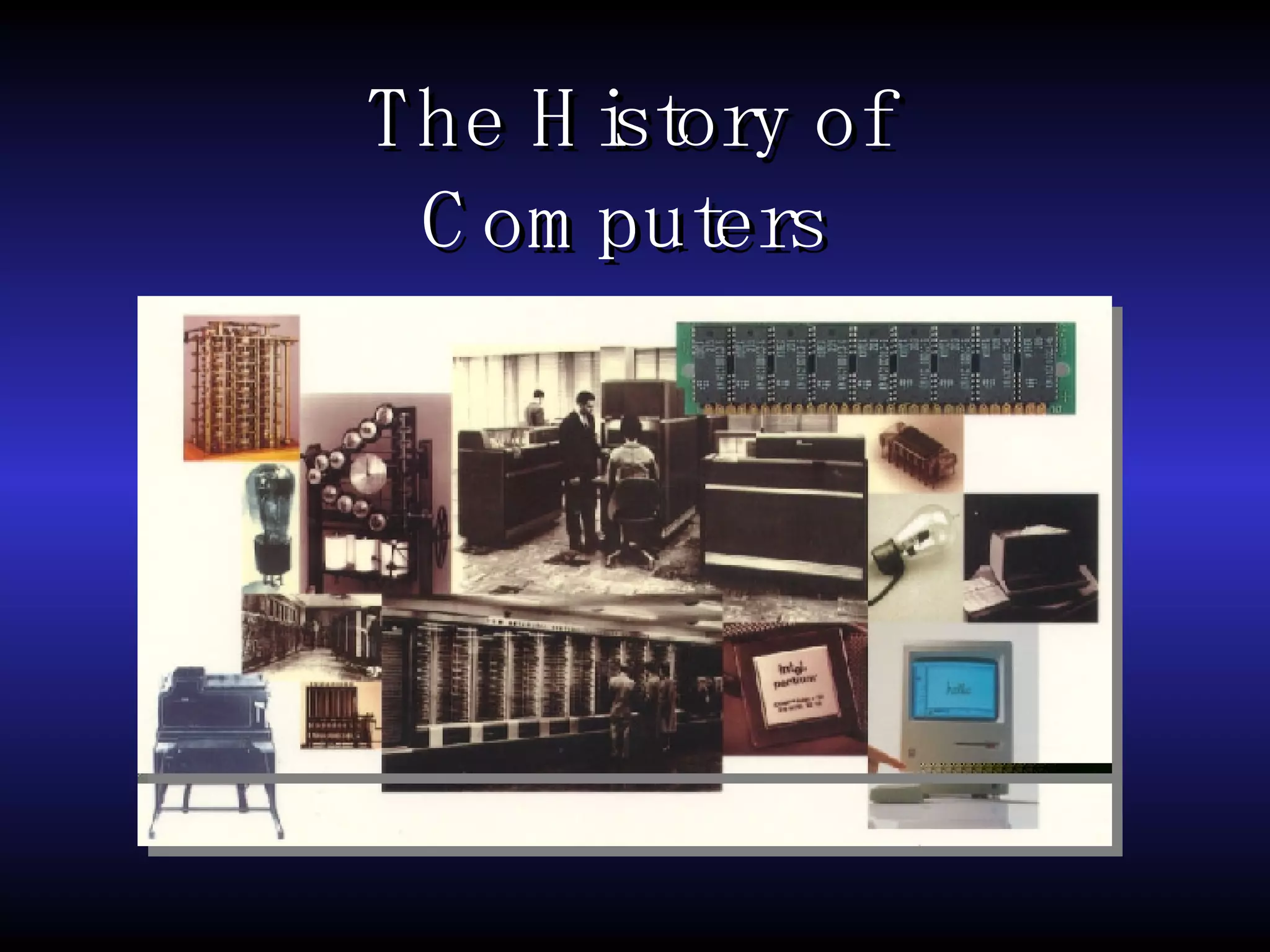
The document summarizes the history of computers from ancient counting machines to modern electronic computers. It describes the evolution from early counting devices like the abacus to modern programmable electronic computers using integrated circuits and microprocessors. Key developments included Charles Babbage's analytical engine, Herman Hollerith's tabulating machine, ENIAC as the first general-purpose electronic computer, the invention of the transistor and integrated circuit, and the introduction of the Altair computer, IBM PC, and Macintosh launching the personal computer revolution.
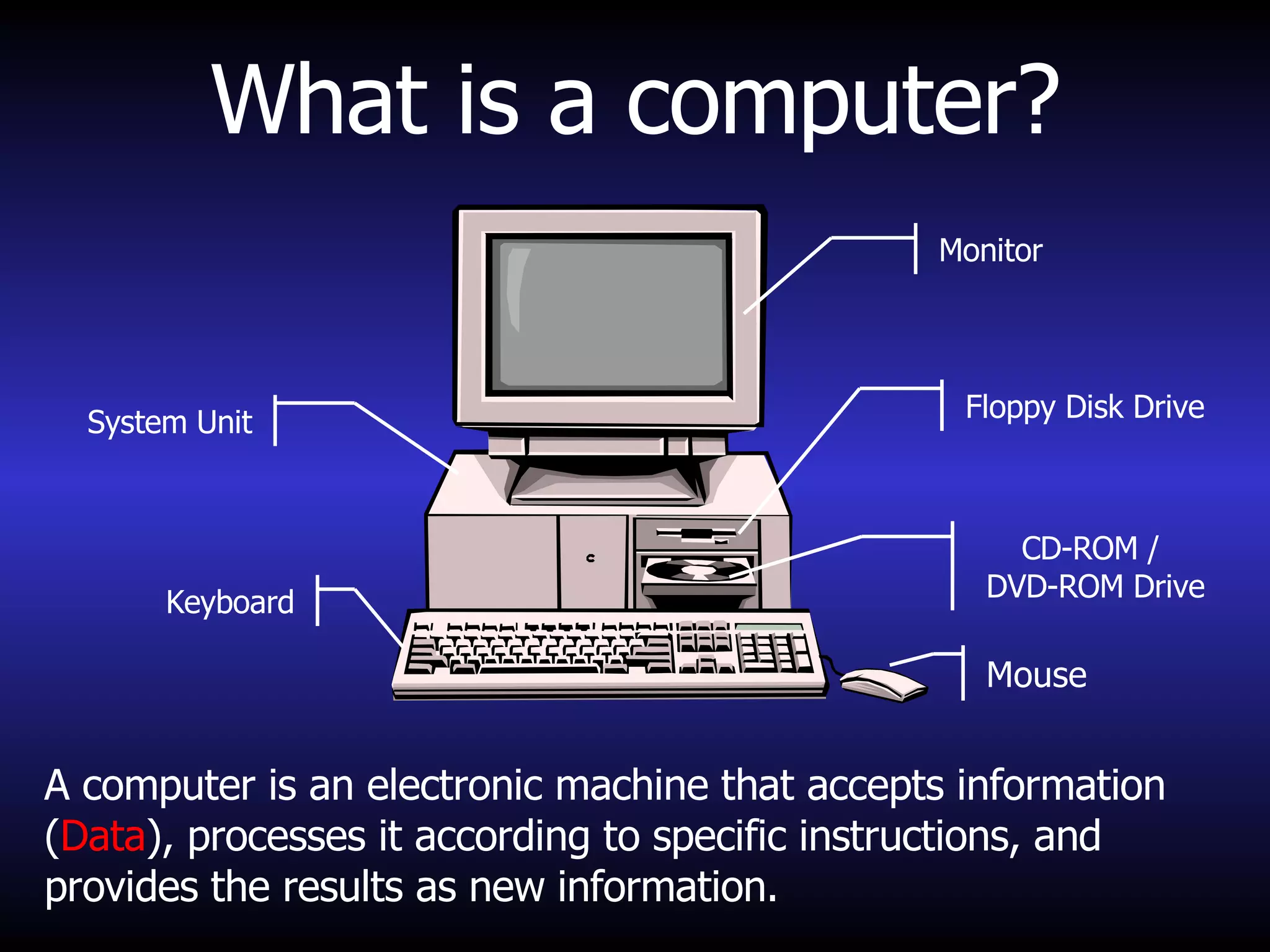
What is acomputer? A computer is an electronic machine that accepts information ( Data ), processes it according to specific instructions, and provides the results as new information. Monitor Floppy Disk Drive System Unit Keyboard CD-ROM / DVD-ROM Drive Mouse
3.
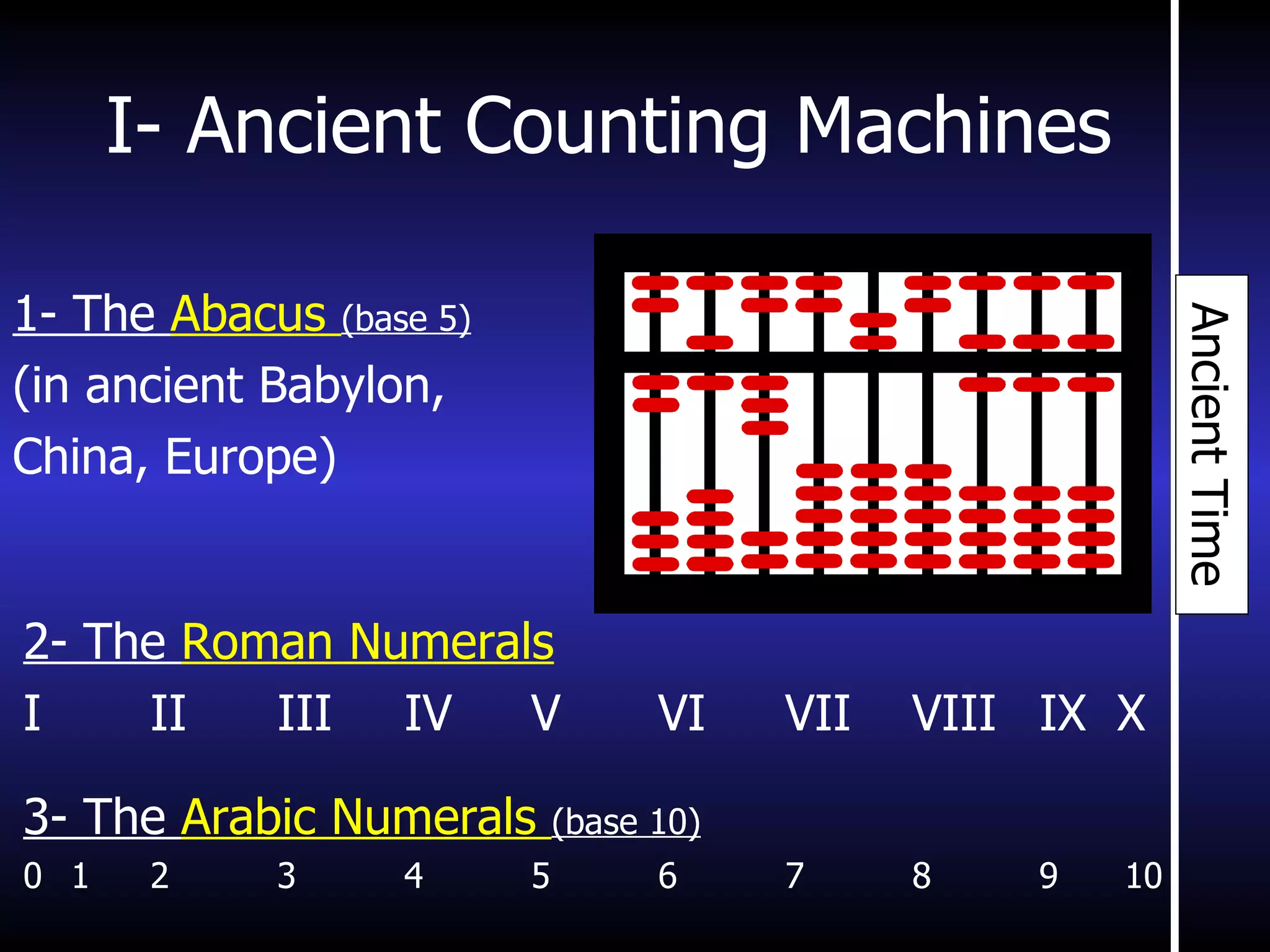
I- Ancient CountingMachines 1- The Abacus (base 5) (in ancient Babylon, China, Europe) 2- The Roman Numerals I II III IV V VI VII VIII IX X 3- The Arabic Numerals (base 10) 0 1 2 3 4 5 6 7 8 9 10 Ancient Time
4.
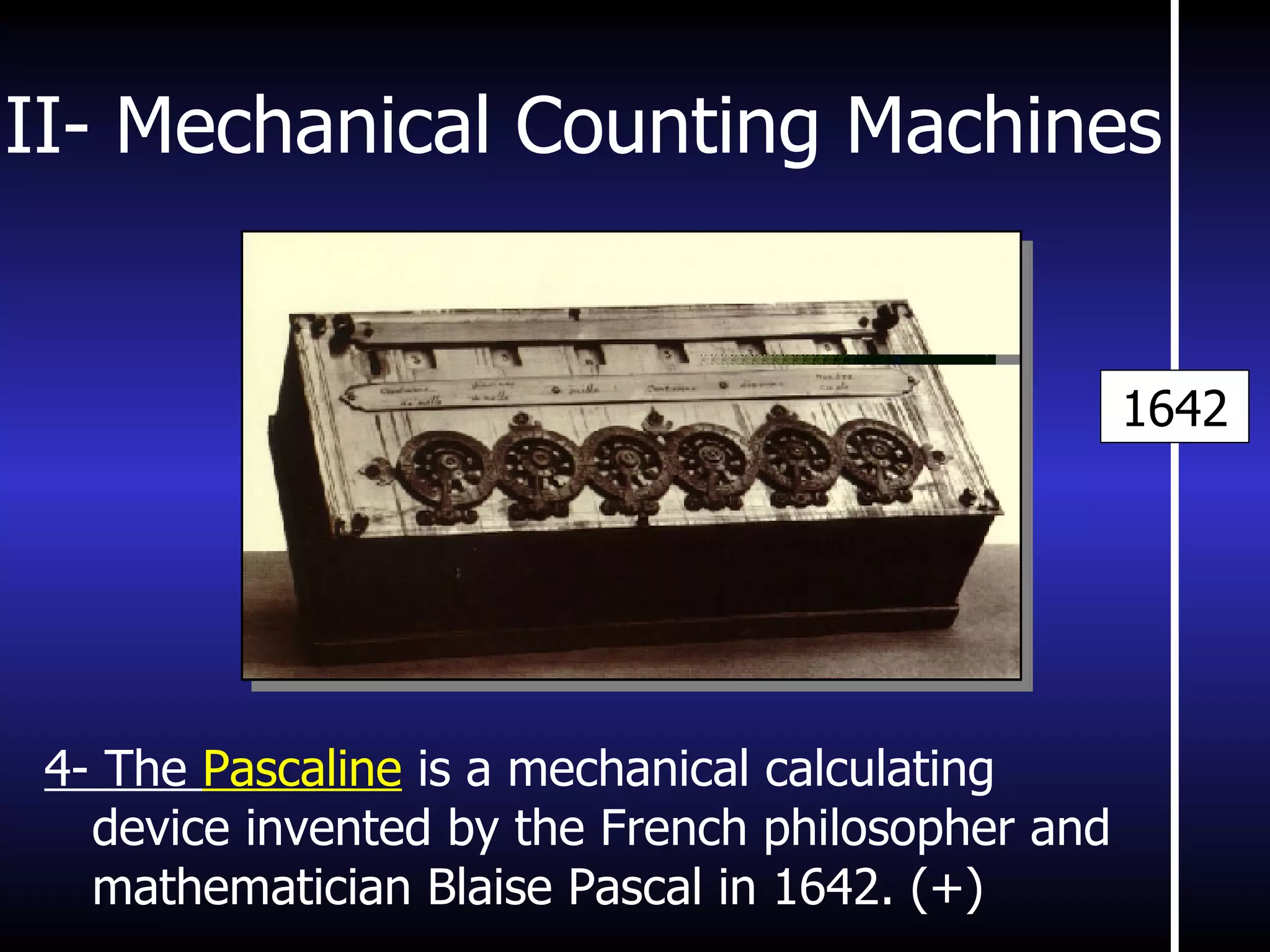
II- Mechanical CountingMachines 4- The Pascaline is a mechanical calculating device invented by the French philosopher and mathematician Blaise Pascal in 1642. (+) 1642
5.
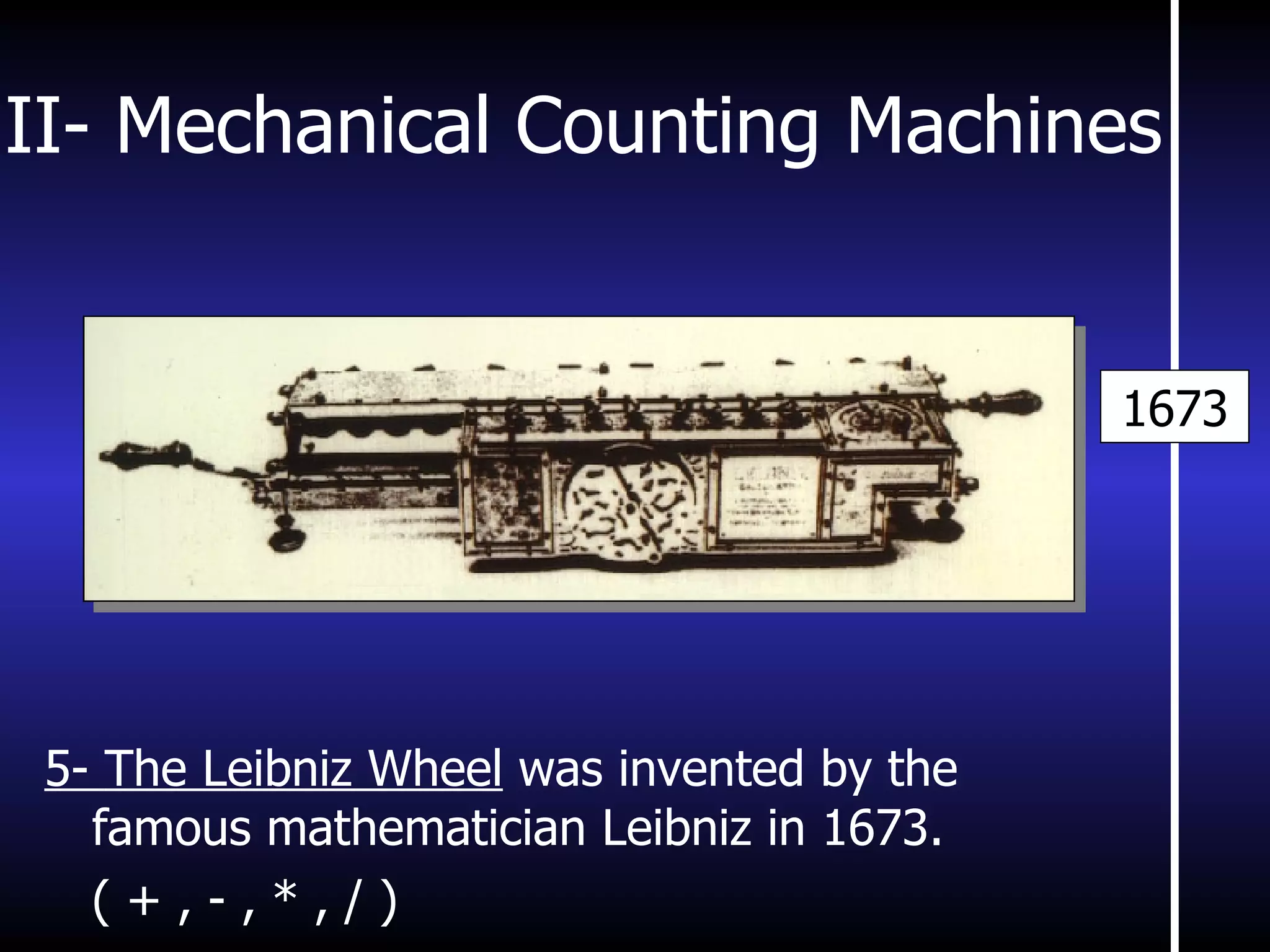
II- Mechanical CountingMachines 5- The Leibniz Wheel was invented by the famous mathematician Leibniz in 1673. ( + , - , * , / ) 1673
6.
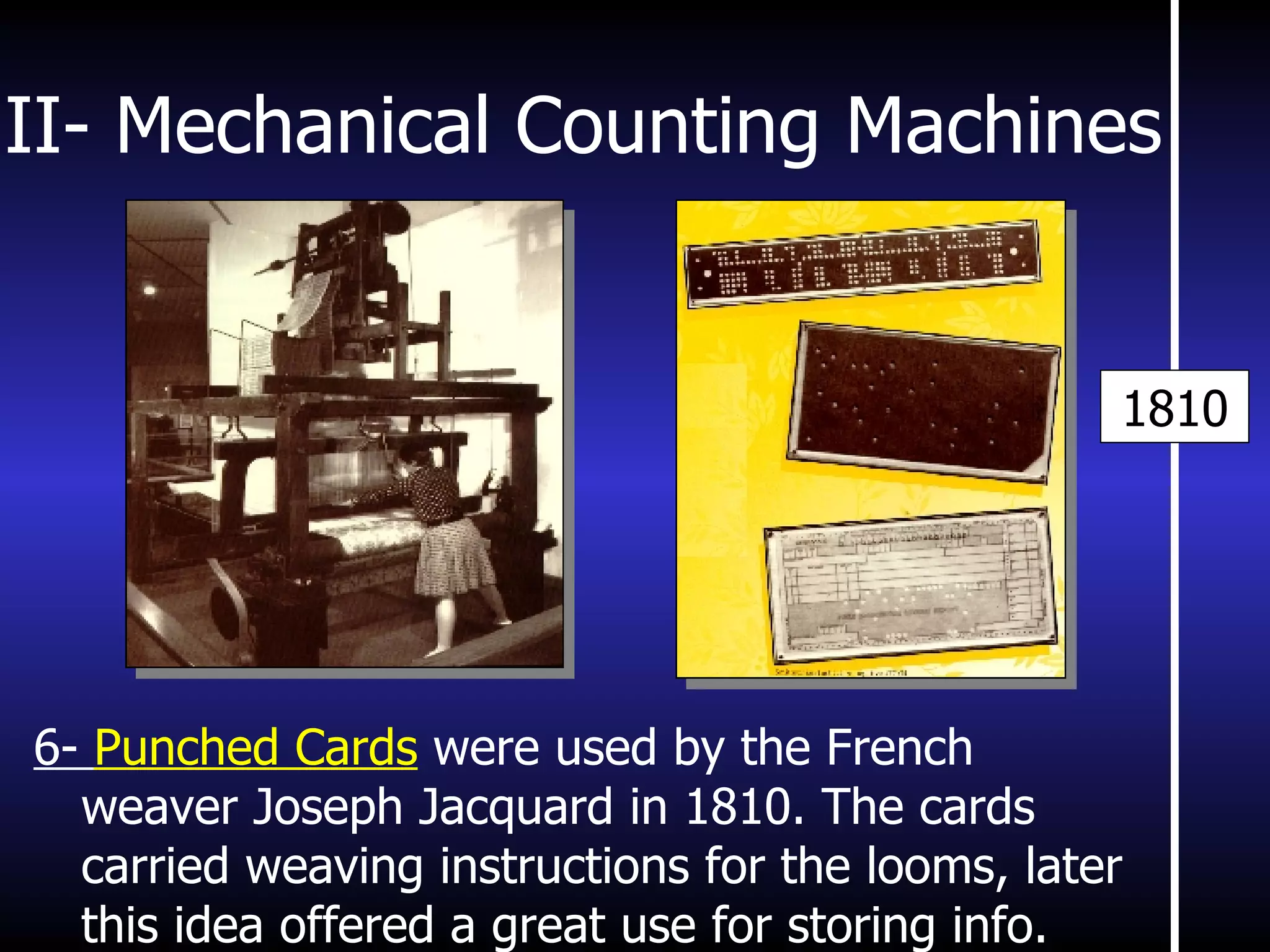
II- Mechanical CountingMachines 6- Punched Cards were used by the French weaver Joseph Jacquard in 1810. The cards carried weaving instructions for the looms, later this idea offered a great use for storing info. 1810
7.
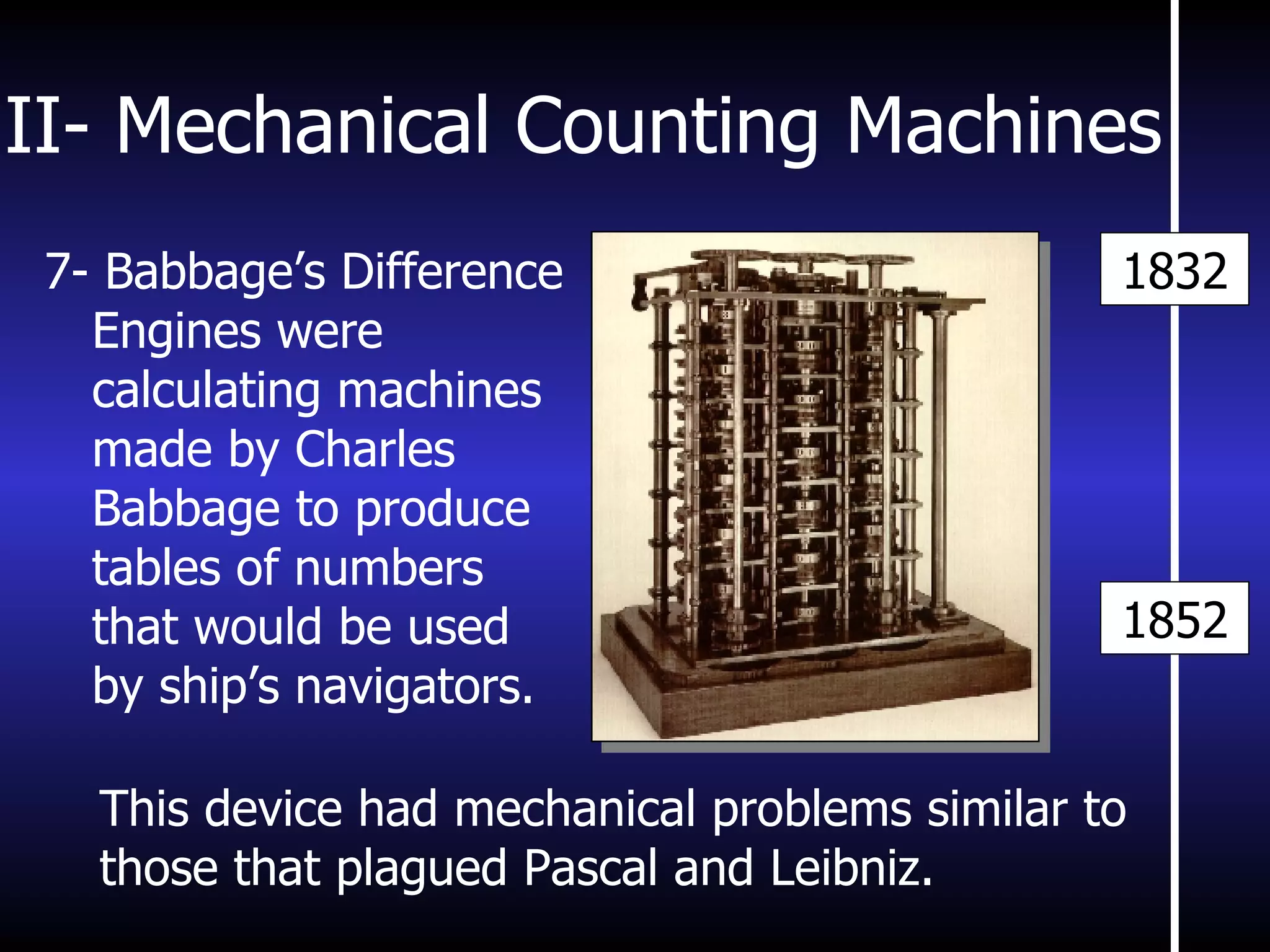
II- Mechanical CountingMachines 7- Babbage’s Difference Engines were calculating machines made by Charles Babbage to produce tables of numbers that would be used by ship’s navigators. 1852 1832 This device had mechanical problems similar to those that plagued Pascal and Leibniz.
8.
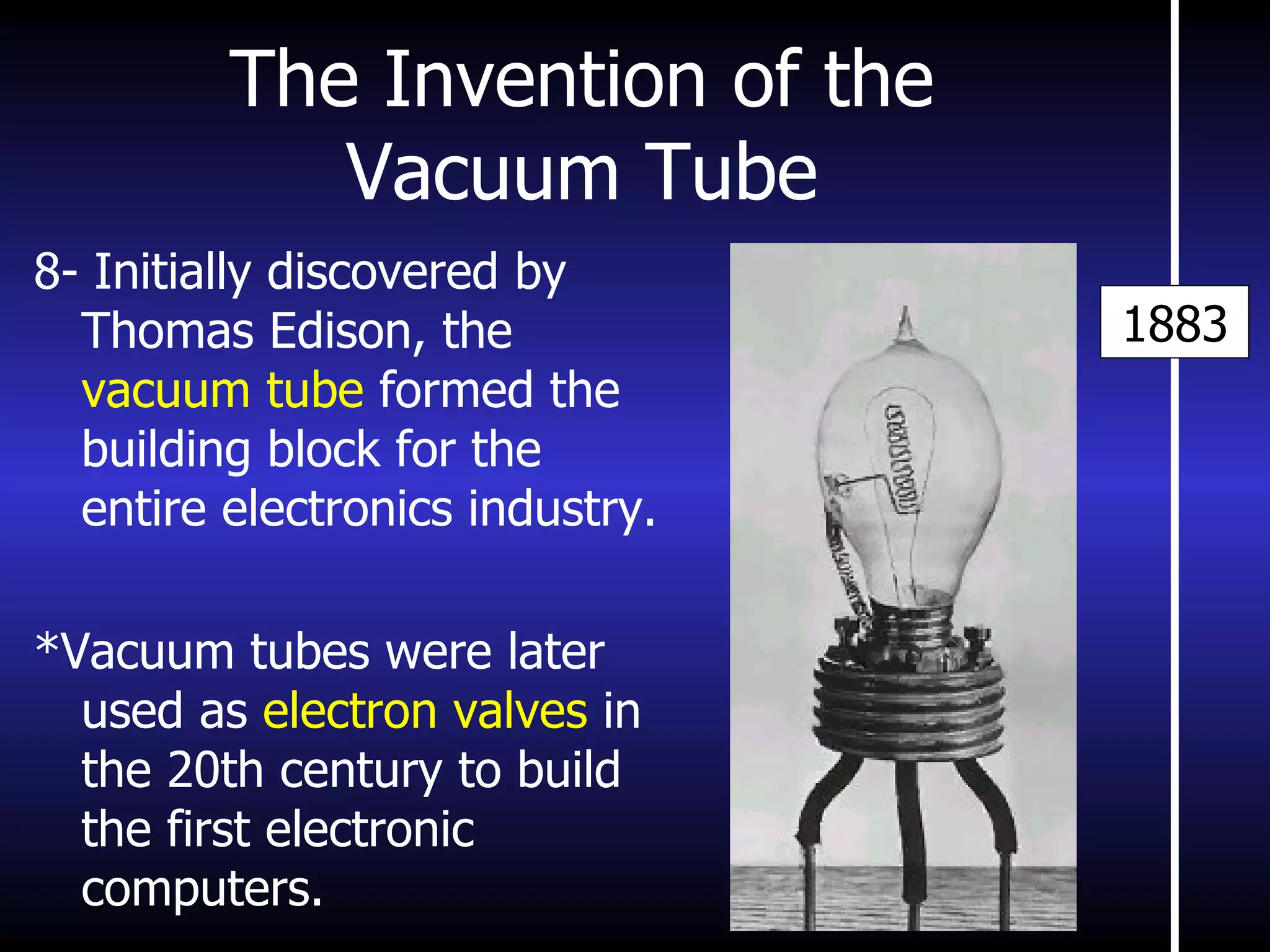
The Invention ofthe Vacuum Tube 8- Initially discovered by Thomas Edison, the vacuum tube formed the building block for the entire electronics industry. *Vacuum tubes were later used as electron valves in the 20th century to build the first electronic computers. 1883
9.
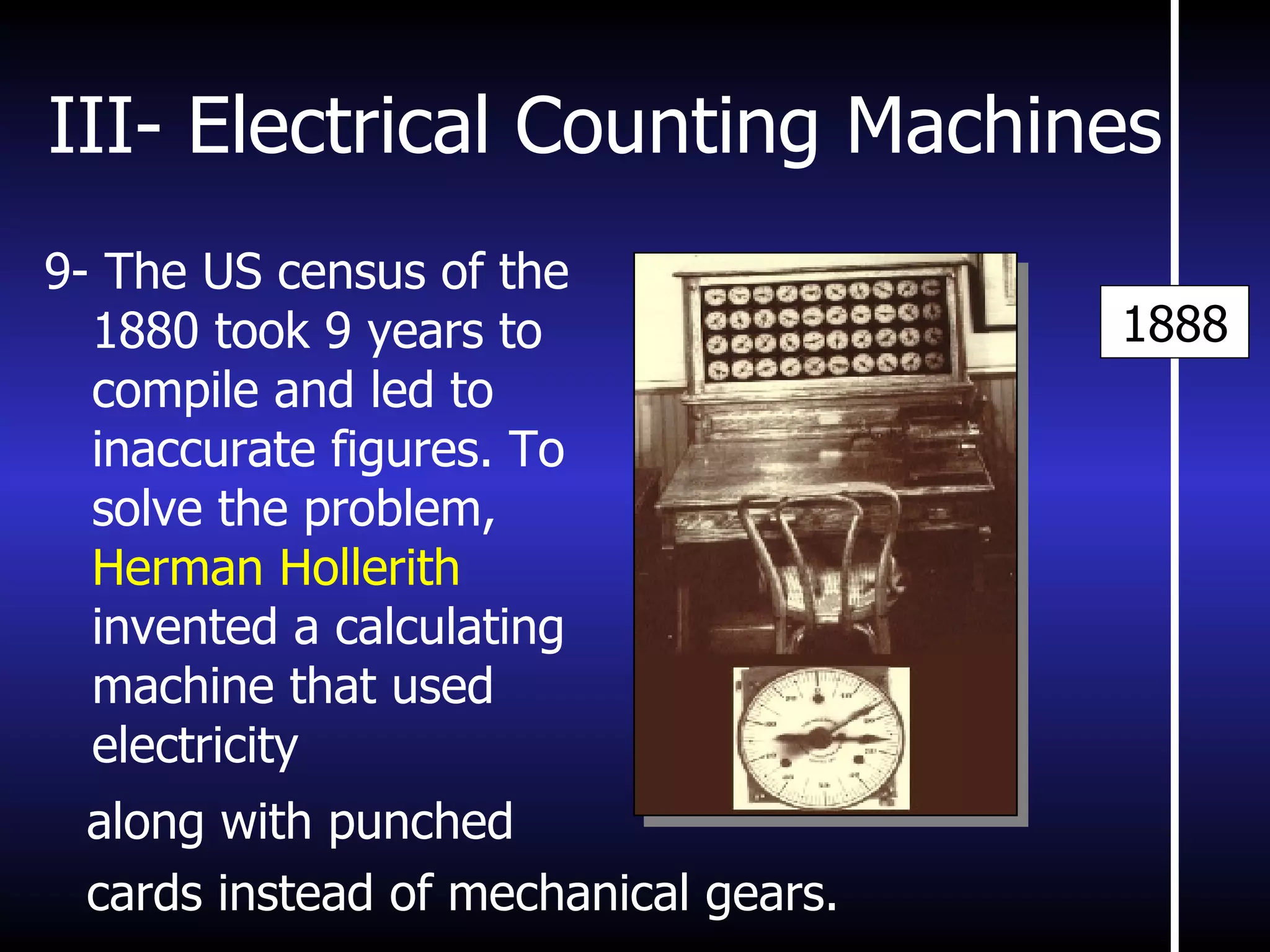
III- Electrical CountingMachines along with punched cards instead of mechanical gears. 9- The US census of the 1880 took 9 years to compile and led to inaccurate figures. To solve the problem, Herman Hollerith invented a calculating machine that used electricity 1888
10.
III- Electrical CountingMachines Hollerith’s machine was immensely successful. The general count of the population, then 63 million, took only 6 weeks to calculate! Based on the success of his invention, Herman Hollerith and some friends formed a company that sold his invention all over the world. The company eventually became known as: International Business Machines IBM 1888
11.
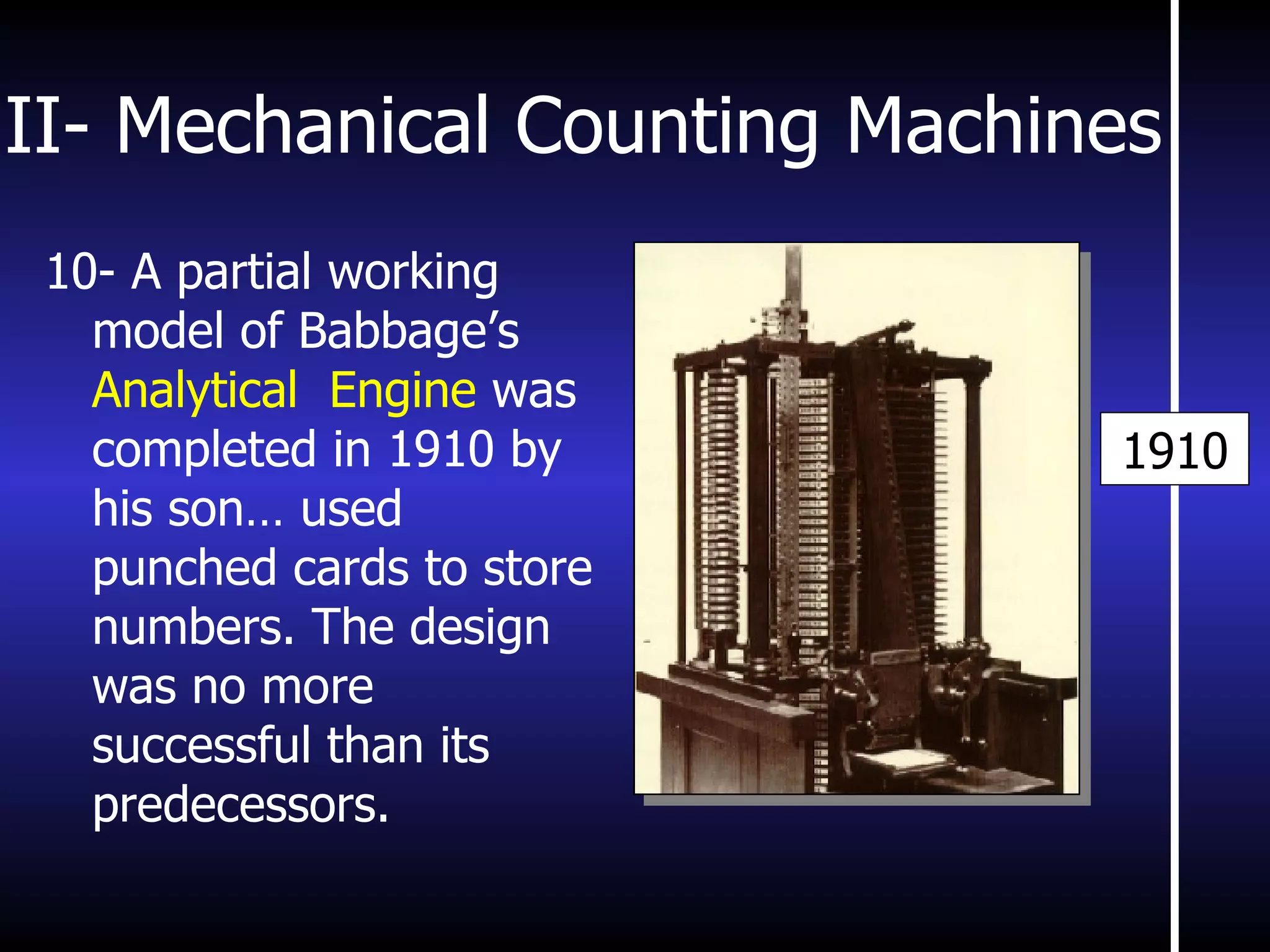
II- Mechanical CountingMachines 10- A partial working model of Babbage’s Analytical Engine was completed in 1910 by his son… used punched cards to store numbers. The design was no more successful than its predecessors. 1910
12.
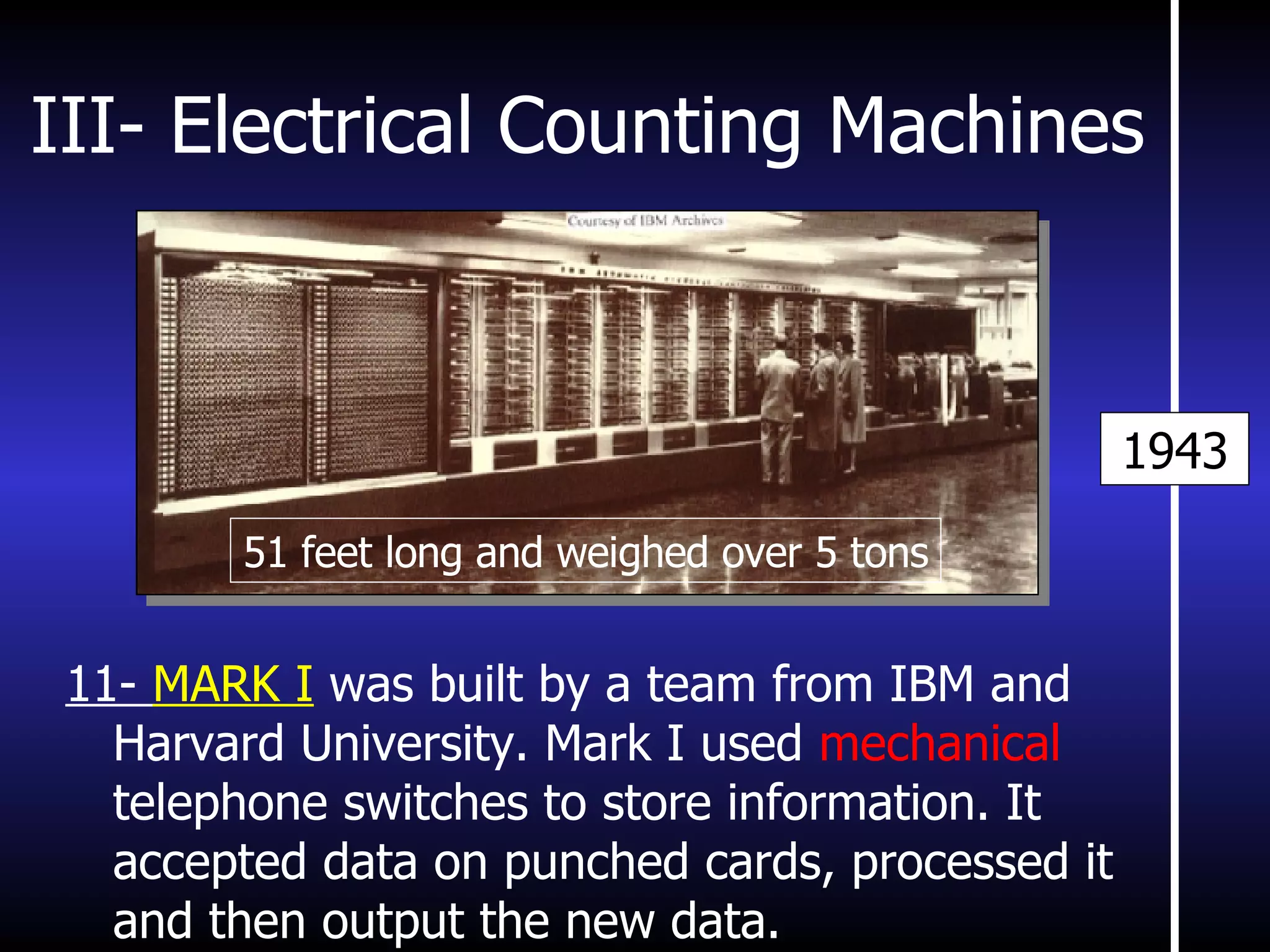
III- Electrical CountingMachines 11- MARK I was built by a team from IBM and Harvard University. Mark I used mechanical telephone switches to store information. It accepted data on punched cards, processed it and then output the new data. 1943 51 feet long and weighed over 5 tons
13.
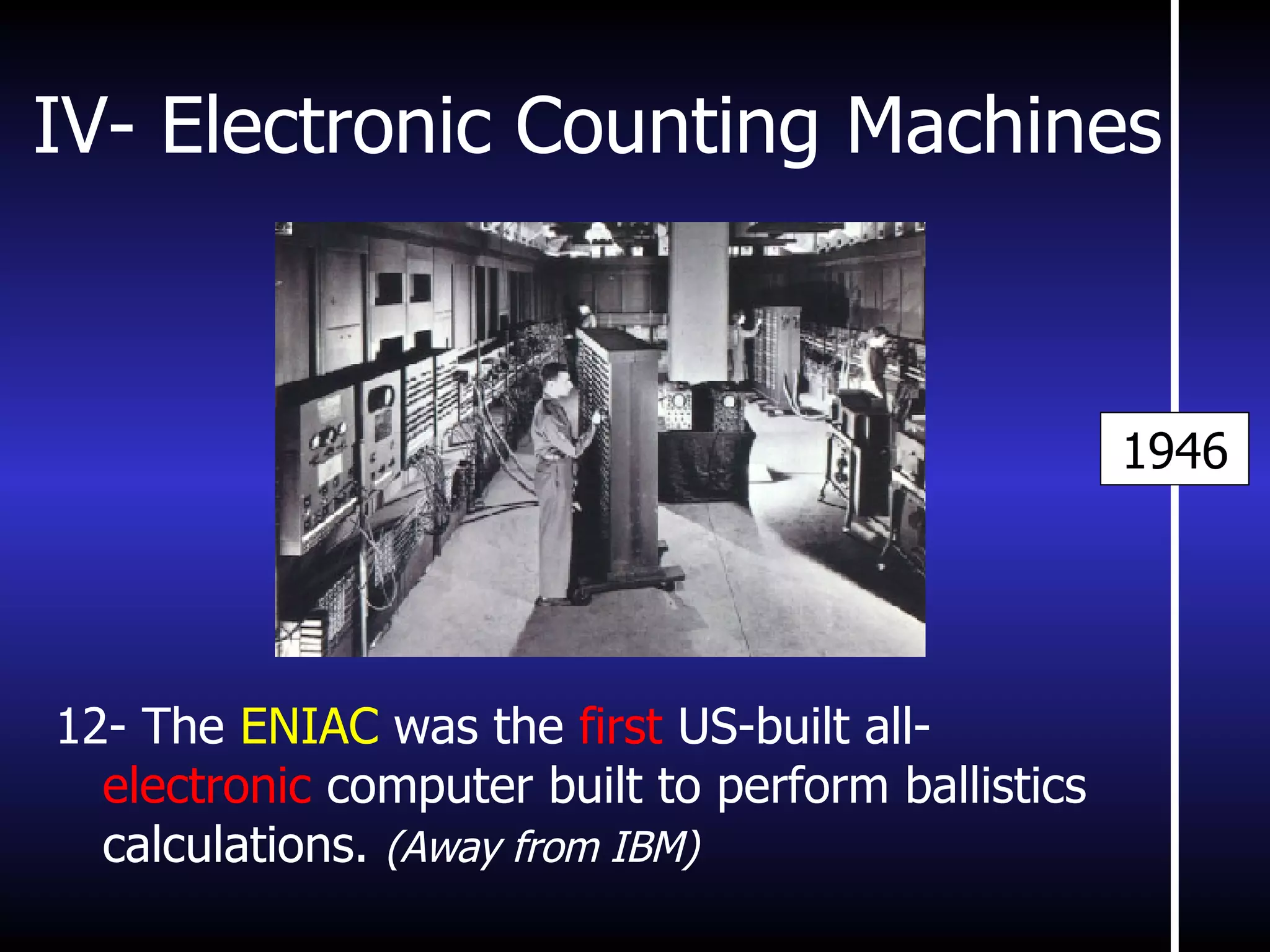
IV- Electronic CountingMachines 12- The ENIAC was the first US-built all- electronic computer built to perform ballistics calculations. (Away from IBM) 1946
14.
IV- Electronic CountingMachines * It was 1000X faster than Mark I, but it drew a lot of power that dimmed the lights of Philadelphia when it was switched on due to the use of Vacuum Tubes. * Mark I: 5 Additions / sec. * ENIAC: 5,000 Additions / sec. * ENIAC was made of 18,000 vacuum tubes. 1946
15.
IV- Electronic CountingMachines ENIAC’s Problems: 1- short life of vacuum tubes 2- It runs a single program, which means rewiring by a group of technicians is needed to change the program!!! Solution: the same group of researchers worked on another version of ENIAC that can store programs on punched cards that are much easier to manage and they came up with:
16.
IV- Electronic CountingMachines EDVAC (electronic Discrete Variable Automatic Computer) (was never completed!) 13- UNIVAC (Universal Automatic Calculator) forty of these computers were sold to businesses. General Electric was the first company to acquire a UNIVAC. * The first UNIVACs were used in the US Army , Air Force , Navy , and Atomic Energy Commission . 1951
17.
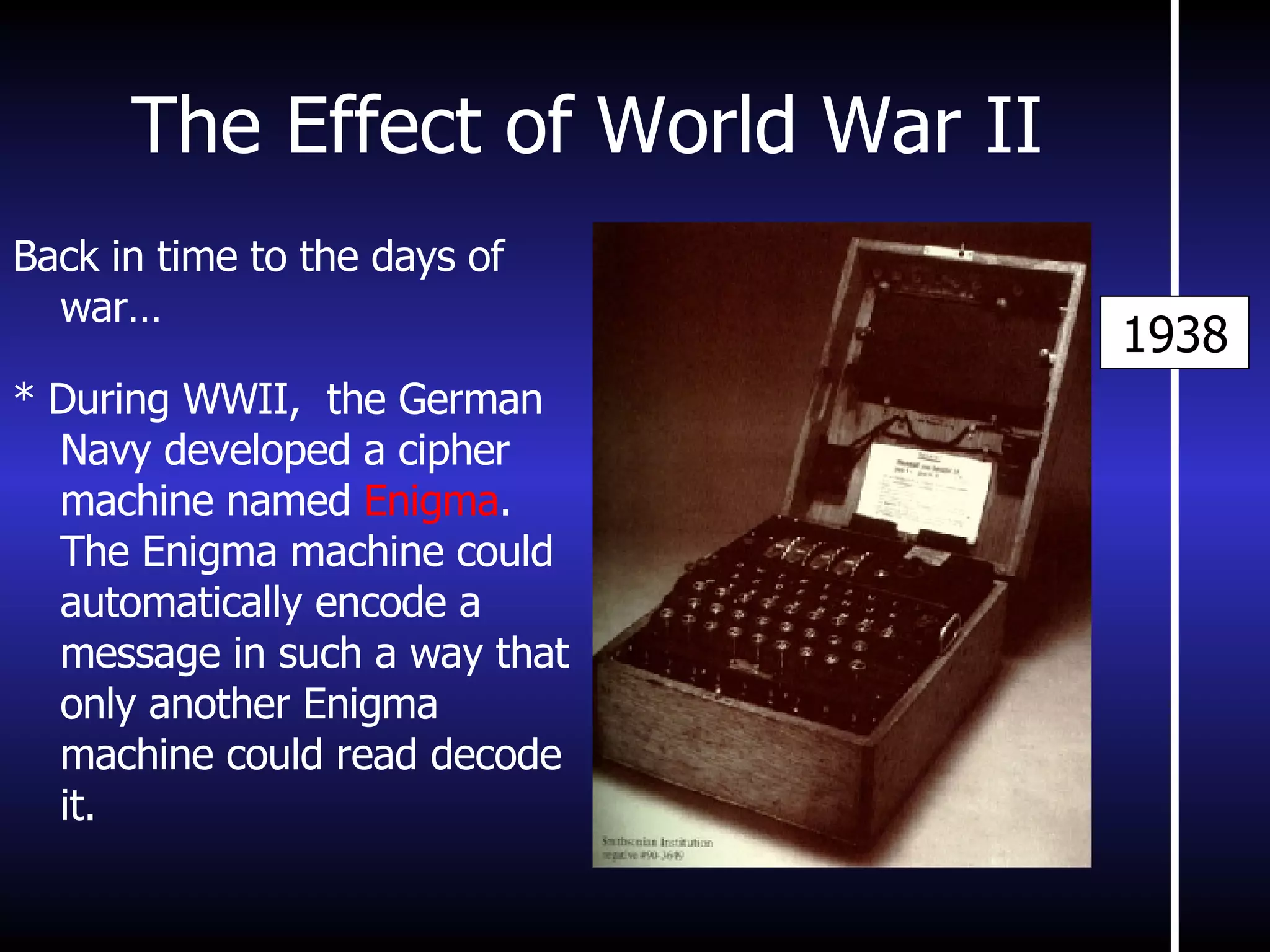
The Effect ofWorld War II 1938 Back in time to the days of war… * During WWII, the German Navy developed a cipher machine named Enigma . The Enigma machine could automatically encode a message in such a way that only another Enigma machine could read decode it.
18.
The Effect ofWorld War II 1938 * In 1938 the Polish Secret Service managed to steal an Enigma machine that was smuggled to England. * Secretly the British developed a computer named Colossus that could decipher as many as 2,000 messages per day. That computer used Vacuum tubes and was the world’s first entirely digital computer. Surprisingly, though Colossus presented a similar technology to that of ENIAC, it had only 2,400 compared to 18,000 in ENIAC!!!
19.
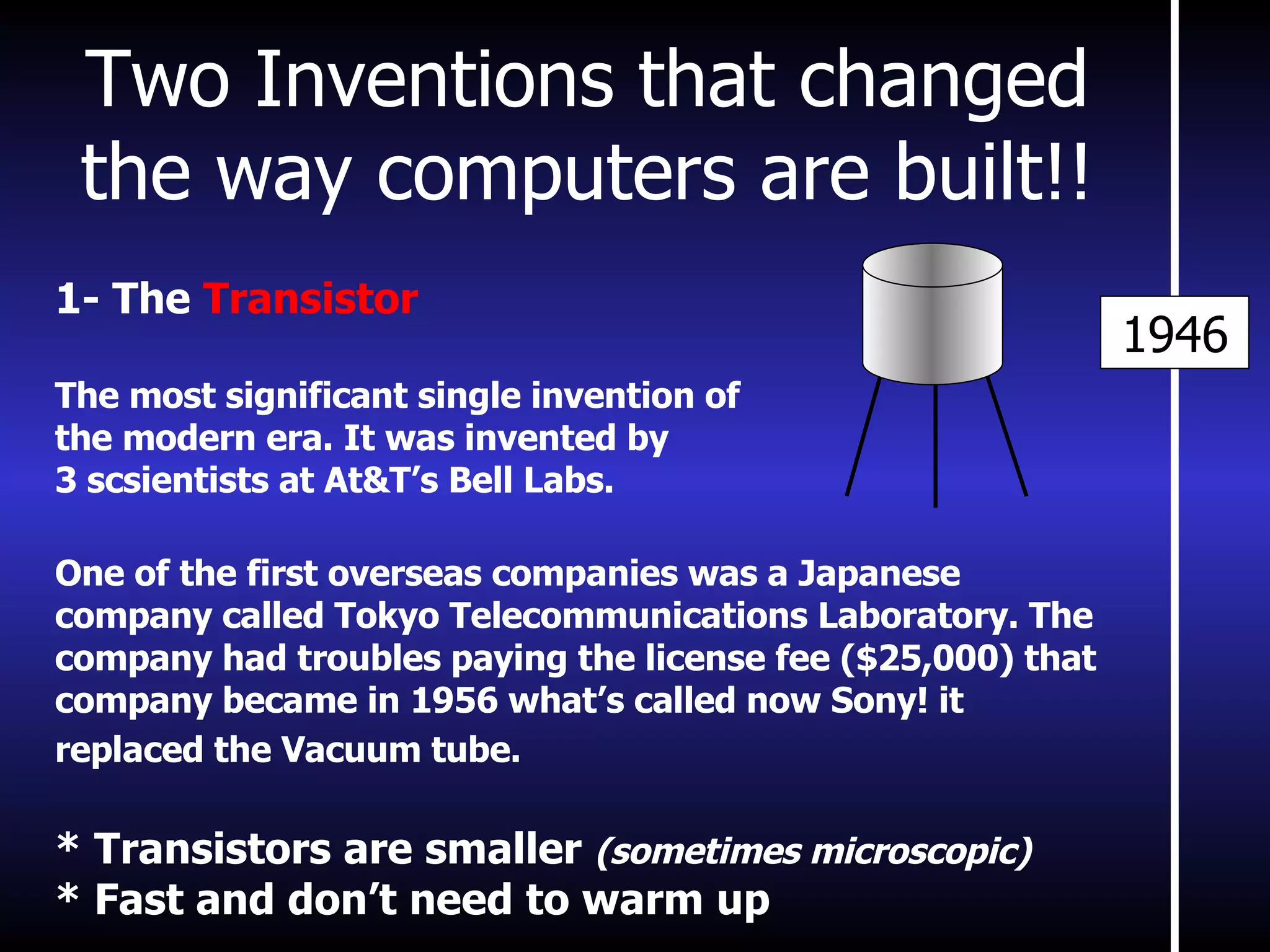
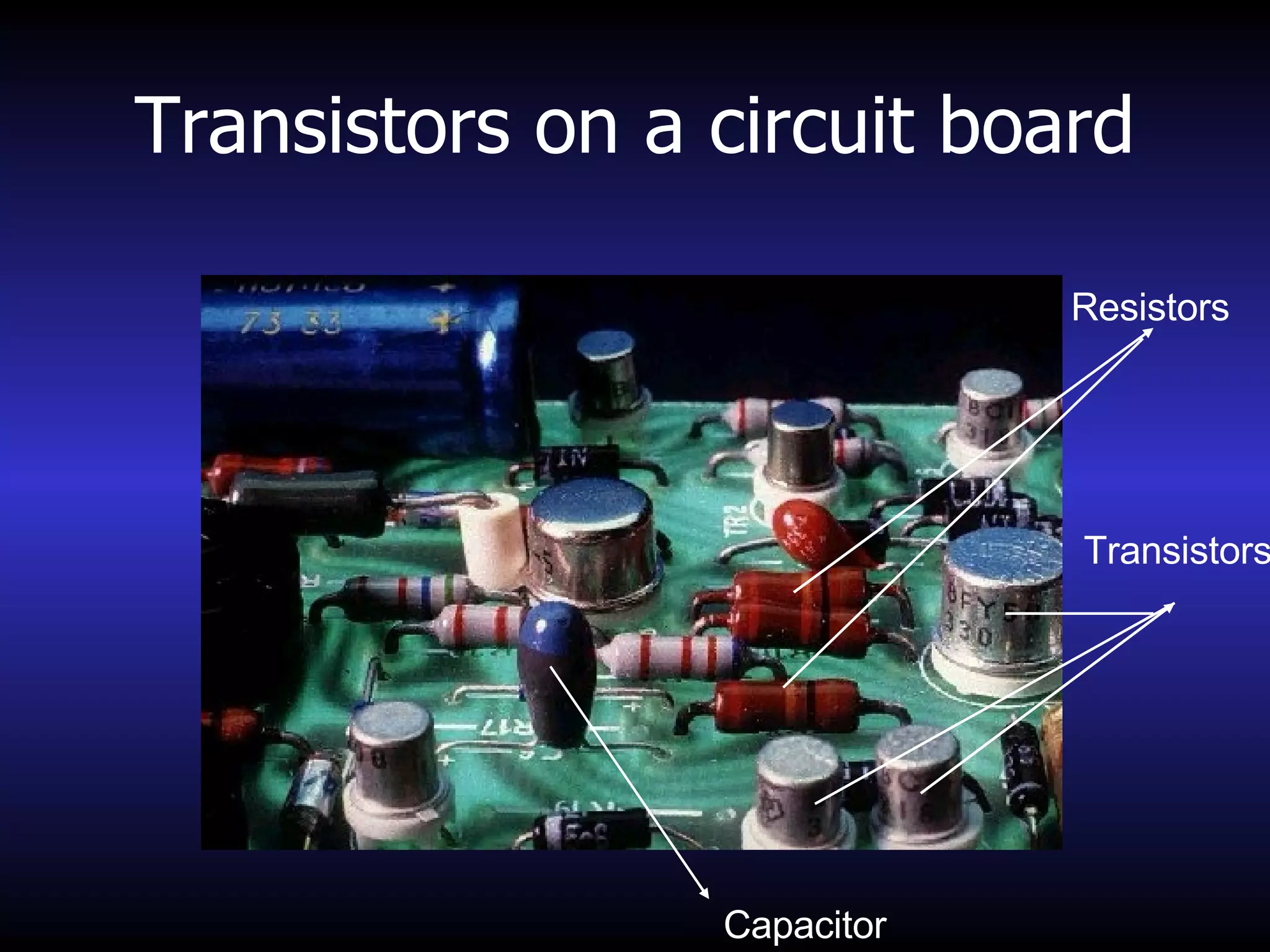
Two Inventions thatchanged the way computers are built!! 1946 1- The Transistor The most significant single invention of the modern era. It was invented by 3 scsientists at At&T’s Bell Labs. One of the first overseas companies was a Japanese company called Tokyo Telecommunications Laboratory. The company had troubles paying the license fee ($25,000) that company became in 1956 what’s called now Sony! it replaced the Vacuum tube. * Transistors are smaller (sometimes microscopic) * Fast and don’t need to warm up
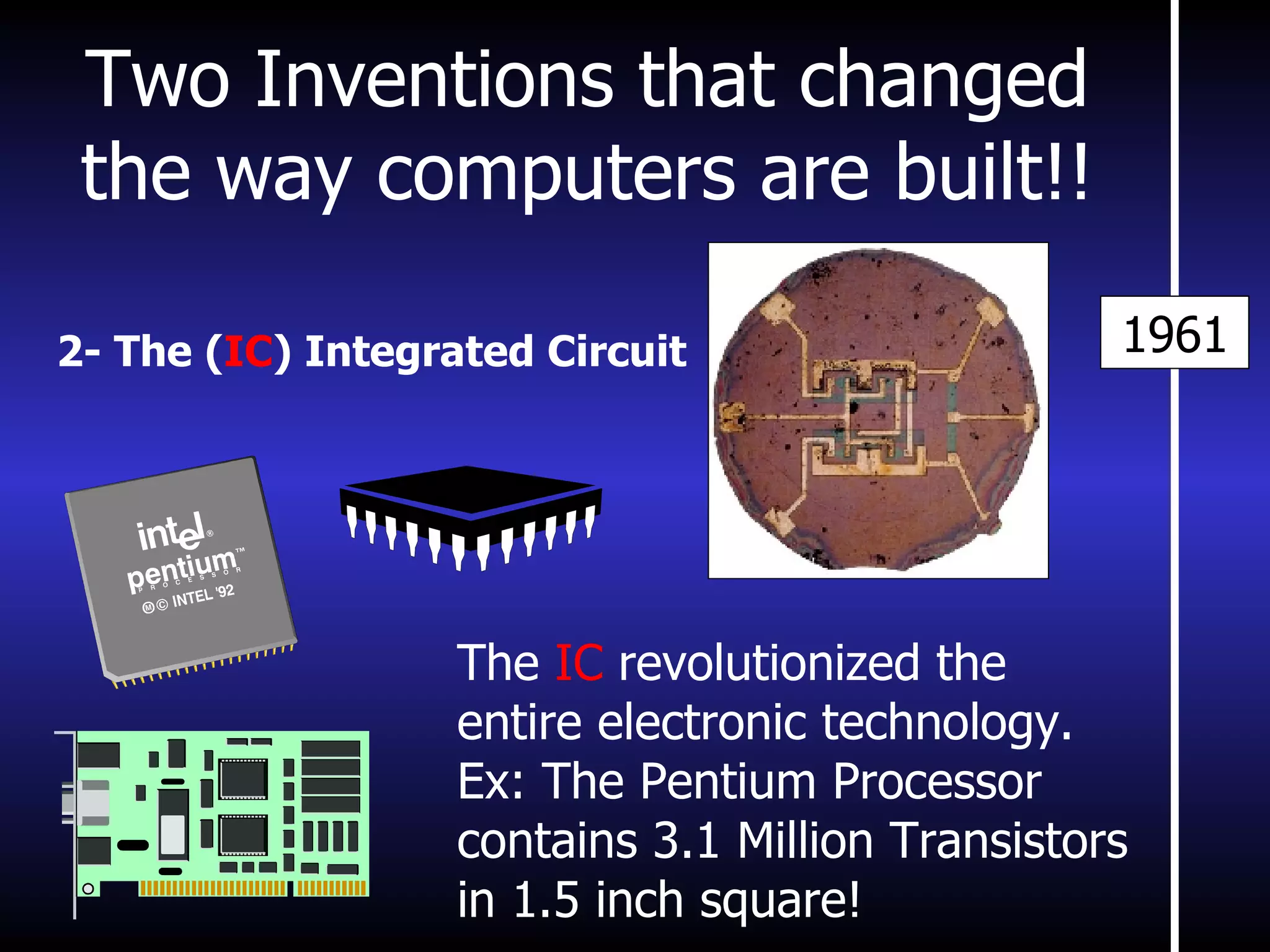
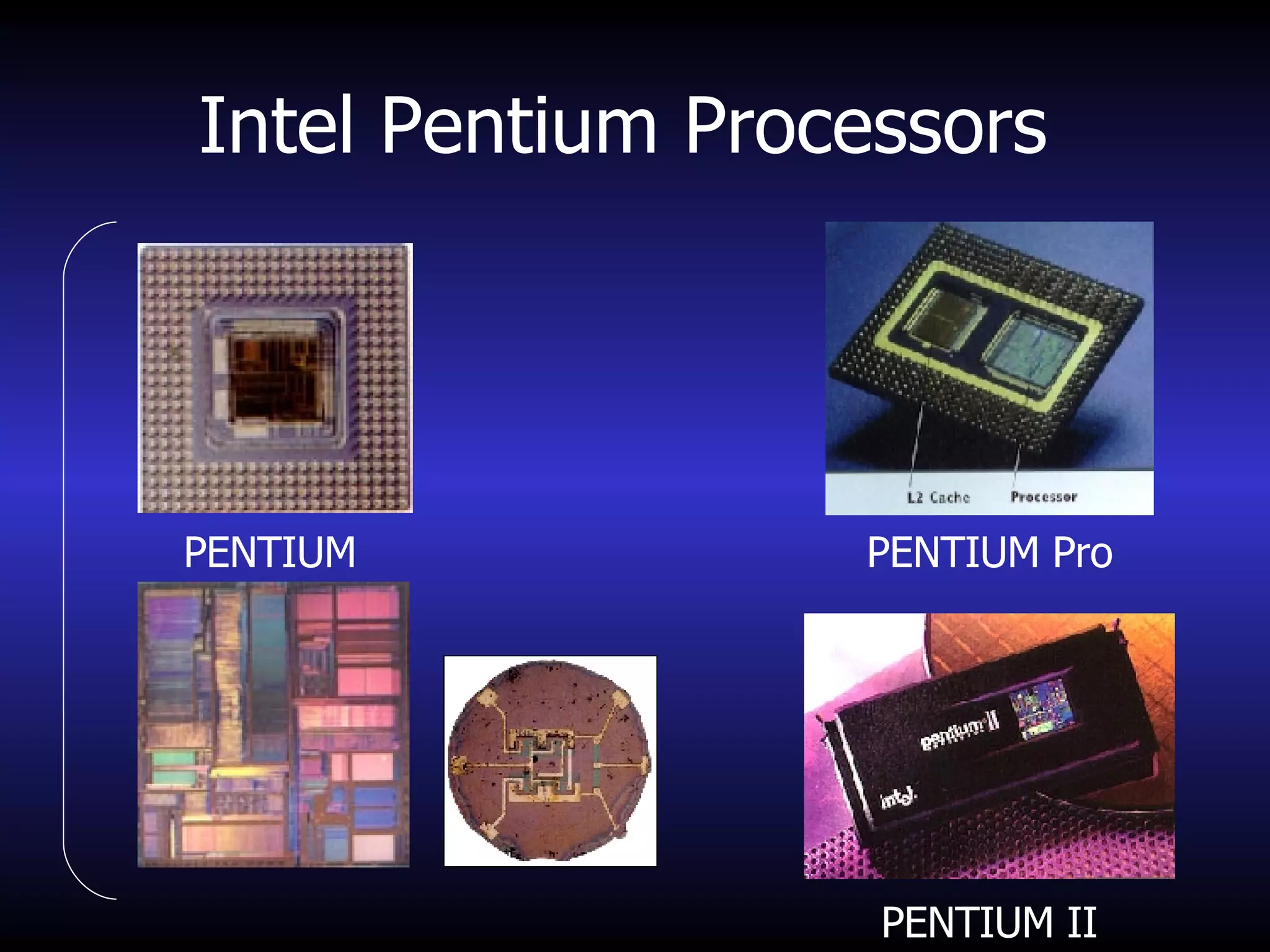
Two Inventions thatchanged the way computers are built!! 1961 The IC revolutionized the entire electronic technology. Ex: The Pentium Processor contains 3.1 Million Transistors in 1.5 inch square! 2- The ( IC ) Integrated Circuit
22.
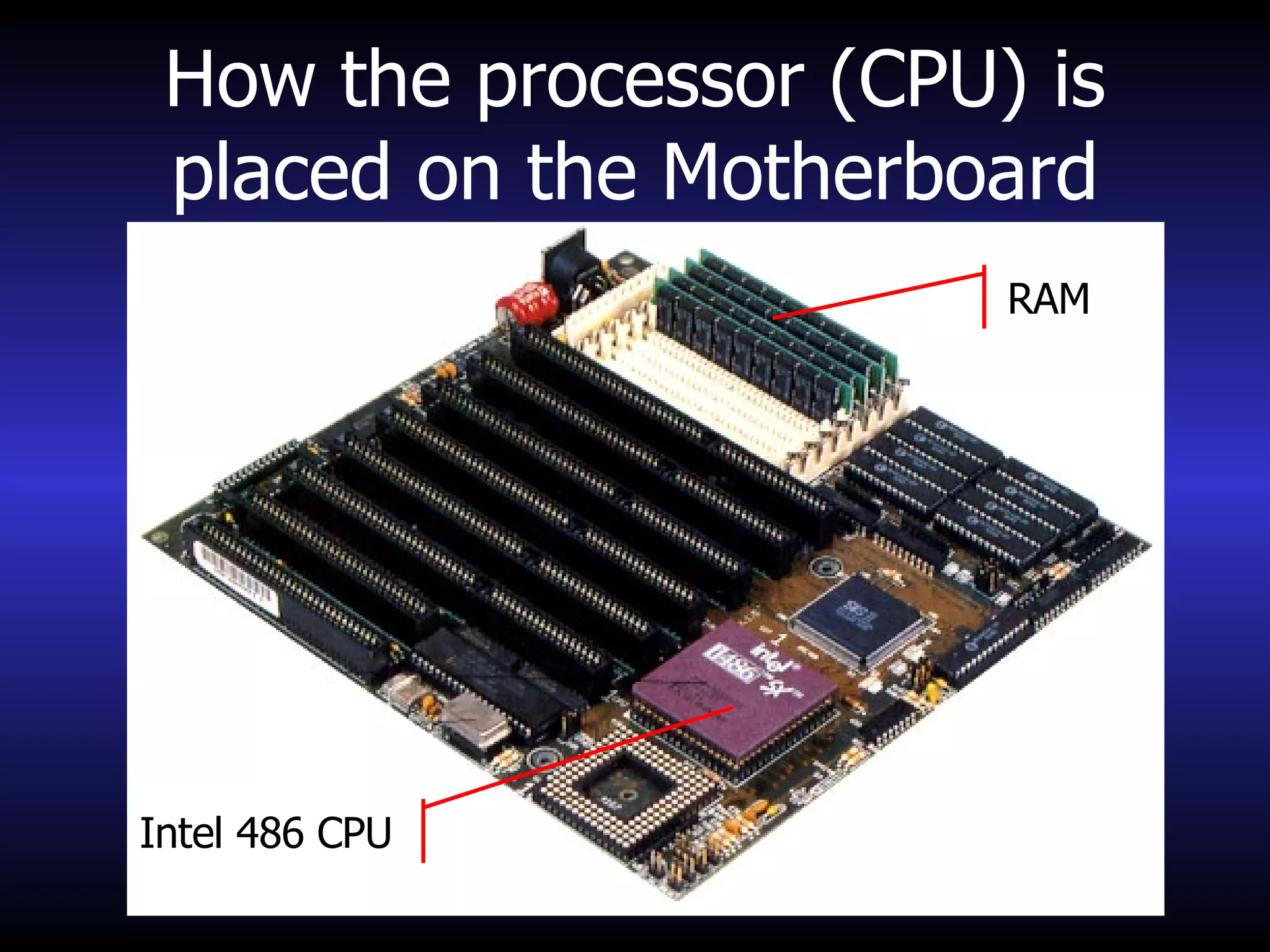
How the processor(CPU) is placed on the Motherboard Intel 486 CPU RAM
23.
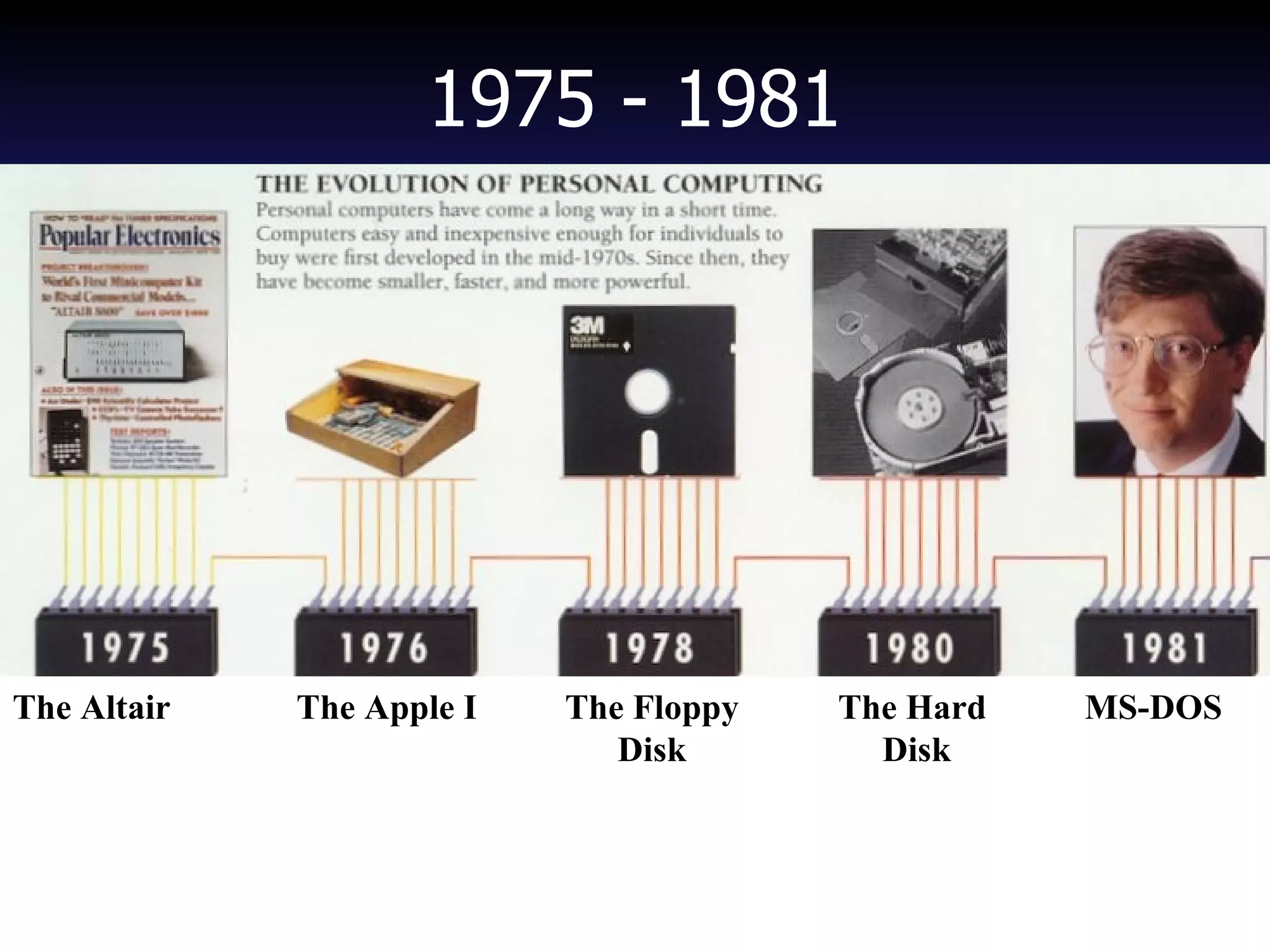
1975 - 1981The Altair The Apple I The Floppy Disk The Hard Disk MS-DOS
24.
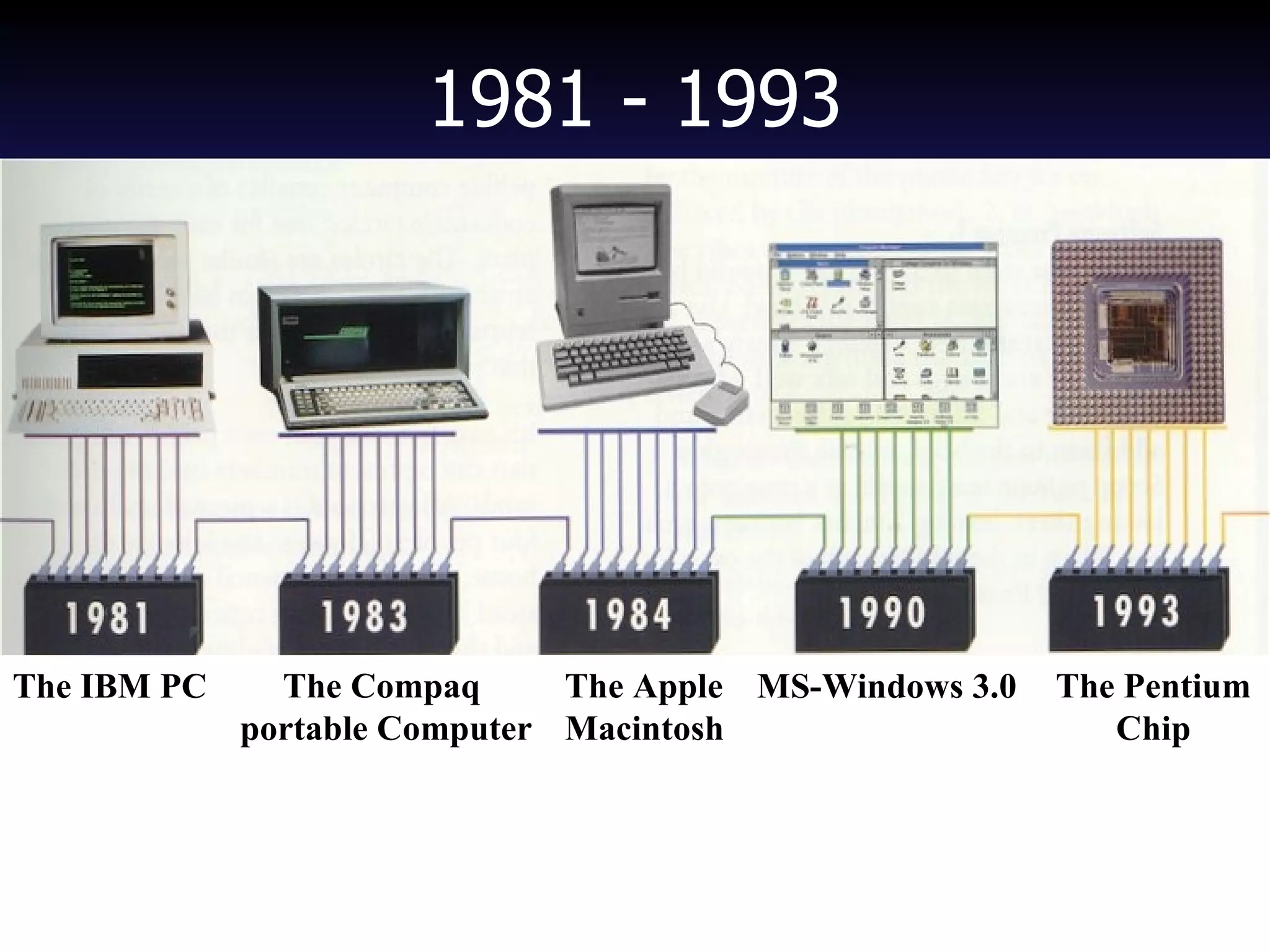
1981 - 1993The IBM PC The Compaq portable Computer The Apple Macintosh MS-Windows 3.0 The Pentium Chip