1. Information technology refers to the use of computers and software to manage information, including storing, protecting, processing, transmitting, and retrieving information.
2. The history of information technology spans from early writing systems to modern computers. Key developments include the abacus, mechanical calculators, punch cards, mainframe computers, and personal computers.
3. Modern information technology is digital and based on integrated circuits and microprocessors. Advances like graphical user interfaces, operating systems, and the internet have driven the widespread use of personal computers and mobile devices.
In this document
Powered by AI
Overview of information technologies and their management.
IT refers to the use of computers and software for managing information in industries.
Explains the evolution of IT from simple data storage to complex systems across four eras.
Discusses early communication methods, input technologies, and early numbering systems.
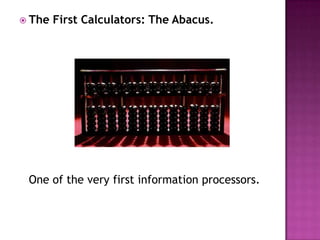
The abacus as one of the first information processing devices.
Focuses on the invention of the printing press and early analog computing devices.
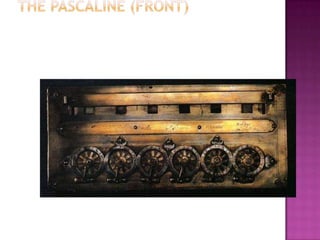
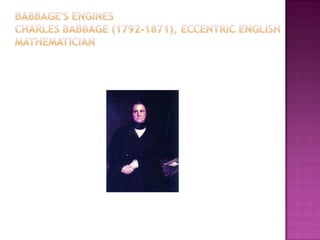
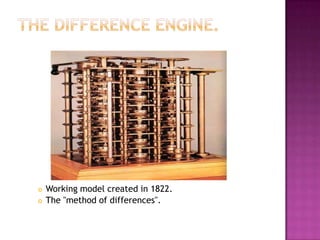
Details on the Pascaline, Leibniz's Machine, and Babbage's Engines.
Describes the impact of electricity on technology, including telecommunication advancements.
Marks the development and details of the Mark I computer and its characteristics.
Introduction to the first electronic computers using vacuum tubes and early stored-program concepts.
Introduces the EDVAC and UNIVAC, noting their significance in computing history.
An overview of four generations of computing, highlighting technological advancements and developments.
Information Technology –A Definition:We use the term information technology or IT to refer to an entire industry. In actuality, information technology is the use of computers and software to manage information. In some companies, this is referred to as Management Information Services (or MIS) or simply as Information Services (or IS). The information technology department of a large company would be responsible for storing information, protecting information, processing the information, transmitting the information as necessary, and later retrieving information as necessary.
3.
History of InformationTechnology:In relative terms, it wasn't long ago that the Information Technology department might have consisted of a single Computer Operator, who might be storing data on magnetic tape, and then putting it in a box down in the basement somewhere
4.
A History ofInformation Technology and SystemsFour basic periodsCharacterized by a principal technology used to solve the input, processing, output and communication problems of the time: Premechanical, Mechanical, Electromechanical, and Electronic
5.
A. The PremechanicalAge: 3000 B.C. - 1450 A.D. Writing and Alphabets--communication.First humans communicated only through speaking and picture drawings. 3000 B.C., the Sumerians in Mesopotamia (what is today southern Iraq) devised cuniformAround 2000 B.C., Phoenicians created symbols The Greeks later adopted the Phoenician alphabet and added vowels; the Romans gave the letters Latin names to create the alphabet we use today.
6.
Paper and Pens--inputtechnologies.Sumerians' input technology was a stylus that could scratch marks in wet clay. About 2600 B.C., the Egyptians write on the papyrus plant around 100 A.D., the Chinese made paper from rags, on which modern-day papermaking is based.
7.
Books and Libraries:Permanent Storage Devices.Religious leaders in Mesopotamia kept the earliest "books" The Egyptians kept scrolls Around 600 B.C., the Greeks began to fold sheets of papyrus vertically into leaves and bind them together.
8.
The First NumberingSystems.Egyptian system: The numbers 1-9 as vertical lines, the number 10 as a U or circle, the number 100 as a coiled rope, and the number 1,000 as a lotus blossom. The first numbering systems similar to those in use today were invented between 100 and 200 A.D. by Hindus in India who created a nine-digit numbering system. Around 875 A.D., the concept of zero was developed.
The Mechanical Age:1450 - 1840 The First Information Explosion.Johann Gutenberg (Mainz, Germany) Invented the movable metal-type printing process in 1450. The development of book indexes and the widespread use of page numbers. The first general purpose "computers"Actually people who held the job title "computer: one who works with numbers."
11.
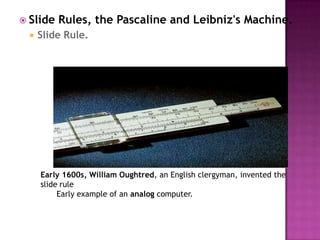
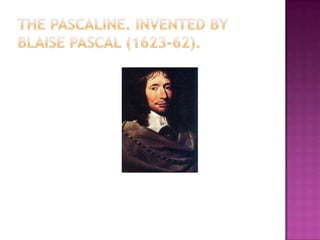
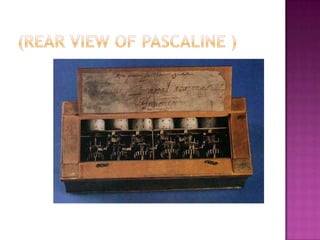
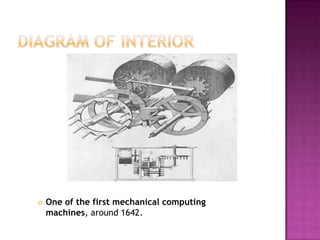
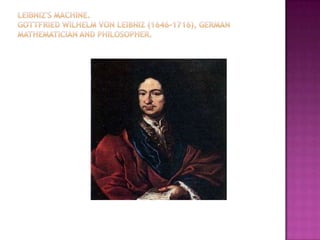
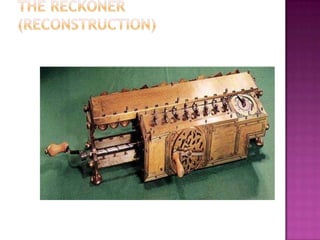
Slide Rules, thePascaline and Leibniz's Machine.Slide Rule.Early 1600s, William Oughtred, an English clergyman, invented the slide rule Early example of an analog computer.
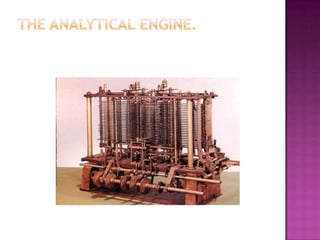
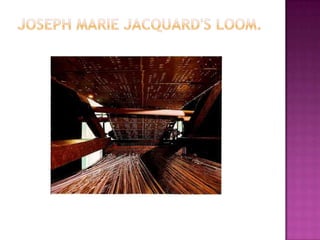
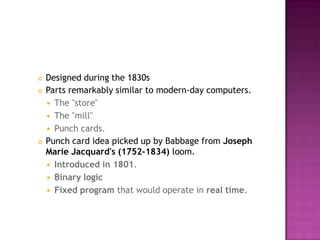
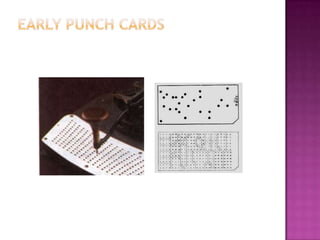
Designed during the1830s Parts remarkably similar to modern-day computers. The "store" The "mill" Punch cards. Punch card idea picked up by Babbage from Joseph Marie Jacquard's (1752-1834) loom. Introduced in 1801. Binary logicFixed program that would operate in real time.
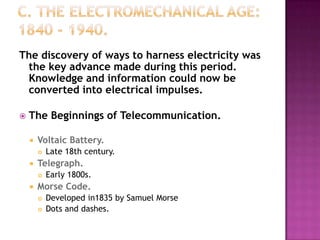
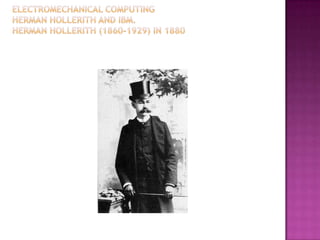
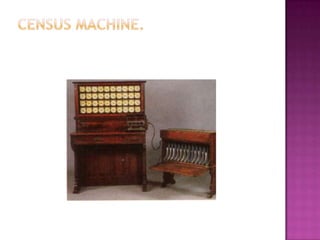
C. The ElectromechanicalAge: 1840 - 1940. The discovery of ways to harness electricity was the key advance made during this period. Knowledge and information could now be converted into electrical impulses.The Beginnings of Telecommunication.Voltaic Battery.Late 18th century. Telegraph.Early 1800s. Morse Code.Developed in1835 by Samuel Morse Dots and dashes.
25.
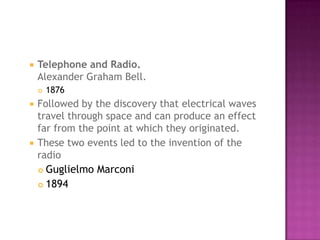
Telephone and Radio.AlexanderGraham Bell. 1876 Followed by the discovery that electrical waves travel through space and can produce an effect far from the point at which they originated. These two events led to the invention of the radio Guglielmo Marconi 1894
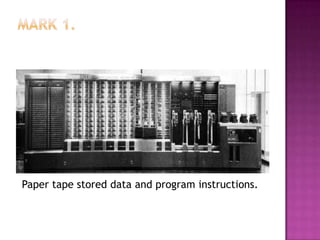
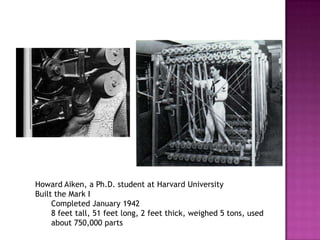
Mark 1. Papertape stored data and program instructions.
30.
Howard Aiken, aPh.D. student at Harvard University Built the Mark I Completed January 1942 8 feet tall, 51 feet long, 2 feet thick, weighed 5 tons, used about 750,000 parts
31.
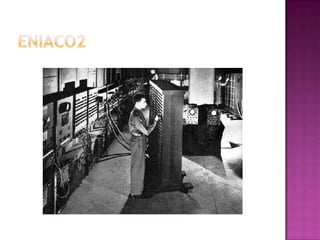
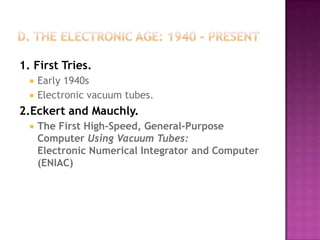
D. The ElectronicAge: 1940 - Present1. First Tries.Early 1940s Electronic vacuum tubes. 2.Eckert and Mauchly.The First High-Speed, General-Purpose Computer Using Vacuum Tubes:Electronic Numerical Integrator and Computer (ENIAC)
32.
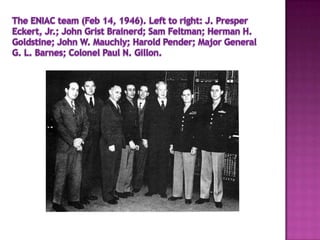
The ENIAC team(Feb 14, 1946). Left to right: J. Presper Eckert, Jr.; John Grist Brainerd; Sam Feltman; Herman H. Goldstine; John W. Mauchly; Harold Pender; Major General G. L. Barnes; Colonel Paul N. Gillon.
Electronic Numerical Integratorand Computer (ENIAC)1946. Used vacuum tubes (not mechanical devices) to do its calculations. Hence, first electronic computer. Developers John Mauchly, a physicist, and J. Prosper Eckert, an electrical engineer The Moore School of Electrical Engineering at the University of Pennsylvania Funded by the U.S. Army. But it could not store its programs (its set of instructions)
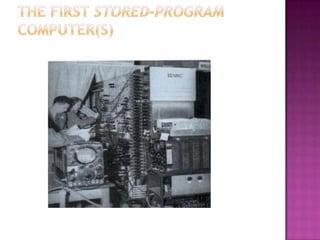
Early 1940s, Mauchlyand Eckert began to design the EDVAC - the Electronic Discreet Variable Computer. John von Neumann's influential report in June 1945: "The Report on the EDVAC" British scientists used this report and outpaced the Americans. Max Newman headed up the effort at Manchester University Where the Manchester Mark I went into operation in June 1948--becoming the first stored-program computer.Maurice Wilkes, a British scientist at Cambridge University, completed the EDSAC (Electronic Delay Storage Automatic Calculator) in 1949--two years before EDVAC was finished. Thus, EDSAC became the first stored-program computer in general use (i.e., not a prototype).
37.
The First General-PurposeComputer for Commercial Use: Universal Automatic Computer (UNIVAC).Late 1940s, Eckert and Mauchly began the development of a computer called UNIVAC (Universal Automatic Computer)Remington Rand. First UNIVAC delivered to Census Bureau in 1951. But, a machine called LEO (Lyons Electronic Office) went into action a few months before UNIVAC and became the world's first commercial computer
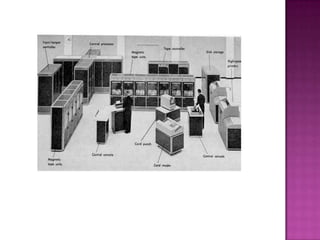
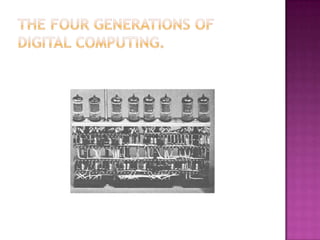
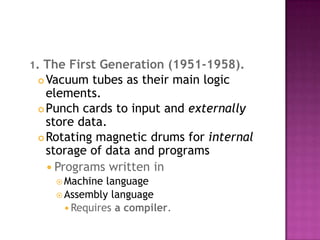
1. The FirstGeneration (1951-1958).Vacuum tubes as their main logic elements. Punch cards to input and externally store data. Rotating magnetic drums for internal storage of data and programs Programs written in Machine language Assembly language Requires a compiler.
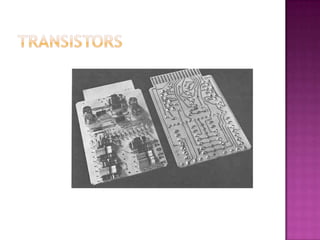
2. The SecondGeneration (1959-1963).Vacuum tubes replaced by transistors as main logic element. AT&T's Bell Laboratories, in the 1940s Crystalline mineral materials called semiconductors could be used in the design of a device called a transistorMagnetic tape and disks began to replace punched cards as external storage devices. Magnetic cores (very small donut-shaped magnets that could be polarized in one of two directions to represent data) strung on wire within the computer became the primary internal storage technology. High-level programming languages E.g., FORTRAN and COBOL
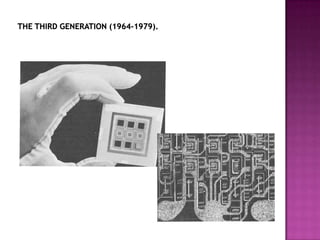
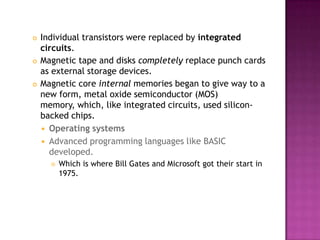
Individual transistors werereplaced by integrated circuits. Magnetic tape and disks completely replace punch cards as external storage devices. Magnetic core internal memories began to give way to a new form, metal oxide semiconductor (MOS) memory, which, like integrated circuits, used silicon-backed chips. Operating systemsAdvanced programming languages like BASIC developed. Which is where Bill Gates and Microsoft got their start in 1975.
45.
The Fourth Generation(1979- Present).Large-scale and very large-scale integrated circuits (LSIs and VLSICs) Microprocessors that contained memory, logic, and control circuits (an entire CPU = Central Processing Unit) on a single chip. Which allowed for home-use personal computers or PCs, like the Apple (II and Mac) and IBM PC.
46.
Apple II releasedto public in 1977, by Stephen Wozniak and Steven Jobs. Initially sold for $1,195 (without a monitor); had 16k RAM. First Apple Mac released in 1984. IBM PC introduced in 1981. Debuts with MS-DOS (Microsoft Disk Operating System)
47.
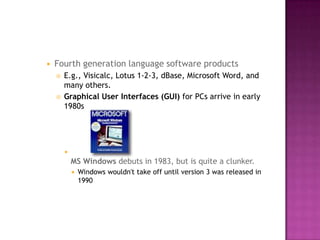
Fourth generation languagesoftware products E.g., Visicalc, Lotus 1-2-3, dBase, Microsoft Word, and many others. Graphical User Interfaces (GUI) for PCs arrive in early 1980s MS Windows debuts in 1983, but is quite a clunker. Windows wouldn't take off until version 3 was released in 1990
48.
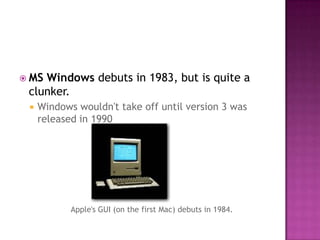
MS Windows debutsin 1983, but is quite a clunker. Windows wouldn't take off until version 3 was released in 1990 Apple's GUI (on the first Mac) debuts in 1984.