3RD Generation
Computer
GROUP : VOLCANIC
CONTENT
• INTRODUCTION
• HISTORY
• INTEGRATES CIRCUIT
• MINI COMPUTER
• FEATURE
• SYSTEM 360
• ADVANTAGE & DISADVANTAGE
• LANGUAGE
• END
HASNAT
SHOHEB
152-15-5813
HISTORY
TELLER
Computer Generations
Generation in computer terminology is a
change in technology a computer is/was
being used.
Initially, the generation term was used to
distinguish between varying hardware
technologies.
 But nowadays, generation includes both
hardware and software, which together
make up an entire computer system.
History
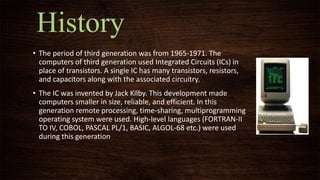
• The period of third generation was from 1965-1971. The
computers of third generation used Integrated Circuits (ICs) in
place of transistors. A single IC has many transistors, resistors,
and capacitors along with the associated circuitry.
• The IC was invented by Jack Kilby. This development made
computers smaller in size, reliable, and efficient. In this
generation remote processing, time-sharing, multiprogramming
operating system were used. High-level languages (FORTRAN-II
TO IV, COBOL, PASCAL PL/1, BASIC, ALGOL-68 etc.) were used
during this generation
INTEGRATED CIRCUIT
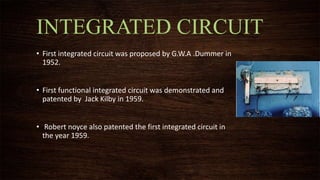
• First integrated circuit was proposed by G.W.A .Dummer in
1952.
• First functional integrated circuit was demonstrated and
patented by Jack Kilby in 1959.
• Robert noyce also patented the first integrated circuit in
the year 1959.
INTEGRATED CIRCUIT
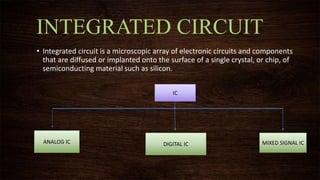
• Integrated circuit is a microscopic array of electronic circuits and components
that are diffused or implanted onto the surface of a single crystal, or chip, of
semiconducting material such as silicon.
ANALOG IC DIGITAL IC MIXED SIGNAL IC
IC
Who ?
• Jack St. Clair Kilby (November 8, 1923 – June 20, 2005) was
an American electrical engineer who took part (along with
Robert Noyce) in the realization of the first integrated
circuit while working at Texas Instruments (TI) in 1958.
• He was awarded the Nobel Prize in Physics on December
10, 2000.
MINI COMPUTER
In November 1966, Hewlett-Packard introduced the 2116A minicomputer
one of the first commercial 16-bit computers. It used CTµL
(Complementary Transistor MicroLogic) in integrated circuits from
Fairchild Semiconductor.
3RD GENERATION
• These were the first computers where users interacted using keyboards
and monitors which interfaced with an operating system, a significant leap
up from the punch cards and printouts.
• This enabled these machines to run several applications at once using a
central program which functioned to monitor memory.
• As a result of these advances which again made machines cheaper and
smaller, a new mass market of users emerged during the ‘60s.
RAYHAN
TURAG
152-15-5597
MAGNET
MAN
Silicon chip & wafers
• Hundreds or even thousands of transistors could be fabricated on a single wafer
of silicon.
• In addition, these fabricated transistors could be
connected to form logic circuits on the same chip.
Silicon chips Silicon Wafers
MEMORY DEVICE
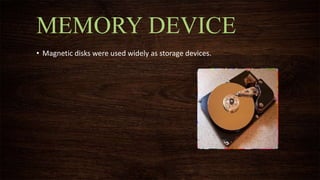
• Magnetic disks were used widely as storage devices.
NOVA
• In 1969, Data General introduced the Nova.
• The popularity of 16-bit computers, such as the
Data General Nova, led the way toward word
lengths that were multiples of the 8-bit byte.
• The Nova was first to employ medium-scale
integration (MSI) circuits from Fairchild
Semiconductor, with subsequent models using
large-scale integrated (LSI) circuits.
• The entire central processor was contained on one
15-inch printed circuit board.
SHAHAB
UDDIN
152-15-483
FEATURE
MAN
The main features of third generation
are
• IC used
• More reliable in comparison to previous two generations
• Smaller size
• Generated less heat
• Faster
• Lesser maintenance
• Costly
• AC required
• Consumed lesser electricity
• Supported high-level language
CHARACTERISTICS
1) IC was used instead of transistors in the third generation computers.
2) Third generation computers were smaller in size and cheaper as compare
to the second generation computers.
3) They were fast and more reliable.
4) High level language was developed.
5) Magnetic core and solid states as main storage.
6) They were able to reduce computational time and had low maintenance
cost.
7) Input/Output devices became more sophisticated.
SOME COMPUTERS OF THIS
GENERATION WERE
• IBM-360 series
• Honeywell-6000 series
• PDP (Personal Data Processor)
• IBM-370/168
• TDC-316
MAHADI
HASAN
152-15-5797
THE LANGUAGE
MAN
COBOL
• It is pronounced as /ˈkoʊbɒl/ kow-bahl.
• COBOL is an acronym for common business-oriented language.
• It is a compiled English-like computer programming language designed for
• business use.
• COBOL was widely used in legacy applications deployed on mainframe
• computers, such as large-scale batch and transaction processing jobs.
• But due to its declining popularity and the retirement of experienced COBOL
• programmers, programs are being migrated to new platforms, rewritten in
• modern languages or replaced with software packages.
Quick History
• COBOL was designed in 1959 by Grace Hopper.
• It was created as part of a US Department of Defense effort to create a
• portable programming language for data processing.
• It was standardized in 1968 and has since been revised four times.
• Expansions include support for structured and object-oriented
• programming.
• The current standard is ISO/IEC 1989:2014.
FORTRAN
• Formula translation
• First high level programming language
• Has been in continual use for over half a century in computationally
intensive areas such as climate modeling, CFD, computational physics and
computational chemistry
• FORTRAN 77, Fortran 90, Fortran 95, Fortran 2003,Fortran 2008
FORTRAN
• Fortran is the dominant programming language used in
engineering applications
• Thousands of codes are available free of cost
• It is important for engineering graduates to be able to read
and modify Fortran code
Fortran compilers
Windows Silverfrost f95 (free) Intel Fortran compiler
(commercial)
Linux G95 Gfortran
ADVANTAGE
numerical weather prediction, finite element analysis,
computational fluid dynamics, computational physics,
crystallography and computational chemistry.
AWOLAD
HOSSAIN
152-15-5536
AH360
DEGREE
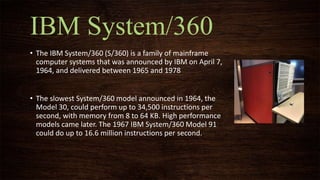
IBM System/360
• The IBM System/360 (S/360) is a family of mainframe
computer systems that was announced by IBM on April 7,
1964, and delivered between 1965 and 1978
• The slowest System/360 model announced in 1964, the
Model 30, could perform up to 34,500 instructions per
second, with memory from 8 to 64 KB. High performance
models came later. The 1967 IBM System/360 Model 91
could do up to 16.6 million instructions per second.
IBM System/360
The IBM 360 was extremely successful in the market, allowing customers
to purchase a smaller system with the knowledge they would always be
able to migrate upward if their needs grew, without reprogramming of
application software or replacing peripheral devices. Many consider the
design one of the most successful computers in history, influencing
computer design for years to come.
PDP 11
• PDP 11– developed by DEC in 1970
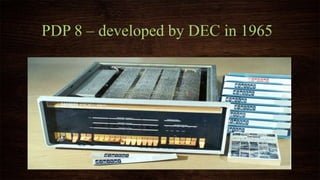
PDP 8 – developed by DEC in 1965
Advantages
• Less energy
• Easily portable
• Maintenance cost is low because hardware failures are rare.
Disadvantages:
•Air conditioning was required
•Tactile sensitivity is decreased
3rd generation computer

3rd generation computer

  • 1.
  • 2.
    CONTENT • INTRODUCTION • HISTORY •INTEGRATES CIRCUIT • MINI COMPUTER • FEATURE • SYSTEM 360 • ADVANTAGE & DISADVANTAGE • LANGUAGE • END
  • 3.
  • 4.
    Computer Generations Generation incomputer terminology is a change in technology a computer is/was being used. Initially, the generation term was used to distinguish between varying hardware technologies.  But nowadays, generation includes both hardware and software, which together make up an entire computer system.
  • 5.
    History • The periodof third generation was from 1965-1971. The computers of third generation used Integrated Circuits (ICs) in place of transistors. A single IC has many transistors, resistors, and capacitors along with the associated circuitry. • The IC was invented by Jack Kilby. This development made computers smaller in size, reliable, and efficient. In this generation remote processing, time-sharing, multiprogramming operating system were used. High-level languages (FORTRAN-II TO IV, COBOL, PASCAL PL/1, BASIC, ALGOL-68 etc.) were used during this generation
  • 6.
    INTEGRATED CIRCUIT • Firstintegrated circuit was proposed by G.W.A .Dummer in 1952. • First functional integrated circuit was demonstrated and patented by Jack Kilby in 1959. • Robert noyce also patented the first integrated circuit in the year 1959.
  • 7.
    INTEGRATED CIRCUIT • Integratedcircuit is a microscopic array of electronic circuits and components that are diffused or implanted onto the surface of a single crystal, or chip, of semiconducting material such as silicon. ANALOG IC DIGITAL IC MIXED SIGNAL IC IC
  • 8.
    Who ? • JackSt. Clair Kilby (November 8, 1923 – June 20, 2005) was an American electrical engineer who took part (along with Robert Noyce) in the realization of the first integrated circuit while working at Texas Instruments (TI) in 1958. • He was awarded the Nobel Prize in Physics on December 10, 2000.
  • 9.
    MINI COMPUTER In November1966, Hewlett-Packard introduced the 2116A minicomputer one of the first commercial 16-bit computers. It used CTµL (Complementary Transistor MicroLogic) in integrated circuits from Fairchild Semiconductor.
  • 10.
    3RD GENERATION • Thesewere the first computers where users interacted using keyboards and monitors which interfaced with an operating system, a significant leap up from the punch cards and printouts. • This enabled these machines to run several applications at once using a central program which functioned to monitor memory. • As a result of these advances which again made machines cheaper and smaller, a new mass market of users emerged during the ‘60s.
  • 11.
  • 12.
    Silicon chip &wafers • Hundreds or even thousands of transistors could be fabricated on a single wafer of silicon. • In addition, these fabricated transistors could be connected to form logic circuits on the same chip. Silicon chips Silicon Wafers
  • 13.
    MEMORY DEVICE • Magneticdisks were used widely as storage devices.
  • 14.
    NOVA • In 1969,Data General introduced the Nova. • The popularity of 16-bit computers, such as the Data General Nova, led the way toward word lengths that were multiples of the 8-bit byte. • The Nova was first to employ medium-scale integration (MSI) circuits from Fairchild Semiconductor, with subsequent models using large-scale integrated (LSI) circuits. • The entire central processor was contained on one 15-inch printed circuit board.
  • 15.
  • 16.
    The main featuresof third generation are • IC used • More reliable in comparison to previous two generations • Smaller size • Generated less heat • Faster • Lesser maintenance • Costly • AC required • Consumed lesser electricity • Supported high-level language
  • 17.
    CHARACTERISTICS 1) IC wasused instead of transistors in the third generation computers. 2) Third generation computers were smaller in size and cheaper as compare to the second generation computers. 3) They were fast and more reliable. 4) High level language was developed. 5) Magnetic core and solid states as main storage. 6) They were able to reduce computational time and had low maintenance cost. 7) Input/Output devices became more sophisticated.
  • 18.
    SOME COMPUTERS OFTHIS GENERATION WERE • IBM-360 series • Honeywell-6000 series • PDP (Personal Data Processor) • IBM-370/168 • TDC-316
  • 19.
  • 20.
    COBOL • It ispronounced as /ˈkoʊbɒl/ kow-bahl. • COBOL is an acronym for common business-oriented language. • It is a compiled English-like computer programming language designed for • business use. • COBOL was widely used in legacy applications deployed on mainframe • computers, such as large-scale batch and transaction processing jobs. • But due to its declining popularity and the retirement of experienced COBOL • programmers, programs are being migrated to new platforms, rewritten in • modern languages or replaced with software packages.
  • 21.
    Quick History • COBOLwas designed in 1959 by Grace Hopper. • It was created as part of a US Department of Defense effort to create a • portable programming language for data processing. • It was standardized in 1968 and has since been revised four times. • Expansions include support for structured and object-oriented • programming. • The current standard is ISO/IEC 1989:2014.
  • 22.
    FORTRAN • Formula translation •First high level programming language • Has been in continual use for over half a century in computationally intensive areas such as climate modeling, CFD, computational physics and computational chemistry • FORTRAN 77, Fortran 90, Fortran 95, Fortran 2003,Fortran 2008
  • 23.
    FORTRAN • Fortran isthe dominant programming language used in engineering applications • Thousands of codes are available free of cost • It is important for engineering graduates to be able to read and modify Fortran code
  • 24.
    Fortran compilers Windows Silverfrostf95 (free) Intel Fortran compiler (commercial) Linux G95 Gfortran
  • 25.
    ADVANTAGE numerical weather prediction,finite element analysis, computational fluid dynamics, computational physics, crystallography and computational chemistry.
  • 26.
  • 27.
    IBM System/360 • TheIBM System/360 (S/360) is a family of mainframe computer systems that was announced by IBM on April 7, 1964, and delivered between 1965 and 1978 • The slowest System/360 model announced in 1964, the Model 30, could perform up to 34,500 instructions per second, with memory from 8 to 64 KB. High performance models came later. The 1967 IBM System/360 Model 91 could do up to 16.6 million instructions per second.
  • 28.
    IBM System/360 The IBM360 was extremely successful in the market, allowing customers to purchase a smaller system with the knowledge they would always be able to migrate upward if their needs grew, without reprogramming of application software or replacing peripheral devices. Many consider the design one of the most successful computers in history, influencing computer design for years to come.
  • 29.
    PDP 11 • PDP11– developed by DEC in 1970
  • 30.
    PDP 8 –developed by DEC in 1965
  • 31.
    Advantages • Less energy •Easily portable • Maintenance cost is low because hardware failures are rare.
  • 32.
    Disadvantages: •Air conditioning wasrequired •Tactile sensitivity is decreased