www.oeclib.in
Submitted By:
Odisha Electronics Control Library
Seminar
On
History of Computer
 Definition of a Computer
 Definition of Modern Computer
 Abacus
 Napier Bones
 Side rule
 Pascaline
 Stepped Reckoner
 Jacquard Loom
 Arithmometer
 Difference Engine and Analytical Engine
The first counting device started to be used by the primitive people. These are
the sticks and stones. As technology improves and human minds develop more
and more computing devices are invented and developed.
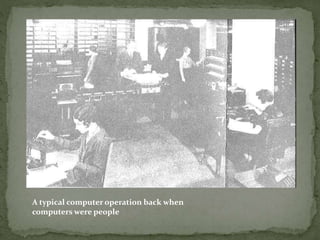
The first computer is really the people. “Computer” then was a job title.
Computer was used to describe human beings especially women whose job is to
perform repetitive calculations required to compute such things as navigation
tables, tide charts, and planetary positions for almanacs.
Humans can be sometimes ineffective and inaccurate and computing
multiplications for long hours can be so boring. Hence, mistakes in
computations will arouse. That’s why inventors made researches to find ways in
computing easier with the aid of machines.
 Information Processor
 Input and Output
 Inputs, outputs, processes and stores information
 Physical: Keyboard, monitor, etc. – are these
necessary components?
A typical computer operation back when
computers were people
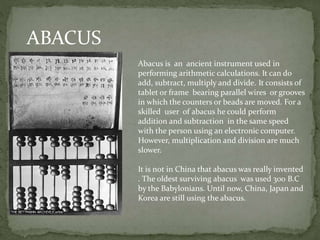
ABACUS
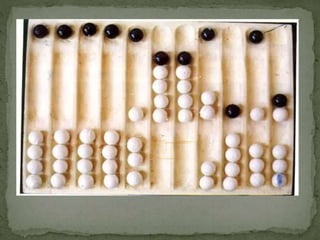
Abacus is an ancient instrument used in
performing arithmetic calculations. It can do
add, subtract, multiply and divide. It consists of
tablet or frame bearing parallel wires or grooves
in which the counters or beads are moved. For a
skilled user of abacus he could perform
addition and subtraction in the same speed
with the person using an electronic computer.
However, multiplication and division are much
slower.
It is not in China that abacus was really invented
. The oldest surviving abacus was used 300 B.C
by the Babylonians. Until now, China, Japan and
Korea are still using the abacus.
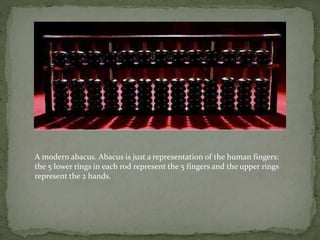
A modern abacus. Abacus is just a representation of the human fingers:
the 5 lower rings in each rod represent the 5 fingers and the upper rings
represent the 2 hands.
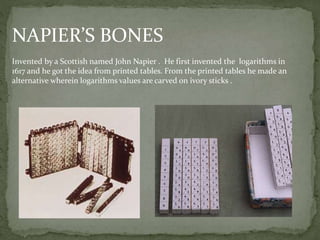
NAPIER’S BONES
Invented by a Scottish named John Napier . He first invented the logarithms in
1617 and he got the idea from printed tables. From the printed tables he made an
alternative wherein logarithms values are carved on ivory sticks .
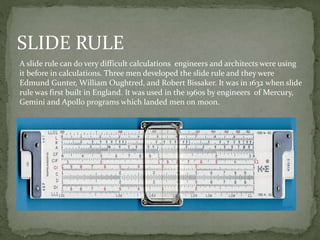
SLIDE RULE
A slide rule can do very difficult calculations engineers and architects were using
it before in calculations. Three men developed the slide rule and they were
Edmund Gunter, William Oughtred, and Robert Bissaker. It was in 1632 when slide
rule was first built in England. It was used in the 1960s by engineers of Mercury,
Gemini and Apollo programs which landed men on moon.
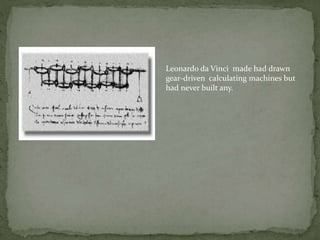
Leonardo da Vinci made had drawn
gear-driven calculating machines but
had never built any.
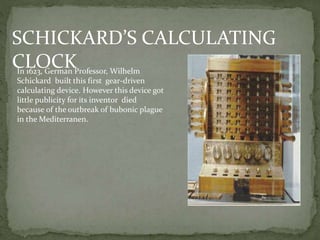
SCHICKARD’S CALCULATING
CLOCKIn 1623, German Professor, Wilhelm
Schickard built this first gear-driven
calculating device. However this device got
little publicity for its inventor died
because of the outbreak of bubonic plague
in the Mediterranen.
PASCALINE
At the age of 19, Blaise Pascal invented the
Pascaline in 1642 for his father who is a tax
collector. He had built 50 of this gear-driven one-
function calculator, which only performs addition.
But he wasn’t able to sell the device because of its
high cost and inaccuracy.
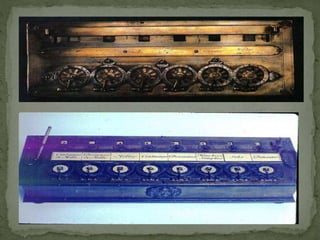
Pascaline uses complicated arrangement of
numbered wheels connected by gears. Pascal
continually develop his machine until it can
already perform subtraction and addition up to
nine digits long.
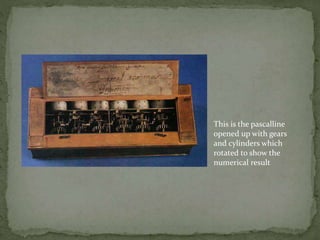
This is the pascalline
opened up with gears
and cylinders which
rotated to show the
numerical result
STEPPED RECKONER
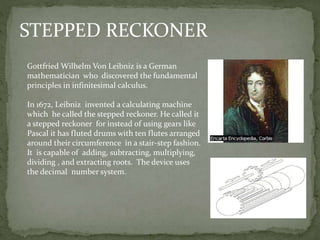
Gottfried Wilhelm Von Leibniz is a German
mathematician who discovered the fundamental
principles in infinitesimal calculus.
In 1672, Leibniz invented a calculating machine
which he called the stepped reckoner. He called it
a stepped reckoner for instead of using gears like
Pascal it has fluted drums with ten flutes arranged
around their circumference in a stair-step fashion.
It is capable of adding, subtracting, multiplying,
dividing , and extracting roots. The device uses
the decimal number system.
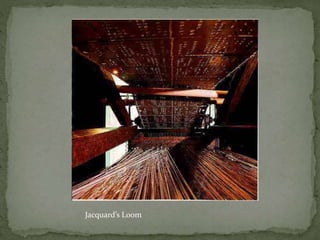
JACQUARD’S LOOM
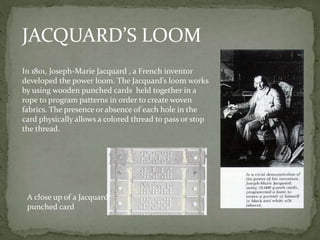
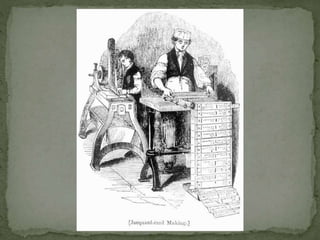
In 1801, Joseph-Marie Jacquard , a French inventor
developed the power loom. The Jacquard’s loom works
by using wooden punched cards held together in a
rope to program patterns in order to create woven
fabrics. The presence or absence of each hole in the
card physically allows a colored thread to pass or stop
the thread.
A close up of a Jacquard
punched card
Jacquard’s Loom
DIFFERENCE ENGINE
Charles Babbage designed this steam driven
calculating machine about the size of the room.
The machine intended to solve tables of
numbers, such as logarithm tables which was
use in navigations. The difference engine should
be capable or calculating 20-decimal capacity of
solving mathematical problems.
The machine was greatly funded by the British
government to be used by the Navy.
Unfortunately, even though a lot of money was
put into the completion of the machine it was
never been finished.
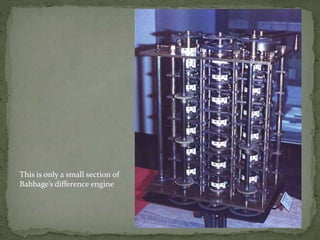
This is only a small section of
Babbage’s difference engine
ANALYTICAL ENGINE
Again, Charles Babbage conceived a new machine, called the analytical
engine. He got the mechanism of Jacquard’s loom. The punched card
technology was used in this machine and Babbage improved it. The analytical
engine is programmable, it is as large as a house with 6 steam engines. It is
capable of performing mathematical calculations, storing information by
using punched cards as a permanent memory. This machine also uses
conditional statement to perform calculations.
Babbage befriended Ada Byron for the fashioning programs of the Analytical
engine. However when Ada had already made plans and notes for the
machine, Babbage refused to publish his ideas. The British government
refused to fund Babbage’s machine and remain unbuilt. It was only in 1833
that the machine was constructed but then only a part of it was finished.
LADY ADA AUGUSTA BYRON
KINGShe is the very first computer programmer. A daughter of the famous poet
Lord Byron. She became the Countess Lady Lovelace. At the age of 19, she
already got interested in Babbage’s ideas of the Analytical Engine. Ada and
Babbage had communicated through letters and meetings and had studied
for the programming of the engine. She wrote a series of notes wherein she
detailed sequences of instructions she had prepared for the analytical
engine.
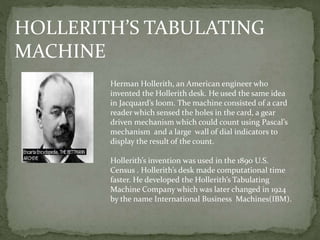
HOLLERITH’S TABULATING
MACHINE
Herman Hollerith, an American engineer who
invented the Hollerith desk. He used the same idea
in Jacquard’s loom. The machine consisted of a card
reader which sensed the holes in the card, a gear
driven mechanism which could count using Pascal’s
mechanism and a large wall of dial indicators to
display the result of the count.
Hollerith’s invention was used in the 1890 U.S.
Census . Hollerith’s desk made computational time
faster. He developed the Hollerith’s Tabulating
Machine Company which was later changed in 1924
by the name International Business Machines(IBM).
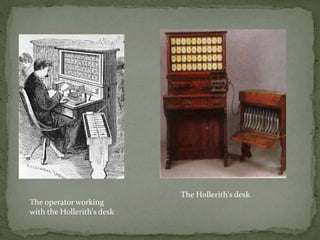
The operator working
with the Hollerith's desk
The Hollerith's desk
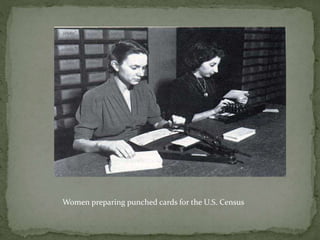
Women preparing punched cards for the U.S. Census
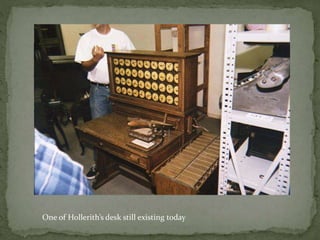
One of Hollerith’s desk still existing today
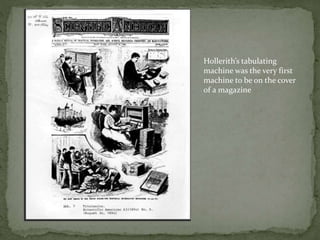
Hollerith’s tabulating
machine was the very first
machine to be on the cover
of a magazine
 www.google.com
 www.wikipedia.com
History of Computers ppt

History of Computers ppt

  • 1.
    www.oeclib.in Submitted By: Odisha ElectronicsControl Library Seminar On History of Computer
  • 2.
     Definition ofa Computer  Definition of Modern Computer  Abacus  Napier Bones  Side rule  Pascaline  Stepped Reckoner  Jacquard Loom  Arithmometer  Difference Engine and Analytical Engine
  • 3.
    The first countingdevice started to be used by the primitive people. These are the sticks and stones. As technology improves and human minds develop more and more computing devices are invented and developed. The first computer is really the people. “Computer” then was a job title. Computer was used to describe human beings especially women whose job is to perform repetitive calculations required to compute such things as navigation tables, tide charts, and planetary positions for almanacs. Humans can be sometimes ineffective and inaccurate and computing multiplications for long hours can be so boring. Hence, mistakes in computations will arouse. That’s why inventors made researches to find ways in computing easier with the aid of machines.
  • 4.
  • 5.
     Inputs, outputs,processes and stores information  Physical: Keyboard, monitor, etc. – are these necessary components?
  • 6.
    A typical computeroperation back when computers were people
  • 7.
    ABACUS Abacus is anancient instrument used in performing arithmetic calculations. It can do add, subtract, multiply and divide. It consists of tablet or frame bearing parallel wires or grooves in which the counters or beads are moved. For a skilled user of abacus he could perform addition and subtraction in the same speed with the person using an electronic computer. However, multiplication and division are much slower. It is not in China that abacus was really invented . The oldest surviving abacus was used 300 B.C by the Babylonians. Until now, China, Japan and Korea are still using the abacus.
  • 9.
    A modern abacus.Abacus is just a representation of the human fingers: the 5 lower rings in each rod represent the 5 fingers and the upper rings represent the 2 hands.
  • 10.
    NAPIER’S BONES Invented bya Scottish named John Napier . He first invented the logarithms in 1617 and he got the idea from printed tables. From the printed tables he made an alternative wherein logarithms values are carved on ivory sticks .
  • 11.
    SLIDE RULE A sliderule can do very difficult calculations engineers and architects were using it before in calculations. Three men developed the slide rule and they were Edmund Gunter, William Oughtred, and Robert Bissaker. It was in 1632 when slide rule was first built in England. It was used in the 1960s by engineers of Mercury, Gemini and Apollo programs which landed men on moon.
  • 12.
    Leonardo da Vincimade had drawn gear-driven calculating machines but had never built any.
  • 13.
    SCHICKARD’S CALCULATING CLOCKIn 1623,German Professor, Wilhelm Schickard built this first gear-driven calculating device. However this device got little publicity for its inventor died because of the outbreak of bubonic plague in the Mediterranen.
  • 14.
    PASCALINE At the ageof 19, Blaise Pascal invented the Pascaline in 1642 for his father who is a tax collector. He had built 50 of this gear-driven one- function calculator, which only performs addition. But he wasn’t able to sell the device because of its high cost and inaccuracy. Pascaline uses complicated arrangement of numbered wheels connected by gears. Pascal continually develop his machine until it can already perform subtraction and addition up to nine digits long.
  • 15.
    This is thepascalline opened up with gears and cylinders which rotated to show the numerical result
  • 17.
    STEPPED RECKONER Gottfried WilhelmVon Leibniz is a German mathematician who discovered the fundamental principles in infinitesimal calculus. In 1672, Leibniz invented a calculating machine which he called the stepped reckoner. He called it a stepped reckoner for instead of using gears like Pascal it has fluted drums with ten flutes arranged around their circumference in a stair-step fashion. It is capable of adding, subtracting, multiplying, dividing , and extracting roots. The device uses the decimal number system.
  • 18.
    JACQUARD’S LOOM In 1801,Joseph-Marie Jacquard , a French inventor developed the power loom. The Jacquard’s loom works by using wooden punched cards held together in a rope to program patterns in order to create woven fabrics. The presence or absence of each hole in the card physically allows a colored thread to pass or stop the thread. A close up of a Jacquard punched card
  • 20.
  • 21.
    DIFFERENCE ENGINE Charles Babbagedesigned this steam driven calculating machine about the size of the room. The machine intended to solve tables of numbers, such as logarithm tables which was use in navigations. The difference engine should be capable or calculating 20-decimal capacity of solving mathematical problems. The machine was greatly funded by the British government to be used by the Navy. Unfortunately, even though a lot of money was put into the completion of the machine it was never been finished.
  • 22.
    This is onlya small section of Babbage’s difference engine
  • 23.
    ANALYTICAL ENGINE Again, CharlesBabbage conceived a new machine, called the analytical engine. He got the mechanism of Jacquard’s loom. The punched card technology was used in this machine and Babbage improved it. The analytical engine is programmable, it is as large as a house with 6 steam engines. It is capable of performing mathematical calculations, storing information by using punched cards as a permanent memory. This machine also uses conditional statement to perform calculations. Babbage befriended Ada Byron for the fashioning programs of the Analytical engine. However when Ada had already made plans and notes for the machine, Babbage refused to publish his ideas. The British government refused to fund Babbage’s machine and remain unbuilt. It was only in 1833 that the machine was constructed but then only a part of it was finished.
  • 24.
    LADY ADA AUGUSTABYRON KINGShe is the very first computer programmer. A daughter of the famous poet Lord Byron. She became the Countess Lady Lovelace. At the age of 19, she already got interested in Babbage’s ideas of the Analytical Engine. Ada and Babbage had communicated through letters and meetings and had studied for the programming of the engine. She wrote a series of notes wherein she detailed sequences of instructions she had prepared for the analytical engine.
  • 25.
    HOLLERITH’S TABULATING MACHINE Herman Hollerith,an American engineer who invented the Hollerith desk. He used the same idea in Jacquard’s loom. The machine consisted of a card reader which sensed the holes in the card, a gear driven mechanism which could count using Pascal’s mechanism and a large wall of dial indicators to display the result of the count. Hollerith’s invention was used in the 1890 U.S. Census . Hollerith’s desk made computational time faster. He developed the Hollerith’s Tabulating Machine Company which was later changed in 1924 by the name International Business Machines(IBM).
  • 26.
    The operator working withthe Hollerith's desk The Hollerith's desk
  • 27.
    Women preparing punchedcards for the U.S. Census
  • 28.
    One of Hollerith’sdesk still existing today
  • 29.
    Hollerith’s tabulating machine wasthe very first machine to be on the cover of a magazine
  • 30.

Editor's Notes