www.oeclib.in
Submitted By:
Odisha Electronics Control Library
Seminar
On
Computer Forensics
CONTENTS
2
• Introduction
• What is Computer Forensics?
• Characteristics
• Needs
• History
• Goal
• Cyber Crime & Evidence
• Rules Of Handling Evidence
• Top 10 Location For Evidence
• Computer Forensics Methodology
• Applications of Computer Forensics
• Who Uses Computer Forensics
• Skills Requirements for Computer Forensics
• Conclusion
• References
Introduction
“Forensic computing is the process of identifying, preserving,
analyzing and presenting digital evidence in a manner that is
legally acceptable.”(Rodney Mckemmish 1999).
What is Computer Forensics?
4
 “Forensic computing is the process of identifying, preserving,
analyzing and presenting digital evidence in a manner that is
legally acceptable.”(Rodney Mckemmish 1999).
 Evidence might be required for a wide range of computer
crimes and misuses.
 Information collected assists in arrests, prosecution,
termination of employment, and preventing future illegal
activity
Characteristics
5
 IDENTIFYING
 PRESERVING
 ANALYZING
 PRESENTING
NEEDS OF COMPUTER FORENSICS
6
o To produce evidence in the court that can lead to the
punishment of the actual.
o To ensure the integrity of the computer system.
o To focus on the response to hi-tech offenses, started to
intertwine.
HISTORY OF COMPUTER FORENSICS
7
o Began to evolve more than 30 years ago in US when law
enforcement and military investigators started seeing
criminals get technical.
o Over the next decades, and up to today, the field has exploded.
Law enforcement and the military continue to have a large
presence in the information security and computer forensic
field at the local, state and federal level.
o Now a days, Software companies continue to produce newer
and more robust forensic software programs. And law
enforcement and the military continue to identify and train
more and more of their personnel in the response to crimes
involving technology.
GOAL OF COMPUTER FORENSICS
8
 The main goal of computer forensic experts is not only to find
the criminal but also to find out the evidence and the
presentation of the evidence in a manner that leads to legal
action of the criminal.
CYBER CRIME & EVIDENCE
9
 CYBER CRIME
 Cyber crime occurs when information technology is used to
commit or conceal an offence.
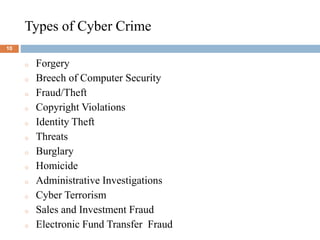
Types of Cyber Crime
10
o Forgery
o Breech of Computer Security
o Fraud/Theft
o Copyright Violations
o Identity Theft
o Threats
o Burglary
o Homicide
o Administrative Investigations
o Cyber Terrorism
o Sales and Investment Fraud
o Electronic Fund Transfer Fraud
11
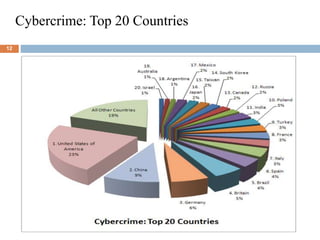
Cybercrime: Top 20 Countries
12
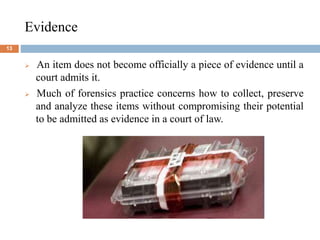
Evidence
13
 An item does not become officially a piece of evidence until a
court admits it.
 Much of forensics practice concerns how to collect, preserve
and analyze these items without compromising their potential
to be admitted as evidence in a court of law.
DIGITAL EVIDENCE
14
 “Any data that is recorded or preserved on any medium
in or by a computer system or other similar device, that
can be read or understand by a person or a computer
system or other similar device. It includes a display, print
out or other output of that data.”
TYPES OF DIGITAL EVIDENCE
15
1) PERSISTANT DATA
Meaning data that remains intact when the computer is
turned off. E.g. hard drives, disk drives and removable storage
devices (such as USB drives or flash drives).
2) VOLATILE DATA,
Meaning data that would be lost if the computer is
turned off. E.g. deleted files, computer history, the computer's
registry, temporary files and web browsing history.
5 RULES OF EVIDENCES
16
1) Admissible
 Must be able to be used in court or elsewhere.
2) Authentic
 Evidence relates to incident in relevant way.
3) Complete (no tunnel vision)
 Exculpatory evidence for alternative suspects.
4) Reliable
 No question about authenticity & veracity.
5) Believable
 Clear, easy to understand, and believable by a jury.
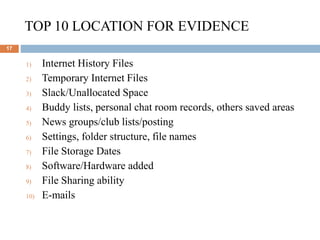
TOP 10 LOCATION FOR EVIDENCE
17
1) Internet History Files
2) Temporary Internet Files
3) Slack/Unallocated Space
4) Buddy lists, personal chat room records, others saved areas
5) News groups/club lists/posting
6) Settings, folder structure, file names
7) File Storage Dates
8) Software/Hardware added
9) File Sharing ability
10) E-mails
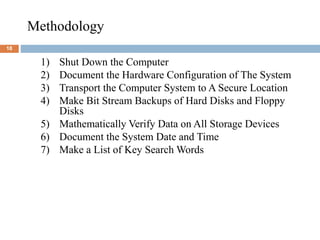
Methodology
18
1) Shut Down the Computer
2) Document the Hardware Configuration of The System
3) Transport the Computer System to A Secure Location
4) Make Bit Stream Backups of Hard Disks and Floppy
Disks
5) Mathematically Verify Data on All Storage Devices
6) Document the System Date and Time
7) Make a List of Key Search Words
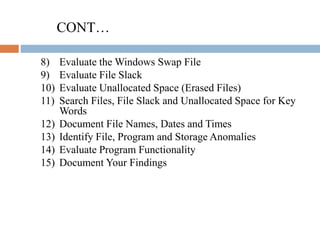
CONT…
8) Evaluate the Windows Swap File
9) Evaluate File Slack
10) Evaluate Unallocated Space (Erased Files)
11) Search Files, File Slack and Unallocated Space for Key
Words
12) Document File Names, Dates and Times
13) Identify File, Program and Storage Anomalies
14) Evaluate Program Functionality
15) Document Your Findings
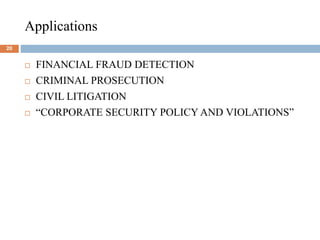
Applications
20
 FINANCIAL FRAUD DETECTION
 CRIMINAL PROSECUTION
 CIVIL LITIGATION
 “CORPORATE SECURITY POLICY AND VIOLATIONS”
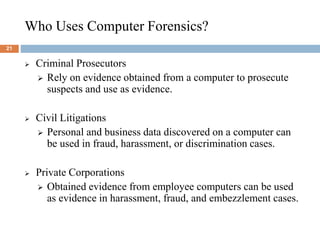
Who Uses Computer Forensics?
21
 Criminal Prosecutors
 Rely on evidence obtained from a computer to prosecute
suspects and use as evidence.
 Civil Litigations
 Personal and business data discovered on a computer can
be used in fraud, harassment, or discrimination cases.
 Private Corporations
 Obtained evidence from employee computers can be used
as evidence in harassment, fraud, and embezzlement cases.
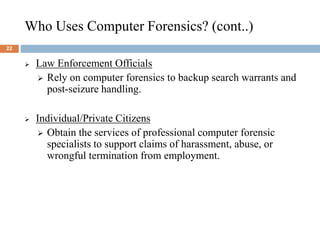
Who Uses Computer Forensics? (cont..)
22
 Law Enforcement Officials
 Rely on computer forensics to backup search warrants and
post-seizure handling.
 Individual/Private Citizens
 Obtain the services of professional computer forensic
specialists to support claims of harassment, abuse, or
wrongful termination from employment.
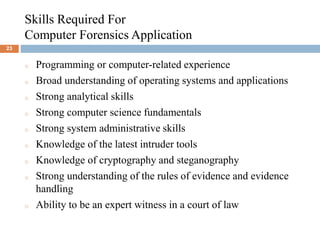
Skills Required For
Computer Forensics Application
23
o Programming or computer-related experience
o Broad understanding of operating systems and applications
o Strong analytical skills
o Strong computer science fundamentals
o Strong system administrative skills
o Knowledge of the latest intruder tools
o Knowledge of cryptography and steganography
o Strong understanding of the rules of evidence and evidence
handling
o Ability to be an expert witness in a court of law
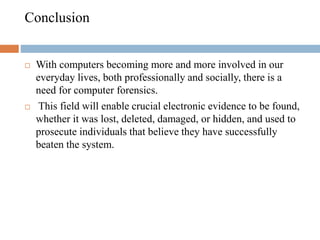
Conclusion
 With computers becoming more and more involved in our
everyday lives, both professionally and socially, there is a
need for computer forensics.
 This field will enable crucial electronic evidence to be found,
whether it was lost, deleted, damaged, or hidden, and used to
prosecute individuals that believe they have successfully
beaten the system.
References
 www.google.com
 www.wikipedia.com
 www.oeclib.in
Thanks
26

Computer Forensics ppt

  • 1.
    www.oeclib.in Submitted By: Odisha ElectronicsControl Library Seminar On Computer Forensics
  • 2.
    CONTENTS 2 • Introduction • Whatis Computer Forensics? • Characteristics • Needs • History • Goal • Cyber Crime & Evidence • Rules Of Handling Evidence • Top 10 Location For Evidence • Computer Forensics Methodology • Applications of Computer Forensics • Who Uses Computer Forensics • Skills Requirements for Computer Forensics • Conclusion • References
  • 3.
    Introduction “Forensic computing isthe process of identifying, preserving, analyzing and presenting digital evidence in a manner that is legally acceptable.”(Rodney Mckemmish 1999).
  • 4.
    What is ComputerForensics? 4  “Forensic computing is the process of identifying, preserving, analyzing and presenting digital evidence in a manner that is legally acceptable.”(Rodney Mckemmish 1999).  Evidence might be required for a wide range of computer crimes and misuses.  Information collected assists in arrests, prosecution, termination of employment, and preventing future illegal activity
  • 5.
  • 6.
    NEEDS OF COMPUTERFORENSICS 6 o To produce evidence in the court that can lead to the punishment of the actual. o To ensure the integrity of the computer system. o To focus on the response to hi-tech offenses, started to intertwine.
  • 7.
    HISTORY OF COMPUTERFORENSICS 7 o Began to evolve more than 30 years ago in US when law enforcement and military investigators started seeing criminals get technical. o Over the next decades, and up to today, the field has exploded. Law enforcement and the military continue to have a large presence in the information security and computer forensic field at the local, state and federal level. o Now a days, Software companies continue to produce newer and more robust forensic software programs. And law enforcement and the military continue to identify and train more and more of their personnel in the response to crimes involving technology.
  • 8.
    GOAL OF COMPUTERFORENSICS 8  The main goal of computer forensic experts is not only to find the criminal but also to find out the evidence and the presentation of the evidence in a manner that leads to legal action of the criminal.
  • 9.
    CYBER CRIME &EVIDENCE 9  CYBER CRIME  Cyber crime occurs when information technology is used to commit or conceal an offence.
  • 10.
    Types of CyberCrime 10 o Forgery o Breech of Computer Security o Fraud/Theft o Copyright Violations o Identity Theft o Threats o Burglary o Homicide o Administrative Investigations o Cyber Terrorism o Sales and Investment Fraud o Electronic Fund Transfer Fraud
  • 11.
  • 12.
    Cybercrime: Top 20Countries 12
  • 13.
    Evidence 13  An itemdoes not become officially a piece of evidence until a court admits it.  Much of forensics practice concerns how to collect, preserve and analyze these items without compromising their potential to be admitted as evidence in a court of law.
  • 14.
    DIGITAL EVIDENCE 14  “Anydata that is recorded or preserved on any medium in or by a computer system or other similar device, that can be read or understand by a person or a computer system or other similar device. It includes a display, print out or other output of that data.”
  • 15.
    TYPES OF DIGITALEVIDENCE 15 1) PERSISTANT DATA Meaning data that remains intact when the computer is turned off. E.g. hard drives, disk drives and removable storage devices (such as USB drives or flash drives). 2) VOLATILE DATA, Meaning data that would be lost if the computer is turned off. E.g. deleted files, computer history, the computer's registry, temporary files and web browsing history.
  • 16.
    5 RULES OFEVIDENCES 16 1) Admissible  Must be able to be used in court or elsewhere. 2) Authentic  Evidence relates to incident in relevant way. 3) Complete (no tunnel vision)  Exculpatory evidence for alternative suspects. 4) Reliable  No question about authenticity & veracity. 5) Believable  Clear, easy to understand, and believable by a jury.
  • 17.
    TOP 10 LOCATIONFOR EVIDENCE 17 1) Internet History Files 2) Temporary Internet Files 3) Slack/Unallocated Space 4) Buddy lists, personal chat room records, others saved areas 5) News groups/club lists/posting 6) Settings, folder structure, file names 7) File Storage Dates 8) Software/Hardware added 9) File Sharing ability 10) E-mails
  • 18.
    Methodology 18 1) Shut Downthe Computer 2) Document the Hardware Configuration of The System 3) Transport the Computer System to A Secure Location 4) Make Bit Stream Backups of Hard Disks and Floppy Disks 5) Mathematically Verify Data on All Storage Devices 6) Document the System Date and Time 7) Make a List of Key Search Words
  • 19.
    CONT… 8) Evaluate theWindows Swap File 9) Evaluate File Slack 10) Evaluate Unallocated Space (Erased Files) 11) Search Files, File Slack and Unallocated Space for Key Words 12) Document File Names, Dates and Times 13) Identify File, Program and Storage Anomalies 14) Evaluate Program Functionality 15) Document Your Findings
  • 20.
    Applications 20  FINANCIAL FRAUDDETECTION  CRIMINAL PROSECUTION  CIVIL LITIGATION  “CORPORATE SECURITY POLICY AND VIOLATIONS”
  • 21.
    Who Uses ComputerForensics? 21  Criminal Prosecutors  Rely on evidence obtained from a computer to prosecute suspects and use as evidence.  Civil Litigations  Personal and business data discovered on a computer can be used in fraud, harassment, or discrimination cases.  Private Corporations  Obtained evidence from employee computers can be used as evidence in harassment, fraud, and embezzlement cases.
  • 22.
    Who Uses ComputerForensics? (cont..) 22  Law Enforcement Officials  Rely on computer forensics to backup search warrants and post-seizure handling.  Individual/Private Citizens  Obtain the services of professional computer forensic specialists to support claims of harassment, abuse, or wrongful termination from employment.
  • 23.
    Skills Required For ComputerForensics Application 23 o Programming or computer-related experience o Broad understanding of operating systems and applications o Strong analytical skills o Strong computer science fundamentals o Strong system administrative skills o Knowledge of the latest intruder tools o Knowledge of cryptography and steganography o Strong understanding of the rules of evidence and evidence handling o Ability to be an expert witness in a court of law
  • 24.
    Conclusion  With computersbecoming more and more involved in our everyday lives, both professionally and socially, there is a need for computer forensics.  This field will enable crucial electronic evidence to be found, whether it was lost, deleted, damaged, or hidden, and used to prosecute individuals that believe they have successfully beaten the system.
  • 25.
  • 26.

Editor's Notes