SUBMITTED BY:
ODISHA ELECTRONICS CONTROL LIABRAY
Content
• Introduction
• History
• Why choose
• Components
• Working
• Applications
• Advantages
• Disadvantages
• Future scope
• Conclusion
INTRODUCTION
• We humans, interact with the world using our five
senses.
• But as the name suggests this technology brings
forward an additional sixth sense.
• A sixth sense is an ESP(Extra Sensory
Perception) that aims at a more developed future
with both the physical and digital world connected
without the help of hardware devices.
History
• Steve Mann is father of sixth sense who made a
wearable computer in 1990.
• The Sixth Sense Technology was first
implemented as the neck worn projector +
camera system.
• He was a media lab student at that time. There
after it was used and implemented by an Indian
who is the man has become very famous in the
recent Pranav Mistry.
WHY CHOOSE SIXTH SENSE TECHNOLOGY?
• This sixth sense technology provides us with the
freedom of interacting with the digital world
using hand gestures.
• This technology has a wide application in the
field of artificial intelligence.
• This methodology can aid in synthesis of bots
that will be able to interact with humans.
COMPONENTS
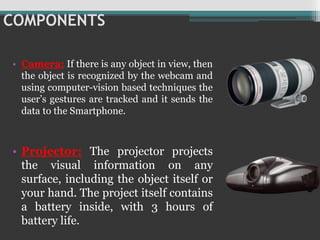
• Camera: If there is any object in view, then
the object is recognized by the webcam and
using computer-vision based techniques the
user’s gestures are tracked and it sends the
data to the Smartphone.
• Projector: The projector projects
the visual information on any
surface, including the object itself or
your hand. The project itself contains
a battery inside, with 3 hours of
battery life.
COMPONENTS…
• Mirror: The downward-facing projector
projects the output image on to the
mirror And the mirror reflects this image
on to the desired surface.
• Mobile Component: The mobile
devices like the Smartphone are used to
handle connection to the internet. Using
mobile internet data and voice can be
communicated across the world either by
transmitting or by receiving it.
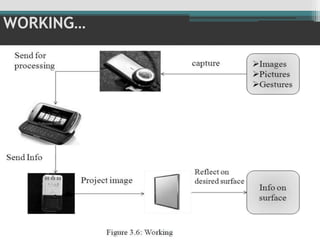
WORKING
The object in view in captured by the camera and
sends it to webcam for processing. With the help
of the markers, the gestures are identified. The
software program analyses the video data caught
by the camera and also tracks down.
The locations of the colored markers by utilizing
single computer vision techniques.
• The software recognizes 3 kinds of gestures:
• Multitouch gestures
• Freehand gestures
• Iconic gestures
WORKING…
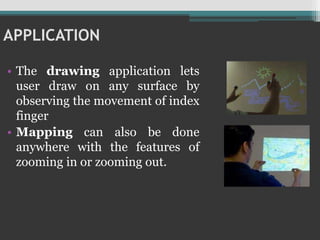
APPLICATION
• The drawing application lets
user draw on any surface by
observing the movement of index
finger
• Mapping can also be done
anywhere with the features of
zooming in or zooming out.
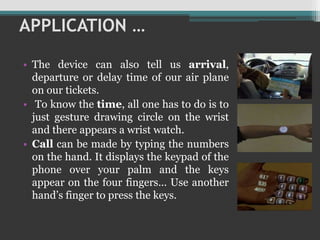
APPLICATION …
• The device can also tell us arrival,
departure or delay time of our air plane
on our tickets.
• To know the time, all one has to do is to
just gesture drawing circle on the wrist
and there appears a wrist watch.
• Call can be made by typing the numbers
on the hand. It displays the keypad of the
phone over your palm and the keys
appear on the four fingers… Use another
hand’s finger to press the keys.
RELATED TECHNOLOGIES TO SIXTH
SENSE DEVICES
• Augmented Reality
• Gesture Recognition
• Computer Vision
• Radio Frequency Identification
Augmented Reality
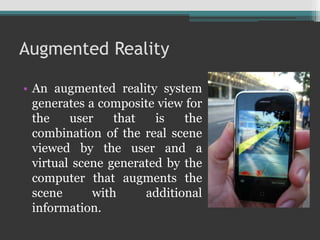
• An augmented reality system
generates a composite view for
the user that is the
combination of the real scene
viewed by the user and a
virtual scene generated by the
computer that augments the
scene with additional
information.
Gesture Recognition
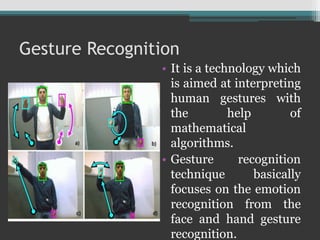
• It is a technology which
is aimed at interpreting
human gestures with
the help of
mathematical
algorithms.
• Gesture recognition
technique basically
focuses on the emotion
recognition from the
face and hand gesture
recognition.
Computer Vision
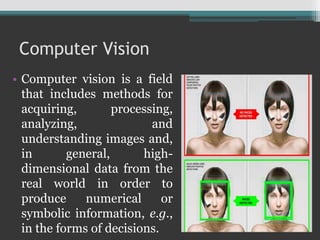
• Computer vision is a field
that includes methods for
acquiring, processing,
analyzing, and
understanding images and,
in general, high-
dimensional data from the
real world in order to
produce numerical or
symbolic information, e.g.,
in the forms of decisions.
Radio Frequency Identification
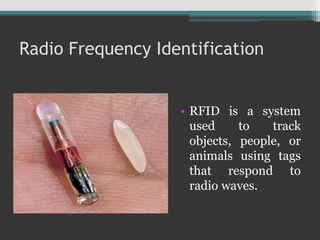
• RFID is a system
used to track
objects, people, or
animals using tags
that respond to
radio waves.
Education Use
• Engagement
• Research
• Collaboration
• Cost-effectiveness
Engagement
▫ Teachers may find that Sixth Sense, because of its
unique ability to work with many of Gardner’s
multiple intelligences, will be a catalyst for students
who might otherwise remain unengaged in learning.
▫ Sixth Sense uses the visual, kinesthetic, intrapersonal
and interpersonal among others.
▫ If this technology does nothing else, the idea that
students can simply use their hands to draw images on
walls and take pictures with their hands will be (at
least initially) quite motivating
Research
• Sixth Sense will give new meaning to
“looking something up.”
• Since we are essentially talking about the
internet, students will be given the
opportunity to portably research the
world.
• They can all go on a virtual field trip and
project the images on their own desks, for
example.
Collaboration
• Students will be given an opportunity
through this technology to feel more
connected to others.
• Although there does seem to be the sense
that individuals could walk through life
wired and lonely, I like to think the
classroom would serve as the environment
in which students and teachers using Sixth
Sense would want to share.
Cost-effectiveness
• As mentioned earlier, this product
currently costs only $350. From an
educator’s stand point, this is minimum
given the amount of money spent on
textbooks, computer labs and LCD
projectors.
• For educator’s, Sixth Sense would be a way
to put technology (literally) into each
student’s hands, because of its size and its
cost.
ADVANTAGES
• Portable: One of the main advantages of the sixth
sense devices is its small size and portability.
• Support multi touch and multi user
interaction: Multi touch and multi user
interaction is another added feature of the sixth
sense devices.
• Cost effective:The cost incurred for the
construction of the sixth sense proto type is quiet
low.
ADVANTAGES…
• Connectedness between real world and digital
world: Forming a connection between the real world
and the digital world was the main aim of the sixth sense
technology.
• Data access directly from the machines in real
time: With help of a sixth sense device the user can
easily access data from any machine at real time speed.
• Open source software:The software that is used to
interpret and analysis the data collected by the device is
made open source.
• Mind map the idea anywhere:With the advent of the
sixth sense device, requirement of a platform or a screen
to analyze and interpret the data has become obsolete.
Disadvantages
• We have to give correct instruction.
• The projectors runs on batteries for power
where regularly have to place.
Current status
• Although the Sixth Sense technology achieved
wide press coverage in 2009, no commercial
product had been released at that time.
• As of September 2013, the open source code
published has not been updated since October
2012, and the Java development branch of the
project was similarly stalled.
FUTURE SCOPE
• As this technology will emerge may be new
devices and hence forth new markets will evolve.
• Mystery made his own tablet computer much
before they hit the market, using just a piece of
paper, a microphone and a camera.
• This technology enables one to account,
compute and browse data on any piece of paper
we can find around.
CONCLUSION
• Sixth Sense recognizes the objects around us,
displaying information automatically and letting
us to access it in any way we need.
• This prototype implements several applications
that demonstrate the usefulness, viability and
flexibility of the system, allowing us to interact
with this information via natural hand gestures.
References
• www.oeclib.in
• www.google.com
• www.wikipedia.com
Thanks..!!!

Sixth sense technology ppt

  • 1.
  • 2.
    Content • Introduction • History •Why choose • Components • Working • Applications • Advantages • Disadvantages • Future scope • Conclusion
  • 3.
    INTRODUCTION • We humans,interact with the world using our five senses. • But as the name suggests this technology brings forward an additional sixth sense. • A sixth sense is an ESP(Extra Sensory Perception) that aims at a more developed future with both the physical and digital world connected without the help of hardware devices.
  • 4.
    History • Steve Mannis father of sixth sense who made a wearable computer in 1990. • The Sixth Sense Technology was first implemented as the neck worn projector + camera system. • He was a media lab student at that time. There after it was used and implemented by an Indian who is the man has become very famous in the recent Pranav Mistry.
  • 5.
    WHY CHOOSE SIXTHSENSE TECHNOLOGY? • This sixth sense technology provides us with the freedom of interacting with the digital world using hand gestures. • This technology has a wide application in the field of artificial intelligence. • This methodology can aid in synthesis of bots that will be able to interact with humans.
  • 6.
    COMPONENTS • Camera: Ifthere is any object in view, then the object is recognized by the webcam and using computer-vision based techniques the user’s gestures are tracked and it sends the data to the Smartphone. • Projector: The projector projects the visual information on any surface, including the object itself or your hand. The project itself contains a battery inside, with 3 hours of battery life.
  • 7.
    COMPONENTS… • Mirror: Thedownward-facing projector projects the output image on to the mirror And the mirror reflects this image on to the desired surface. • Mobile Component: The mobile devices like the Smartphone are used to handle connection to the internet. Using mobile internet data and voice can be communicated across the world either by transmitting or by receiving it.
  • 8.
    WORKING The object inview in captured by the camera and sends it to webcam for processing. With the help of the markers, the gestures are identified. The software program analyses the video data caught by the camera and also tracks down. The locations of the colored markers by utilizing single computer vision techniques. • The software recognizes 3 kinds of gestures: • Multitouch gestures • Freehand gestures • Iconic gestures
  • 9.
  • 10.
    APPLICATION • The drawingapplication lets user draw on any surface by observing the movement of index finger • Mapping can also be done anywhere with the features of zooming in or zooming out.
  • 11.
    APPLICATION … • Thedevice can also tell us arrival, departure or delay time of our air plane on our tickets. • To know the time, all one has to do is to just gesture drawing circle on the wrist and there appears a wrist watch. • Call can be made by typing the numbers on the hand. It displays the keypad of the phone over your palm and the keys appear on the four fingers… Use another hand’s finger to press the keys.
  • 12.
    RELATED TECHNOLOGIES TOSIXTH SENSE DEVICES • Augmented Reality • Gesture Recognition • Computer Vision • Radio Frequency Identification
  • 13.
    Augmented Reality • Anaugmented reality system generates a composite view for the user that is the combination of the real scene viewed by the user and a virtual scene generated by the computer that augments the scene with additional information.
  • 14.
    Gesture Recognition • Itis a technology which is aimed at interpreting human gestures with the help of mathematical algorithms. • Gesture recognition technique basically focuses on the emotion recognition from the face and hand gesture recognition.
  • 15.
    Computer Vision • Computervision is a field that includes methods for acquiring, processing, analyzing, and understanding images and, in general, high- dimensional data from the real world in order to produce numerical or symbolic information, e.g., in the forms of decisions.
  • 16.
    Radio Frequency Identification •RFID is a system used to track objects, people, or animals using tags that respond to radio waves.
  • 17.
    Education Use • Engagement •Research • Collaboration • Cost-effectiveness
  • 18.
    Engagement ▫ Teachers mayfind that Sixth Sense, because of its unique ability to work with many of Gardner’s multiple intelligences, will be a catalyst for students who might otherwise remain unengaged in learning. ▫ Sixth Sense uses the visual, kinesthetic, intrapersonal and interpersonal among others. ▫ If this technology does nothing else, the idea that students can simply use their hands to draw images on walls and take pictures with their hands will be (at least initially) quite motivating
  • 19.
    Research • Sixth Sensewill give new meaning to “looking something up.” • Since we are essentially talking about the internet, students will be given the opportunity to portably research the world. • They can all go on a virtual field trip and project the images on their own desks, for example.
  • 20.
    Collaboration • Students willbe given an opportunity through this technology to feel more connected to others. • Although there does seem to be the sense that individuals could walk through life wired and lonely, I like to think the classroom would serve as the environment in which students and teachers using Sixth Sense would want to share.
  • 21.
    Cost-effectiveness • As mentionedearlier, this product currently costs only $350. From an educator’s stand point, this is minimum given the amount of money spent on textbooks, computer labs and LCD projectors. • For educator’s, Sixth Sense would be a way to put technology (literally) into each student’s hands, because of its size and its cost.
  • 22.
    ADVANTAGES • Portable: Oneof the main advantages of the sixth sense devices is its small size and portability. • Support multi touch and multi user interaction: Multi touch and multi user interaction is another added feature of the sixth sense devices. • Cost effective:The cost incurred for the construction of the sixth sense proto type is quiet low.
  • 23.
    ADVANTAGES… • Connectedness betweenreal world and digital world: Forming a connection between the real world and the digital world was the main aim of the sixth sense technology. • Data access directly from the machines in real time: With help of a sixth sense device the user can easily access data from any machine at real time speed. • Open source software:The software that is used to interpret and analysis the data collected by the device is made open source. • Mind map the idea anywhere:With the advent of the sixth sense device, requirement of a platform or a screen to analyze and interpret the data has become obsolete.
  • 24.
    Disadvantages • We haveto give correct instruction. • The projectors runs on batteries for power where regularly have to place.
  • 25.
    Current status • Althoughthe Sixth Sense technology achieved wide press coverage in 2009, no commercial product had been released at that time. • As of September 2013, the open source code published has not been updated since October 2012, and the Java development branch of the project was similarly stalled.
  • 26.
    FUTURE SCOPE • Asthis technology will emerge may be new devices and hence forth new markets will evolve. • Mystery made his own tablet computer much before they hit the market, using just a piece of paper, a microphone and a camera. • This technology enables one to account, compute and browse data on any piece of paper we can find around.
  • 27.
    CONCLUSION • Sixth Senserecognizes the objects around us, displaying information automatically and letting us to access it in any way we need. • This prototype implements several applications that demonstrate the usefulness, viability and flexibility of the system, allowing us to interact with this information via natural hand gestures.
  • 28.
  • 29.

Editor's Notes