1
Digital Forensics
Prepared by Cleverence Kombe
Outline
Forensic and Digital Forensic Definitions
Digital Evidence
Digital Forensic Model
Digital Forensic Process
Need and Benefits of Digital Forensic
Applications of Digital Forensic
Skills required and Challenges faced by Digital Forensic
Digital Forensic Software Tools
Conclusion
2
What is forensic?
 Collection and analysis of evidence
Using scientific test or techniques
To establish facts against crime
For presenting in a legal proceeding
 Therefore forensic science is a scientific method of
gathering and examining information about the past
which is then used in court of law
3
What is digital forensic?
• Digital Forensics is the use of scientifically derived and proven
methods toward:
the preservation, collection, validation, identification, analysis,
interpretation, documentation, and presentation of digital
evidence derived from digital devices
for the purpose of facilitation or furthering the reconstruction of
events found to be criminal, or helping to anticipate
unauthorized actions shown to be disruptive to planned operations.
4
Branches of Digital Forensics
• The technical aspect of an investigation is divided into
several sub-branches, relating to the type of digital devices
involved:
Computer forensics, Firewall Forensics, Database Forensics,
Network forensics, Forensic data analysis and Mobile device
forensics.
• The typical forensic process encompasses the seizure,
forensic imaging and analysis of digital media and the
production of a report into collected evidence.
5
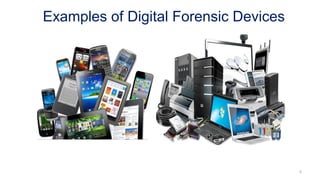
Examples of Digital Forensic Devices
6
Digital Evidence
• Evidence
A piece of information that supports a conclusion
• Digital evidence
Any data that is recorded or preserved on any medium in or
by a computer system or other similar digital device, that
can be read or understood by a person or a computer
system or other similar device.
 It includes a display, printout or other output of that data.
7
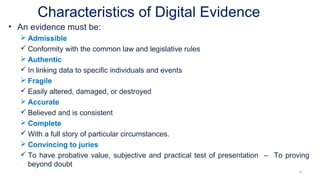
Characteristics of Digital Evidence
• An evidence must be:
 Admissible
 Conformity with the common law and legislative rules
 Authentic
 In linking data to specific individuals and events
 Fragile
 Easily altered, damaged, or destroyed
 Accurate
 Believed and is consistent
 Complete
 With a full story of particular circumstances.
 Convincing to juries
 To have probative value, subjective and practical test of presentation – To proving
beyond doubt
8
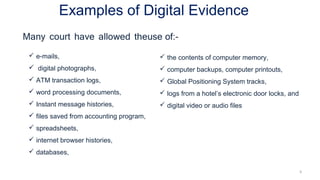
Examples of Digital Evidence
9
 e-mails,
 digital photographs,
 ATM transaction logs,
 word processing documents,
 Instant message histories,
 files saved from accounting program,
 spreadsheets,
 internet browser histories,
 databases,
 the contents of computer memory,
 computer backups, computer printouts,
 Global Positioning System tracks,
 logs from a hotel’s electronic door locks, and
 digital video or audio files
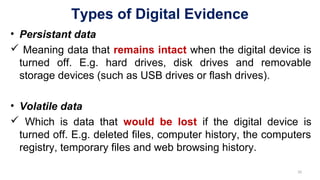
Types of Digital Evidence
• Persistant data
 Meaning data that remains intact when the digital device is
turned off. E.g. hard drives, disk drives and removable
storage devices (such as USB drives or flash drives).
• Volatile data
 Which is data that would be lost if the digital device is
turned off. E.g. deleted files, computer history, the computers
registry, temporary files and web browsing history.
10
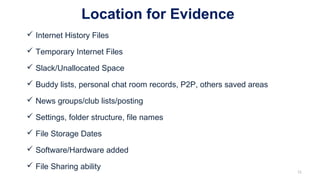
Location for Evidence
 Internet History Files
 Temporary Internet Files
 Slack/Unallocated Space
 Buddy lists, personal chat room records, P2P, others saved areas
 News groups/club lists/posting
 Settings, folder structure, file names
 File Storage Dates
 Software/Hardware added
 File Sharing ability
11
Digital Forensic Model
• Because digital forensics is a new discipline:
 there is little standardization and consistency
 across the courts and industry
12
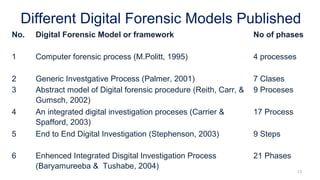
Different Digital Forensic Models Published
No. Digital Forensic Model or framework No of phases
1 Computer forensic process (M.Politt, 1995) 4 processes
2 Generic Investgative Process (Palmer, 2001) 7 Clases
3 Abstract model of Digital forensic procedure (Reith, Carr, &
Gumsch, 2002)
9 Proceses
4 An integrated digital investigation proceses (Carrier &
Spafford, 2003)
17 Process
5 End to End Digital Investigation (Stephenson, 2003) 9 Steps
6 Enhenced Integrated Disgital Investigation Process
(Baryamureeba & Tushabe, 2004)
21 Phases
13
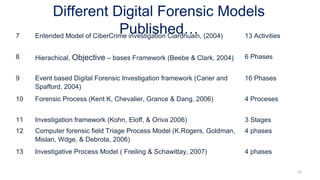
Different Digital Forensic Models
Published…7 Entended Model of CiberCrime investigation Ciardhuain, (2004) 13 Activities
8 Hierachical, Objective – bases Framework (Beebe & Clark, 2004) 6 Phases
9 Event based Digital Forensic Investigation framework (Carier and
Spafford, 2004)
16 Phases
10 Forensic Process (Kent K, Chevalier, Grance & Dang, 2006) 4 Proceses
11 Investigation framework (Kohn, Eloff, & Oriva 2006) 3 Stages
12 Computer forensic field Triage Process Model (K.Rogers, Goldman,
Mislan, Wdge, & Debrota, 2006)
4 phases
13 Investigative Process Model ( Freiling & Schawittay, 2007) 4 phases
14
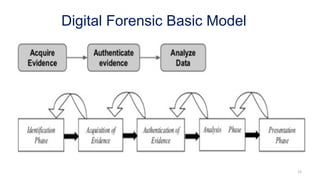
Digital Forensic Basic Model
15
Digital Forensic Process
• Broad process steps:
Identification
Preservation
Analysis
Documentation
Presentation
16
Identification
• The first step in the forensic process:
 What evidence is present
 Where it is stored and
 How it is stored
• Electronic stores can be:
 Person computers
 Mobile phones
 PDAs
 Smart cards
• Key parameters in identification:
 Type of information
 format 17
Preservation
Isolate, secure and preserve the state of physical and
digital evidence.
This includes preventing people from using the digital
device or allowing other electromagnetic devices to be
used within an affected radius.
18
Analysis
Determine significance, reconstruct fragments of
data and draw conclusions based on evidence found.
It may take several iterations of examination and
analysis to support a crime theory.
19
Documentation
A record of all visible data must be created, which helps
in recreating the scene and reviewing it any time
Involves proper documentation of the crime scene along
with photographing, sketching and crime-scene
mapping.
20
Presentation
• Summarize and provide explanation of
conclusions.
 This should be written in a layperson’s terms
using abstracted terminologies.
 All abstracted terminologies should reference
the specific details.
21
Need for Digital Forensics
To ensure the integrity of digital system.
To focus on the response to hi-tech offenses, started to
intervene the system.
Digital forensics has been efficiently used to track down the
terrorists from the various parts of the world.
To produce evidence in the court that can lead to the
punishment of the criminal.
22
The Benefits of Digital
Forensics
Digital Forensics help to protect from and solve cases
involving:
•Theft of intellectual property
This pertains to any act that allows access to patents, trade
secrets, customer data, and any confidential information.
•Financial Fraud
This pertains to anything that uses fraudulent solicitation
of victims information to conduct fraudulent transactions.
23
The benefits of digital
forensics ...
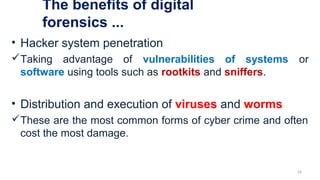
• Hacker system penetration
Taking advantage of vulnerabilities of systems or
software using tools such as rootkits and sniffers.
• Distribution and execution of viruses and worms
These are the most common forms of cyber crime and often
cost the most damage.
24
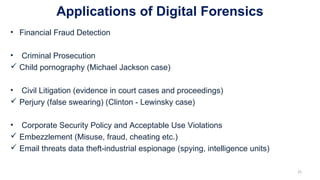
Applications of Digital Forensics
• Financial Fraud Detection
• Criminal Prosecution
 Child pornography (Michael Jackson case)
• Civil Litigation (evidence in court cases and proceedings)
 Perjury (false swearing) (Clinton - Lewinsky case)
• Corporate Security Policy and Acceptable Use Violations
 Embezzlement (Misuse, fraud, cheating etc.)
 Email threats data theft-industrial espionage (spying, intelligence units)
25
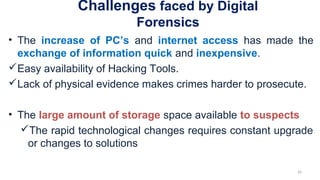
Challenges faced by Digital
Forensics
• The increase of PC’s and internet access has made the
exchange of information quick and inexpensive.
Easy availability of Hacking Tools.
Lack of physical evidence makes crimes harder to prosecute.
• The large amount of storage space available to suspects
The rapid technological changes requires constant upgrade
or changes to solutions
26
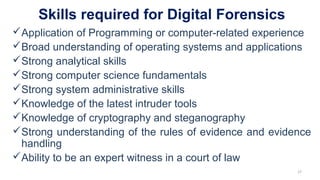
Skills required for Digital Forensics
Application of Programming or computer-related experience
Broad understanding of operating systems and applications
Strong analytical skills
Strong computer science fundamentals
Strong system administrative skills
Knowledge of the latest intruder tools
Knowledge of cryptography and steganography
Strong understanding of the rules of evidence and evidence
handling
Ability to be an expert witness in a court of law
27
Digital Forensic Software
Tools
• BACKTRACK 5R3 (Linux operating system)-This OS has
many forensic tools to analyze any compromised system or
find security holes
In that a large amount of open source bundled packages are
installed in this OS.
• Kali Linux is a Debian-derived Linux distribution designed
for digital forensics and penetration testing
It was developed through the rewrite of Backtrack 5, their
previous forensics Linux distribution.
28
Conclusion

Digital forensics is important for solving crimes

with digital devices

against digitial devices

against people where evidence may reside in a device

Several sound tools and techniques exist to search and
analyse digital data

Regardless of existing tools, evolving digital age and
development of technology requires heavier research in
digital forensics
References
 www.accessdata.com.(2006).
 http//www.logicubeforensics.com/.(2008).
 http://www.dibsusa.com/.
 http://www.computerforensicshq.com. (n.d.). Panagiotis, K. (2006).
 Digital Crime and Forensic Science in Cyberspace. USA: Idea Group Publishing.
Wiles Jack, C. K. (2007).
 The Best Damn Cybercrime and Forensics Book Period. USA: Syngress Publishing.
 www.zawya.com. (n.d.).
30
END OF THE PRESENTATION
31
Thank You

Digital Forensic

  • 1.
  • 2.
    Outline Forensic and DigitalForensic Definitions Digital Evidence Digital Forensic Model Digital Forensic Process Need and Benefits of Digital Forensic Applications of Digital Forensic Skills required and Challenges faced by Digital Forensic Digital Forensic Software Tools Conclusion 2
  • 3.
    What is forensic? Collection and analysis of evidence Using scientific test or techniques To establish facts against crime For presenting in a legal proceeding  Therefore forensic science is a scientific method of gathering and examining information about the past which is then used in court of law 3
  • 4.
    What is digitalforensic? • Digital Forensics is the use of scientifically derived and proven methods toward: the preservation, collection, validation, identification, analysis, interpretation, documentation, and presentation of digital evidence derived from digital devices for the purpose of facilitation or furthering the reconstruction of events found to be criminal, or helping to anticipate unauthorized actions shown to be disruptive to planned operations. 4
  • 5.
    Branches of DigitalForensics • The technical aspect of an investigation is divided into several sub-branches, relating to the type of digital devices involved: Computer forensics, Firewall Forensics, Database Forensics, Network forensics, Forensic data analysis and Mobile device forensics. • The typical forensic process encompasses the seizure, forensic imaging and analysis of digital media and the production of a report into collected evidence. 5
  • 6.
    Examples of DigitalForensic Devices 6
  • 7.
    Digital Evidence • Evidence Apiece of information that supports a conclusion • Digital evidence Any data that is recorded or preserved on any medium in or by a computer system or other similar digital device, that can be read or understood by a person or a computer system or other similar device.  It includes a display, printout or other output of that data. 7
  • 8.
    Characteristics of DigitalEvidence • An evidence must be:  Admissible  Conformity with the common law and legislative rules  Authentic  In linking data to specific individuals and events  Fragile  Easily altered, damaged, or destroyed  Accurate  Believed and is consistent  Complete  With a full story of particular circumstances.  Convincing to juries  To have probative value, subjective and practical test of presentation – To proving beyond doubt 8
  • 9.
    Examples of DigitalEvidence 9  e-mails,  digital photographs,  ATM transaction logs,  word processing documents,  Instant message histories,  files saved from accounting program,  spreadsheets,  internet browser histories,  databases,  the contents of computer memory,  computer backups, computer printouts,  Global Positioning System tracks,  logs from a hotel’s electronic door locks, and  digital video or audio files
  • 10.
    Types of DigitalEvidence • Persistant data  Meaning data that remains intact when the digital device is turned off. E.g. hard drives, disk drives and removable storage devices (such as USB drives or flash drives). • Volatile data  Which is data that would be lost if the digital device is turned off. E.g. deleted files, computer history, the computers registry, temporary files and web browsing history. 10
  • 11.
    Location for Evidence Internet History Files  Temporary Internet Files  Slack/Unallocated Space  Buddy lists, personal chat room records, P2P, others saved areas  News groups/club lists/posting  Settings, folder structure, file names  File Storage Dates  Software/Hardware added  File Sharing ability 11
  • 12.
    Digital Forensic Model •Because digital forensics is a new discipline:  there is little standardization and consistency  across the courts and industry 12
  • 13.
    Different Digital ForensicModels Published No. Digital Forensic Model or framework No of phases 1 Computer forensic process (M.Politt, 1995) 4 processes 2 Generic Investgative Process (Palmer, 2001) 7 Clases 3 Abstract model of Digital forensic procedure (Reith, Carr, & Gumsch, 2002) 9 Proceses 4 An integrated digital investigation proceses (Carrier & Spafford, 2003) 17 Process 5 End to End Digital Investigation (Stephenson, 2003) 9 Steps 6 Enhenced Integrated Disgital Investigation Process (Baryamureeba & Tushabe, 2004) 21 Phases 13
  • 14.
    Different Digital ForensicModels Published…7 Entended Model of CiberCrime investigation Ciardhuain, (2004) 13 Activities 8 Hierachical, Objective – bases Framework (Beebe & Clark, 2004) 6 Phases 9 Event based Digital Forensic Investigation framework (Carier and Spafford, 2004) 16 Phases 10 Forensic Process (Kent K, Chevalier, Grance & Dang, 2006) 4 Proceses 11 Investigation framework (Kohn, Eloff, & Oriva 2006) 3 Stages 12 Computer forensic field Triage Process Model (K.Rogers, Goldman, Mislan, Wdge, & Debrota, 2006) 4 phases 13 Investigative Process Model ( Freiling & Schawittay, 2007) 4 phases 14
  • 15.
  • 16.
    Digital Forensic Process •Broad process steps: Identification Preservation Analysis Documentation Presentation 16
  • 17.
    Identification • The firststep in the forensic process:  What evidence is present  Where it is stored and  How it is stored • Electronic stores can be:  Person computers  Mobile phones  PDAs  Smart cards • Key parameters in identification:  Type of information  format 17
  • 18.
    Preservation Isolate, secure andpreserve the state of physical and digital evidence. This includes preventing people from using the digital device or allowing other electromagnetic devices to be used within an affected radius. 18
  • 19.
    Analysis Determine significance, reconstructfragments of data and draw conclusions based on evidence found. It may take several iterations of examination and analysis to support a crime theory. 19
  • 20.
    Documentation A record ofall visible data must be created, which helps in recreating the scene and reviewing it any time Involves proper documentation of the crime scene along with photographing, sketching and crime-scene mapping. 20
  • 21.
    Presentation • Summarize andprovide explanation of conclusions.  This should be written in a layperson’s terms using abstracted terminologies.  All abstracted terminologies should reference the specific details. 21
  • 22.
    Need for DigitalForensics To ensure the integrity of digital system. To focus on the response to hi-tech offenses, started to intervene the system. Digital forensics has been efficiently used to track down the terrorists from the various parts of the world. To produce evidence in the court that can lead to the punishment of the criminal. 22
  • 23.
    The Benefits ofDigital Forensics Digital Forensics help to protect from and solve cases involving: •Theft of intellectual property This pertains to any act that allows access to patents, trade secrets, customer data, and any confidential information. •Financial Fraud This pertains to anything that uses fraudulent solicitation of victims information to conduct fraudulent transactions. 23
  • 24.
    The benefits ofdigital forensics ... • Hacker system penetration Taking advantage of vulnerabilities of systems or software using tools such as rootkits and sniffers. • Distribution and execution of viruses and worms These are the most common forms of cyber crime and often cost the most damage. 24
  • 25.
    Applications of DigitalForensics • Financial Fraud Detection • Criminal Prosecution  Child pornography (Michael Jackson case) • Civil Litigation (evidence in court cases and proceedings)  Perjury (false swearing) (Clinton - Lewinsky case) • Corporate Security Policy and Acceptable Use Violations  Embezzlement (Misuse, fraud, cheating etc.)  Email threats data theft-industrial espionage (spying, intelligence units) 25
  • 26.
    Challenges faced byDigital Forensics • The increase of PC’s and internet access has made the exchange of information quick and inexpensive. Easy availability of Hacking Tools. Lack of physical evidence makes crimes harder to prosecute. • The large amount of storage space available to suspects The rapid technological changes requires constant upgrade or changes to solutions 26
  • 27.
    Skills required forDigital Forensics Application of Programming or computer-related experience Broad understanding of operating systems and applications Strong analytical skills Strong computer science fundamentals Strong system administrative skills Knowledge of the latest intruder tools Knowledge of cryptography and steganography Strong understanding of the rules of evidence and evidence handling Ability to be an expert witness in a court of law 27
  • 28.
    Digital Forensic Software Tools •BACKTRACK 5R3 (Linux operating system)-This OS has many forensic tools to analyze any compromised system or find security holes In that a large amount of open source bundled packages are installed in this OS. • Kali Linux is a Debian-derived Linux distribution designed for digital forensics and penetration testing It was developed through the rewrite of Backtrack 5, their previous forensics Linux distribution. 28
  • 29.
    Conclusion  Digital forensics isimportant for solving crimes  with digital devices  against digitial devices  against people where evidence may reside in a device  Several sound tools and techniques exist to search and analyse digital data  Regardless of existing tools, evolving digital age and development of technology requires heavier research in digital forensics
  • 30.
    References  www.accessdata.com.(2006).  http//www.logicubeforensics.com/.(2008). http://www.dibsusa.com/.  http://www.computerforensicshq.com. (n.d.). Panagiotis, K. (2006).  Digital Crime and Forensic Science in Cyberspace. USA: Idea Group Publishing. Wiles Jack, C. K. (2007).  The Best Damn Cybercrime and Forensics Book Period. USA: Syngress Publishing.  www.zawya.com. (n.d.). 30
  • 31.
    END OF THEPRESENTATION 31 Thank You