A SEMINAR PRESENTATION ON……..
“COMPUTER AIDED PROCESS PLANNING”
(a case of METCAPP)
Presented By:-
Sunil Kumar Yadav
M. Tech. (P.T.)
KNIT, Sultanpur
INTRODUCTION
Technological advances are reshaping the face of
manufacturing, creating paperless manufacturing environments in
which computer automated process planning (CAPP) will play an
important role.
MetCAPP - software looks for the least costly plan capable of
producing the design and evaluates the plans.
PROCESS PLANNING
 To convert the product design into a physical entity, a
manufacturing plan is needed. The activity of developing such
a plan is called process planning.
 Process planning involves determining the sequence of
processing and assembly steps that must be accomplished to
make the product.
List of many decisions included within the
scope of process planning:-
1. Interpretation of design drawings
2. Processes and sequences
3. Equipment selection
4. Tools, Dies, Moulds, Fixtures and gauges
5. Method analysis
COMPUTER-AIDED PROCESS PLANNING (CAPP)
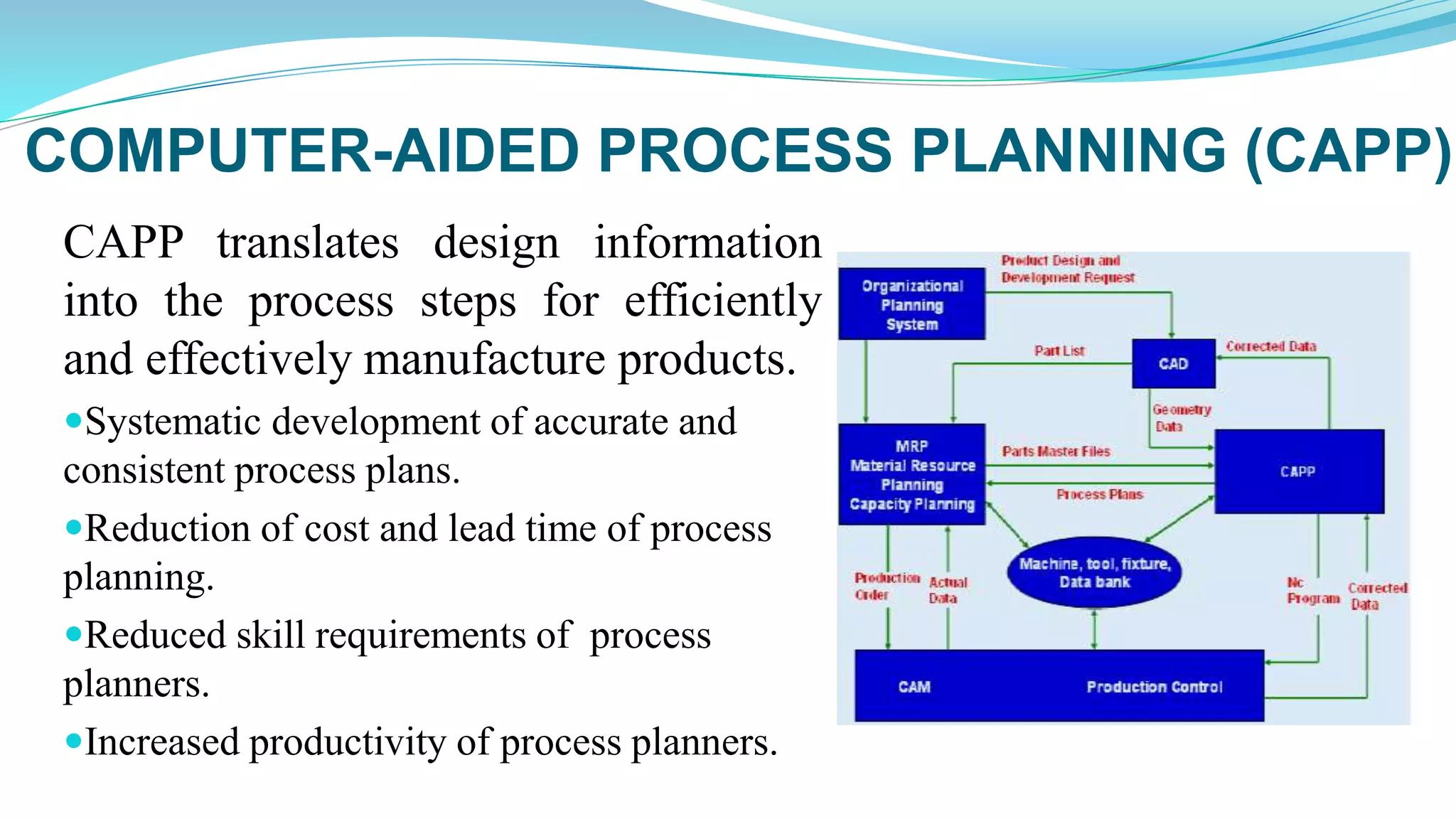
CAPP translates design information
into the process steps for efficiently
and effectively manufacture products.
Systematic development of accurate and
consistent process plans.
Reduction of cost and lead time of process
planning.
Reduced skill requirements of process
planners.
Increased productivity of process planners.
COMPUTER-AIDED PROCESS PLANNING- Types
1) Retrieval CAPP System or Variant Approach.
2) Generative CAPP System or Generative Approach.
RETRIEVAL CAPP SYSTEM
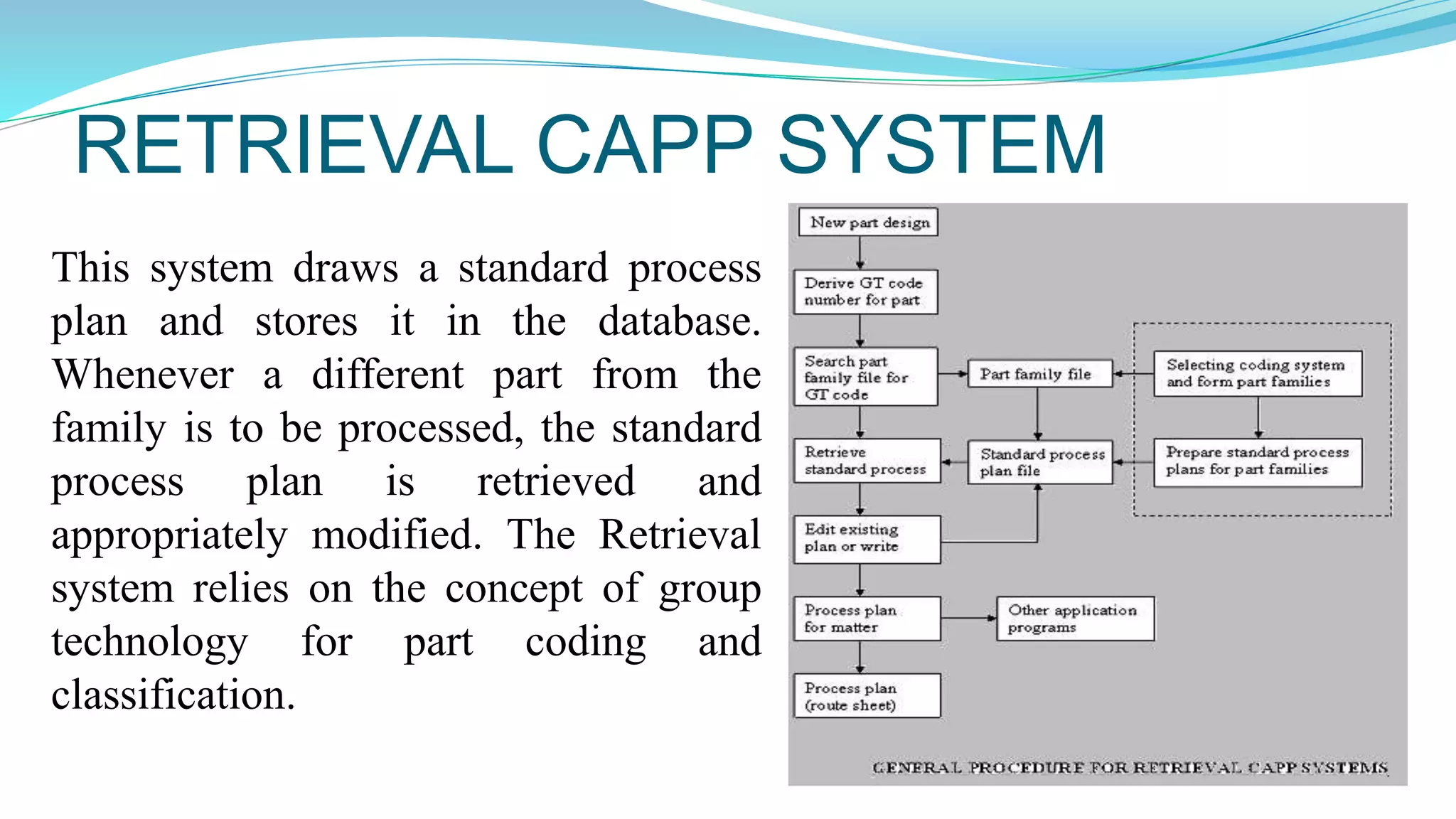
This system draws a standard process
plan and stores it in the database.
Whenever a different part from the
family is to be processed, the standard
process plan is retrieved and
appropriately modified. The Retrieval
system relies on the concept of group
technology for part coding and
classification.
GENERATIVE CAPP SYSTEM
 A Generative CAPP System is usually considered part of the field of
expert systems, a branch of artificial intelligence.
 An expert system is a computer program that is capable of solving
complex problems that normally require a human with years of
education and experience.
 In expert system, applied to process planning, the knowledge and logic
of human process planner’s is incorporated into it, so called “knowledge
base”. The Generative CAPP System then uses that knowledge base to
solve process planning problems (i.e. create route sheets).
METCAPP SOFTWARE
 MetCAPP is a knowledge based process planning system.
 MetCAPP provides the link between design and manufacturing
floor. It provides the ability to take CAD generated solid
models and use them to generate process plans.
 The user effectively manage the system with the help of
technology module manager.
Basic Approach Used in MetCAPP
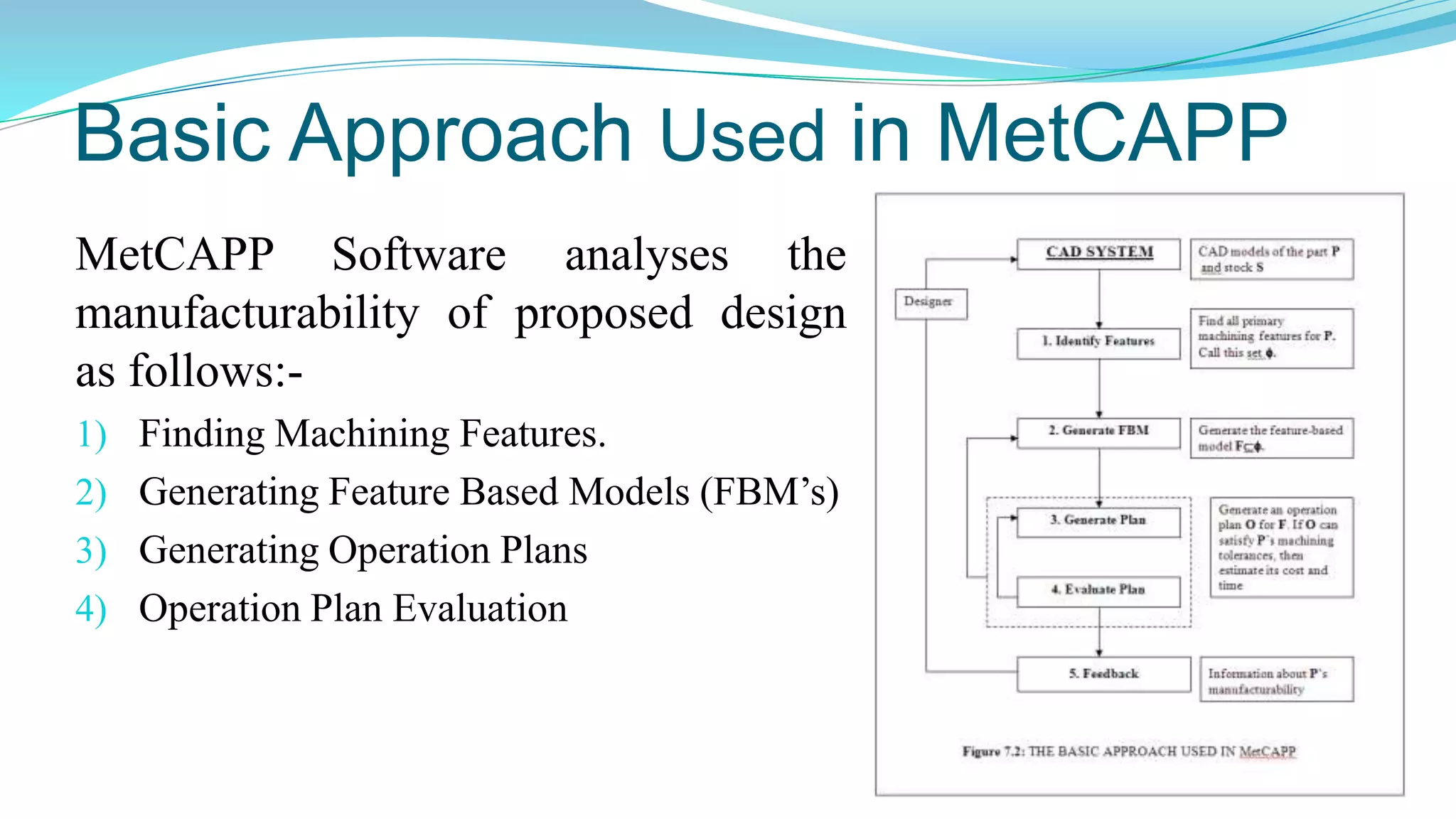
MetCAPP Software analyses the
manufacturability of proposed design
as follows:-
1) Finding Machining Features.
2) Generating Feature Based Models (FBM’s)
3) Generating Operation Plans
4) Operation Plan Evaluation
METCAPP FEATURES
1) Automated Feature Recognition
2) MetCAPP’s Report Writer
3) MetCAPP’s Redline Capability
4) The MetCAPP Technology Modules
5) Cost Estimating
6) Group Technology
MetCAPP BENEFITS
1) 50% increase in process planner productivity.
2) 40% increase in existing equipment’s capacity.
3) 25% reduction in setup costs.
4) 12% reduction in tooling requirements.
5) 10% reduction in scrap and rework.
6) 10% reduction in shop floor labor.
7) 4% reduction in material usage.
CAPP BENEFITS
1) About 58% reduction in process planning effort.
2) Increased productivity of process planners.
3) Reduced process planning and production lead time.
4) Greater process plan consistency can be achieved.
5) Improved cost estimating procedures and fewer calculation errors.
6) Improved production scheduling and capacity utilization.
7) Improved ability to introduce new manufacturing technology and
rapidly update process plans to utilize the improved technology.
CONCLUSION
CAPP is a highly effective technology for discrete manufacturers with a
significant number of products and process steps. Commercially
available software tools currently exist to support both GT and CAPP.
As a result, many companies can achieve the benefits of GT and CAPP
with minimum cost and risks. Effective use of these tools can improve
a manufacturer’s competitive advantage too.
THANK YOU

CAPP-ppt.ppt

  • 1.
    A SEMINAR PRESENTATIONON…….. “COMPUTER AIDED PROCESS PLANNING” (a case of METCAPP) Presented By:- Sunil Kumar Yadav M. Tech. (P.T.) KNIT, Sultanpur
  • 2.
    INTRODUCTION Technological advances arereshaping the face of manufacturing, creating paperless manufacturing environments in which computer automated process planning (CAPP) will play an important role. MetCAPP - software looks for the least costly plan capable of producing the design and evaluates the plans.
  • 3.
    PROCESS PLANNING  Toconvert the product design into a physical entity, a manufacturing plan is needed. The activity of developing such a plan is called process planning.  Process planning involves determining the sequence of processing and assembly steps that must be accomplished to make the product.
  • 4.
    List of manydecisions included within the scope of process planning:- 1. Interpretation of design drawings 2. Processes and sequences 3. Equipment selection 4. Tools, Dies, Moulds, Fixtures and gauges 5. Method analysis
  • 5.
    COMPUTER-AIDED PROCESS PLANNING(CAPP) CAPP translates design information into the process steps for efficiently and effectively manufacture products. Systematic development of accurate and consistent process plans. Reduction of cost and lead time of process planning. Reduced skill requirements of process planners. Increased productivity of process planners.
  • 6.
    COMPUTER-AIDED PROCESS PLANNING-Types 1) Retrieval CAPP System or Variant Approach. 2) Generative CAPP System or Generative Approach.
  • 7.
    RETRIEVAL CAPP SYSTEM Thissystem draws a standard process plan and stores it in the database. Whenever a different part from the family is to be processed, the standard process plan is retrieved and appropriately modified. The Retrieval system relies on the concept of group technology for part coding and classification.
  • 8.
    GENERATIVE CAPP SYSTEM A Generative CAPP System is usually considered part of the field of expert systems, a branch of artificial intelligence.  An expert system is a computer program that is capable of solving complex problems that normally require a human with years of education and experience.  In expert system, applied to process planning, the knowledge and logic of human process planner’s is incorporated into it, so called “knowledge base”. The Generative CAPP System then uses that knowledge base to solve process planning problems (i.e. create route sheets).
  • 9.
    METCAPP SOFTWARE  MetCAPPis a knowledge based process planning system.  MetCAPP provides the link between design and manufacturing floor. It provides the ability to take CAD generated solid models and use them to generate process plans.  The user effectively manage the system with the help of technology module manager.
  • 10.
    Basic Approach Usedin MetCAPP MetCAPP Software analyses the manufacturability of proposed design as follows:- 1) Finding Machining Features. 2) Generating Feature Based Models (FBM’s) 3) Generating Operation Plans 4) Operation Plan Evaluation
  • 11.
    METCAPP FEATURES 1) AutomatedFeature Recognition 2) MetCAPP’s Report Writer 3) MetCAPP’s Redline Capability 4) The MetCAPP Technology Modules 5) Cost Estimating 6) Group Technology
  • 12.
    MetCAPP BENEFITS 1) 50%increase in process planner productivity. 2) 40% increase in existing equipment’s capacity. 3) 25% reduction in setup costs. 4) 12% reduction in tooling requirements. 5) 10% reduction in scrap and rework. 6) 10% reduction in shop floor labor. 7) 4% reduction in material usage.
  • 13.
    CAPP BENEFITS 1) About58% reduction in process planning effort. 2) Increased productivity of process planners. 3) Reduced process planning and production lead time. 4) Greater process plan consistency can be achieved. 5) Improved cost estimating procedures and fewer calculation errors. 6) Improved production scheduling and capacity utilization. 7) Improved ability to introduce new manufacturing technology and rapidly update process plans to utilize the improved technology.
  • 14.
    CONCLUSION CAPP is ahighly effective technology for discrete manufacturers with a significant number of products and process steps. Commercially available software tools currently exist to support both GT and CAPP. As a result, many companies can achieve the benefits of GT and CAPP with minimum cost and risks. Effective use of these tools can improve a manufacturer’s competitive advantage too.
  • 15.