Computer Aided Process 
Planning 
Dr. Pulak M. Pandey 
http://paniit.iitd.ac.in/~pmpandey
Computer Aided Process Planning (CAPP) 
……..Process planning with the aid of computer 
•• Process planning is concerned with the preparation of route sheets that 
list the sequence of operations and work centers require to produce the 
product and its components. 
•• Manufacturing firms try to automate the task of process planning using 
CAPP systems due to many limitations of manual process planning. 
These includes: 
–– Tied to personal experience 
–– and knowledge of planner of production facilities, equipment, their 
capabilities, process and tooling. This results in inconsistent plans. 
–– Manual process planning is time consuming and slow. 
–– Slow in responding to changes in product design and production. 
•• The experience of manufacturing of different engineers, who are likely 
to retire, can be made available in future by CAPP. 
•• CAPP is usually considered to be part of CAM, however this results CAM 
as stand alone system. 
•• Synergy of CAM can be achieved by integrating it with CAD system and 
CAPP acts as a connection between the two. 
•• Readymade CAPP systems are available today to prepare route sheets.
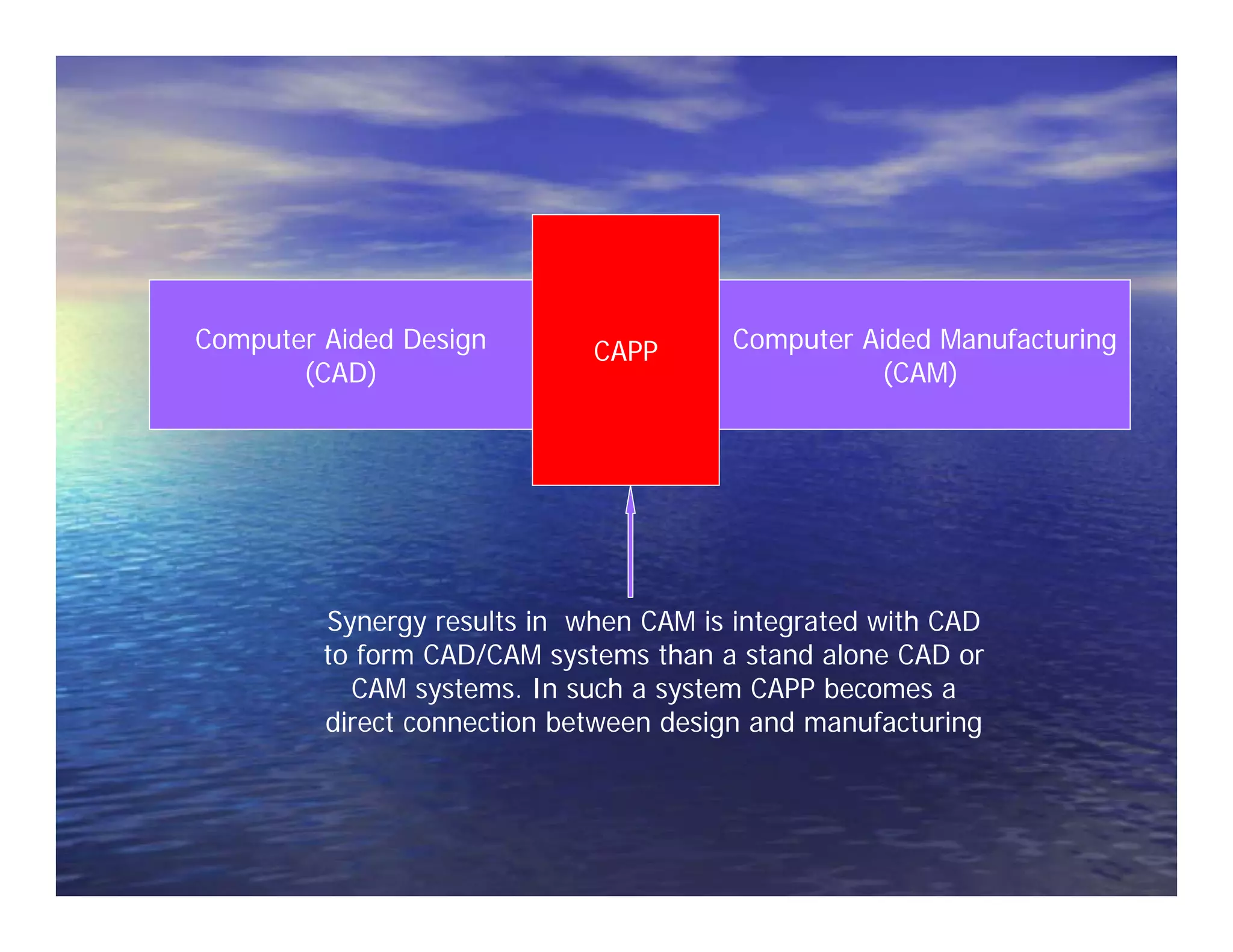
Computer Aided Design 
(CAD) 
Computer Aided Manufacturing 
(CAM) 
CAPP 
Synergy results in when CAM is integrated with CAD 
to form CAD/CAM systems than a stand alone CAD or 
CAM systems. In such a system CAPP becomes a 
direct connection between design and manufacturing
Benefits derived from CAPP 
•• Process rationalization and standardization 
•• Increased productivity of process planners 
•• Reduced lead time for process planning 
•• Improved legibility 
•• Incorporation of other application programs
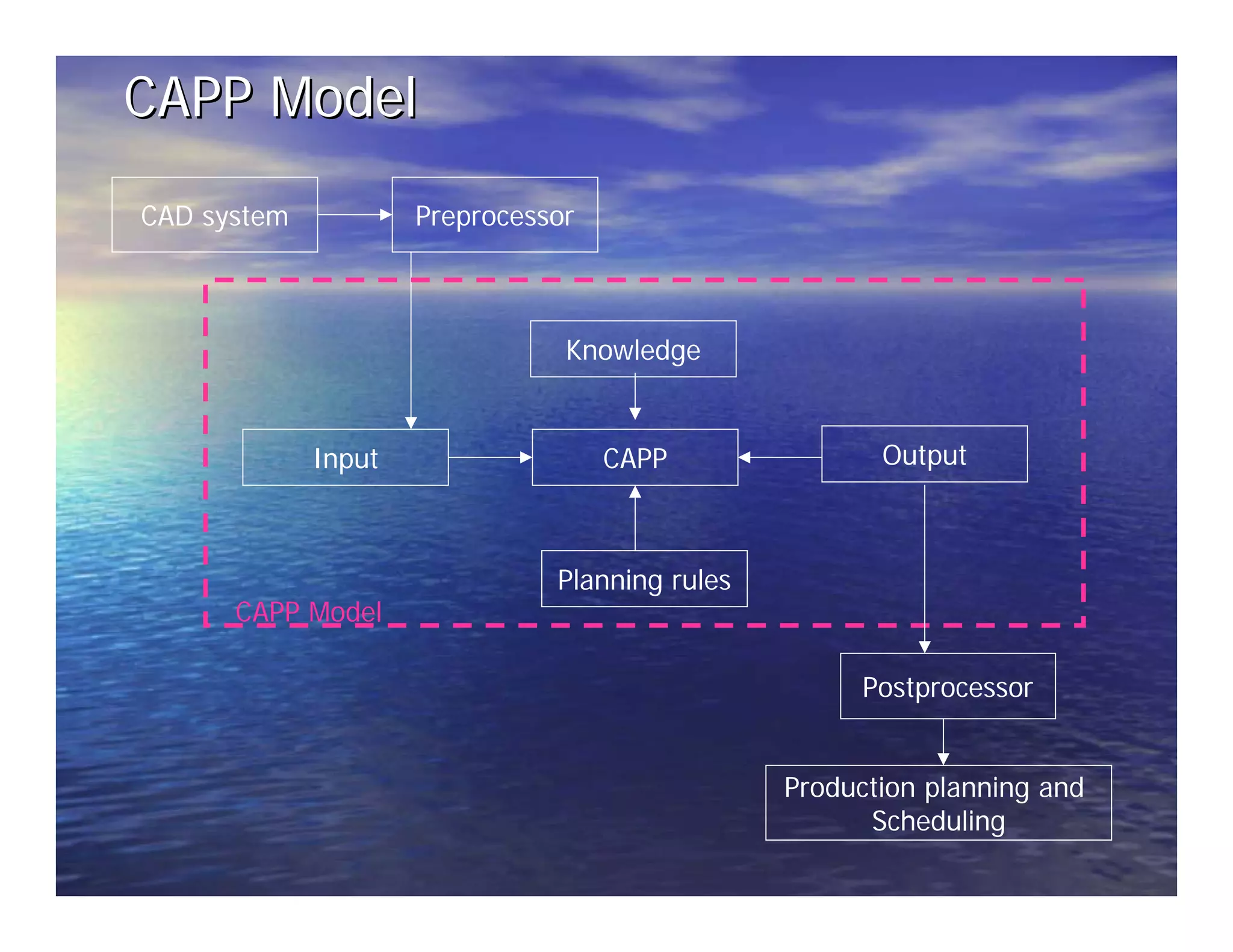
CAD system Preprocessor 
Knowledge 
Input CAPP 
Output 
Planning rules 
Postprocessor 
Production planning and 
Scheduling 
CAPP Model 
CAPP Model
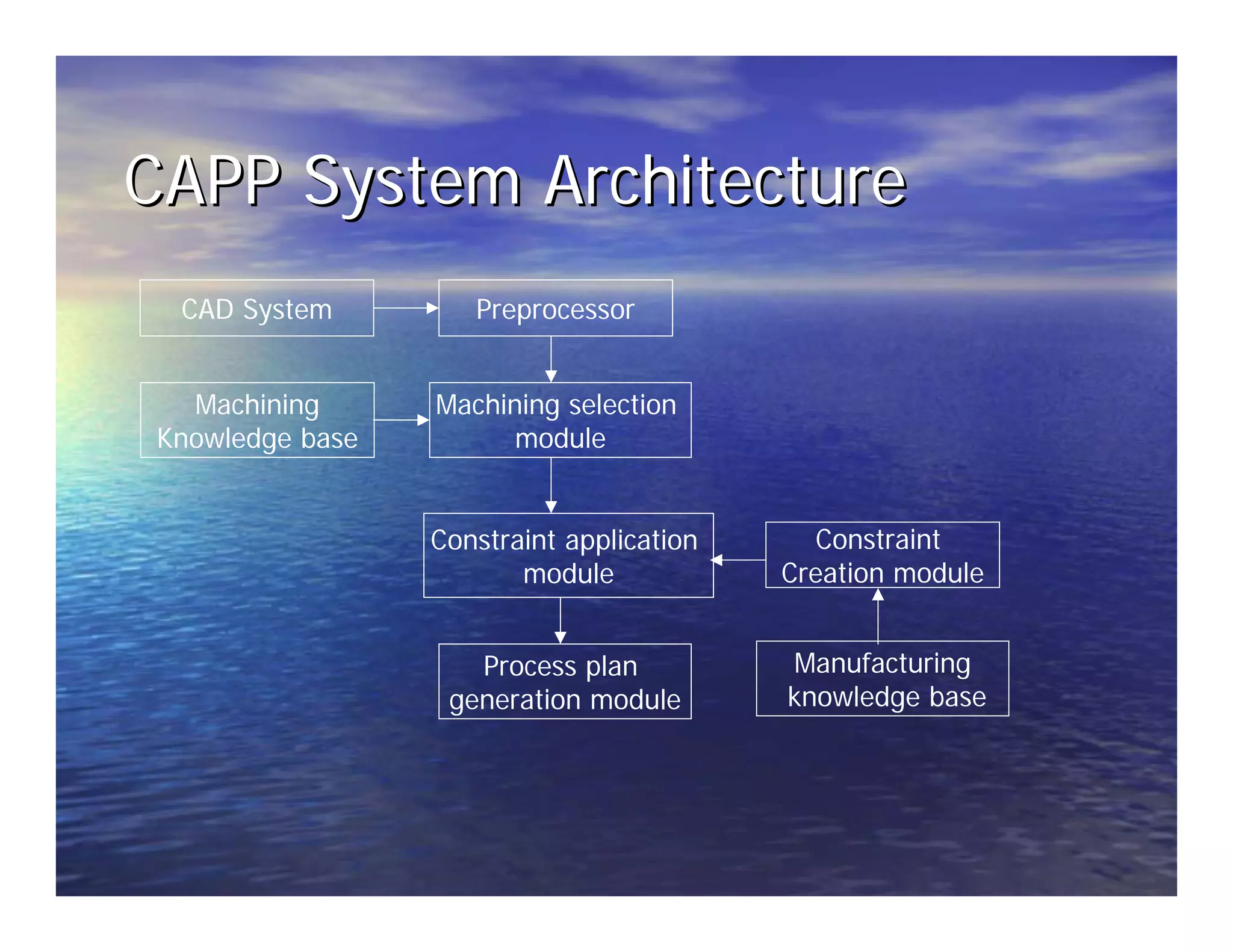
CAPP System Architecture 
CAD System Preprocessor 
Machining 
Knowledge base 
Machining selection 
module 
Constraint application 
module 
Process plan 
generation module 
Constraint 
Creation module 
Manufacturing 
knowledge base
Design approaches of CAPP systems 
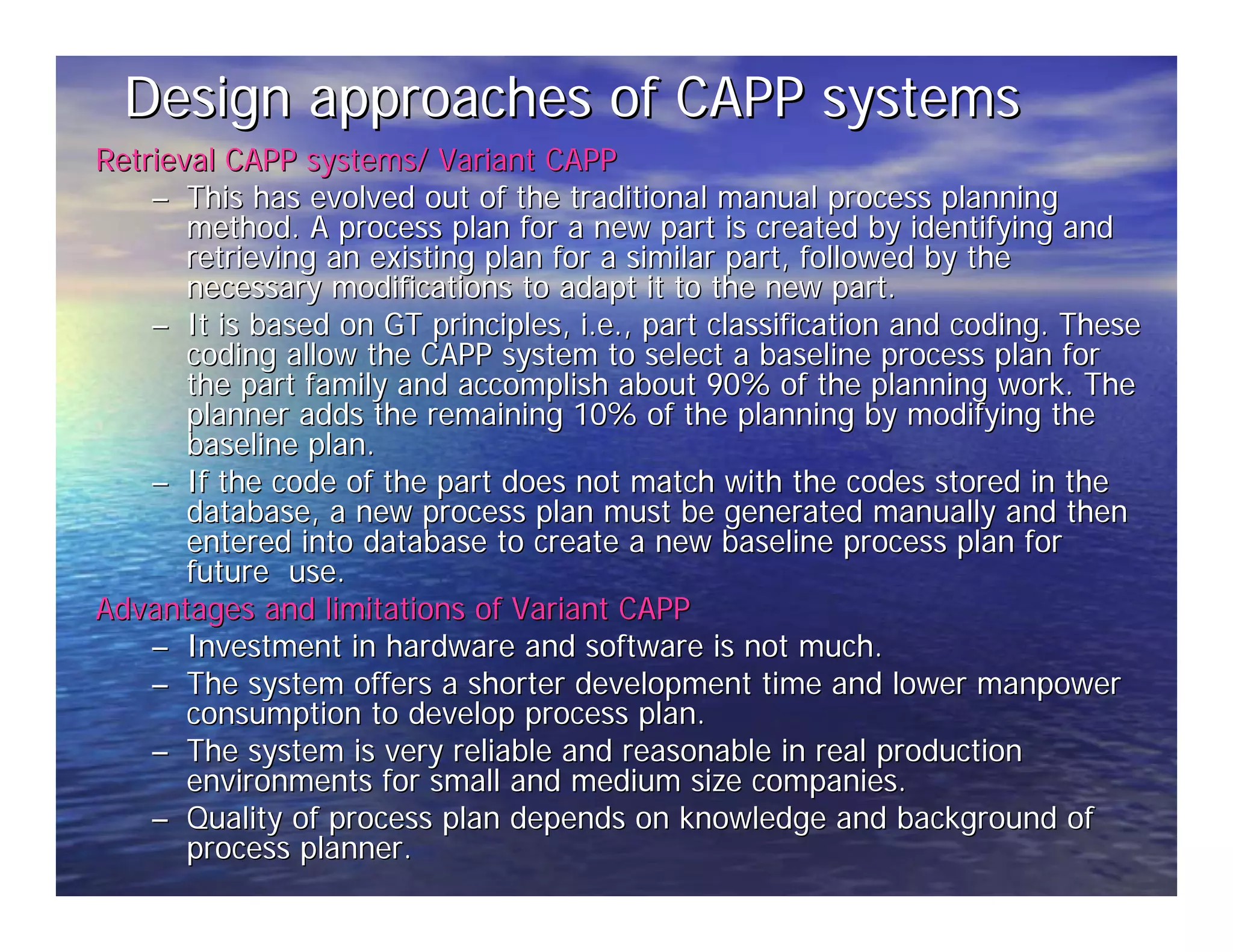
Retrieval CAPP systems/ Variant CAPP 
–– This has evolved out of the traditional manual process planning 
method. A process plan for a new part is created by identifying and 
retrieving an existing plan for a similar part, followed by the 
necessary modifications to adapt it to the new part. 
–– It is based on GT principles, i.e., part classification and coding. These 
coding allow the CAPP system to select a baseline process plan for 
the part family and accomplish about 90% of the planning work. The 
planner adds the remaining 10% of the planning by modifying the 
baseline plan. 
–– If the code of the part does not match with the codes stored in the 
database, a new process plan must be generated manually and then 
entered into database to create a new baseline process plan for 
future use. 
Advantages and limitations of Variant CAPP 
–– Investment in hardware and software is not much. 
–– The system offers a shorter development time and lower manpower 
consumption to develop process plan. 
–– The system is very reliable and reasonable in real production 
environments for small and medium size companies. 
–– Quality of process plan depends on knowledge and background of 
process planner.
Generative CAPP 
•• Process plans are generated by means of decision logics, 
formulas, algorithms, and geometry based data that are 
built or fed as input to the system. 
•• Format of input 
–– Text input (interactive) 
–– Graphical input (from CAD models) 
•• First key: to develop decision rules appropriate for the 
part to be processed. These rules are specified using 
decision trees, logical statements, such as if-then-else, 
or artificial intelligence approaches with object oriented 
programming. 
•• Second key: Finding out the data related to part to drive 
the planning. Simple forms of generative CAPP systems 
may be driven by GT codes.
•• A pure generative system can produce a complete process plan 
from part classification and other design data which does not 
require any further modification or manual interaction. 
•• In generating such plans, initial state of the part (stock) must 
be defined in order to reach the final state i.e., finished part. 
•• Forward or backward planning can be done. 
•• Forward and backward planning apparently appear to be similar 
but they effect programming significantly. The requirement and 
the results in of a setup in forward planning are the results and 
requirements , respectively, of the set up in backward planning. 
•• Forward planning suffers from conditioning problems; the 
results of a setup affects the next set up. 
•• In backward planning, conditioning problems are eliminated 
because setups are selected to satisfy the initial requirements 
only. 
•• The generative CAPP has all the advantages of variant CAPP 
however it has an additional advantage that it is fully automatic 
and a up-to-date process plan is generated at each time. 
•• It requires major revisions if a new equipment or processing 
capabilities became available. 
•• The development of the system in the beginning is a difficult

Capp

  • 1.
    Computer Aided Process Planning Dr. Pulak M. Pandey http://paniit.iitd.ac.in/~pmpandey
  • 2.
    Computer Aided ProcessPlanning (CAPP) ……..Process planning with the aid of computer •• Process planning is concerned with the preparation of route sheets that list the sequence of operations and work centers require to produce the product and its components. •• Manufacturing firms try to automate the task of process planning using CAPP systems due to many limitations of manual process planning. These includes: –– Tied to personal experience –– and knowledge of planner of production facilities, equipment, their capabilities, process and tooling. This results in inconsistent plans. –– Manual process planning is time consuming and slow. –– Slow in responding to changes in product design and production. •• The experience of manufacturing of different engineers, who are likely to retire, can be made available in future by CAPP. •• CAPP is usually considered to be part of CAM, however this results CAM as stand alone system. •• Synergy of CAM can be achieved by integrating it with CAD system and CAPP acts as a connection between the two. •• Readymade CAPP systems are available today to prepare route sheets.
  • 3.
    Computer Aided Design (CAD) Computer Aided Manufacturing (CAM) CAPP Synergy results in when CAM is integrated with CAD to form CAD/CAM systems than a stand alone CAD or CAM systems. In such a system CAPP becomes a direct connection between design and manufacturing
  • 4.
    Benefits derived fromCAPP •• Process rationalization and standardization •• Increased productivity of process planners •• Reduced lead time for process planning •• Improved legibility •• Incorporation of other application programs
  • 5.
    CAD system Preprocessor Knowledge Input CAPP Output Planning rules Postprocessor Production planning and Scheduling CAPP Model CAPP Model
  • 6.
    CAPP System Architecture CAD System Preprocessor Machining Knowledge base Machining selection module Constraint application module Process plan generation module Constraint Creation module Manufacturing knowledge base
  • 7.
    Design approaches ofCAPP systems Retrieval CAPP systems/ Variant CAPP –– This has evolved out of the traditional manual process planning method. A process plan for a new part is created by identifying and retrieving an existing plan for a similar part, followed by the necessary modifications to adapt it to the new part. –– It is based on GT principles, i.e., part classification and coding. These coding allow the CAPP system to select a baseline process plan for the part family and accomplish about 90% of the planning work. The planner adds the remaining 10% of the planning by modifying the baseline plan. –– If the code of the part does not match with the codes stored in the database, a new process plan must be generated manually and then entered into database to create a new baseline process plan for future use. Advantages and limitations of Variant CAPP –– Investment in hardware and software is not much. –– The system offers a shorter development time and lower manpower consumption to develop process plan. –– The system is very reliable and reasonable in real production environments for small and medium size companies. –– Quality of process plan depends on knowledge and background of process planner.
  • 8.
    Generative CAPP ••Process plans are generated by means of decision logics, formulas, algorithms, and geometry based data that are built or fed as input to the system. •• Format of input –– Text input (interactive) –– Graphical input (from CAD models) •• First key: to develop decision rules appropriate for the part to be processed. These rules are specified using decision trees, logical statements, such as if-then-else, or artificial intelligence approaches with object oriented programming. •• Second key: Finding out the data related to part to drive the planning. Simple forms of generative CAPP systems may be driven by GT codes.
  • 9.
    •• A puregenerative system can produce a complete process plan from part classification and other design data which does not require any further modification or manual interaction. •• In generating such plans, initial state of the part (stock) must be defined in order to reach the final state i.e., finished part. •• Forward or backward planning can be done. •• Forward and backward planning apparently appear to be similar but they effect programming significantly. The requirement and the results in of a setup in forward planning are the results and requirements , respectively, of the set up in backward planning. •• Forward planning suffers from conditioning problems; the results of a setup affects the next set up. •• In backward planning, conditioning problems are eliminated because setups are selected to satisfy the initial requirements only. •• The generative CAPP has all the advantages of variant CAPP however it has an additional advantage that it is fully automatic and a up-to-date process plan is generated at each time. •• It requires major revisions if a new equipment or processing capabilities became available. •• The development of the system in the beginning is a difficult