TOPIC : FRICTION AND EXPLOSION
WELDING
GOVERNMENT ENGINEERING COLLEGE BHARUCH
SUBJECT : MANUFACTURING PROCESS - II
DIV : MECHANICAL B (SEM - IV)
PREPARED BY :
 RATHWA RAHUL - 160140119095
 RAVAL KRUNAL - 160140119096
 SAKHIWALA MAHIR -160140119098
 SARDHARA KISHAN -160140119099
WELDING
 Welding is a fabrication or sculptural process that joins
materials, usually metals or thermoplastics, by causing
fusion, which is distinct from lower temperature metal-
joining techniques such as
brazing and soldering,
which do not melt the base
metal.
TYPES OF WELDING PROCESS
SOLID STATE WELDING:
 Solid State Welding is a welding process, in which two
work pieces are joined under a pressure providing an
intimate contact between them and at a temperature
essentially below the melting point of the parent material.
 Forge Welding (FOW)
 Cold Welding (CW)
 Friction Welding (FRW)
 Explosive Welding (EXW)
 Diffusion Welding (DFW)
 Ultrasonic Welding (USW)
Friction Welding (FRW):
PRINCIPLES:
 Friction welding (FRW) is a solid state welding process .In
Friction welding process heat is required to produce a joint
Between two objects. One of the parts to be joined is rotated
At a high speed around 3000 revolutions per minute (rpm)
And the other part is axially aligned with the second one and
Pressed tightly against it. The friction between the two parts
Raises the temperature of both ends, then the rotation of the
Part is stopped abruptly and the pressure on the fixed part is
Increased so that the joining takes place.
Material that can be welded in Friction
Welding:
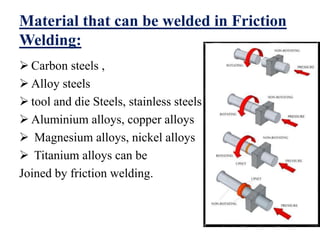
 Carbon steels ,
 Alloy steels
 tool and die Steels, stainless steels
 Aluminium alloys, copper alloys
 Magnesium alloys, nickel alloys
 Titanium alloys can be
Joined by friction welding.
Sequence of operations in the friction
welding process:
 Fig. (a) Left part is rotated at high speed
 Fig. (b) Right part is brought into contact under an axial
force
 Fig. (c) Axial force increased; flash begins to form
 Fig. (d) Left part stops rotation. Weld is completed. Flash
can beremoved by machining or grinding.
ANAYLSIS:
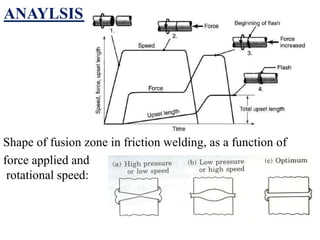
Shape of fusion zone in friction welding, as a function of
force applied and
rotational speed:
Advantages of Friction Welding:
 Simplicity of operation and simple equipment.
 Less time requirement.
 Low Surface impurities and oxide films.
 Compare to resistance butt welding produces improved
welds at higher speed and lower cost, less electric
current is required.
 Heat affected zone is small as compare to conventional
flash welding.
 Less shortening of the component, as compared to that in
flash or butt welding.
 There is no flux, gas, filler metal.
Disadvantages of Friction Welding:
 Process is restricted to flat and angular butt welds.
 Use only for joining small parts.
 In case of tube welding process becomes
complicated.
 In case of high carbon steels it is difficult to remove
flash.
 It require heavy rigid machine due to high Thrust
pressure.
Applications:
 Automobile: Bimetallic engine valve, universal joint yoke, gear hub.
 Aerospace: Turbine blade joining, seamless joining etc.
 Consumer: Hand tools, sports equipment
 Industrial: Spindles, tapers, tools Military
 Medical: Stainless steel joining of containers
 Marine: Shipping Industry
 Mining/Drilling: Twist drill etc.
 Hydraulic equipments
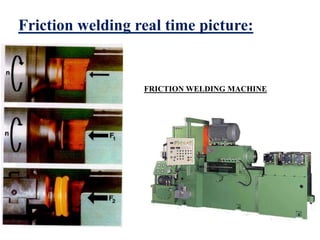
Friction welding real time picture:
• FRICTION WELDING MACHINE
•
EXPLOSION WELDING
 Explosion welding was developed relatively recently,
decades after world war-II.
 This process is most commonly utilized to cladcarbon steel
with the corrosion-resistant material e.g. stainless steel,
nickel alloy, titanium, zirconium, etc.
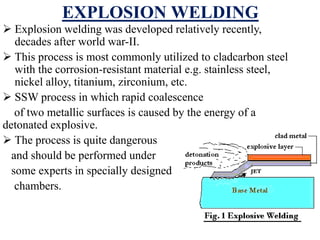
 SSW process in which rapid coalescence
of two metallic surfaces is caused by the energy of a
detonated explosive.
 The process is quite dangerous
and should be performed under
some experts in specially designed
chambers.
 Explosive Welding is a Solid State Welding process, in
which welded parts (plates) are metallurgical bonded as a
result of oblique impact pressure exerted on them by a
controlled detonation of an explosive charge.
Dissimilar metals may be joined by Explosive Welding:
 Copper to steel
 Nickel to steel
 Aluminium to steel
 Tungsten to steel
 Titanium to steel
 Copper to aluminium.
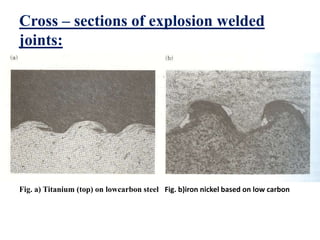
Cross – sections of explosion welded
joints:
Fig. a) Titanium (top) on lowcarbon steel Fig. b)iron nickel based on low carbon
ADVANTAGES:
• Dissimilar material joining is possible through this process.
E.g., Al to steel, Cu to steel, Tungsten to steel, etc.
• No filler metal used , no external heat applied.
• Bonding is metallurgical, combined with mechanical
interlocking that results from a rippled or wavy interface
between the metals.
APPLICATIONS:
• Joining of pipes and tubes
• Attaching cooling fins
• Major app. In pressure vessels
DISADVANTAGES:
 Brittle materials( Low impact toughness) can not be
welded.
 Extensive knowledge of explosives is needed before
the procedure may be attempted safely.
 The geometries must be simple.
THANK YOU

FRICTION AND EXPLOSION WELDING

  • 1.
    TOPIC : FRICTIONAND EXPLOSION WELDING GOVERNMENT ENGINEERING COLLEGE BHARUCH SUBJECT : MANUFACTURING PROCESS - II DIV : MECHANICAL B (SEM - IV) PREPARED BY :  RATHWA RAHUL - 160140119095  RAVAL KRUNAL - 160140119096  SAKHIWALA MAHIR -160140119098  SARDHARA KISHAN -160140119099
  • 2.
    WELDING  Welding isa fabrication or sculptural process that joins materials, usually metals or thermoplastics, by causing fusion, which is distinct from lower temperature metal- joining techniques such as brazing and soldering, which do not melt the base metal.
  • 3.
  • 4.
    SOLID STATE WELDING: Solid State Welding is a welding process, in which two work pieces are joined under a pressure providing an intimate contact between them and at a temperature essentially below the melting point of the parent material.  Forge Welding (FOW)  Cold Welding (CW)  Friction Welding (FRW)  Explosive Welding (EXW)  Diffusion Welding (DFW)  Ultrasonic Welding (USW)
  • 5.
    Friction Welding (FRW): PRINCIPLES: Friction welding (FRW) is a solid state welding process .In Friction welding process heat is required to produce a joint Between two objects. One of the parts to be joined is rotated At a high speed around 3000 revolutions per minute (rpm) And the other part is axially aligned with the second one and Pressed tightly against it. The friction between the two parts Raises the temperature of both ends, then the rotation of the Part is stopped abruptly and the pressure on the fixed part is Increased so that the joining takes place.
  • 6.
    Material that canbe welded in Friction Welding:  Carbon steels ,  Alloy steels  tool and die Steels, stainless steels  Aluminium alloys, copper alloys  Magnesium alloys, nickel alloys  Titanium alloys can be Joined by friction welding.
  • 7.
    Sequence of operationsin the friction welding process:  Fig. (a) Left part is rotated at high speed  Fig. (b) Right part is brought into contact under an axial force  Fig. (c) Axial force increased; flash begins to form  Fig. (d) Left part stops rotation. Weld is completed. Flash can beremoved by machining or grinding.
  • 8.
    ANAYLSIS: Shape of fusionzone in friction welding, as a function of force applied and rotational speed:
  • 9.
    Advantages of FrictionWelding:  Simplicity of operation and simple equipment.  Less time requirement.  Low Surface impurities and oxide films.  Compare to resistance butt welding produces improved welds at higher speed and lower cost, less electric current is required.  Heat affected zone is small as compare to conventional flash welding.  Less shortening of the component, as compared to that in flash or butt welding.  There is no flux, gas, filler metal.
  • 10.
    Disadvantages of FrictionWelding:  Process is restricted to flat and angular butt welds.  Use only for joining small parts.  In case of tube welding process becomes complicated.  In case of high carbon steels it is difficult to remove flash.  It require heavy rigid machine due to high Thrust pressure.
  • 11.
    Applications:  Automobile: Bimetallicengine valve, universal joint yoke, gear hub.  Aerospace: Turbine blade joining, seamless joining etc.  Consumer: Hand tools, sports equipment  Industrial: Spindles, tapers, tools Military  Medical: Stainless steel joining of containers  Marine: Shipping Industry  Mining/Drilling: Twist drill etc.  Hydraulic equipments
  • 12.
    Friction welding realtime picture: • FRICTION WELDING MACHINE •
  • 13.
    EXPLOSION WELDING  Explosionwelding was developed relatively recently, decades after world war-II.  This process is most commonly utilized to cladcarbon steel with the corrosion-resistant material e.g. stainless steel, nickel alloy, titanium, zirconium, etc.  SSW process in which rapid coalescence of two metallic surfaces is caused by the energy of a detonated explosive.  The process is quite dangerous and should be performed under some experts in specially designed chambers.
  • 14.
     Explosive Weldingis a Solid State Welding process, in which welded parts (plates) are metallurgical bonded as a result of oblique impact pressure exerted on them by a controlled detonation of an explosive charge. Dissimilar metals may be joined by Explosive Welding:  Copper to steel  Nickel to steel  Aluminium to steel  Tungsten to steel  Titanium to steel  Copper to aluminium.
  • 15.
    Cross – sectionsof explosion welded joints: Fig. a) Titanium (top) on lowcarbon steel Fig. b)iron nickel based on low carbon
  • 16.
    ADVANTAGES: • Dissimilar materialjoining is possible through this process. E.g., Al to steel, Cu to steel, Tungsten to steel, etc. • No filler metal used , no external heat applied. • Bonding is metallurgical, combined with mechanical interlocking that results from a rippled or wavy interface between the metals. APPLICATIONS: • Joining of pipes and tubes • Attaching cooling fins • Major app. In pressure vessels
  • 17.
    DISADVANTAGES:  Brittle materials(Low impact toughness) can not be welded.  Extensive knowledge of explosives is needed before the procedure may be attempted safely.  The geometries must be simple.
  • 18.