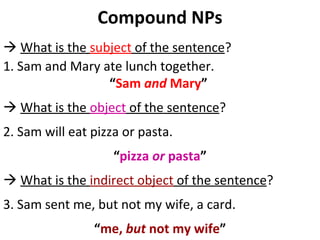
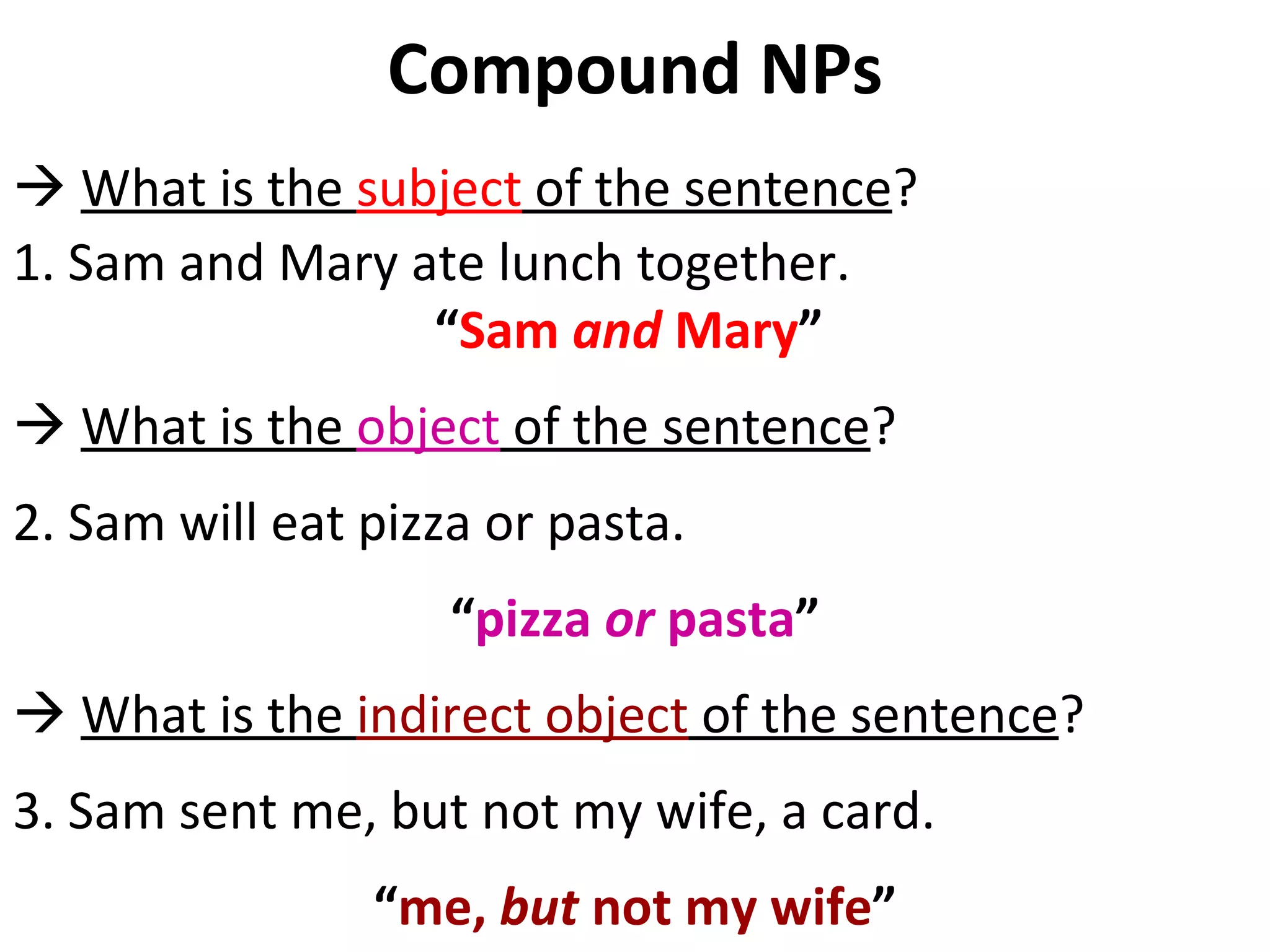
Compound NPs    What is the  subject  of the sentence ?  1. Sam and Mary ate lunch together.  “ Sam  and  Mary ”      What is the  object  of the sentence ?  2. Sam will eat pizza or pasta.  “ pizza  or  pasta ”    What is the  indirect object  of the sentence ? 3. Sam sent me, but not my wife, a card.  “ me,  but  not my wife ”
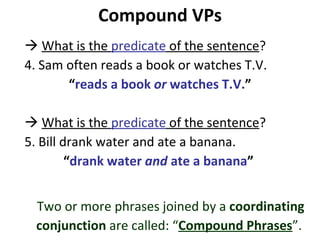
Compound VPs    What is the  predicate  of the sentence ?  4. Sam often reads a book or watches T.V.  “ reads a book  or  watches T.V. ”    What is the  predicate  of the sentence ?  5. Bill drank water and ate a banana.  “ drank water  and  ate a banana ”  Two or more phrases joined by a  coordinating conjunction  are called: “ Compound Phrases ”.
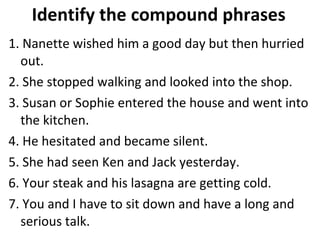
Identify the compound phrases 1. Nanette wished him a good day but then hurried out.  2. She stopped walking and looked into the shop.  3. Susan or Sophie entered the house and went into the kitchen.  4. He hesitated and became silent.  5. She had seen Ken and Jack yesterday.  6. Your steak and his lasagna are getting cold.  7. You and I have to sit down and have a long and serious talk.
Sentences Sentences can be :  Simple Compound Complex
Simple Sentences A simple sentence  is a sentence that consists of  exactly one clause . Examples : John met Bill at the supermarket.  He came to N.Y. and stayed for one week.  Sam saw a movie but didn’t eat popcorn.  Simple sentences have  one   subject  and  one  predicate .  The  predicate  of a simple sentence might be a  compound VP  (examples 2 and 3).
Compound Sentences How many clauses are in the sentence?  1. Bill was tired so he went home. There are 2 main clauses More Examples :  2. [John is excited]  but  [Mary is scared]. 3. [Bill is driving us there]  and  [Mary is bringing cake].     Compound Sentences  are sentences that contain  at least   two clauses , that are connected by a  coordinating conjunction .
Compound  vs.  Simple Sentences 1.  John   drank   but   he   didn’t eat .  2.  John   drank   and   ate .    Both sentences contain  two   verbs . but…  Sentence 1  is a  compound sentence .  Sentence 1 has  two  clauses .  Each clause has  a subject  and  a predicate . Sentence 2  is a  simple sentence , with a  compound VP Sentence 2 has only  one  clause.  It has  one  subject  and  one  (compound)  predicate .
Homework Read and do all the exercises in lessons 43, 44, 46 and 47.
Complex Sentences Complex sentences  are sentences with  two or more clauses , that are connected by either a  subordinating conjunction  or a  relative pronoun . Subordinating conjunctions  start  subordinate clauses  –   Sam was thinking [ that  he should work harder]. I don’t know [ when  the movie starts].  Relative Pronouns  start  Relative clauses  –  3.  I read the book [ that  you recommended].  4.  She bought a laptop [ which  had good features].
Simple, Compound or Complex? 1. The Brooklyn Bridge was built in the 19th century. 2. Her novels are getting the acclaim they deserve. 3. Marie has been sitting and looking out the window. 4. Ben is a man who always has a twinkle in his eyes. 5. They performed the song their lead singer wrote. 6. A committee that has been working on that issue will soon publish its recommendations. 7. His belief, which he has held for a long time, is incorrect. 8. I believe the car meets all safety standards. 9. Nick and I will order coffee unless you prefer tea.
1. Brad is an amateur photographer, but he didn’t have his camera with him that day. 2. When Greg arrived at the hotel, he unpacked. 3. Martha opened the front door and then she hurried to her neighbor’s house. 4. The ingredients were on the kitchen counter. 5. The Wilsons know they’ll be moving soon. 6. They will book a trip once they get their passports. 7. His belief, which he has held for a long time, is incorrect.  8. John married his niece and they had three children, who each became physicians.
Subordinate Clauses as Arguments Subordinate clauses  can be an  argument  of the  verb  in the main clause . Subordinate clauses  as  Object : 1. John believes  that Mary is telling the truth .  Argument Structure:  believe : verb;  1  2     NP  S   Subordinate clauses  as  Subject : 2.  That it snowed in October  surprised us.  Argument Structure:  surprise : verb;  1  2   S  NP
Subordinate Clauses as  Objects 1.  Sam thinks that the movie started .  Step I:   Count how many  verbs  there are in total .     Two  – “ thinks ” and “ started ” Step II:  How many  arguments  does each verb select?   “ think ” –  two .  “ started ” –  one .  Step III :  Find the phrasal category of each argument! Who   thinks ?  Sam  –  NP !  What  does he  think ? [that the movie started] –  S !  What   started ?  the movie  –  NP ! think : verb;  1  2   NP  S start : verb;  1    NP
2.  That Bill ate the cake annoyed us .  Step I:   Count how many  verbs  there are in total .     Two  – “ ate ” and “ annoyed ” Step II:  How many  arguments  does each verb select?   “ eat ” –  two   “ annoyed ” -  two   Step III :  Find the phrasal category of each argument! What   annoyed ? [that Bill ate the cake] –  S ! Who did it   annoy ?  us  –  NP !  Subordinate Clauses as  Subjects annoy : verb;  1  2   S  NP eat : verb;  1  2    NP  NP
Subordinate Clauses as arguments of  adjectives 3.  That Bill won the race is wonderful .  Step I:  Count how many  verbs  there are in total.     Two  – “ won ” and “ is ” Step II:  How many arguments does each verb select?  “ won ” –  two   “ is ” –  zero arguments, but… “ wonderful ”  selects  one argument –     What  is  wonderful ? “[That Bill won the race]” –  S .  wonderful : adjective;  1 S Argument Structure:
Is the subordinate clause an argument? 1. Sam thinks that Mary is very nice. 2. John laughed while Mary cried.  3. I don’t know when the movie starts. 4. Why Sam got an “A” in Math is unknown.  5. We exercise everyday after we study. 6. That Bill is talented became clear early in his life.  7. How Jane sleeps well at night is a good question. 8. That Susan failed the course surprised everyone.  9. Jane wonders whether she has class this week.  10. That her son was not home yet worried her.  11. I haven’t seen him since he was a baby.
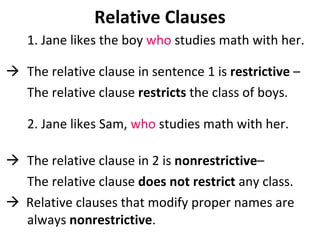
Relative Clauses 1. Jane likes the boy  who  studies math with her.  The relative clause in sentence 1 is  restrictive  –  The relative clause  restricts  the class of boys.  2. Jane likes Sam,  who  studies math with her.  The relative clause in 2 is  nonrestrictive –  The relative clause  does not restrict  any class.    Relative clauses that modify proper names are always  nonrestrictive .
Restrictive  vs.  Nonrestrictive Jane read the book [ which  John recommended].  Sam ate the cookie [Bill wanted].  Restrictive  relative clauses help  identify  the  noun . Restrictive  relative clauses can start  without  a  relative pronoun !!! 3. Jane read “Peter Pan” ,  [ which  she really liked]. 4. Sam ate Bill’s cookie ,  [ which  was quite tasty].    Nonrestrictive relative  clauses  don’t help to identify  the  noun , but rather add  extra  information about it.
Homework Read and do all the exercises in lessons 48 and 49.  Note:   Ignore   the terms “noun clause”, “adverbial clause”, etc.
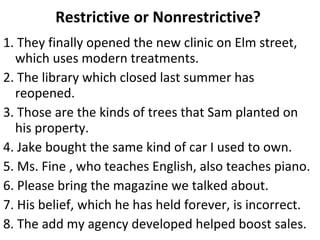
Restrictive or Nonrestrictive?  1. They finally opened the new clinic on Elm street, which uses modern treatments. 2. The library which closed last summer has reopened. 3. Those are the kinds of trees that Sam planted on his property. 4. Jake bought the same kind of car I used to own. 5. Ms. Fine , who teaches English, also teaches piano. 6. Please bring the magazine we talked about. 7. His belief, which he has held forever, is incorrect. 8. The add my agency developed helped boost sales.
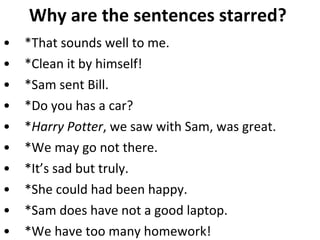
Why are the sentences starred?  *That sounds well to me.  *Clean it by himself! *Sam sent Bill.  *Do you has a car?  * Harry Potter , we saw with Sam, was great.  *We may go not there. *It’s sad but truly.  *She could had been happy.  *Sam does have not a good laptop.  *We have too many homework!
Prescriptive  Vs.  Descriptive The word “law” has two meanings :  Human law  (e.g.  don’t steal )  Natural law  (e.g.  gravity ) Human laws  are  prescriptive   – they  prescribe  how people  should  or  ought  to live.  Human laws  are invented by people.  Natural laws  are  descriptive  – they  describe  how the world  is .  Natural laws  are NOT invented by humans.
Descriptive  Vs.  Prescriptive The distinction in linguistics : Prescriptive  grammar  (e.g.  after a preposition say “whom”, not “who” ) Descriptive  grammar  (e.g.  Modern English speakers always say “who”, not “whom” )  Which type of grammar have we been studying in this course?  Are the grammatical  rules  we’ve learned  descriptive   rules  or  prescriptive   rules ?
The grammar of English Rule :  A pronoun does not follow a determiner.  Example: *Sam sent the me a letter.  But observe:   2. “ That’s the biggest me I have ever seen ”.
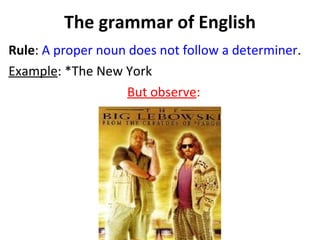
The grammar of English Rule :  A proper noun does not follow a determiner .  Example : *The New York  But observe :
The grammar of English Rule :  Every clause has a subject . But observe :  Hey, great to see you! Thank you!  Good to hear from you!
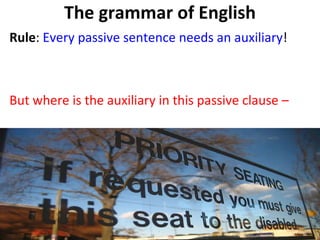
The grammar of English Rule :  Every clause has a subject . [If requested] you must give this seat to the disabled.  [If  this seat is requested ] you must give this seat to the disabled.
The grammar of English Rule :  Every passive sentence needs an auxiliary !  But where is the auxiliary in this passive clause –
The grammar of English Rule :  The object always comes  after  the verb But observe :  John loves apples,  but peaches he really hates.
The grammar of English Rule :  The subject always comes  before  the verb But observe :  George, can you do me a favor? Up in my room,  on the nightstand,  is   a pinkish-reddish  envelope ...  In Germany you can drive as fast as you like and you may feel like the king of the road – until you look  in the  rear mirror. Zooming  in on  you  like a guided missile,  comes   a  rival  contender …
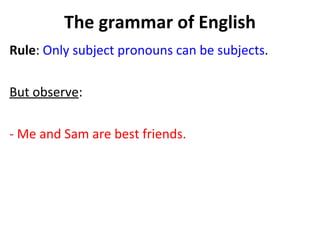
The grammar of English Rule :  Only subject pronouns can be subjects . But observe :  - Me and Sam are best friends.
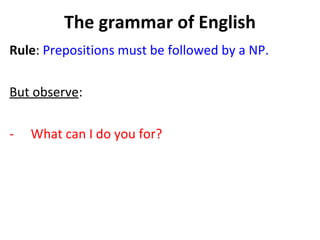
The grammar of English Rule :  Prepositions must be followed by a NP. But observe :  What can I do you for?
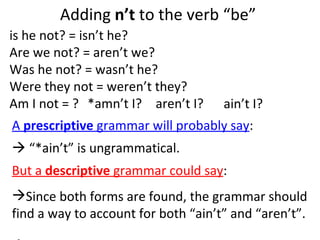
Adding  n’t  to the verb “be”  A  prescriptive  grammar will probably say :    “ *ain’t” is ungrammatical.  But a  descriptive  grammar could say :  Since both forms are found, the grammar should find a way to account for both “ain’t” and “aren’t”.  “ it's quite your regular night; ain't it?”   is he not? = isn’t he? Are we not? = aren’t we?  Was he not? = wasn’t he?  Were they not = weren’t they?  Am I not = ?  *amn’t I? aren’t I? ain’t I?

compounds and complex sentences and conclusions

  • 1.
    Compound NPs  What is the subject of the sentence ? 1. Sam and Mary ate lunch together. “ Sam and Mary ”  What is the object of the sentence ? 2. Sam will eat pizza or pasta. “ pizza or pasta ”  What is the indirect object of the sentence ? 3. Sam sent me, but not my wife, a card. “ me, but not my wife ”
  • 2.
    Compound VPs  What is the predicate of the sentence ? 4. Sam often reads a book or watches T.V. “ reads a book or watches T.V. ”  What is the predicate of the sentence ? 5. Bill drank water and ate a banana. “ drank water and ate a banana ” Two or more phrases joined by a coordinating conjunction are called: “ Compound Phrases ”.
  • 3.
    Identify the compoundphrases 1. Nanette wished him a good day but then hurried out. 2. She stopped walking and looked into the shop. 3. Susan or Sophie entered the house and went into the kitchen. 4. He hesitated and became silent. 5. She had seen Ken and Jack yesterday. 6. Your steak and his lasagna are getting cold. 7. You and I have to sit down and have a long and serious talk.
  • 4.
    Sentences Sentences canbe : Simple Compound Complex
  • 5.
    Simple Sentences Asimple sentence is a sentence that consists of exactly one clause . Examples : John met Bill at the supermarket. He came to N.Y. and stayed for one week. Sam saw a movie but didn’t eat popcorn. Simple sentences have one subject and one predicate . The predicate of a simple sentence might be a compound VP (examples 2 and 3).
  • 6.
    Compound Sentences Howmany clauses are in the sentence? 1. Bill was tired so he went home. There are 2 main clauses More Examples : 2. [John is excited] but [Mary is scared]. 3. [Bill is driving us there] and [Mary is bringing cake].  Compound Sentences are sentences that contain at least two clauses , that are connected by a coordinating conjunction .
  • 7.
    Compound vs. Simple Sentences 1. John drank but he didn’t eat . 2. John drank and ate .  Both sentences contain two verbs . but… Sentence 1 is a compound sentence . Sentence 1 has two clauses . Each clause has a subject and a predicate . Sentence 2 is a simple sentence , with a compound VP Sentence 2 has only one clause. It has one subject and one (compound) predicate .
  • 8.
    Homework Read anddo all the exercises in lessons 43, 44, 46 and 47.
  • 9.
    Complex Sentences Complexsentences are sentences with two or more clauses , that are connected by either a subordinating conjunction or a relative pronoun . Subordinating conjunctions start subordinate clauses – Sam was thinking [ that he should work harder]. I don’t know [ when the movie starts]. Relative Pronouns start Relative clauses – 3. I read the book [ that you recommended]. 4. She bought a laptop [ which had good features].
  • 10.
    Simple, Compound orComplex? 1. The Brooklyn Bridge was built in the 19th century. 2. Her novels are getting the acclaim they deserve. 3. Marie has been sitting and looking out the window. 4. Ben is a man who always has a twinkle in his eyes. 5. They performed the song their lead singer wrote. 6. A committee that has been working on that issue will soon publish its recommendations. 7. His belief, which he has held for a long time, is incorrect. 8. I believe the car meets all safety standards. 9. Nick and I will order coffee unless you prefer tea.
  • 11.
    1. Brad isan amateur photographer, but he didn’t have his camera with him that day. 2. When Greg arrived at the hotel, he unpacked. 3. Martha opened the front door and then she hurried to her neighbor’s house. 4. The ingredients were on the kitchen counter. 5. The Wilsons know they’ll be moving soon. 6. They will book a trip once they get their passports. 7. His belief, which he has held for a long time, is incorrect. 8. John married his niece and they had three children, who each became physicians.
  • 12.
    Subordinate Clauses asArguments Subordinate clauses can be an argument of the verb in the main clause . Subordinate clauses as Object : 1. John believes that Mary is telling the truth . Argument Structure: believe : verb; 1 2 NP S Subordinate clauses as Subject : 2. That it snowed in October surprised us. Argument Structure: surprise : verb; 1 2 S NP
  • 13.
    Subordinate Clauses as Objects 1. Sam thinks that the movie started . Step I: Count how many verbs there are in total .  Two – “ thinks ” and “ started ” Step II: How many arguments does each verb select? “ think ” – two . “ started ” – one . Step III : Find the phrasal category of each argument! Who thinks ? Sam – NP ! What does he think ? [that the movie started] – S ! What started ? the movie – NP ! think : verb; 1 2 NP S start : verb; 1 NP
  • 14.
    2. ThatBill ate the cake annoyed us . Step I: Count how many verbs there are in total .  Two – “ ate ” and “ annoyed ” Step II: How many arguments does each verb select? “ eat ” – two “ annoyed ” - two Step III : Find the phrasal category of each argument! What annoyed ? [that Bill ate the cake] – S ! Who did it annoy ? us – NP ! Subordinate Clauses as Subjects annoy : verb; 1 2 S NP eat : verb; 1 2 NP NP
  • 15.
    Subordinate Clauses asarguments of adjectives 3. That Bill won the race is wonderful . Step I: Count how many verbs there are in total.  Two – “ won ” and “ is ” Step II: How many arguments does each verb select? “ won ” – two “ is ” – zero arguments, but… “ wonderful ” selects one argument –  What is wonderful ? “[That Bill won the race]” – S . wonderful : adjective; 1 S Argument Structure:
  • 16.
    Is the subordinateclause an argument? 1. Sam thinks that Mary is very nice. 2. John laughed while Mary cried. 3. I don’t know when the movie starts. 4. Why Sam got an “A” in Math is unknown. 5. We exercise everyday after we study. 6. That Bill is talented became clear early in his life. 7. How Jane sleeps well at night is a good question. 8. That Susan failed the course surprised everyone. 9. Jane wonders whether she has class this week. 10. That her son was not home yet worried her. 11. I haven’t seen him since he was a baby.
  • 17.
    Relative Clauses 1.Jane likes the boy who studies math with her. The relative clause in sentence 1 is restrictive – The relative clause restricts the class of boys. 2. Jane likes Sam, who studies math with her. The relative clause in 2 is nonrestrictive – The relative clause does not restrict any class.  Relative clauses that modify proper names are always nonrestrictive .
  • 18.
    Restrictive vs. Nonrestrictive Jane read the book [ which John recommended]. Sam ate the cookie [Bill wanted]. Restrictive relative clauses help identify the noun . Restrictive relative clauses can start without a relative pronoun !!! 3. Jane read “Peter Pan” , [ which she really liked]. 4. Sam ate Bill’s cookie , [ which was quite tasty].  Nonrestrictive relative clauses don’t help to identify the noun , but rather add extra information about it.
  • 19.
    Homework Read anddo all the exercises in lessons 48 and 49. Note: Ignore the terms “noun clause”, “adverbial clause”, etc.
  • 20.
    Restrictive or Nonrestrictive? 1. They finally opened the new clinic on Elm street, which uses modern treatments. 2. The library which closed last summer has reopened. 3. Those are the kinds of trees that Sam planted on his property. 4. Jake bought the same kind of car I used to own. 5. Ms. Fine , who teaches English, also teaches piano. 6. Please bring the magazine we talked about. 7. His belief, which he has held forever, is incorrect. 8. The add my agency developed helped boost sales.
  • 21.
    Why are thesentences starred? *That sounds well to me. *Clean it by himself! *Sam sent Bill. *Do you has a car? * Harry Potter , we saw with Sam, was great. *We may go not there. *It’s sad but truly. *She could had been happy. *Sam does have not a good laptop. *We have too many homework!
  • 22.
    Prescriptive Vs. Descriptive The word “law” has two meanings : Human law (e.g. don’t steal ) Natural law (e.g. gravity ) Human laws are prescriptive – they prescribe how people should or ought to live. Human laws are invented by people. Natural laws are descriptive – they describe how the world is . Natural laws are NOT invented by humans.
  • 23.
    Descriptive Vs. Prescriptive The distinction in linguistics : Prescriptive grammar (e.g. after a preposition say “whom”, not “who” ) Descriptive grammar (e.g. Modern English speakers always say “who”, not “whom” ) Which type of grammar have we been studying in this course? Are the grammatical rules we’ve learned descriptive rules or prescriptive rules ?
  • 24.
    The grammar ofEnglish Rule : A pronoun does not follow a determiner. Example: *Sam sent the me a letter. But observe: 2. “ That’s the biggest me I have ever seen ”.
  • 25.
    The grammar ofEnglish Rule : A proper noun does not follow a determiner . Example : *The New York But observe :
  • 26.
    The grammar ofEnglish Rule : Every clause has a subject . But observe : Hey, great to see you! Thank you! Good to hear from you!
  • 27.
    The grammar ofEnglish Rule : Every clause has a subject . [If requested] you must give this seat to the disabled. [If this seat is requested ] you must give this seat to the disabled.
  • 28.
    The grammar ofEnglish Rule : Every passive sentence needs an auxiliary ! But where is the auxiliary in this passive clause –
  • 29.
    The grammar ofEnglish Rule : The object always comes after the verb But observe : John loves apples, but peaches he really hates.
  • 30.
    The grammar ofEnglish Rule : The subject always comes before the verb But observe : George, can you do me a favor? Up in my room, on the nightstand, is a pinkish-reddish envelope ... In Germany you can drive as fast as you like and you may feel like the king of the road – until you look in the rear mirror. Zooming in on you like a guided missile, comes a rival contender …
  • 31.
    The grammar ofEnglish Rule : Only subject pronouns can be subjects . But observe : - Me and Sam are best friends.
  • 32.
    The grammar ofEnglish Rule : Prepositions must be followed by a NP. But observe : What can I do you for?
  • 33.
    Adding n’t to the verb “be” A prescriptive grammar will probably say :  “ *ain’t” is ungrammatical. But a descriptive grammar could say : Since both forms are found, the grammar should find a way to account for both “ain’t” and “aren’t”. “ it's quite your regular night; ain't it?” is he not? = isn’t he? Are we not? = aren’t we? Was he not? = wasn’t he? Were they not = weren’t they? Am I not = ? *amn’t I? aren’t I? ain’t I?