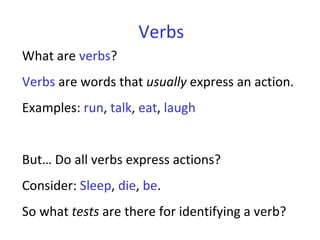
Verbs What are  verbs ?  Verbs  are words that  usually  express an action.  Examples:  run ,  talk ,  eat ,  laugh But… Do all verbs express actions?  Consider:  Sleep ,  die ,  be .  So what  tests  are there for identifying a verb?
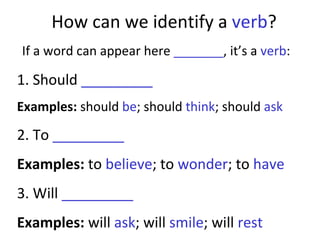
How can we identify a  verb ?  If a word can appear here  _______ , it’s a  verb :  1. Should  _________ Examples:  should  be ; should  think ; should  ask 2. To  _________ Examples:  to  believe ; to  wonder ; to  have 3. Will  _________ Examples:  will  ask ; will  smile ; will  rest
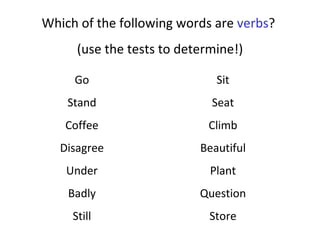
Which of the following words are  verbs ?  (use the tests to determine!) Go Stand Coffee Disagree Under Badly Still Sit Seat Climb Beautiful Plant Question Store
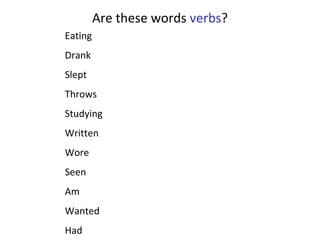
Are these words  verbs ? Eating Drank Slept Throws Studying Written Wore Seen Am Wanted Had
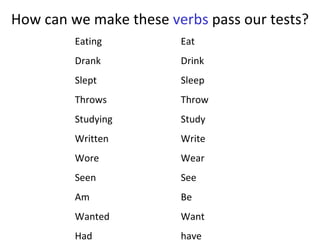
How can we make these  verbs  pass our tests? Eating Drank Slept Throws Studying Written Wore Seen Am Wanted Had Eat  Drink Sleep Throw Study Write Wear See Be Want have
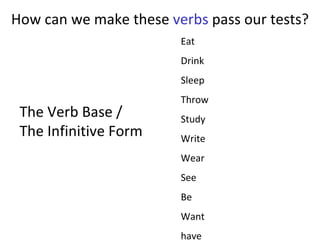
How can we make these  verbs  pass our tests? Eat  Drink Sleep Throw Study Write Wear See Be Want have The Verb Base / The Infinitive Form
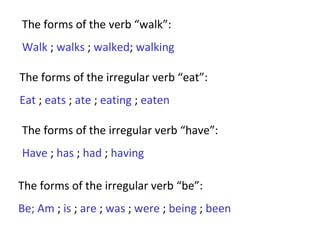
The forms of the irregular verb “be”:  Be; Am  ;  is  ;  are  ;  was  ;  were  ;  being  ;  been   The forms of the verb “walk”:  Walk  ;  walks  ;  walked ;  walking   The forms of the irregular verb “eat”:  Eat  ;  eats  ;  ate  ;  eating  ;  eaten The forms of the irregular verb “have”: Have  ;  has  ;  had  ;  having
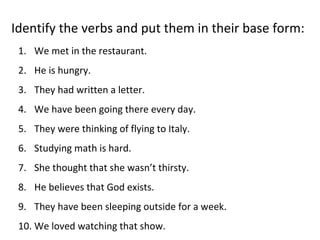
Identify the verbs and put them in their base form:  We met in the restaurant.  He is hungry.  They had written a letter.  We have been going there every day.  They were thinking of flying to Italy.  Studying math is hard.  She thought that she wasn’t thirsty. He believes that God exists.  They have been sleeping outside for a week.  We loved watching that show.
Homework Verbs: 7.1 –   7.2 The verb base: 8.1 – 8.3
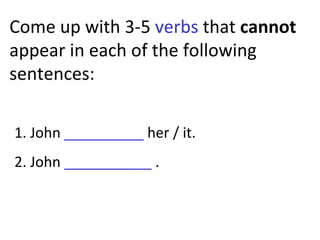
Come up with 3-5  verbs  that  cannot  appear in each of the following sentences: 1. John  __________  her / it. 2. John  ___________  .
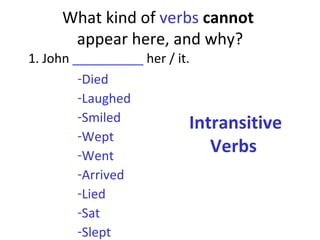
What kind of  verbs   cannot   appear here, and why? 1. John  __________  her / it. Died  Laughed  Smiled  Wept  Went  Arrived Lied  Sat  Slept Intransitive Verbs
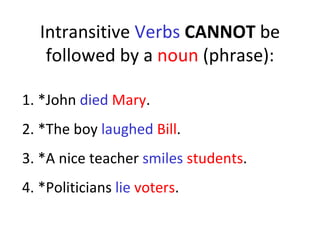
Intransitive  Verbs   CANNOT  be followed by a  noun  (phrase): 1. *John  died   Mary . 2. *The boy  laughed   Bill .  3. *A nice teacher  smiles   students .  4. *Politicians  lie   voters .
What kind of  verbs   cannot   appear here, and why? 2. John  ___________   . Bought  Kissed  Sold Noticed  Touched Believed  Shoved  Corrected  Transitive Verbs
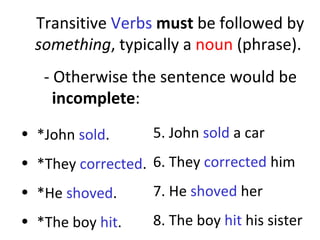
Transitive  Verbs   must  be followed by  something , typically a  noun  (phrase).  - Otherwise the sentence would be    incomplete :  *John  sold .  *They  corrected .  *He  shoved .  *The boy  hit .  5. John  sold  a car 6. They  corrected  him 7. He  shoved  her 8. The boy  hit  his sister
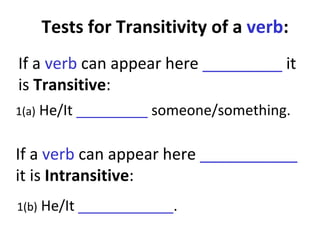
If a  verb  can appear here  _________  it is  Transitive :  1(a)  He/It  _________  someone/something. If a  verb  can appear here  ___________  it is  Intransitive :  1(b)  He/It  ____________ . Tests for Transitivity of a  verb :
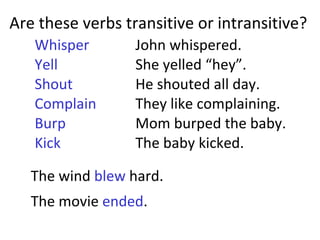
Are these verbs transitive or intransitive?  Whisper  Yell  Shout Complain  Burp  Kick The wind  blew  hard.  The movie  ended .  John whispered.  She yelled “hey”. He shouted all day. They like complaining. Mom burped the baby. The baby kicked.
Are these verbs transitive, intransitive or both?  Use the tests to determine!! Eat  Drink Run Sing Read Study
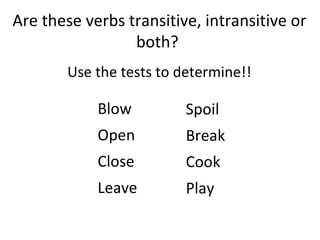
Blow Open Close Leave Spoil Break  Cook Play Are these verbs transitive, intransitive or both?  Use the tests to determine!!
Linking Verbs Linking verbs  are  verbs  that  link  the subject of the sentence to an  adjective  or a  noun  (phrase).  Examples: 1. The food  tastes   excellent .  2.   John   is  a  teacher .  3.   Plato  was  a  philosopher .  4.   Sharon  sounds   sick . 5.   John  seems   happy . Linking Verbs
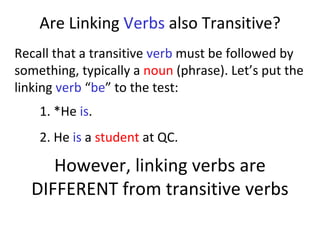
Are Linking  Verbs  also   Transitive? Recall that a transitive  verb  must be followed by something, typically a  noun  (phrase). Let’s put the linking  verb  “ be ” to the test: 1. *He  is . 2. He  is  a  student  at QC.  However, linking verbs are DIFFERENT from transitive verbs
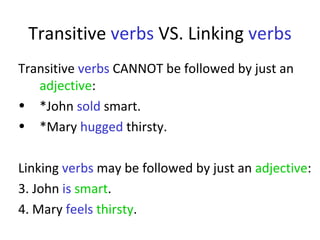
Transitive  verbs  VS. Linking  verbs Transitive  verbs  CANNOT be followed by just an  adjective :  *John  sold  smart.  *Mary  hugged  thirsty.  Linking  verbs  may be followed by just an  adjective :  3. John  is   smart .  4. Mary  feels   thirsty .
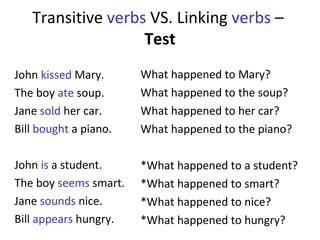
Transitive  verbs  VS. Linking  verbs  –  Test John  kissed  Mary.  The boy  ate  soup.  Jane  sold  her car. Bill  bought  a piano. John  is  a student.  The boy  seems  smart. Jane  sounds  nice. Bill  appears  hungry.  What happened to Mary?  What happened to the soup? What happened to her car? What happened to the piano? *What happened to a student? *What happened to smart? *What happened to nice?  *What happened to hungry?
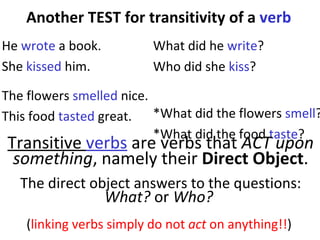
He  wrote  a book. She  kissed  him.  The flowers  smelled  nice.  This food  tasted  great.  What did he  write ?  Who did she  kiss ? *What did the flowers  smell ? *What did the food  taste ?  Another TEST for transitivity of a  verb Transitive  verbs  are verbs that  ACT   upon   something , namely their  Direct Object . The direct object answers to the questions:  What?  or  Who?   ( linking verbs simply do not  act  on anything!! )
a. Katie  dropped  her notebook.  b. Katie  dropped  off the files at the office.  a. Sam  took  the car.  b. Same  took  off his glasses.  Phrasal Verbs
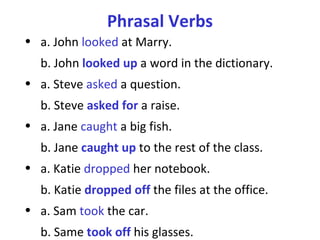
Phrasal Verbs a. John  looked  at Marry.  b. John  looked   up  a word in the dictionary.  a. Steve  asked  a question.  b. Steve  asked   for  a raise.  a. Jane  caught  a big fish.  b. Jane  caught   up  to the rest of the class.  a. Katie  dropped  her notebook.  b. Katie  dropped   off  the files at the office.  a. Sam  took  the car.  b. Same  took   off  his glasses.
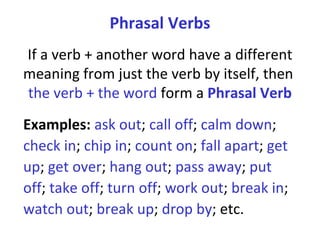
Phrasal Verbs If a verb + another word have a different meaning from just the verb by itself, then  the verb + the word  form a  Phrasal Verb Examples:  ask out ;  call off ;  calm down ;  check in ;  chip in ;  count on ;  fall apart ;  get up ;  get over ;  hang out ;  pass away ;  put off ;  take off ;  turn off ;  work out ;  break in ;  watch out ;  break up ;  drop by ; etc.
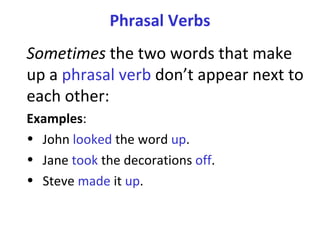
Phrasal Verbs Sometimes  the two words that make up a  phrasal verb  don’t appear next to each other:  Examples :  John  looked  the word  up .  Jane  took  the decorations  off .  Steve  made  it  up .
Phrasal Verbs Challenge Question:  Does a  phrasal verb   always  have a different meaning from that of the same  verb , but by itself?
Homework:  All the exercises in lesson 11.
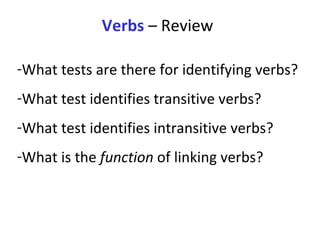
Verbs  – Review What tests are there for identifying verbs?  What test identifies transitive verbs? What test identifies intransitive verbs?  What is the  function  of linking verbs?
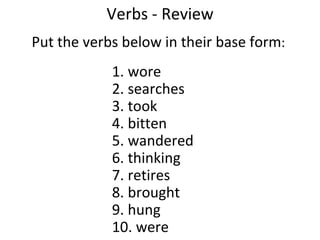
Verbs - Review Put the verbs below in their base form :  1. wore 2. searches 3. took  4. bitten 5. wandered 6. thinking 7. retires  8. brought 9. hung 10. were
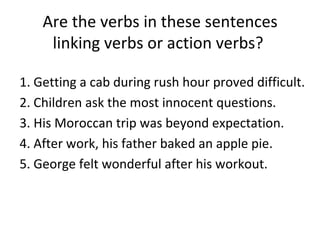
Are the verbs in these sentences linking verbs or action verbs?  1. Getting a cab during rush hour proved difficult. 2. Children ask the most innocent questions.  3. His Moroccan trip was beyond expectation. 4. After work, his father baked an apple pie. 5. George felt wonderful after his workout.
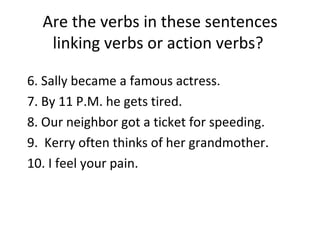
Are the verbs in these sentences linking verbs or action verbs?  6. Sally became a famous actress. 7. By 11 P.M. he gets tired. 8. Our neighbor got a ticket for speeding. 9.  Kerry often thinks of her grandmother. 10. I feel your pain.
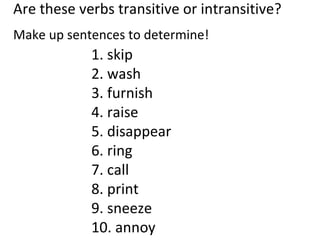
Are these verbs transitive or intransitive? Make up sentences to determine!   1. skip 2. wash 3. furnish 4. raise 5. disappear 6. ring 7. call 8. print 9. sneeze 10. annoy
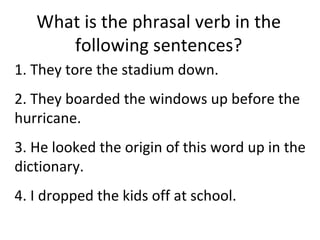
What is the phrasal verb in the following sentences? 1. They tore the stadium down.  2. They boarded the windows up before the hurricane.  3. He looked the origin of this word up in the dictionary. 4. I dropped the kids off at school.

 

Unit 2 verbs

  • 1.
    Verbs What are verbs ? Verbs are words that usually express an action. Examples: run , talk , eat , laugh But… Do all verbs express actions? Consider: Sleep , die , be . So what tests are there for identifying a verb?
  • 2.
    How can weidentify a verb ? If a word can appear here _______ , it’s a verb : 1. Should _________ Examples: should be ; should think ; should ask 2. To _________ Examples: to believe ; to wonder ; to have 3. Will _________ Examples: will ask ; will smile ; will rest
  • 3.
    Which of thefollowing words are verbs ? (use the tests to determine!) Go Stand Coffee Disagree Under Badly Still Sit Seat Climb Beautiful Plant Question Store
  • 4.
    Are these words verbs ? Eating Drank Slept Throws Studying Written Wore Seen Am Wanted Had
  • 5.
    How can wemake these verbs pass our tests? Eating Drank Slept Throws Studying Written Wore Seen Am Wanted Had Eat Drink Sleep Throw Study Write Wear See Be Want have
  • 6.
    How can wemake these verbs pass our tests? Eat Drink Sleep Throw Study Write Wear See Be Want have The Verb Base / The Infinitive Form
  • 7.
    The forms ofthe irregular verb “be”: Be; Am ; is ; are ; was ; were ; being ; been The forms of the verb “walk”: Walk ; walks ; walked ; walking The forms of the irregular verb “eat”: Eat ; eats ; ate ; eating ; eaten The forms of the irregular verb “have”: Have ; has ; had ; having
  • 8.
    Identify the verbsand put them in their base form: We met in the restaurant. He is hungry. They had written a letter. We have been going there every day. They were thinking of flying to Italy. Studying math is hard. She thought that she wasn’t thirsty. He believes that God exists. They have been sleeping outside for a week. We loved watching that show.
  • 9.
    Homework Verbs: 7.1– 7.2 The verb base: 8.1 – 8.3
  • 10.
    Come up with3-5 verbs that cannot appear in each of the following sentences: 1. John __________ her / it. 2. John ___________ .
  • 11.
    What kind of verbs cannot appear here, and why? 1. John __________ her / it. Died Laughed Smiled Wept Went Arrived Lied Sat Slept Intransitive Verbs
  • 12.
    Intransitive Verbs CANNOT be followed by a noun (phrase): 1. *John died Mary . 2. *The boy laughed Bill . 3. *A nice teacher smiles students . 4. *Politicians lie voters .
  • 13.
    What kind of verbs cannot appear here, and why? 2. John ___________ . Bought Kissed Sold Noticed Touched Believed Shoved Corrected Transitive Verbs
  • 14.
    Transitive Verbs must be followed by something , typically a noun (phrase). - Otherwise the sentence would be incomplete : *John sold . *They corrected . *He shoved . *The boy hit . 5. John sold a car 6. They corrected him 7. He shoved her 8. The boy hit his sister
  • 15.
    If a verb can appear here _________ it is Transitive : 1(a) He/It _________ someone/something. If a verb can appear here ___________ it is Intransitive : 1(b) He/It ____________ . Tests for Transitivity of a verb :
  • 16.
    Are these verbstransitive or intransitive? Whisper Yell Shout Complain Burp Kick The wind blew hard. The movie ended . John whispered. She yelled “hey”. He shouted all day. They like complaining. Mom burped the baby. The baby kicked.
  • 17.
    Are these verbstransitive, intransitive or both? Use the tests to determine!! Eat Drink Run Sing Read Study
  • 18.
    Blow Open CloseLeave Spoil Break Cook Play Are these verbs transitive, intransitive or both? Use the tests to determine!!
  • 19.
    Linking Verbs Linkingverbs are verbs that link the subject of the sentence to an adjective or a noun (phrase). Examples: 1. The food tastes excellent . 2. John is a teacher . 3. Plato was a philosopher . 4. Sharon sounds sick . 5. John seems happy . Linking Verbs
  • 20.
    Are Linking Verbs also Transitive? Recall that a transitive verb must be followed by something, typically a noun (phrase). Let’s put the linking verb “ be ” to the test: 1. *He is . 2. He is a student at QC. However, linking verbs are DIFFERENT from transitive verbs
  • 21.
    Transitive verbs VS. Linking verbs Transitive verbs CANNOT be followed by just an adjective : *John sold smart. *Mary hugged thirsty. Linking verbs may be followed by just an adjective : 3. John is smart . 4. Mary feels thirsty .
  • 22.
    Transitive verbs VS. Linking verbs – Test John kissed Mary. The boy ate soup. Jane sold her car. Bill bought a piano. John is a student. The boy seems smart. Jane sounds nice. Bill appears hungry. What happened to Mary? What happened to the soup? What happened to her car? What happened to the piano? *What happened to a student? *What happened to smart? *What happened to nice? *What happened to hungry?
  • 23.
    He wrote a book. She kissed him. The flowers smelled nice. This food tasted great. What did he write ? Who did she kiss ? *What did the flowers smell ? *What did the food taste ? Another TEST for transitivity of a verb Transitive verbs are verbs that ACT upon something , namely their Direct Object . The direct object answers to the questions: What? or Who? ( linking verbs simply do not act on anything!! )
  • 24.
    a. Katie dropped her notebook. b. Katie dropped off the files at the office. a. Sam took the car. b. Same took off his glasses. Phrasal Verbs
  • 25.
    Phrasal Verbs a.John looked at Marry. b. John looked up a word in the dictionary. a. Steve asked a question. b. Steve asked for a raise. a. Jane caught a big fish. b. Jane caught up to the rest of the class. a. Katie dropped her notebook. b. Katie dropped off the files at the office. a. Sam took the car. b. Same took off his glasses.
  • 26.
    Phrasal Verbs Ifa verb + another word have a different meaning from just the verb by itself, then the verb + the word form a Phrasal Verb Examples: ask out ; call off ; calm down ; check in ; chip in ; count on ; fall apart ; get up ; get over ; hang out ; pass away ; put off ; take off ; turn off ; work out ; break in ; watch out ; break up ; drop by ; etc.
  • 27.
    Phrasal Verbs Sometimes the two words that make up a phrasal verb don’t appear next to each other: Examples : John looked the word up . Jane took the decorations off . Steve made it up .
  • 28.
    Phrasal Verbs ChallengeQuestion: Does a phrasal verb always have a different meaning from that of the same verb , but by itself?
  • 29.
    Homework: Allthe exercises in lesson 11.
  • 30.
    Verbs –Review What tests are there for identifying verbs? What test identifies transitive verbs? What test identifies intransitive verbs? What is the function of linking verbs?
  • 31.
    Verbs - ReviewPut the verbs below in their base form : 1. wore 2. searches 3. took 4. bitten 5. wandered 6. thinking 7. retires 8. brought 9. hung 10. were
  • 32.
    Are the verbsin these sentences linking verbs or action verbs? 1. Getting a cab during rush hour proved difficult. 2. Children ask the most innocent questions. 3. His Moroccan trip was beyond expectation. 4. After work, his father baked an apple pie. 5. George felt wonderful after his workout.
  • 33.
    Are the verbsin these sentences linking verbs or action verbs? 6. Sally became a famous actress. 7. By 11 P.M. he gets tired. 8. Our neighbor got a ticket for speeding. 9. Kerry often thinks of her grandmother. 10. I feel your pain.
  • 34.
    Are these verbstransitive or intransitive? Make up sentences to determine! 1. skip 2. wash 3. furnish 4. raise 5. disappear 6. ring 7. call 8. print 9. sneeze 10. annoy
  • 35.
    What is thephrasal verb in the following sentences? 1. They tore the stadium down. 2. They boarded the windows up before the hurricane. 3. He looked the origin of this word up in the dictionary. 4. I dropped the kids off at school.
  • 36.