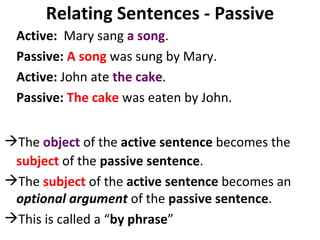
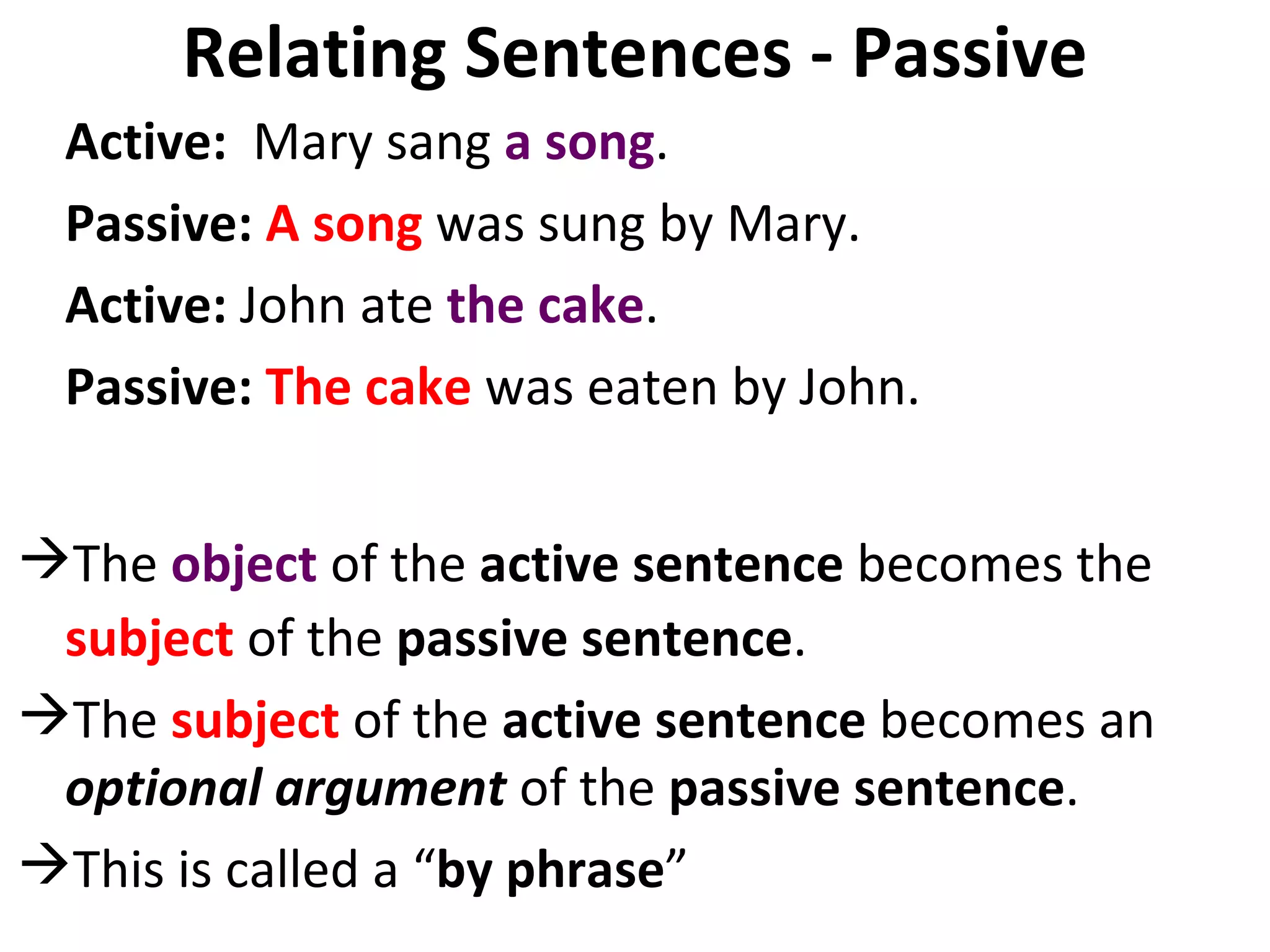
Relating Sentences - Passive Active:  Mary sang  a song .  Passive:   A song  was sung by Mary. Active:  John ate  the cake .  Passive:   The cake  was eaten by John.  The  object  of the  active sentence  becomes the  subject  of the  passive sentence .  The  subject  of the  active sentence  becomes an  optional argument  of the  passive sentence .  This is called a “ by phrase ”
How do you passivize a sentence? I. First,  only transitive verbs  can be passivized!  II. Take the  object  and make it the  subject . III. The  subject  is followed by the  auxiliary  “ be ”.  IV. The  verb  in its  Past Participle Form  follows “ be ”.  Example:   John   ate   a banana .   I. “ eat ” is a transitive verb! So we may proceed.  II.  Object  becomes  subject : “ A banana …  ” III. Add the  auxiliary  “ be ”: “ A banana   was … ” IV. Add the  verb  in its  Past Participle Form :  A banana   was   eaten .
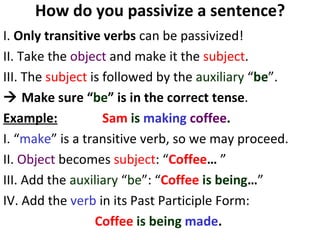
How do you passivize a sentence? I.  Only transitive verbs  can be passivized!  II. Take the  object  and make it the  subject . III. The  subject  is followed by the  auxiliary  “ be ”.     Make sure “ be ” is in the correct tense .  Example:   Sam   is  making   coffee .   I. “ make ” is a transitive verb, so we may proceed.  II.  Object  becomes  subject : “ Coffee …  ” III. Add the  auxiliary  “ be ”: “ Coffee   is being … ” IV. Add the  verb  in its Past Participle Form:  Coffee   is being   made .
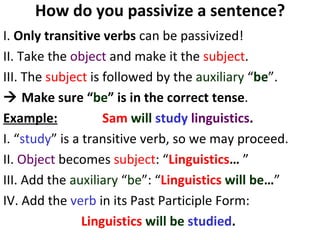
How do you passivize a sentence? I.  Only transitive verbs  can be passivized!  II. Take the  object  and make it the  subject . III. The  subject  is followed by the  auxiliary  “ be ”.     Make sure “ be ” is in the correct tense .  Example:   Sam   will  study   linguistics .   I. “ study ” is a transitive verb, so we may proceed.  II.  Object  becomes  subject : “ Linguistics …  ” III. Add the  auxiliary  “ be ”: “ Linguistics   will be … ” IV. Add the  verb  in its Past Participle Form:  Linguistics   will be   studied .
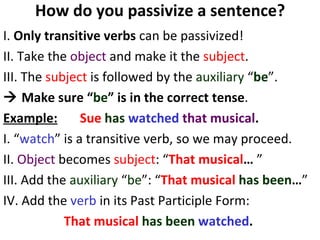
How do you passivize a sentence? I.  Only transitive verbs  can be passivized!  II. Take the  object  and make it the  subject . III. The  subject  is followed by the  auxiliary  “ be ”.     Make sure “ be ” is in the correct tense .  Example:   Sue   has  watched   that musical .   I. “ watch ” is a transitive verb, so we may proceed.  II.  Object  becomes  subject : “ That musical …  ” III. Add the  auxiliary  “ be ”: “ That musical   has been … ” IV. Add the  verb  in its Past Participle Form:  That musical   has been   watched .
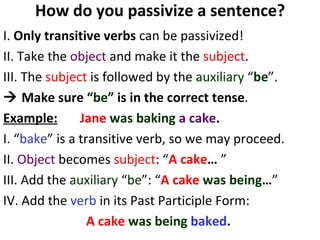
How do you passivize a sentence? I.  Only transitive verbs  can be passivized!  II. Take the  object  and make it the  subject . III. The  subject  is followed by the  auxiliary  “ be ”.     Make sure “ be ” is in the correct tense .  Example:   Jane   was baking  a cake .   I. “ bake ” is a transitive verb, so we may proceed.  II.  Object  becomes  subject : “ A cake …  ” III. Add the  auxiliary  “ be ”: “ A cake   was being … ” IV. Add the  verb  in its Past Participle Form:  A cake   was being  baked .
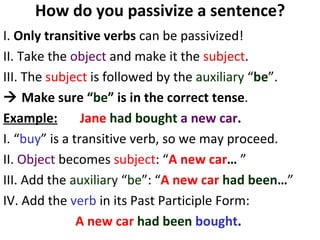
How do you passivize a sentence? I.  Only transitive verbs  can be passivized!  II. Take the  object  and make it the  subject . III. The  subject  is followed by the  auxiliary  “ be ”.     Make sure “ be ” is in the correct tense .  Example:   Jane   had bought  a new car .   I. “ buy ” is a transitive verb, so we may proceed.  II.  Object  becomes  subject : “ A new car …  ” III. Add the  auxiliary  “ be ”: “ A new car   had been … ” IV. Add the  verb  in its Past Participle Form:  A new car   had been  bought .
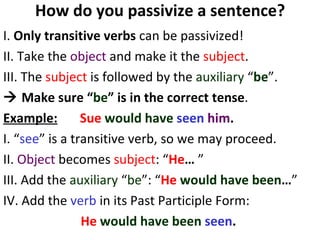
How do you passivize a sentence? I.  Only transitive verbs  can be passivized!  II. Take the  object  and make it the  subject . III. The  subject  is followed by the  auxiliary  “ be ”.     Make sure “ be ” is in the correct tense .  Example:   Sue   would have  seen   him .   I. “ see ” is a transitive verb, so we may proceed.  II.  Object  becomes  subject : “ He …  ” III. Add the  auxiliary  “ be ”: “ He   would   have been … ” IV. Add the  verb  in its Past Participle Form:  He   would   have been  seen .
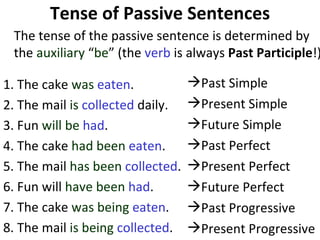
Tense of Passive Sentences The tense of the passive sentence is determined by the  auxiliary  “ be ” (the  verb  is always  Past Participle !) 1. The cake  was   eaten .  2. The mail  is   collected  daily.  3. Fun  will   be   had .  4. The cake  had   been   eaten .  5. The mail  has   been   collected .  6. Fun will  have   been   had .  7. The cake  was   being   eaten .  8. The mail  is   being   collected . Past Simple Present Simple Future Simple Past Perfect Present Perfect Future Perfect Past Progressive Present Progressive
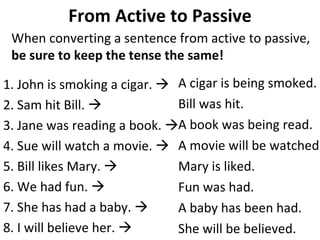
From Active to Passive When converting a sentence from active to passive,  be sure to keep the tense the same!   1. John is smoking a cigar.     2. Sam hit Bill.   3. Jane was reading a book.     4. Sue will watch a movie.     5. Bill likes Mary.     6. We had fun.     7. She has had a baby.     8. I will believe her.     A cigar is being smoked.  Bill was hit.  A book was being read. A movie will be watched. Mary is liked.  Fun was had.  A baby has been had.  She will be believed.
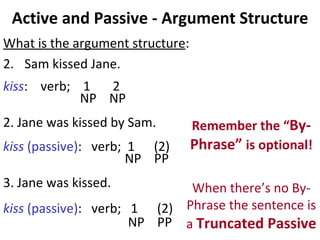
Active and Passive - Argument Structure What is the argument structure :  Sam kissed Jane.  kiss :  verb;  1  2   NP  NP 2. Jane was kissed by Sam.  kiss  (passive) :  verb;  1  (2) NP  PP 3. Jane was kissed.  kiss  (passive) :  verb;  1  (2)   NP  PP Remember the “ By- Phrase”  is optional! When there’s no By-Phrase the sentence is a  Truncated Passive
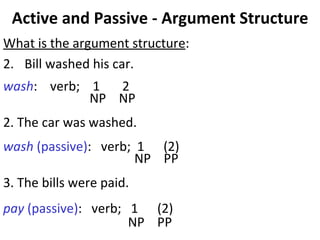
Active and Passive - Argument Structure What is the argument structure :  Bill washed his car.  wash :  verb;  1  2   NP  NP 2. The car was washed.  wash  (passive) :  verb;  1  (2) NP  PP 3. The bills were paid.  pay  (passive) :  verb;  1  (2)   NP  PP
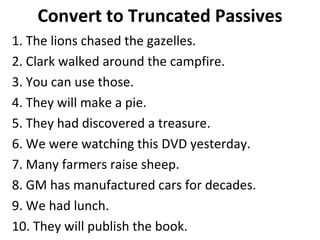
Convert to Truncated Passives 1. The lions chased the gazelles. 2. Clark walked around the campfire. 3. You can use those. 4. They will make a pie. 5. They had discovered a treasure. 6. We were watching this DVD yesterday.  7. Many farmers raise sheep. 8. GM has manufactured cars for decades.  9. We had lunch.  10. They will publish the book.
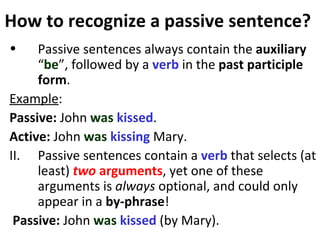
How to recognize a passive sentence?  Passive sentences always contain the  auxiliary  “ be ”, followed by a  verb  in the  past participle form .  Example : Passive:  John  was   kissed .  Active:  John  was   kissing  Mary. II.  Passive sentences contain a  verb  that selects (at least)  two   arguments , yet one of these arguments is  always  optional, and could only appear in a  by-phrase ! Passive:  John  was   kissed  (by Mary).
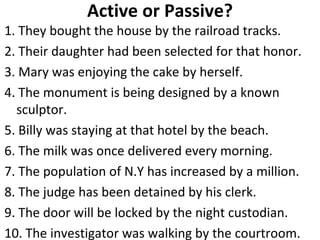
Active or Passive? 1. They bought the house by the railroad tracks. 2. Their daughter had been selected for that honor. 3. Mary was enjoying the cake by herself. 4. The monument is being designed by a known sculptor. 5. Billy was staying at that hotel by the beach. 6. The milk was once delivered every morning. 7. The population of N.Y has increased by a million. 8. The judge has been detained by his clerk. 9. The door will be locked by the night custodian. 10. The investigator was walking by the courtroom.
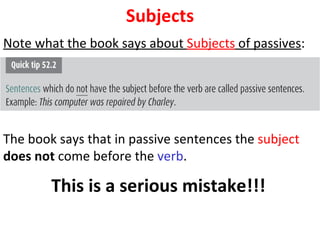
Subjects Note what the book says about  Subjects  of passives :  The book says that in passive sentences the  subject   does not  come before the  verb . This is a serious mistake!!!
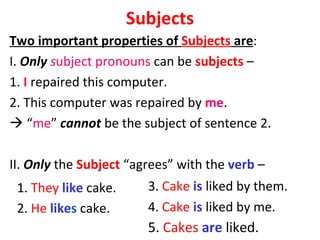
Subjects Two important properties of  Subjects  are :  I.  Only  s ubject pronouns  can be  subjects  –  1.  I  repaired this computer.  2. This computer was repaired by  me .    “ me ”  cannot  be the subject of sentence 2.  II.  Only  the  Subject  “agrees” with the  verb  –  1.  They   like  cake.  2.  He   like s  cake. 3.  Cake   is  liked by them.  4.  Cake   is  liked by me.  5.  Cakes   are  liked.
Homework Read and do all the exercises of lesson 52    Watch out for quick-tip 52.2
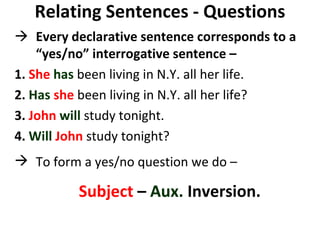
Relating Sentences - Questions    Every declarative sentence corresponds to a “yes/no” interrogative sentence –  1.  She   has  been living in N.Y. all her life.  2.  Has   she  been living in N.Y. all her life?  3.  John   will  study tonight.  4.  Will   John  study tonight? To form a yes/no question we do –  Subject  –  Aux.  Inversion.
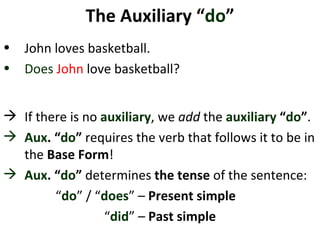
The Auxiliary “ do ” John loves basketball.  Does   John  love basketball?  If there is no  auxiliary , we  add  the  auxiliary  “ do ” .  Aux . “ do ”  requires the verb that follows it to be in the  Base Form !  Aux . “ do ”  determines  the tense  of the sentence: “ do ” / “ does ” –  Present simple  “ did ” –  Past   simple
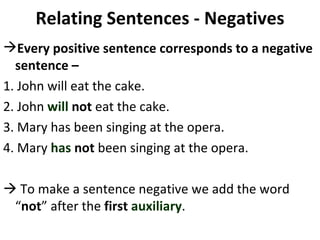
Relating Sentences - Negatives Every positive sentence corresponds to a negative sentence –  1. John will eat the cake.  2. John  will   not  eat the cake.  3. Mary has been singing at the opera.  4. Mary  has   not  been singing at the opera.   To make a sentence negative we add the word “ not ” after the  first  auxiliary .
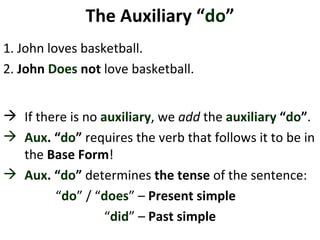
The Auxiliary “ do ” 1. John loves basketball.  2.   John  Does   not  love basketball. If there is no  auxiliary , we  add  the  auxiliary  “ do ” .  Aux . “ do ”  requires the verb that follows it to be in the  Base Form !  Aux . “ do ”  determines  the tense  of the sentence: “ do ” / “ does ” –  Present simple  “ did ” –  Past   simple
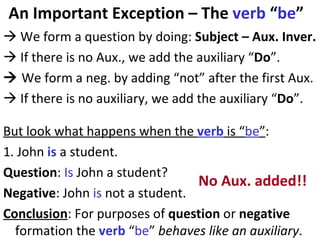
An Important Exception – The  verb  “ be ”    We form a question by doing:  Subject – Aux. Inver.     If there is no Aux., we add the auxiliary “ Do ”.    We form a neg. by adding “not” after the first Aux.    If there is no auxiliary, we add the auxiliary “ Do ”. But look what happens when the  verb  is “ be ” :  1. John  is  a student.  Question :  Is  John a student?  Negative : John  is  not a student.  Conclusion : For purposes of  question  or  negative  formation the  verb  “ be ”  behaves like an auxiliary .  No Aux. added!!
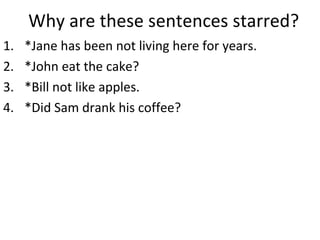
Why are these sentences starred? *Jane has been not living here for years.  *John eat the cake? *Bill not like apples.  *Did Sam drank his coffee?
Homework Read lesson 51.  Read and do all the exercises of lesson 53.

Unit 17 relating sentences- negatives, questions, passive and active

  • 1.
    Relating Sentences -Passive Active: Mary sang a song . Passive: A song was sung by Mary. Active: John ate the cake . Passive: The cake was eaten by John. The object of the active sentence becomes the subject of the passive sentence . The subject of the active sentence becomes an optional argument of the passive sentence . This is called a “ by phrase ”
  • 2.
    How do youpassivize a sentence? I. First, only transitive verbs can be passivized! II. Take the object and make it the subject . III. The subject is followed by the auxiliary “ be ”. IV. The verb in its Past Participle Form follows “ be ”. Example: John ate a banana . I. “ eat ” is a transitive verb! So we may proceed. II. Object becomes subject : “ A banana … ” III. Add the auxiliary “ be ”: “ A banana was … ” IV. Add the verb in its Past Participle Form : A banana was eaten .
  • 3.
    How do youpassivize a sentence? I. Only transitive verbs can be passivized! II. Take the object and make it the subject . III. The subject is followed by the auxiliary “ be ”.  Make sure “ be ” is in the correct tense . Example: Sam is making coffee . I. “ make ” is a transitive verb, so we may proceed. II. Object becomes subject : “ Coffee … ” III. Add the auxiliary “ be ”: “ Coffee is being … ” IV. Add the verb in its Past Participle Form: Coffee is being made .
  • 4.
    How do youpassivize a sentence? I. Only transitive verbs can be passivized! II. Take the object and make it the subject . III. The subject is followed by the auxiliary “ be ”.  Make sure “ be ” is in the correct tense . Example: Sam will study linguistics . I. “ study ” is a transitive verb, so we may proceed. II. Object becomes subject : “ Linguistics … ” III. Add the auxiliary “ be ”: “ Linguistics will be … ” IV. Add the verb in its Past Participle Form: Linguistics will be studied .
  • 5.
    How do youpassivize a sentence? I. Only transitive verbs can be passivized! II. Take the object and make it the subject . III. The subject is followed by the auxiliary “ be ”.  Make sure “ be ” is in the correct tense . Example: Sue has watched that musical . I. “ watch ” is a transitive verb, so we may proceed. II. Object becomes subject : “ That musical … ” III. Add the auxiliary “ be ”: “ That musical has been … ” IV. Add the verb in its Past Participle Form: That musical has been watched .
  • 6.
    How do youpassivize a sentence? I. Only transitive verbs can be passivized! II. Take the object and make it the subject . III. The subject is followed by the auxiliary “ be ”.  Make sure “ be ” is in the correct tense . Example: Jane was baking a cake . I. “ bake ” is a transitive verb, so we may proceed. II. Object becomes subject : “ A cake … ” III. Add the auxiliary “ be ”: “ A cake was being … ” IV. Add the verb in its Past Participle Form: A cake was being baked .
  • 7.
    How do youpassivize a sentence? I. Only transitive verbs can be passivized! II. Take the object and make it the subject . III. The subject is followed by the auxiliary “ be ”.  Make sure “ be ” is in the correct tense . Example: Jane had bought a new car . I. “ buy ” is a transitive verb, so we may proceed. II. Object becomes subject : “ A new car … ” III. Add the auxiliary “ be ”: “ A new car had been … ” IV. Add the verb in its Past Participle Form: A new car had been bought .
  • 8.
    How do youpassivize a sentence? I. Only transitive verbs can be passivized! II. Take the object and make it the subject . III. The subject is followed by the auxiliary “ be ”.  Make sure “ be ” is in the correct tense . Example: Sue would have seen him . I. “ see ” is a transitive verb, so we may proceed. II. Object becomes subject : “ He … ” III. Add the auxiliary “ be ”: “ He would have been … ” IV. Add the verb in its Past Participle Form: He would have been seen .
  • 9.
    Tense of PassiveSentences The tense of the passive sentence is determined by the auxiliary “ be ” (the verb is always Past Participle !) 1. The cake was eaten . 2. The mail is collected daily. 3. Fun will be had . 4. The cake had been eaten . 5. The mail has been collected . 6. Fun will have been had . 7. The cake was being eaten . 8. The mail is being collected . Past Simple Present Simple Future Simple Past Perfect Present Perfect Future Perfect Past Progressive Present Progressive
  • 10.
    From Active toPassive When converting a sentence from active to passive, be sure to keep the tense the same! 1. John is smoking a cigar.  2. Sam hit Bill.  3. Jane was reading a book.  4. Sue will watch a movie.  5. Bill likes Mary.  6. We had fun.  7. She has had a baby.  8. I will believe her.  A cigar is being smoked. Bill was hit. A book was being read. A movie will be watched. Mary is liked. Fun was had. A baby has been had. She will be believed.
  • 11.
    Active and Passive- Argument Structure What is the argument structure : Sam kissed Jane. kiss : verb; 1 2 NP NP 2. Jane was kissed by Sam. kiss (passive) : verb; 1 (2) NP PP 3. Jane was kissed. kiss (passive) : verb; 1 (2) NP PP Remember the “ By- Phrase” is optional! When there’s no By-Phrase the sentence is a Truncated Passive
  • 12.
    Active and Passive- Argument Structure What is the argument structure : Bill washed his car. wash : verb; 1 2 NP NP 2. The car was washed. wash (passive) : verb; 1 (2) NP PP 3. The bills were paid. pay (passive) : verb; 1 (2) NP PP
  • 13.
    Convert to TruncatedPassives 1. The lions chased the gazelles. 2. Clark walked around the campfire. 3. You can use those. 4. They will make a pie. 5. They had discovered a treasure. 6. We were watching this DVD yesterday. 7. Many farmers raise sheep. 8. GM has manufactured cars for decades. 9. We had lunch. 10. They will publish the book.
  • 14.
    How to recognizea passive sentence? Passive sentences always contain the auxiliary “ be ”, followed by a verb in the past participle form . Example : Passive: John was kissed . Active: John was kissing Mary. II. Passive sentences contain a verb that selects (at least) two arguments , yet one of these arguments is always optional, and could only appear in a by-phrase ! Passive: John was kissed (by Mary).
  • 15.
    Active or Passive?1. They bought the house by the railroad tracks. 2. Their daughter had been selected for that honor. 3. Mary was enjoying the cake by herself. 4. The monument is being designed by a known sculptor. 5. Billy was staying at that hotel by the beach. 6. The milk was once delivered every morning. 7. The population of N.Y has increased by a million. 8. The judge has been detained by his clerk. 9. The door will be locked by the night custodian. 10. The investigator was walking by the courtroom.
  • 16.
    Subjects Note whatthe book says about Subjects of passives : The book says that in passive sentences the subject does not come before the verb . This is a serious mistake!!!
  • 17.
    Subjects Two importantproperties of Subjects are : I. Only s ubject pronouns can be subjects – 1. I repaired this computer. 2. This computer was repaired by me .  “ me ” cannot be the subject of sentence 2. II. Only the Subject “agrees” with the verb – 1. They like cake. 2. He like s cake. 3. Cake is liked by them. 4. Cake is liked by me. 5. Cakes are liked.
  • 18.
    Homework Read anddo all the exercises of lesson 52  Watch out for quick-tip 52.2
  • 19.
    Relating Sentences -Questions  Every declarative sentence corresponds to a “yes/no” interrogative sentence – 1. She has been living in N.Y. all her life. 2. Has she been living in N.Y. all her life? 3. John will study tonight. 4. Will John study tonight? To form a yes/no question we do – Subject – Aux. Inversion.
  • 20.
    The Auxiliary “do ” John loves basketball. Does John love basketball? If there is no auxiliary , we add the auxiliary “ do ” . Aux . “ do ” requires the verb that follows it to be in the Base Form ! Aux . “ do ” determines the tense of the sentence: “ do ” / “ does ” – Present simple “ did ” – Past simple
  • 21.
    Relating Sentences -Negatives Every positive sentence corresponds to a negative sentence – 1. John will eat the cake. 2. John will not eat the cake. 3. Mary has been singing at the opera. 4. Mary has not been singing at the opera.  To make a sentence negative we add the word “ not ” after the first auxiliary .
  • 22.
    The Auxiliary “do ” 1. John loves basketball. 2. John Does not love basketball. If there is no auxiliary , we add the auxiliary “ do ” . Aux . “ do ” requires the verb that follows it to be in the Base Form ! Aux . “ do ” determines the tense of the sentence: “ do ” / “ does ” – Present simple “ did ” – Past simple
  • 23.
    An Important Exception– The verb “ be ”  We form a question by doing: Subject – Aux. Inver.  If there is no Aux., we add the auxiliary “ Do ”.  We form a neg. by adding “not” after the first Aux.  If there is no auxiliary, we add the auxiliary “ Do ”. But look what happens when the verb is “ be ” : 1. John is a student. Question : Is John a student? Negative : John is not a student. Conclusion : For purposes of question or negative formation the verb “ be ” behaves like an auxiliary . No Aux. added!!
  • 24.
    Why are thesesentences starred? *Jane has been not living here for years. *John eat the cake? *Bill not like apples. *Did Sam drank his coffee?
  • 25.
    Homework Read lesson51. Read and do all the exercises of lesson 53.