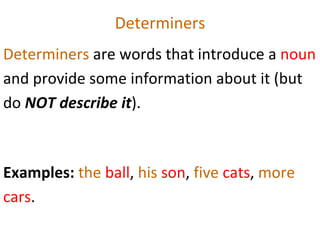
Determiners Determiners  are words that introduce a  noun  and provide some information about it (but do  NOT describe it ).  Examples:  the  ball ,  his  son ,  five  cats ,  more  cars .
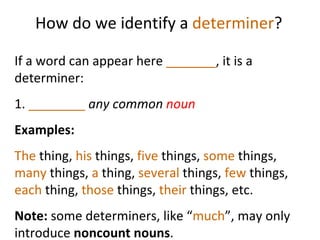
How do we identify a  determiner ? If a word can appear here  _______ , it is a determiner:  1.  ________   any common  noun Examples:  The  thing,  his  things,  five  things,  some  things,  many  things,  a  thing,  several  things,  few  things,  each  thing,  those  things,  their  things, etc.  Note:  some determiners, like   “ much ”, may only introduce  noncount nouns .
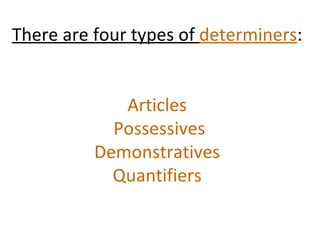
There are four types of  determiners :  Articles     Possessives     Demonstratives   Quantifiers
Articles There are only three articles in English:  The ,  a ,  an
“ the ” is called the  Definite Article :  It  normally  introduces a noun that is familiar to the listener.  Example:  The  earth is round.  “ the ” may introduce either a  singular  or a  plural  noun.  “ a ” or “ an ” are called the  Indefinite Article : “ a ” or “ an ” normally introduce a noun that is not yet familiar to the listener.  Example:  I saw  a  new movie.  “ a ” or “ an ” may only introduce a  singular  noun.
What is the difference between “ a ” and “ an ”? “ a ” precedes words that start with a  consonant sound . Examples:  a  table,  a  chair,  and also…  a  eulogy  “ an ” precedes words that start with a  vowel sound .  Examples:  an  apple,  an  umbrella, and also…  an  hour
Demonstratives  Demonstratives  are words that are used to  point  at someone or something (whether it’s concrete or abstract).  Examples:  that  book;  this  time;  these  ideas;  those  chairs There are only four  demonstratives  in English:
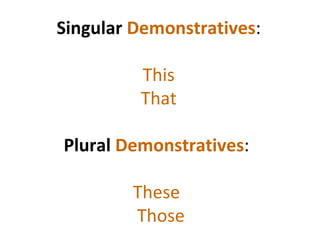
Singular  Demonstratives :   This   That   Plural  Demonstratives :  These     Those
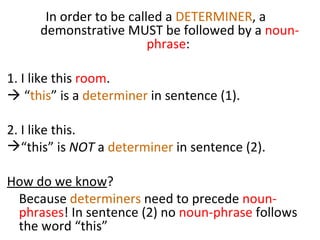
In order to be called a  DETERMINER , a  demonstrative MUST be followed by a  noun-phrase :  1. I like this  room .    “ this ” is a  determiner  in sentence (1).  2. I like this.  “this” is  NOT  a  determiner  in sentence (2). How do we know ?  Because  determiners  need to precede  noun-phrases ! In sentence (2) no  noun-phrase  follows  the word “this”
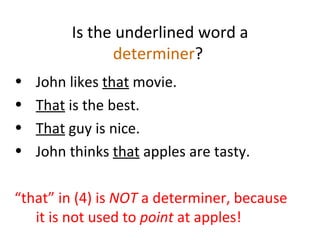
Is the underlined word a  determiner ?  John likes  that  movie.  That  is the best. That  guy is nice.  John thinks  that  apples are tasty.  “ that” in (4) is  NOT  a determiner, because it is not used to  point  at apples!
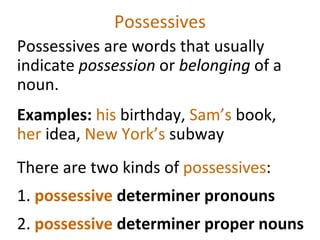
Possessives Possessives are words that usually indicate  possession  or  belonging  of a noun.  Examples:  his  birthday,  Sam’s  book,  her  idea,  New York’s  subway  There are two kinds of  possessives :  1.  possessive  determiner pronouns 2.  possessive  determiner proper nouns
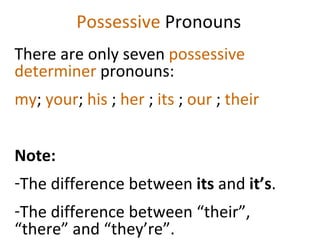
Possessive  Pronouns There are only seven  possessive determiner  pronouns:  my ;  your ;  his  ;  her  ;  its  ;  our  ;  their Note:  The difference between  its  and  it’s . The difference between “their”, “there” and “they’re”.
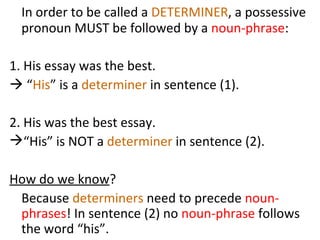
In order to be called a  DETERMINER , a possessive pronoun MUST be followed by a  noun-phrase :  1. His essay was the best.    “ His ” is a  determiner  in sentence (1).  2. His was the best essay.  “His” is NOT a  determiner  in sentence (2). How do we know ?  Because  determiners  need to precede  noun-phrases ! In sentence (2) no  noun-phrase  follows the word “his”.
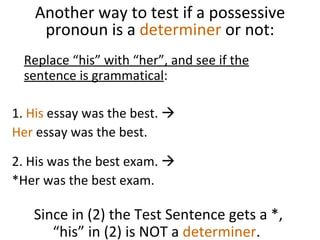
Another way to test if a possessive pronoun is a  determiner  or not: Replace “his” with “her”, and see if the sentence is grammatical :  1.  His  essay was the best.     Her  essay was the best.  2. His was the best exam.   *Her was the best exam.  Since in (2) the Test Sentence gets a *, “his” in (2) is NOT a  determiner .
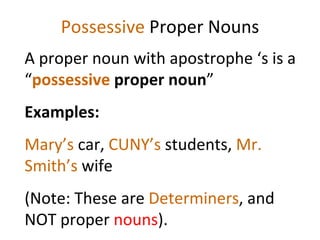
Possessive  Proper Nouns A proper noun with apostrophe ‘s is a “ possessive  proper noun ”  Examples:  Mary’s  car,  CUNY’s  students,  Mr. Smith’s  wife  (Note: These are  Determiners , and NOT proper  nouns ).
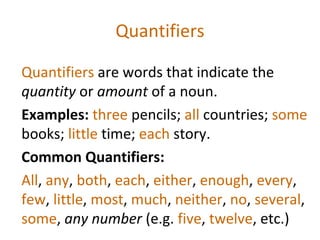
Quantifiers Quantifiers  are words that indicate the  quantity  or  amount  of a noun.  Examples:  three  pencils;  all  countries;  some  books;  little  time;  each  story. Common Quantifiers:  All ,  any ,  both ,  each ,  either ,  enough ,  every ,  few ,  little ,  most ,  much ,  neither ,  no ,  several ,  some ,  any number  (e.g.  five ,  twelve , etc.)
To conclude The  Determiners  are:  Articles  Demonstratives Possessives  Quantifiers
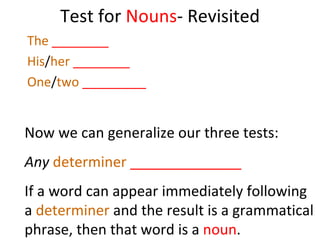
Test for  Nouns - Revisited The   ________ His / her   ________ One / two   _________ Now we can generalize our three tests:  Any   determiner   ______________ If a word can appear immediately following a  determiner  and the result is a grammatical phrase, then that word is a  noun .
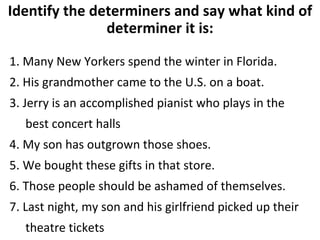
Identify the determiners and say what kind of determiner it is: 1. Many New Yorkers spend the winter in Florida.  2. His grandmother came to the U.S. on a boat. 3. Jerry is an accomplished pianist who plays in the best concert halls  4. My son has outgrown those shoes. 5. We bought these gifts in that store. 6. Those people should be ashamed of themselves.  7. Last night, my son and his girlfriend picked up their theatre tickets
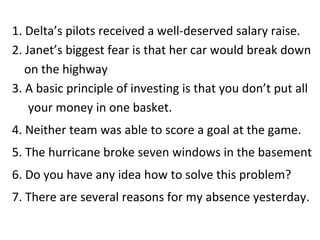
1. Delta’s pilots received a well-deserved salary raise. 2. Janet’s biggest fear is that her car would break down  on the highway  3. A basic principle of investing is that you don’t put all your money in one basket. 4. Neither team was able to score a goal at the game. 5. The hurricane broke seven windows in the basement 6. Do you have any idea how to solve this problem?  7. There are several reasons for my absence yesterday.
Homework ALL the exercises of unit 3 – Determiners.

Unit 3 determiners

  • 1.
    Determiners Determiners are words that introduce a noun and provide some information about it (but do NOT describe it ). Examples: the ball , his son , five cats , more cars .
  • 2.
    How do weidentify a determiner ? If a word can appear here _______ , it is a determiner: 1. ________ any common noun Examples: The thing, his things, five things, some things, many things, a thing, several things, few things, each thing, those things, their things, etc. Note: some determiners, like “ much ”, may only introduce noncount nouns .
  • 3.
    There are fourtypes of determiners : Articles Possessives Demonstratives Quantifiers
  • 4.
    Articles There areonly three articles in English: The , a , an
  • 5.
    “ the ”is called the Definite Article : It normally introduces a noun that is familiar to the listener. Example: The earth is round. “ the ” may introduce either a singular or a plural noun. “ a ” or “ an ” are called the Indefinite Article : “ a ” or “ an ” normally introduce a noun that is not yet familiar to the listener. Example: I saw a new movie. “ a ” or “ an ” may only introduce a singular noun.
  • 6.
    What is thedifference between “ a ” and “ an ”? “ a ” precedes words that start with a consonant sound . Examples: a table, a chair, and also… a eulogy “ an ” precedes words that start with a vowel sound . Examples: an apple, an umbrella, and also… an hour
  • 7.
    Demonstratives Demonstratives are words that are used to point at someone or something (whether it’s concrete or abstract). Examples: that book; this time; these ideas; those chairs There are only four demonstratives in English:
  • 8.
    Singular Demonstratives: This That Plural Demonstratives : These Those
  • 9.
    In order tobe called a DETERMINER , a demonstrative MUST be followed by a noun-phrase : 1. I like this room .  “ this ” is a determiner in sentence (1). 2. I like this. “this” is NOT a determiner in sentence (2). How do we know ? Because determiners need to precede noun-phrases ! In sentence (2) no noun-phrase follows the word “this”
  • 10.
    Is the underlinedword a determiner ? John likes that movie. That is the best. That guy is nice. John thinks that apples are tasty. “ that” in (4) is NOT a determiner, because it is not used to point at apples!
  • 11.
    Possessives Possessives arewords that usually indicate possession or belonging of a noun. Examples: his birthday, Sam’s book, her idea, New York’s subway There are two kinds of possessives : 1. possessive determiner pronouns 2. possessive determiner proper nouns
  • 12.
    Possessive PronounsThere are only seven possessive determiner pronouns: my ; your ; his ; her ; its ; our ; their Note: The difference between its and it’s . The difference between “their”, “there” and “they’re”.
  • 13.
    In order tobe called a DETERMINER , a possessive pronoun MUST be followed by a noun-phrase : 1. His essay was the best.  “ His ” is a determiner in sentence (1). 2. His was the best essay. “His” is NOT a determiner in sentence (2). How do we know ? Because determiners need to precede noun-phrases ! In sentence (2) no noun-phrase follows the word “his”.
  • 14.
    Another way totest if a possessive pronoun is a determiner or not: Replace “his” with “her”, and see if the sentence is grammatical : 1. His essay was the best.  Her essay was the best. 2. His was the best exam.  *Her was the best exam. Since in (2) the Test Sentence gets a *, “his” in (2) is NOT a determiner .
  • 15.
    Possessive ProperNouns A proper noun with apostrophe ‘s is a “ possessive proper noun ” Examples: Mary’s car, CUNY’s students, Mr. Smith’s wife (Note: These are Determiners , and NOT proper nouns ).
  • 16.
    Quantifiers Quantifiers are words that indicate the quantity or amount of a noun. Examples: three pencils; all countries; some books; little time; each story. Common Quantifiers: All , any , both , each , either , enough , every , few , little , most , much , neither , no , several , some , any number (e.g. five , twelve , etc.)
  • 17.
    To conclude The Determiners are: Articles Demonstratives Possessives Quantifiers
  • 18.
    Test for Nouns - Revisited The ________ His / her ________ One / two _________ Now we can generalize our three tests: Any determiner ______________ If a word can appear immediately following a determiner and the result is a grammatical phrase, then that word is a noun .
  • 19.
    Identify the determinersand say what kind of determiner it is: 1. Many New Yorkers spend the winter in Florida. 2. His grandmother came to the U.S. on a boat. 3. Jerry is an accomplished pianist who plays in the best concert halls 4. My son has outgrown those shoes. 5. We bought these gifts in that store. 6. Those people should be ashamed of themselves. 7. Last night, my son and his girlfriend picked up their theatre tickets
  • 20.
    1. Delta’s pilotsreceived a well-deserved salary raise. 2. Janet’s biggest fear is that her car would break down on the highway 3. A basic principle of investing is that you don’t put all your money in one basket. 4. Neither team was able to score a goal at the game. 5. The hurricane broke seven windows in the basement 6. Do you have any idea how to solve this problem? 7. There are several reasons for my absence yesterday.
  • 21.
    Homework ALL theexercises of unit 3 – Determiners.