Dependent or independent – that is the question…  PART ONE:  Joining Independent Clauses
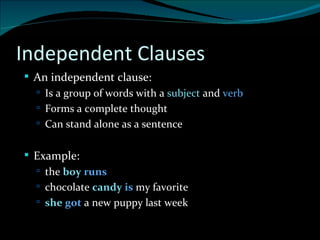
Independent Clauses An independent clause: Is a group of words with a  subject  and  verb Forms a complete thought Can stand alone as a sentence Example: the  boy   runs chocolate  candy   is  my favorite she   got  a new puppy last week
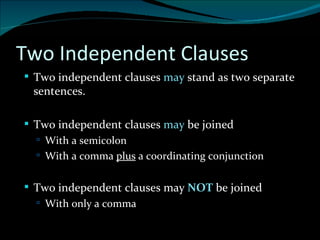
Two Independent Clauses Two independent clauses  may  stand as two separate sentences. Two independent clauses  may  be joined With a semicolon With a comma  plus  a coordinating conjunction Two independent clauses may  NOT  be joined With only a comma
Stand Alone Two independent clauses  may  stand as two separate sentences. Example: I   was  hungry.  I   ate  some pizza. Both clauses have a  subject  and a  verb .  They both form a complete thought.  Each clause may stand as a separate sentence.
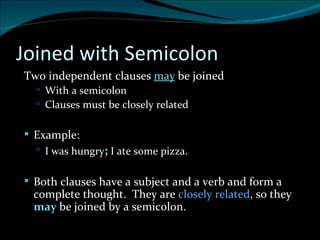
Joined with Semicolon Two independent clauses  may  be joined With a semicolon Clauses must be closely related Example: I was hungry ;  I ate some pizza. Both clauses have a subject and a verb and form a complete thought.  They are  closely related , so they  may  be joined by a semicolon.
Coordinating Conjunctions Two independent clauses may be joined: With a comma  plus  a  coordinating conjunction MEMORIZE And But For Or Nor So Yet
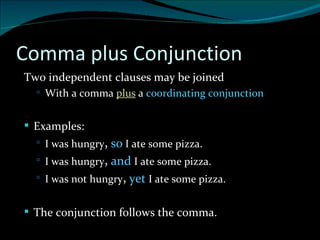
Comma plus Conjunction Two independent clauses may be joined With a comma  plus   a  coordinating conjunction Examples: I was hungry ,   so  I ate some pizza. I was hungry ,   and   I ate some pizza. I was not hungry ,   yet   I ate some pizza.  The conjunction follows the comma.
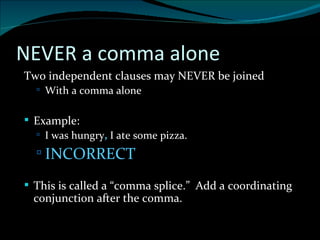
NEVER a comma alone Two independent clauses may NEVER be joined With a comma alone Example: I was hungry ,  I ate some pizza. INCORRECT This is called a “comma splice.”  Add a coordinating conjunction after the comma.
Is this correct? It rained all day, Judy could not go play outside.
It rained all day, Judy could not go play outside. Answer: Two independent clauses may NOT be joined by a comma alone.
Is this correct? The rain soon disappeared, for the sun had returned.
Answer: The rain soon disappeared, for the sun had returned. Two independent clauses MAY be joined with a  comma  PLUS a  coordinating conjunction.
Is this correct? Everyone loves Sam; he is always smiling.
Answer: Everyone loves Sam; he is always smiling. Two independent clauses MAY be joined with a  comma  PLUS a  coordinating conjunction.
Summary An independent clause is a group of words that form a complete thought and can stand alone as a complete sentence. You may join two independent clauses in these ways: Use a period between them to allow them to stand as two separate sentences. Use a comma followed by a coordinating conjunction. Use a semicolon. You may NOT use a comma alone when joining two independent clauses.

Joining Independent Clauses

  • 1.
    Dependent or independent– that is the question… PART ONE: Joining Independent Clauses
  • 2.
    Independent Clauses Anindependent clause: Is a group of words with a subject and verb Forms a complete thought Can stand alone as a sentence Example: the boy runs chocolate candy is my favorite she got a new puppy last week
  • 3.
    Two Independent ClausesTwo independent clauses may stand as two separate sentences. Two independent clauses may be joined With a semicolon With a comma plus a coordinating conjunction Two independent clauses may NOT be joined With only a comma
  • 4.
    Stand Alone Twoindependent clauses may stand as two separate sentences. Example: I was hungry. I ate some pizza. Both clauses have a subject and a verb . They both form a complete thought. Each clause may stand as a separate sentence.
  • 5.
    Joined with SemicolonTwo independent clauses may be joined With a semicolon Clauses must be closely related Example: I was hungry ; I ate some pizza. Both clauses have a subject and a verb and form a complete thought. They are closely related , so they may be joined by a semicolon.
  • 6.
    Coordinating Conjunctions Twoindependent clauses may be joined: With a comma plus a coordinating conjunction MEMORIZE And But For Or Nor So Yet
  • 7.
    Comma plus ConjunctionTwo independent clauses may be joined With a comma plus a coordinating conjunction Examples: I was hungry , so I ate some pizza. I was hungry , and I ate some pizza. I was not hungry , yet I ate some pizza. The conjunction follows the comma.
  • 8.
    NEVER a commaalone Two independent clauses may NEVER be joined With a comma alone Example: I was hungry , I ate some pizza. INCORRECT This is called a “comma splice.” Add a coordinating conjunction after the comma.
  • 9.
    Is this correct?It rained all day, Judy could not go play outside.
  • 10.
    It rained allday, Judy could not go play outside. Answer: Two independent clauses may NOT be joined by a comma alone.
  • 11.
    Is this correct?The rain soon disappeared, for the sun had returned.
  • 12.
    Answer: The rainsoon disappeared, for the sun had returned. Two independent clauses MAY be joined with a comma PLUS a coordinating conjunction.
  • 13.
    Is this correct?Everyone loves Sam; he is always smiling.
  • 14.
    Answer: Everyone lovesSam; he is always smiling. Two independent clauses MAY be joined with a comma PLUS a coordinating conjunction.
  • 15.
    Summary An independentclause is a group of words that form a complete thought and can stand alone as a complete sentence. You may join two independent clauses in these ways: Use a period between them to allow them to stand as two separate sentences. Use a comma followed by a coordinating conjunction. Use a semicolon. You may NOT use a comma alone when joining two independent clauses.