Simple Future Tense
Simple Future Tense
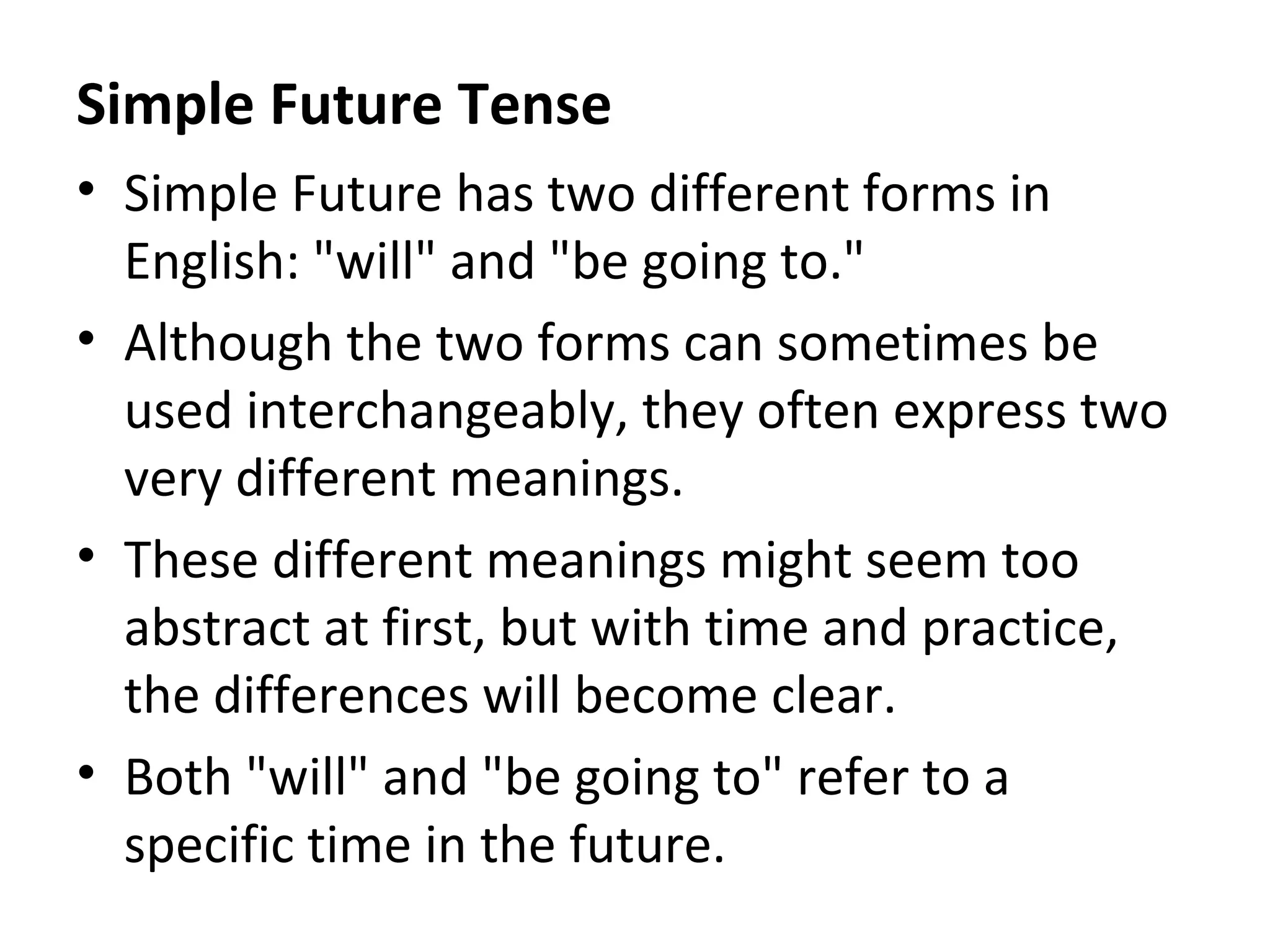
• Simple Future has two different forms in
English: "will" and "be going to."
• Although the two forms can sometimes be
used interchangeably, they often express two
very different meanings.
• These different meanings might seem too
abstract at first, but with time and practice,
the differences will become clear.
• Both "will" and "be going to" refer to a
specific time in the future.
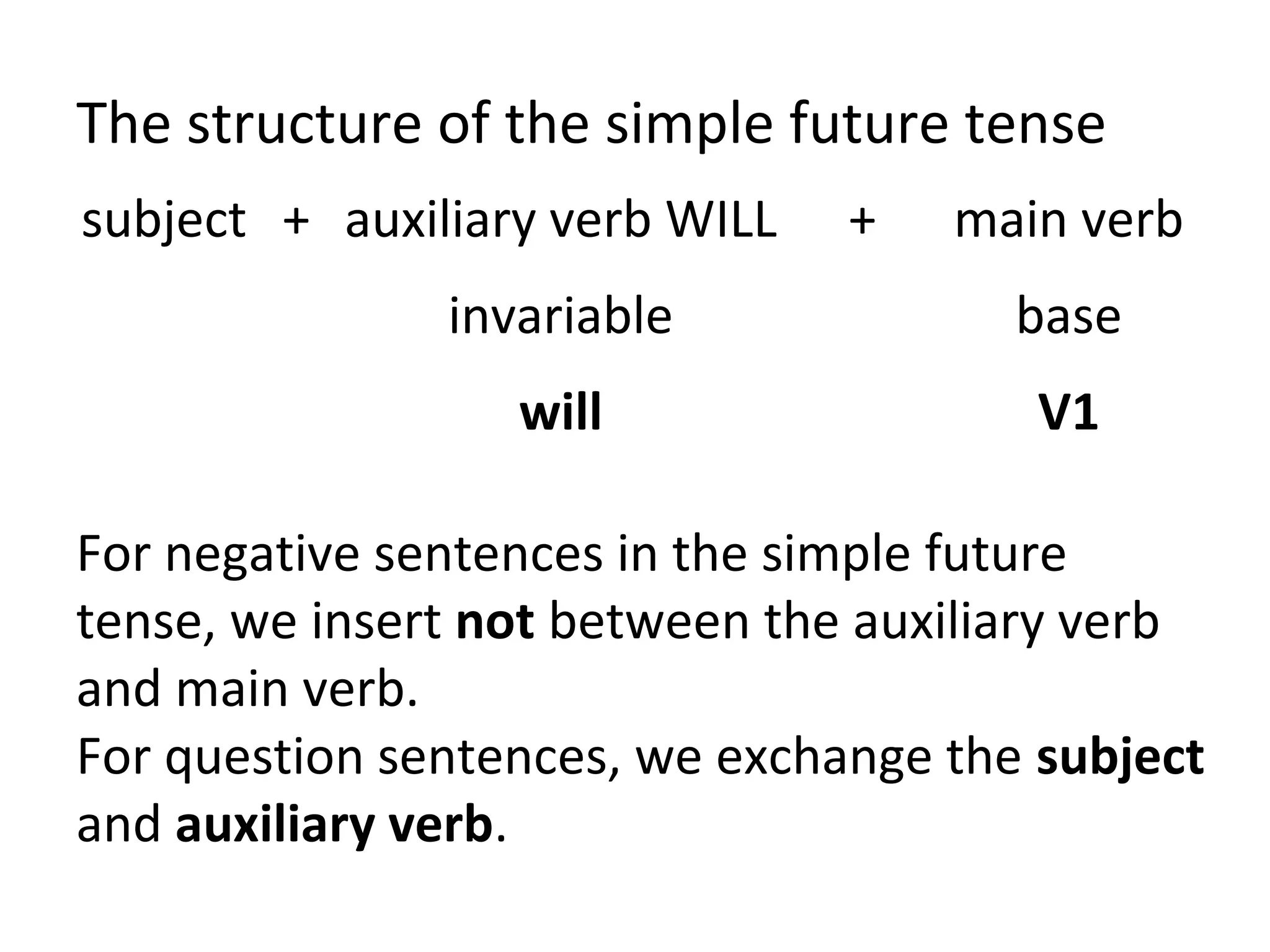
The structure of the simple future tense
subject + auxiliary verb WILL

+

main verb

invariable

base

will

V1

For negative sentences in the simple future
tense, we insert not between the auxiliary verb
and main verb.
For question sentences, we exchange the subject
and auxiliary verb.
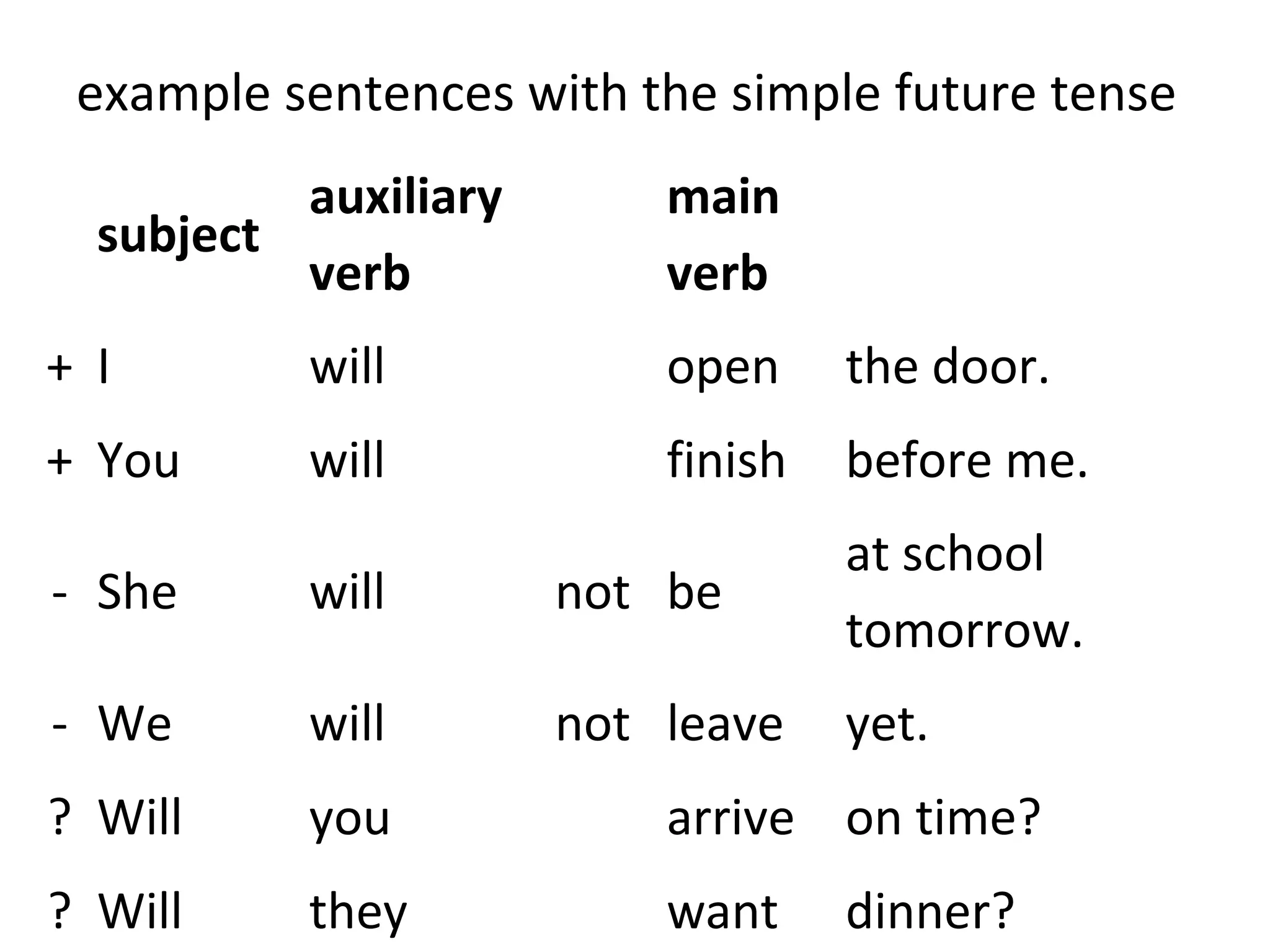
example sentences with the simple future tense
auxiliary
subject
verb

main
verb

+ I

will

open

the door.

+ You

will

finish

before me.

- She

will

not be

at school
tomorrow.

- We

will

not leave

yet.

? Will

you

arrive on time?

? Will

they

want

dinner?
contract the subject and auxiliary verb
Positive

Negative

I will

I'll

I will

I'll

you will

you'll

you will

you'll

he will
she will
it will

he'll
she'll
it'll

he will
she will
it will

he'll
she'll
it'll

we will

we'll

we will

we'll

they will

they'll

they will

they'll
Be Going To
Form

[am/is/are + going to + verb]
Examples:
• You are going to meet Jane tonight.
• Are you going to meet Jane tonight?
• You are not going to meet Jane tonight.
USE 1 : "Will" to Express a Voluntary
Action
• "Will" often suggests that a speaker will do
something voluntarily. A voluntary action is
one the speaker offers to do for someone
else.
• Often, we use "will" to respond to someone
else's complaint or request for help.
• We also use "will" when we request that
someone help us or volunteer to do
something for us. Similarly, we use "will not"
or "won't" when we refuse to voluntarily do
Examples:
•
•
•
•
•
•
•

I will send you the information when I get it.
I will translate the email, so Mr. Smith can read it.
Will you help me move this heavy table?
Will you make dinner?
I will not do your homework for you.
I won't do all the housework myself!
A: I'm really hungry.
B: I'll make some sandwiches.
• A: I'm so tired. I'm about to fall asleep.
B: I'll get you some coffee.
• A: The phone is ringing.
B: I'll get it.
USE 2 : "Will" to Express a Promise
"Will" is usually used in promises.
Examples:
• I will call you when I arrive.
• If I am elected President of the United States, I
will make sure everyone has access to
inexpensive health insurance.
• I promise I will not tell him about the surprise
party.
• Don't worry, I'll be careful.
• I won't tell anyone your secret.
USE 3 "Be going to" to Express a Plan
• "Be going to" expresses that something is a
plan.
• It expresses the idea that a person intends to
do something in the future.
• It does not matter whether the plan is realistic
or not.
Examples:
• He is going to spend his vacation in Hawaii.
• She is not going to spend her vacation in Hawaii.
• A: When are we going to meet each other tonight?
B: We are going to meet at 6 PM.
• I'm going to be an actor when I grow up.
• Michelle is going to begin medical school next year.
• They are going to drive all the way to Alaska.
• Who are you going to invite to the party?
• A: Who is going to make John's birthday cake?
B: Sue is going to make John's birthday cake.
USE 4 "Will" or "Be Going to" to Express a
Prediction
• Both "will" and "be going to" can express the
idea of a general prediction about the future.
• Predictions are guesses about what might
happen in the future.
• In "prediction" sentences, the subject usually
has little control over the future and therefore
USES 1-3 do not apply.
• In the following examples, there is no
difference in meaning.
Examples:
• The year 2222 will be a very interesting year.
The year 2222 is going to be a very interesting
year.
• John Smith will be the next President.
John Smith is going to be the next President.
• The movie "Zenith" will win several Academy
Awards.
The movie "Zenith" is going to win several
Academy Awards.
IMPORTANT
• In the Simple Future, it is not always clear
which USE the speaker has in mind.
• Often, there is more than one way to interpret
a sentence's meaning.
No Future in Time Clauses
• Like all future forms, the Simple Future cannot
be used in clauses beginning with time
expressions such as: when, while, before,
after, by the time, as soon as, if, unless, etc.
Instead of Simple Future, Simple Present is
used.
Examples:
• When you will arrive tonight, we will go out
for dinner. Not Correct
• When you arrive tonight, we will go out for
dinner. Correct

Simple future tense

  • 1.
  • 2.
    Simple Future Tense •Simple Future has two different forms in English: "will" and "be going to." • Although the two forms can sometimes be used interchangeably, they often express two very different meanings. • These different meanings might seem too abstract at first, but with time and practice, the differences will become clear. • Both "will" and "be going to" refer to a specific time in the future.
  • 3.
    The structure ofthe simple future tense subject + auxiliary verb WILL + main verb invariable base will V1 For negative sentences in the simple future tense, we insert not between the auxiliary verb and main verb. For question sentences, we exchange the subject and auxiliary verb.
  • 4.
    example sentences withthe simple future tense auxiliary subject verb main verb + I will open the door. + You will finish before me. - She will not be at school tomorrow. - We will not leave yet. ? Will you arrive on time? ? Will they want dinner?
  • 5.
    contract the subjectand auxiliary verb Positive Negative I will I'll I will I'll you will you'll you will you'll he will she will it will he'll she'll it'll he will she will it will he'll she'll it'll we will we'll we will we'll they will they'll they will they'll
  • 6.
    Be Going To Form [am/is/are+ going to + verb] Examples: • You are going to meet Jane tonight. • Are you going to meet Jane tonight? • You are not going to meet Jane tonight.
  • 7.
    USE 1 :"Will" to Express a Voluntary Action • "Will" often suggests that a speaker will do something voluntarily. A voluntary action is one the speaker offers to do for someone else. • Often, we use "will" to respond to someone else's complaint or request for help. • We also use "will" when we request that someone help us or volunteer to do something for us. Similarly, we use "will not" or "won't" when we refuse to voluntarily do
  • 8.
    Examples: • • • • • • • I will sendyou the information when I get it. I will translate the email, so Mr. Smith can read it. Will you help me move this heavy table? Will you make dinner? I will not do your homework for you. I won't do all the housework myself! A: I'm really hungry. B: I'll make some sandwiches. • A: I'm so tired. I'm about to fall asleep. B: I'll get you some coffee. • A: The phone is ringing. B: I'll get it.
  • 9.
    USE 2 :"Will" to Express a Promise "Will" is usually used in promises. Examples: • I will call you when I arrive. • If I am elected President of the United States, I will make sure everyone has access to inexpensive health insurance. • I promise I will not tell him about the surprise party. • Don't worry, I'll be careful. • I won't tell anyone your secret.
  • 10.
    USE 3 "Begoing to" to Express a Plan • "Be going to" expresses that something is a plan. • It expresses the idea that a person intends to do something in the future. • It does not matter whether the plan is realistic or not.
  • 11.
    Examples: • He isgoing to spend his vacation in Hawaii. • She is not going to spend her vacation in Hawaii. • A: When are we going to meet each other tonight? B: We are going to meet at 6 PM. • I'm going to be an actor when I grow up. • Michelle is going to begin medical school next year. • They are going to drive all the way to Alaska. • Who are you going to invite to the party? • A: Who is going to make John's birthday cake? B: Sue is going to make John's birthday cake.
  • 12.
    USE 4 "Will"or "Be Going to" to Express a Prediction • Both "will" and "be going to" can express the idea of a general prediction about the future. • Predictions are guesses about what might happen in the future. • In "prediction" sentences, the subject usually has little control over the future and therefore USES 1-3 do not apply. • In the following examples, there is no difference in meaning.
  • 13.
    Examples: • The year2222 will be a very interesting year. The year 2222 is going to be a very interesting year. • John Smith will be the next President. John Smith is going to be the next President. • The movie "Zenith" will win several Academy Awards. The movie "Zenith" is going to win several Academy Awards.
  • 14.
    IMPORTANT • In theSimple Future, it is not always clear which USE the speaker has in mind. • Often, there is more than one way to interpret a sentence's meaning.
  • 15.
    No Future inTime Clauses • Like all future forms, the Simple Future cannot be used in clauses beginning with time expressions such as: when, while, before, after, by the time, as soon as, if, unless, etc. Instead of Simple Future, Simple Present is used.
  • 16.
    Examples: • When youwill arrive tonight, we will go out for dinner. Not Correct • When you arrive tonight, we will go out for dinner. Correct