ESCUELA : PONENTE : BIMESTRE : SYNTAX CICLO : INGLÉS II BIMESTRE Dra. Rosario Burneo ABRIL  – AGOSTO 2007
MODIFICATION Modification is the use of words or structures to give more information about the person, thing, action or quality being modified. Traditionally, modification relations are classified in two categories: adjectives and adverbs.  Adjectives modify nouns. While adverbs might modify verbs, adjectives and other adverbs
ADJECTIVES The category “adjective” is an open class. It means that there many adjectives in English. Adjectives can be compared and intensified. Adjectives are “content words”
Adjectives In this category, we can include: Typical adjectives (tall),  Present participles forms (charming), describing an ongoing situation;  and, past participles forms (broken), which describe a resultant state.
TYPES OF ADJECTIVES Also nouns might function as adjectives. They are called Denominal adjectives. The history class is tomorrow Prenominal adjectives go before the noun they modify. They can modify almost any noun in English. I bought an old house
Predicate adjectives follow copula verbs Your career is important.
Adjectives Postnominal adjectives occur after the noun they modify. Typical adjectives and PPs fulfill this function. -The people present  were angry - The girl in blue is my sister
COPULA VERBS A copula verb links a subject to a complement in a sentence. The verb BE is usually known as a copula, but some linking verbs (become, look, seem, feel) also perform this function.  My children are very young They feel tired
ADJECTIVE COMPLEMENTS Adjective complements complete the meaning of some adjectives, such as fond, aware, etc. Mike is fond of his profession Prepositional phrases function as adjective complements
ADVERBIALS Adverbs tell you where, when, how long, how, why, how often, to what extent, and under what condition something happens. PPS, typical adverbs, adverb phrases and clauses might function as adverbials. Locative adverbs: adverbs of place adverbs of direction My history book in on that desk (place) They walked down this street (direction)
Temporal Adverbs Adverbs of point on time indicate when an event occurs. They can indicate: a.  Specific time frame. Our class is at 5 p.m.
Temporal Adverbs b.  Time frame bound on one side You must be back at noon c.  Time frame bound on both  sides The meeting  is from 10 to 12
Temporal Adverbs d.  Vague time frame (not specific) We plan to visit Brazil someday Adverbs of duration indicate how long an event lasts. They will be here for two weeks Adverbs of frequency specify how often an event occurs Sam was sick twice last month
Temporal Adverbs Time relationship adverbs communicate a time in relation to some other time. I lost my cell phone again
Adverbs of Manner and Means Adverbs of manner indicate how something is done The President acted very coldly Steven learns math easily Adverbs of means indicate by what method something is done They usually indicate the instrument used to do something  I cut my finger with a knife
Adverbs of Reason/purpose and Result Adverbs of reason and purpose indicate why something happens. Elizabeth killed herself for love (reason) My students trained hard for the context (purpose)
CLAUSES A clause is a syntactic structure larger than a phrase. It must have two main constituents: a noun phrase that functions as the subject, and a verb phrase that functions as the predicate. word: people phrase: these people clause: these people live in a small town
Constituents A constituent is a string of words grammatically structured and which expresses meaning. Noun phrases verbs phrases, prepositional phrases,  and others are regarded as constituents.
Constituents… A constituent has these characteristics: - It behaves distributinally. For example, a noun phrase can appear in subject or object position. The students are in class (NP subject)
Constituents… - It can be coordinated with another similar structure. For example, two noun phrases can be joined by the conjunction AND.  I live here and my brother lives next door
Constituents… It can be replaced by a proform.  Martha said that she will cook dinner, and so she will I like this car because it is fast
Constituents - It can be omitted under appropriate discourse conditions. A constituent can be omitted to avoid repetition. Who took the money? Bob did (took the money)
OPERATIONS TO JOIN CLAUSES Coordination joins two or more structures of the same type to form a conjoined structure. - Conjunction (and) - Disjunction (but) - Alternation (or)
Correlative conjunctions Correlative Conjunctions (both…and, …) might express conjunction, disjunction and alternation. Either  Mike or Vincent will pay te bill
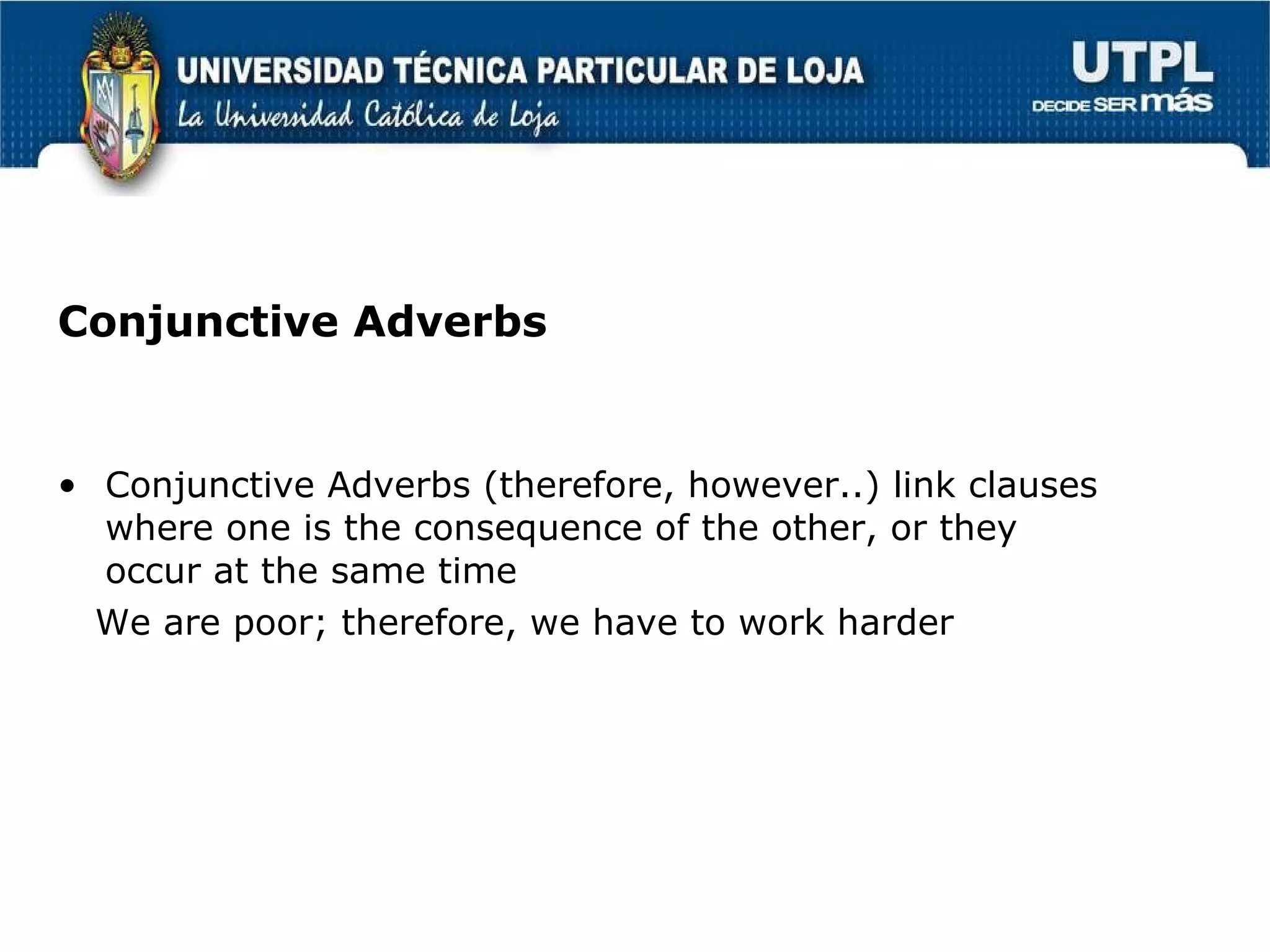
Conjunctive Adverbs Conjunctive Adverbs (therefore, however..) link clauses where one is the consequence of the other, or they occur at the same time We are poor; therefore, we have to work harder
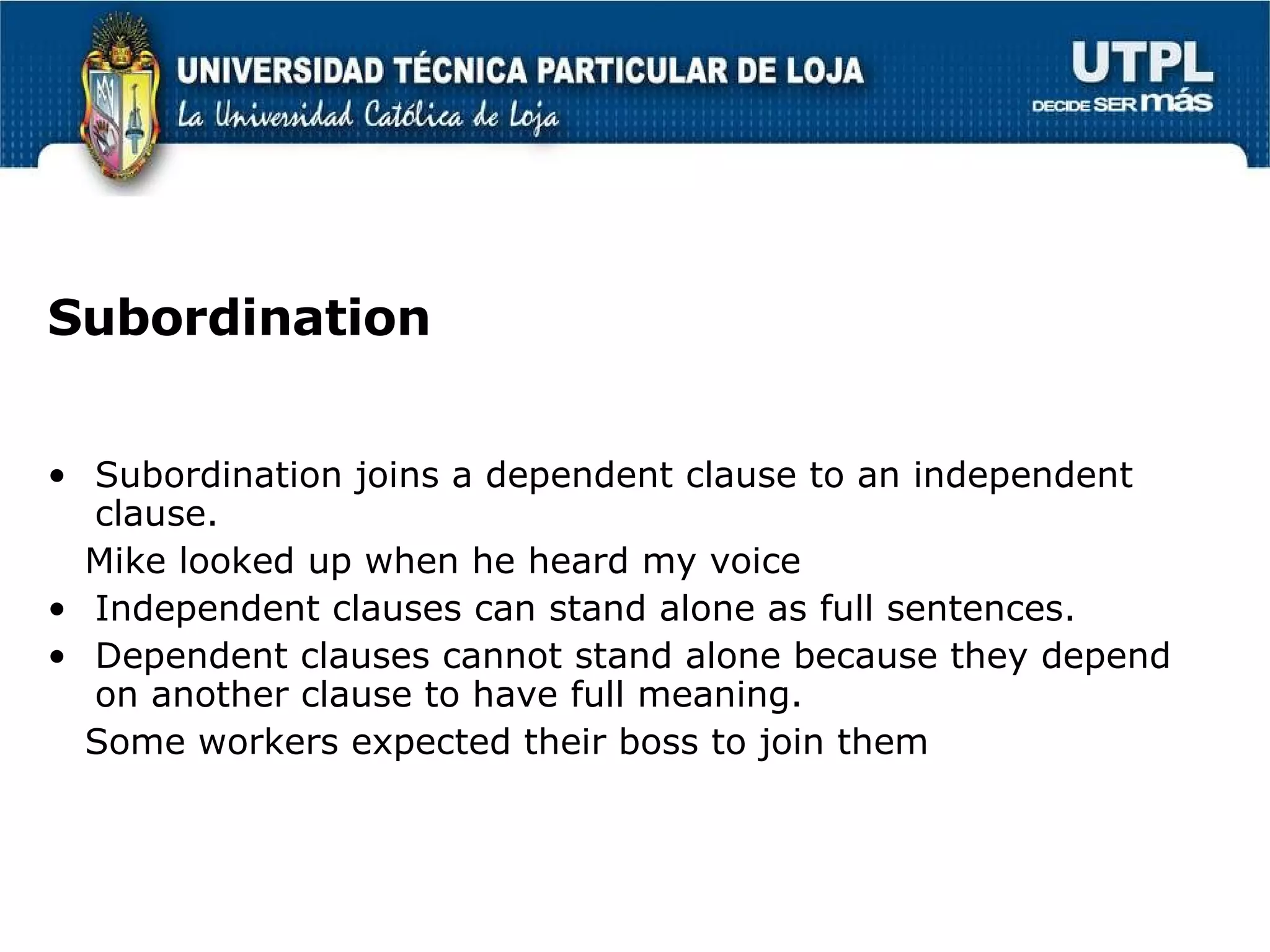
Subordination Subordination joins a dependent clause to an independent clause. Mike looked up when he heard my voice Independent clauses can stand alone as full sentences. Dependent clauses cannot stand alone because they depend on another clause to have full meaning. Some workers expected their boss to join them
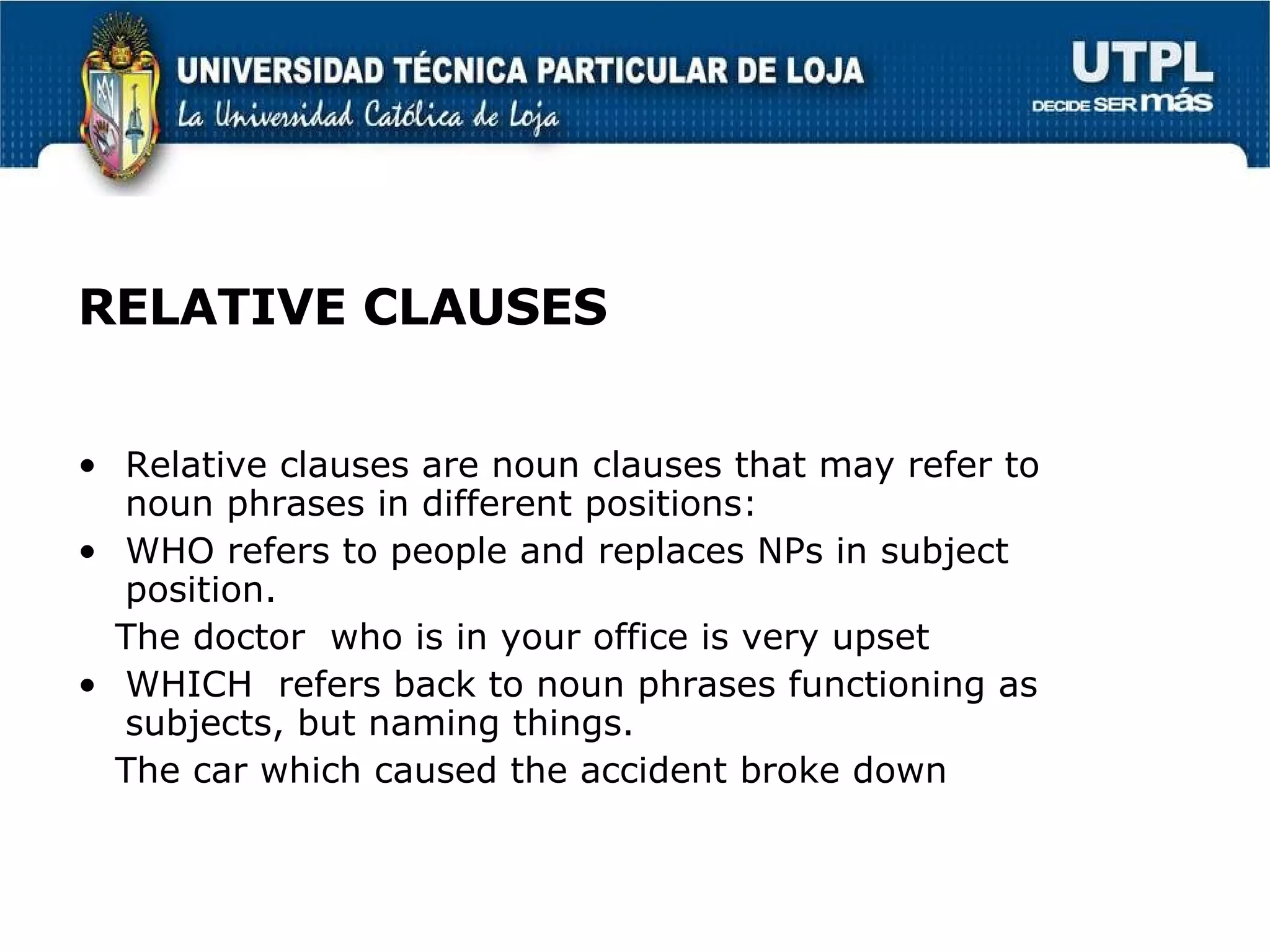
RELATIVE CLAUSES Relative clauses are noun clauses that may refer to  noun phrases in different positions: WHO refers to people and replaces NPs in subject position. The doctor  who is in your office is very upset WHICH  refers back to noun phrases functioning as subjects, but naming things. The car which caused the accident broke down
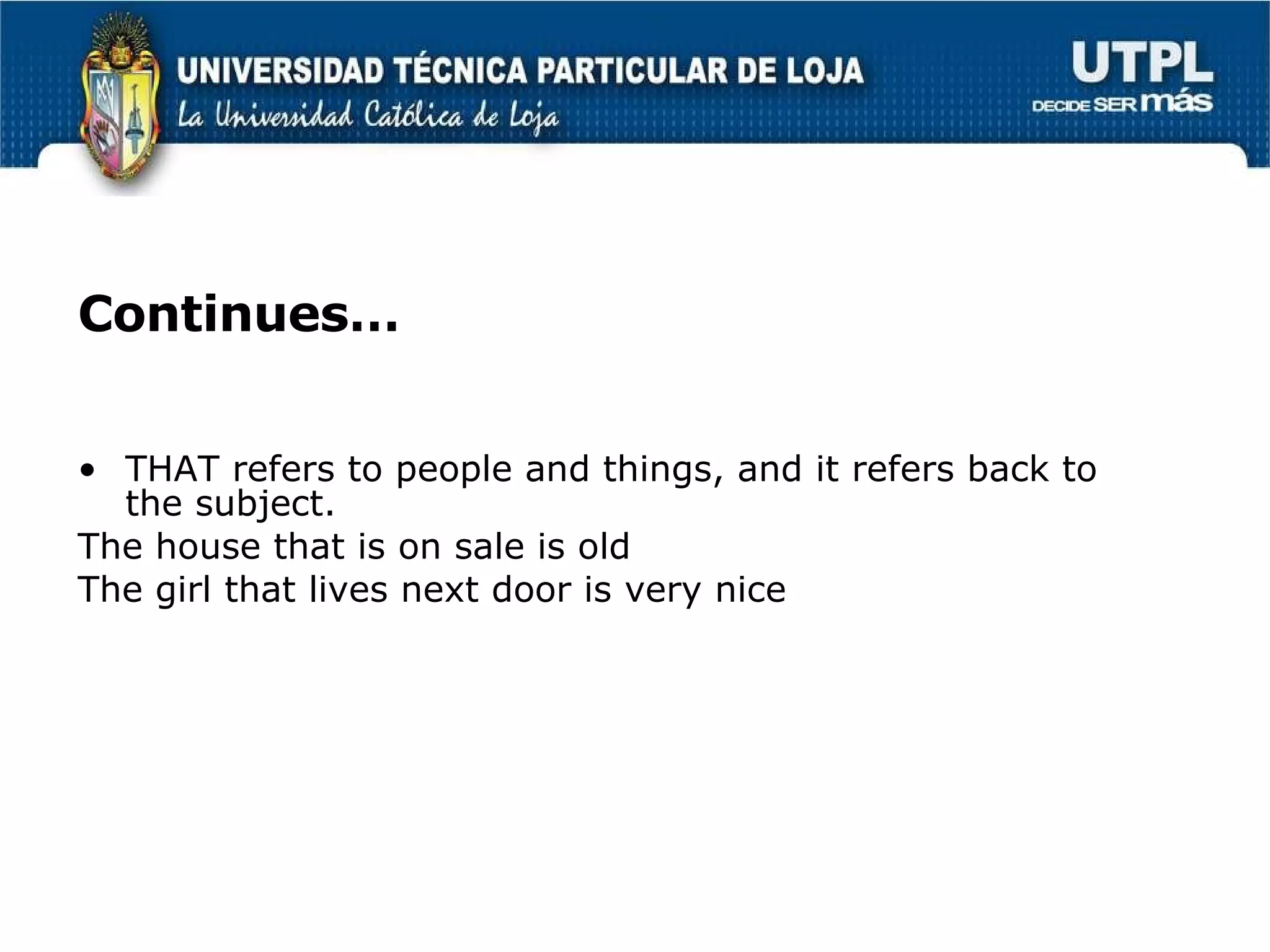
Continues… THAT refers to people and things, and it refers back to the subject. The house that is on sale is old The girl that lives next door is very nice
Finite and Non-finite Clauses Also we can distinguish  finite  and  non-finite  clauses.  Finite clauses contain tensed verbs or modals.  Non-finite clauses have verbs not marked for tense
ESTRICTIVE AND NONRESTRICTIVE RELATIVE CLAUSES Restrictive relative clauses are noun clauses functioning as adjectives.  The bus  which caused the accident  broke down Non restrictive relative clauses are set off by commas. Doctor Bush, who is an old man, is in the hospital
THAT CLAUSES & RELATIVE CLAUSES That clauses fill noun phrase slots. They function as nouns. Architects claim that adobe houses are better for health Relative clauses function as adjectives and they are embedded into noun phrases. Architects build adobe houses which are better for health
OTHER TYPES OF CLAUSES Infinitival Clauses He wants  to be  happy I would prefer for the boys  to finish  their studies Indirect Questions The librarian asked which books Sam took
Adverbial clauses are introduced by words like: after, before, because, if, unless… Marie went to Quito after she finished classes
THE EXTERNAL SYNTAX OF CLAUSES Clauses as complements of verbs: I  asked  which car he bought Clauses as complements of adjectives Michael is eager to come home
Clauses as complements of prepositions. Results depend on how data is processed
Continues……….. Clauses as complements of nouns Robert’s  eagerness to win the game is amazing Clauses as subjects That  Sam bought a new house surprised me
TRANSFORMATIONS Syntactic Rules:  - Phrase Structure Rules - The Lexicon - Lexical Insertion Rule
Operations *  movement *  insertion *  deletion *  copying
STRUCTURAL DESCRIPTION AND STRUCTURAL CHANGE Structural description refers to any string of words that can be analyzed (NP + VP + NP) Structural Change  to the transformations that can be applied to a basic structure. Deletion, insertion and movement are the types of structural change.
TRANSFORMATION RULES NP-Aux. Inversion Rule WH-Movement Negative Insertion Rule Passive Transformation Rule
 

Syntax (II Bimestre)

  • 1.
    ESCUELA : PONENTE: BIMESTRE : SYNTAX CICLO : INGLÉS II BIMESTRE Dra. Rosario Burneo ABRIL – AGOSTO 2007
  • 2.
    MODIFICATION Modification isthe use of words or structures to give more information about the person, thing, action or quality being modified. Traditionally, modification relations are classified in two categories: adjectives and adverbs. Adjectives modify nouns. While adverbs might modify verbs, adjectives and other adverbs
  • 3.
    ADJECTIVES The category“adjective” is an open class. It means that there many adjectives in English. Adjectives can be compared and intensified. Adjectives are “content words”
  • 4.
    Adjectives In thiscategory, we can include: Typical adjectives (tall), Present participles forms (charming), describing an ongoing situation; and, past participles forms (broken), which describe a resultant state.
  • 5.
    TYPES OF ADJECTIVESAlso nouns might function as adjectives. They are called Denominal adjectives. The history class is tomorrow Prenominal adjectives go before the noun they modify. They can modify almost any noun in English. I bought an old house
  • 6.
    Predicate adjectives followcopula verbs Your career is important.
  • 7.
    Adjectives Postnominal adjectivesoccur after the noun they modify. Typical adjectives and PPs fulfill this function. -The people present were angry - The girl in blue is my sister
  • 8.
    COPULA VERBS Acopula verb links a subject to a complement in a sentence. The verb BE is usually known as a copula, but some linking verbs (become, look, seem, feel) also perform this function. My children are very young They feel tired
  • 9.
    ADJECTIVE COMPLEMENTS Adjectivecomplements complete the meaning of some adjectives, such as fond, aware, etc. Mike is fond of his profession Prepositional phrases function as adjective complements
  • 10.
    ADVERBIALS Adverbs tellyou where, when, how long, how, why, how often, to what extent, and under what condition something happens. PPS, typical adverbs, adverb phrases and clauses might function as adverbials. Locative adverbs: adverbs of place adverbs of direction My history book in on that desk (place) They walked down this street (direction)
  • 11.
    Temporal Adverbs Adverbsof point on time indicate when an event occurs. They can indicate: a. Specific time frame. Our class is at 5 p.m.
  • 12.
    Temporal Adverbs b. Time frame bound on one side You must be back at noon c. Time frame bound on both sides The meeting is from 10 to 12
  • 13.
    Temporal Adverbs d. Vague time frame (not specific) We plan to visit Brazil someday Adverbs of duration indicate how long an event lasts. They will be here for two weeks Adverbs of frequency specify how often an event occurs Sam was sick twice last month
  • 14.
    Temporal Adverbs Timerelationship adverbs communicate a time in relation to some other time. I lost my cell phone again
  • 15.
    Adverbs of Mannerand Means Adverbs of manner indicate how something is done The President acted very coldly Steven learns math easily Adverbs of means indicate by what method something is done They usually indicate the instrument used to do something I cut my finger with a knife
  • 16.
    Adverbs of Reason/purposeand Result Adverbs of reason and purpose indicate why something happens. Elizabeth killed herself for love (reason) My students trained hard for the context (purpose)
  • 17.
    CLAUSES A clauseis a syntactic structure larger than a phrase. It must have two main constituents: a noun phrase that functions as the subject, and a verb phrase that functions as the predicate. word: people phrase: these people clause: these people live in a small town
  • 18.
    Constituents A constituentis a string of words grammatically structured and which expresses meaning. Noun phrases verbs phrases, prepositional phrases, and others are regarded as constituents.
  • 19.
    Constituents… A constituenthas these characteristics: - It behaves distributinally. For example, a noun phrase can appear in subject or object position. The students are in class (NP subject)
  • 20.
    Constituents… - Itcan be coordinated with another similar structure. For example, two noun phrases can be joined by the conjunction AND. I live here and my brother lives next door
  • 21.
    Constituents… It canbe replaced by a proform. Martha said that she will cook dinner, and so she will I like this car because it is fast
  • 22.
    Constituents - Itcan be omitted under appropriate discourse conditions. A constituent can be omitted to avoid repetition. Who took the money? Bob did (took the money)
  • 23.
    OPERATIONS TO JOINCLAUSES Coordination joins two or more structures of the same type to form a conjoined structure. - Conjunction (and) - Disjunction (but) - Alternation (or)
  • 24.
    Correlative conjunctions CorrelativeConjunctions (both…and, …) might express conjunction, disjunction and alternation. Either Mike or Vincent will pay te bill
  • 25.
    Conjunctive Adverbs ConjunctiveAdverbs (therefore, however..) link clauses where one is the consequence of the other, or they occur at the same time We are poor; therefore, we have to work harder
  • 26.
    Subordination Subordination joinsa dependent clause to an independent clause. Mike looked up when he heard my voice Independent clauses can stand alone as full sentences. Dependent clauses cannot stand alone because they depend on another clause to have full meaning. Some workers expected their boss to join them
  • 27.
    RELATIVE CLAUSES Relativeclauses are noun clauses that may refer to noun phrases in different positions: WHO refers to people and replaces NPs in subject position. The doctor who is in your office is very upset WHICH refers back to noun phrases functioning as subjects, but naming things. The car which caused the accident broke down
  • 28.
    Continues… THAT refersto people and things, and it refers back to the subject. The house that is on sale is old The girl that lives next door is very nice
  • 29.
    Finite and Non-finiteClauses Also we can distinguish finite and non-finite clauses. Finite clauses contain tensed verbs or modals. Non-finite clauses have verbs not marked for tense
  • 30.
    ESTRICTIVE AND NONRESTRICTIVERELATIVE CLAUSES Restrictive relative clauses are noun clauses functioning as adjectives. The bus which caused the accident broke down Non restrictive relative clauses are set off by commas. Doctor Bush, who is an old man, is in the hospital
  • 31.
    THAT CLAUSES &RELATIVE CLAUSES That clauses fill noun phrase slots. They function as nouns. Architects claim that adobe houses are better for health Relative clauses function as adjectives and they are embedded into noun phrases. Architects build adobe houses which are better for health
  • 32.
    OTHER TYPES OFCLAUSES Infinitival Clauses He wants to be happy I would prefer for the boys to finish their studies Indirect Questions The librarian asked which books Sam took
  • 33.
    Adverbial clauses areintroduced by words like: after, before, because, if, unless… Marie went to Quito after she finished classes
  • 34.
    THE EXTERNAL SYNTAXOF CLAUSES Clauses as complements of verbs: I asked which car he bought Clauses as complements of adjectives Michael is eager to come home
  • 35.
    Clauses as complementsof prepositions. Results depend on how data is processed
  • 36.
    Continues……….. Clauses ascomplements of nouns Robert’s eagerness to win the game is amazing Clauses as subjects That Sam bought a new house surprised me
  • 37.
    TRANSFORMATIONS Syntactic Rules: - Phrase Structure Rules - The Lexicon - Lexical Insertion Rule
  • 38.
    Operations * movement * insertion * deletion * copying
  • 39.
    STRUCTURAL DESCRIPTION ANDSTRUCTURAL CHANGE Structural description refers to any string of words that can be analyzed (NP + VP + NP) Structural Change to the transformations that can be applied to a basic structure. Deletion, insertion and movement are the types of structural change.
  • 40.
    TRANSFORMATION RULES NP-Aux.Inversion Rule WH-Movement Negative Insertion Rule Passive Transformation Rule
  • 41.