ADVERBS
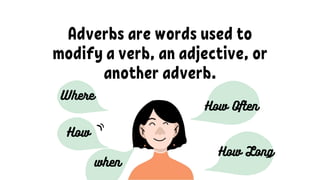
Adverbs are words used to
modify a verb, an adjective, or
another adverb.
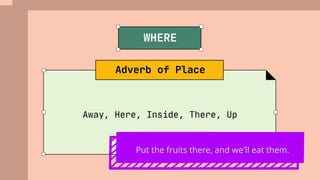
Away, Here, Inside, There, Up
Adverb of Place
WHERE
Put the fruits there, and we'll eat them.
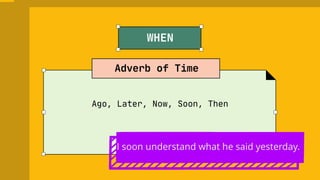
Ago, Later, Now, Soon, Then
Adverb of Time
WHEN
I soon understand what he said yesterday.
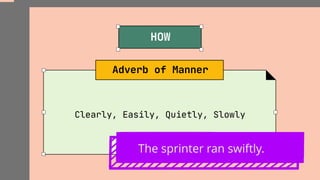
Clearly, Easily, Quietly, Slowly
Adverb of Manner
HOW
The sprinter ran swiftly.
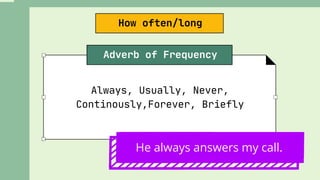
Always, Usually, Never,
Continously,Forever, Briefly
Adverb of Frequency
How often/long
He always answers my call.
Almost, so, too,more, least,
extremely, quite
Adverb of Degree/Intensity
TO WHAT EXTENT/
HOW MUCH
He kicked the ball too hard.
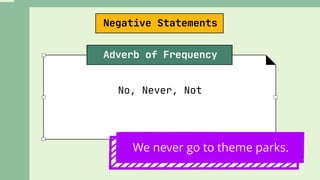
No, Never, Not
Adverb of Frequency
Negative Statements
We never go to theme parks.
Adverbs are
distinguished
from
adjectives by
the suffix -ly
They are
distinguished
from
corresponding
nouns by the
suffix -ways and
-wise
They go with
verbs,
adjectives,
and adverbs.
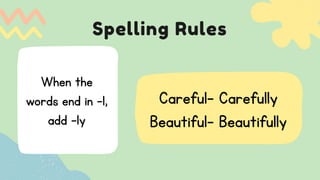
Spelling Rules
Careful- Carefully
Beautiful- Beautifully
When the
words end in -l,
add -ly
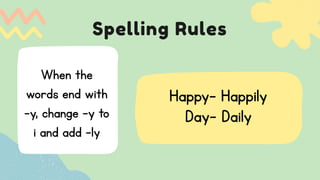
Spelling Rules
Happy- Happily
Day- Daily
When the
words end with
-y, change -y to
i and add -ly
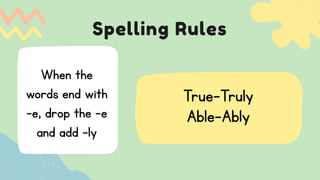
Spelling Rules
True-Truly
Able-Ably
When the
words end with
-e, drop the -e
and add -ly
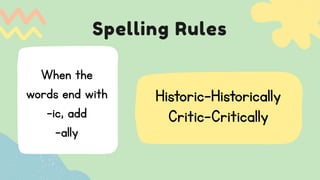
Spelling Rules
Historic-Historically
Critic-Critically
When the
words end with
-ic, add
-ally
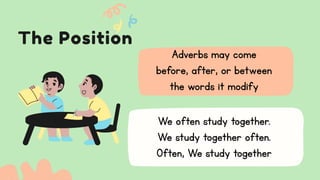
The Position
We often study together.
We study together often.
Often, We study together
Adverbs may come
before, after, or between
the words it modify
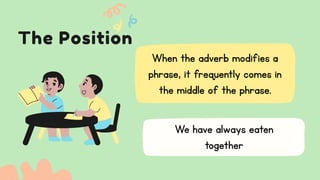
The Position
When the adverb modifies a
phrase, it frequently comes in
the middle of the phrase.
We have always eaten
together
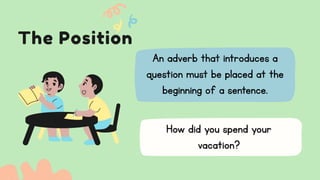
The Position
An adverb that introduces a
question must be placed at the
beginning of a sentence.
How did you spend your
vacation?
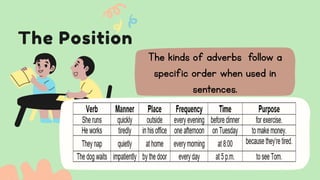
The Position
The kinds of adverbs follow a
specific order when used in
sentences.
Thank You!
Do you have any questions?

ADVERBS

Editor's Notes

  • #12 Wonderful Gracefu Playful Final