TENSES
UNIVERSITY OF THE PUNJAB
DEPARTMENT: Microbiology &
Molecular Genetics
USES
1.A future action that will be completed prior to a
specific future time.
 Example: I will have finished this work by midnight.
2.A state or action that will be completed in the
future prior to some other future time or event.
 Example: I will have finished my essay by the time you
return from college.
TENSES
 Grammar:
Grammar is the set of rules governing how the words in a
language may be joined to make sense.
 Verb Tenses:
 Verb tenses are tools that English speakers use to express time in
their language.
 Events can happen in the
 Present
 Past
 Future.
IMPORTANCE
 Importance of Verb Tenses:
 The English becomes easy and clear to understand.
 Consistency in speaking.
 To express the event with proper verb tenses.
 One can better communicate with society
PRESENT INDEFINITE TENSE
Otherwise known as the timeless present
Present Indefinite
 Subject + 1st form of verb + object
Negative
subject+ do not/ does not + first form + object
Interrogative
wh-words + do/does + subject + 1st form + object
Simple present tense is used
 Habitual action
Example: He goes for a walk daily.
Universal truths
Example: the sunsets in the west.
General statements/ Facts
Example: God helps those who help
themselves
Indicators
 Always
 whenever
 everyday
 Usually
 often
 frequently
 Sometimes
 rarely
 occasionally
 never
PRESENT CONTINUOUS TENSE
Some times called the present
progressive tense.
PRESENT CONTINUOUS TENSE
 Actions that are occurring right now
Example :
o She is typing a paper for her class.
o He cant talk .He is fixing the sink right now.
For temporary, present actions.
Example:
Ahmed is living in Islamabad , but he might move soon
Present continuous formulas
Simple
 Subject + is/am/are+1st form + ing + object
Negative
 Subject +is /am/are+not+1st form + ing + object
Interrogative
 Wh words + is /am/are+1st form + ing+ object
Indicators
Right now , at this moment
Still
This year
Week
 Month
As we speak
PRESENT PERFECT TENSE
A tense very commonly used in
English to refer to the past
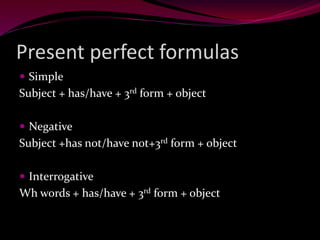
Present perfect formulas
 Simple
Subject + has/have + 3rd form + object
 Negative
Subject +has not/have not+3rd form + object
 Interrogative
Wh words + has/have + 3rd form + object
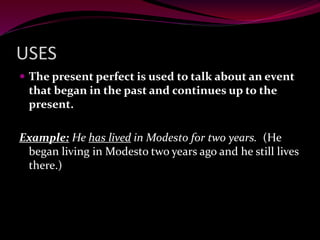
USES
 The present perfect is used to talk about an event
that began in the past and continues up to the
present.
Example: He has lived in Modesto for two years. (He
began living in Modesto two years ago and he still lives
there.)
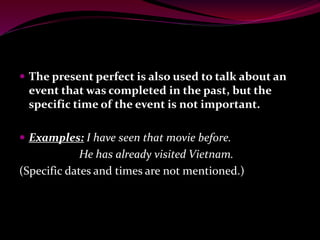
 The present perfect is also used to talk about an
event that was completed in the past, but the
specific time of the event is not important.
 Examples: I have seen that movie before.
He has already visited Vietnam.
(Specific dates and times are not mentioned.)
 When an activity was very recently
completed before now.
 Examples: I have just eaten.
Nabila has just finished her
homework
INDICATORS
 Before
 Ever
 So far
 Never
 Yet
 For
 Recently
 Just
 Since
 already
PRESENT PERFECT CONTINUOUS TENSE
OR
PRESENT PERFECT PROGRESSIVE TENSE
formulas
Subject + has been / have been +1st
form + since/for + time
 For specific time since
2 o’clock, morning, childhood, Monday
,10th December 2010
For not specific time for
1 hour, 10 days, 5 years, 2months
FORMULAS
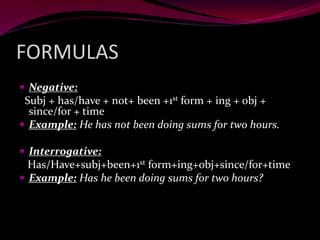
 Negative:
Subj + has/have + not+ been +1st form + ing + obj +
since/for + time
 Example: He has not been doing sums for two hours.
 Interrogative:
Has/Have+subj+been+1st form+ing+obj+since/for+time
 Example: Has he been doing sums for two hours?
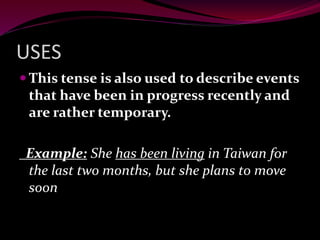
USES
 This tense is also used to describe events
that have been in progress recently and
are rather temporary.
Example: She has been living in Taiwan for
the last two months, but she plans to move
soon
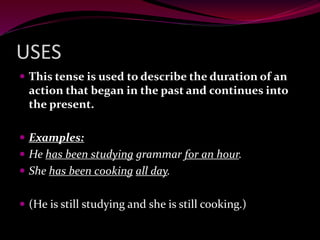
USES
 This tense is used to describe the duration of an
action that began in the past and continues into
the present.
 Examples:
 He has been studying grammar for an hour.
 She has been cooking all day.
 (He is still studying and she is still cooking.)
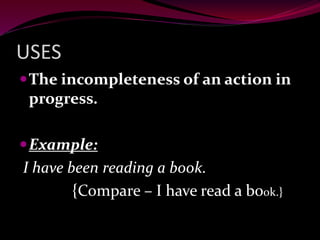
USES
The incompleteness of an action in
progress.
Example:
I have been reading a book.
{Compare – I have read a book.}
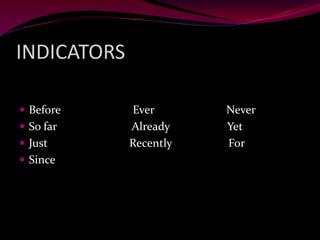
INDICATORS
 Before Ever Never
 So far Already Yet
 Just Recently For
 Since
PAST TENSE
PAST
INDEFINITE TENSE
(SIMPLE PAST TENSE)
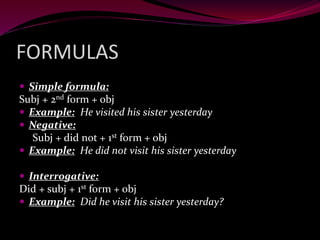
FORMULAS
 Simple formula:
Subj + 2nd form + obj
 Example: He visited his sister yesterday
 Negative:
Subj + did not + 1st form + obj
 Example: He did not visit his sister yesterday
 Interrogative:
Did + subj + 1st form + obj
 Example: Did he visit his sister yesterday?
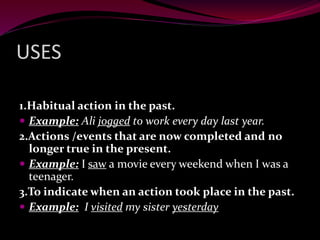
USES
1.Habitual action in the past.
 Example: Ali jogged to work every day last year.
2.Actions /events that are now completed and no
longer true in the present.
 Example: I saw a movie every weekend when I was a
teenager.
3.To indicate when an action took place in the past.
 Example: I visited my sister yesterday
INDICATORS
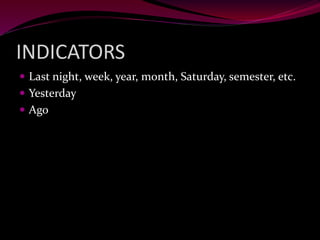
 Last night, week, year, month, Saturday, semester, etc.
 Yesterday
 Ago
The Past Progressive
Tense:
It is also called Past Continuous Tense
FORMULAS
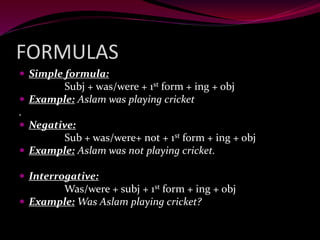
 Simple formula:
Subj + was/were + 1st form + ing + obj
 Example: Aslam was playing cricket
.
 Negative:
Sub + was/were+ not + 1st form + ing + obj
 Example: Aslam was not playing cricket.
 Interrogative:
Was/were + subj + 1st form + ing + obj
 Example: Was Aslam playing cricket?
USES
1.When one action was in progress while another
action occurred.
 Example: I was watching TV when the door bell rang.
2.When two actions in the past continued at the
same time.
 Example: Fatima was watching T.V while Amna was
sleeping
PAST PERFECT TENSE
FORMULA
 Simple formula:
Sub + had + 3rd from + obj
Example: He had visited her many times before she died.
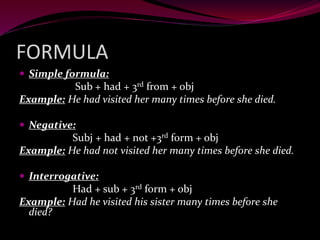
 Negative:
Subj + had + not +3rd form + obj
Example: He had not visited her many times before she died.
 Interrogative:
Had + sub + 3rd form + obj
Example: Had he visited his sister many times before she
died?
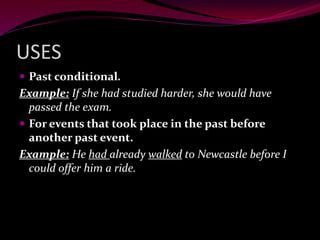
USES
 Past conditional.
Example: If she had studied harder, she would have
passed the exam.
 For events that took place in the past before
another past event.
Example: He had already walked to Newcastle before I
could offer him a ride.
PAST PERFECT
PROGRESSIVE
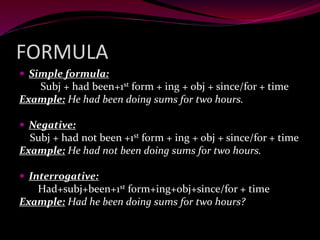
FORMULA
 Simple formula:
Subj + had been+1st form + ing + obj + since/for + time
Example: He had been doing sums for two hours.
 Negative:
Subj + had not been +1st form + ing + obj + since/for + time
Example: He had not been doing sums for two hours.
 Interrogative:
Had+subj+been+1st form+ing+obj+since/for + time
Example: Had he been doing sums for two hours?
USES
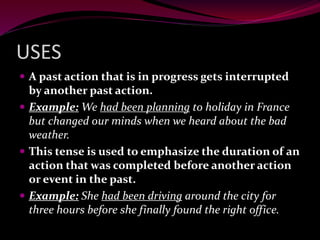
 A past action that is in progress gets interrupted
by another past action.
 Example: We had been planning to holiday in France
but changed our minds when we heard about the bad
weather.
 This tense is used to emphasize the duration of an
action that was completed before another action
or event in the past.
 Example: She had been driving around the city for
three hours before she finally found the right office.
FUTURE TENSE
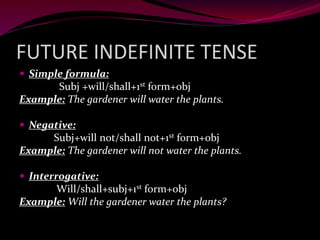
FUTURE INDEFINITE TENSE
 Simple formula:
Subj +will/shall+1st form+obj
Example: The gardener will water the plants.
 Negative:
Subj+will not/shall not+1st form+obj
Example: The gardener will not water the plants.
 Interrogative:
Will/shall+subj+1st form+obj
Example: Will the gardener water the plants?
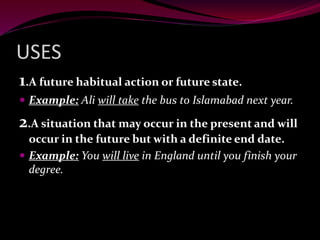
USES
1.A future habitual action or future state.
 Example: Ali will take the bus to Islamabad next year.
2.A situation that may occur in the present and will
occur in the future but with a definite end date.
 Example: You will live in England until you finish your
degree.
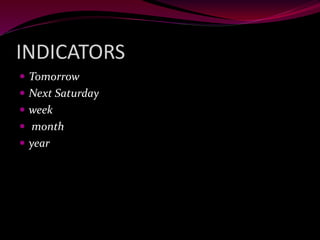
INDICATORS
 Tomorrow
 Next Saturday
 week
 month
 year
The Future
Progressive Tense:
(FUTURE CONTINUOUS TENSE)
FORMULA
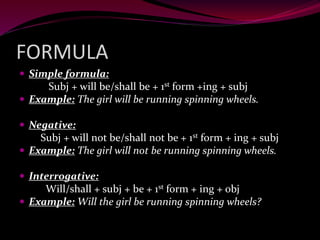
 Simple formula:
Subj + will be/shall be + 1st form +ing + subj
 Example: The girl will be running spinning wheels.
 Negative:
Subj + will not be/shall not be + 1st form + ing + subj
 Example: The girl will not be running spinning wheels.
 Interrogative:
Will/shall + subj + be + 1st form + ing + obj
 Example: Will the girl be running spinning wheels?
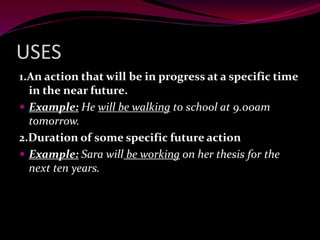
USES
1.An action that will be in progress at a specific time
in the near future.
 Example: He will be walking to school at 9.00am
tomorrow.
2.Duration of some specific future action
 Example: Sara will be working on her thesis for the
next ten years.
The Future Perfect
Tense
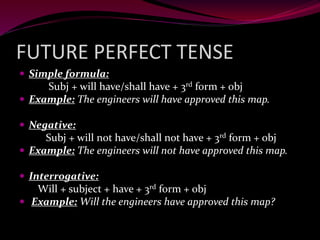
FUTURE PERFECT TENSE
 Simple formula:
Subj + will have/shall have + 3rd form + obj
 Example: The engineers will have approved this map.
 Negative:
Subj + will not have/shall not have + 3rd form + obj
 Example: The engineers will not have approved this map.
 Interrogative:
Will + subject + have + 3rd form + obj
 Example: Will the engineers have approved this map?
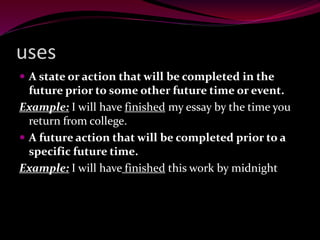
uses
 A state or action that will be completed in the
future prior to some other future time or event.
Example: I will have finished my essay by the time you
return from college.
 A future action that will be completed prior to a
specific future time.
Example: I will have finished this work by midnight
The Future Perfect
Progressive Tense:
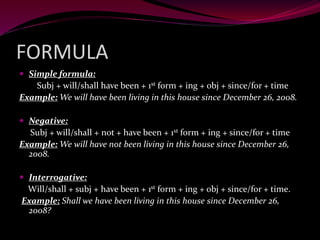
FORMULA
 Simple formula:
Subj + will/shall have been + 1st form + ing + obj + since/for + time
Example: We will have been living in this house since December 26, 2008.
 Negative:
Subj + will/shall + not + have been + 1st form + ing + since/for + time
Example: We will have not been living in this house since December 26,
2008.
 Interrogative:
Will/shall + subj + have been + 1st form + ing + obj + since/for + time.
Example: Shall we have been living in this house since December 26,
2008?
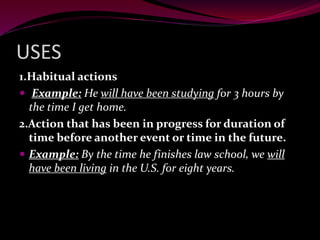
USES
1.Habitual actions
 Example: He will have been studying for 3 hours by
the time I get home.
2.Action that has been in progress for duration of
time before another event or time in the future.
 Example: By the time he finishes law school, we will
have been living in the U.S. for eight years.
Activity
1. She reads the newspaper after getting up.
2.We are not wasting our time.
3. Why has she fallen ill?
4. I had been working very hard before the
examination.
5. I shall have been called to Rawalpindi by Febuary.
Remember !
Whenever you are writing you should
try to stay in the same tense all the
way through.
THANK YOU
&
GOD BLESS YOU 

Verb Tenses

  • 1.
  • 2.
    UNIVERSITY OF THEPUNJAB DEPARTMENT: Microbiology & Molecular Genetics
  • 3.
    USES 1.A future actionthat will be completed prior to a specific future time.  Example: I will have finished this work by midnight. 2.A state or action that will be completed in the future prior to some other future time or event.  Example: I will have finished my essay by the time you return from college.
  • 4.
    TENSES  Grammar: Grammar isthe set of rules governing how the words in a language may be joined to make sense.  Verb Tenses:  Verb tenses are tools that English speakers use to express time in their language.  Events can happen in the  Present  Past  Future.
  • 5.
    IMPORTANCE  Importance ofVerb Tenses:  The English becomes easy and clear to understand.  Consistency in speaking.  To express the event with proper verb tenses.  One can better communicate with society
  • 6.
    PRESENT INDEFINITE TENSE Otherwiseknown as the timeless present
  • 7.
    Present Indefinite  Subject+ 1st form of verb + object Negative subject+ do not/ does not + first form + object Interrogative wh-words + do/does + subject + 1st form + object
  • 8.
    Simple present tenseis used  Habitual action Example: He goes for a walk daily. Universal truths Example: the sunsets in the west. General statements/ Facts Example: God helps those who help themselves
  • 9.
    Indicators  Always  whenever everyday  Usually  often  frequently  Sometimes  rarely  occasionally  never
  • 10.
    PRESENT CONTINUOUS TENSE Sometimes called the present progressive tense.
  • 11.
    PRESENT CONTINUOUS TENSE Actions that are occurring right now Example : o She is typing a paper for her class. o He cant talk .He is fixing the sink right now. For temporary, present actions. Example: Ahmed is living in Islamabad , but he might move soon
  • 12.
    Present continuous formulas Simple Subject + is/am/are+1st form + ing + object Negative  Subject +is /am/are+not+1st form + ing + object Interrogative  Wh words + is /am/are+1st form + ing+ object
  • 13.
    Indicators Right now ,at this moment Still This year Week  Month As we speak
  • 14.
    PRESENT PERFECT TENSE Atense very commonly used in English to refer to the past
  • 15.
    Present perfect formulas Simple Subject + has/have + 3rd form + object  Negative Subject +has not/have not+3rd form + object  Interrogative Wh words + has/have + 3rd form + object
  • 16.
    USES  The presentperfect is used to talk about an event that began in the past and continues up to the present. Example: He has lived in Modesto for two years. (He began living in Modesto two years ago and he still lives there.)
  • 17.
     The presentperfect is also used to talk about an event that was completed in the past, but the specific time of the event is not important.  Examples: I have seen that movie before. He has already visited Vietnam. (Specific dates and times are not mentioned.)
  • 18.
     When anactivity was very recently completed before now.  Examples: I have just eaten. Nabila has just finished her homework
  • 19.
    INDICATORS  Before  Ever So far  Never  Yet  For  Recently  Just  Since  already
  • 20.
    PRESENT PERFECT CONTINUOUSTENSE OR PRESENT PERFECT PROGRESSIVE TENSE
  • 21.
    formulas Subject + hasbeen / have been +1st form + since/for + time  For specific time since 2 o’clock, morning, childhood, Monday ,10th December 2010 For not specific time for 1 hour, 10 days, 5 years, 2months
  • 22.
    FORMULAS  Negative: Subj +has/have + not+ been +1st form + ing + obj + since/for + time  Example: He has not been doing sums for two hours.  Interrogative: Has/Have+subj+been+1st form+ing+obj+since/for+time  Example: Has he been doing sums for two hours?
  • 23.
    USES  This tenseis also used to describe events that have been in progress recently and are rather temporary. Example: She has been living in Taiwan for the last two months, but she plans to move soon
  • 24.
    USES  This tenseis used to describe the duration of an action that began in the past and continues into the present.  Examples:  He has been studying grammar for an hour.  She has been cooking all day.  (He is still studying and she is still cooking.)
  • 25.
    USES The incompleteness ofan action in progress. Example: I have been reading a book. {Compare – I have read a book.}
  • 26.
    INDICATORS  Before EverNever  So far Already Yet  Just Recently For  Since
  • 27.
  • 28.
    FORMULAS  Simple formula: Subj+ 2nd form + obj  Example: He visited his sister yesterday  Negative: Subj + did not + 1st form + obj  Example: He did not visit his sister yesterday  Interrogative: Did + subj + 1st form + obj  Example: Did he visit his sister yesterday?
  • 29.
    USES 1.Habitual action inthe past.  Example: Ali jogged to work every day last year. 2.Actions /events that are now completed and no longer true in the present.  Example: I saw a movie every weekend when I was a teenager. 3.To indicate when an action took place in the past.  Example: I visited my sister yesterday
  • 30.
    INDICATORS  Last night,week, year, month, Saturday, semester, etc.  Yesterday  Ago
  • 31.
    The Past Progressive Tense: Itis also called Past Continuous Tense
  • 32.
    FORMULAS  Simple formula: Subj+ was/were + 1st form + ing + obj  Example: Aslam was playing cricket .  Negative: Sub + was/were+ not + 1st form + ing + obj  Example: Aslam was not playing cricket.  Interrogative: Was/were + subj + 1st form + ing + obj  Example: Was Aslam playing cricket?
  • 33.
    USES 1.When one actionwas in progress while another action occurred.  Example: I was watching TV when the door bell rang. 2.When two actions in the past continued at the same time.  Example: Fatima was watching T.V while Amna was sleeping
  • 34.
  • 35.
    FORMULA  Simple formula: Sub+ had + 3rd from + obj Example: He had visited her many times before she died.  Negative: Subj + had + not +3rd form + obj Example: He had not visited her many times before she died.  Interrogative: Had + sub + 3rd form + obj Example: Had he visited his sister many times before she died?
  • 36.
    USES  Past conditional. Example:If she had studied harder, she would have passed the exam.  For events that took place in the past before another past event. Example: He had already walked to Newcastle before I could offer him a ride.
  • 37.
  • 38.
    FORMULA  Simple formula: Subj+ had been+1st form + ing + obj + since/for + time Example: He had been doing sums for two hours.  Negative: Subj + had not been +1st form + ing + obj + since/for + time Example: He had not been doing sums for two hours.  Interrogative: Had+subj+been+1st form+ing+obj+since/for + time Example: Had he been doing sums for two hours?
  • 39.
    USES  A pastaction that is in progress gets interrupted by another past action.  Example: We had been planning to holiday in France but changed our minds when we heard about the bad weather.  This tense is used to emphasize the duration of an action that was completed before another action or event in the past.  Example: She had been driving around the city for three hours before she finally found the right office.
  • 40.
  • 41.
    FUTURE INDEFINITE TENSE Simple formula: Subj +will/shall+1st form+obj Example: The gardener will water the plants.  Negative: Subj+will not/shall not+1st form+obj Example: The gardener will not water the plants.  Interrogative: Will/shall+subj+1st form+obj Example: Will the gardener water the plants?
  • 42.
    USES 1.A future habitualaction or future state.  Example: Ali will take the bus to Islamabad next year. 2.A situation that may occur in the present and will occur in the future but with a definite end date.  Example: You will live in England until you finish your degree.
  • 43.
    INDICATORS  Tomorrow  NextSaturday  week  month  year
  • 44.
  • 45.
    FORMULA  Simple formula: Subj+ will be/shall be + 1st form +ing + subj  Example: The girl will be running spinning wheels.  Negative: Subj + will not be/shall not be + 1st form + ing + subj  Example: The girl will not be running spinning wheels.  Interrogative: Will/shall + subj + be + 1st form + ing + obj  Example: Will the girl be running spinning wheels?
  • 46.
    USES 1.An action thatwill be in progress at a specific time in the near future.  Example: He will be walking to school at 9.00am tomorrow. 2.Duration of some specific future action  Example: Sara will be working on her thesis for the next ten years.
  • 47.
  • 48.
    FUTURE PERFECT TENSE Simple formula: Subj + will have/shall have + 3rd form + obj  Example: The engineers will have approved this map.  Negative: Subj + will not have/shall not have + 3rd form + obj  Example: The engineers will not have approved this map.  Interrogative: Will + subject + have + 3rd form + obj  Example: Will the engineers have approved this map?
  • 49.
    uses  A stateor action that will be completed in the future prior to some other future time or event. Example: I will have finished my essay by the time you return from college.  A future action that will be completed prior to a specific future time. Example: I will have finished this work by midnight
  • 50.
  • 51.
    FORMULA  Simple formula: Subj+ will/shall have been + 1st form + ing + obj + since/for + time Example: We will have been living in this house since December 26, 2008.  Negative: Subj + will/shall + not + have been + 1st form + ing + since/for + time Example: We will have not been living in this house since December 26, 2008.  Interrogative: Will/shall + subj + have been + 1st form + ing + obj + since/for + time. Example: Shall we have been living in this house since December 26, 2008?
  • 52.
    USES 1.Habitual actions  Example:He will have been studying for 3 hours by the time I get home. 2.Action that has been in progress for duration of time before another event or time in the future.  Example: By the time he finishes law school, we will have been living in the U.S. for eight years.
  • 53.
    Activity 1. She readsthe newspaper after getting up. 2.We are not wasting our time. 3. Why has she fallen ill? 4. I had been working very hard before the examination. 5. I shall have been called to Rawalpindi by Febuary.
  • 54.
    Remember ! Whenever youare writing you should try to stay in the same tense all the way through.
  • 55.