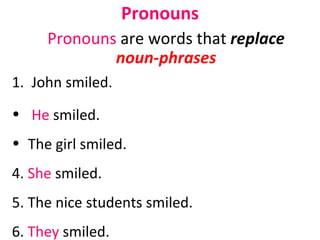
Pronouns Pronouns  are words that  replace  noun-phrases John smiled. He  smiled.  The girl smiled.  4.  She  smiled.  5. The nice students smiled. 6.  They  smiled.
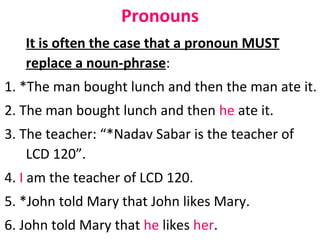
Pronouns It is often the case that a pronoun MUST replace a noun-phrase :  1. *The man bought lunch and then the man ate it.  2. The man bought lunch and then  he  ate it.  3. The teacher: “*Nadav Sabar is the teacher of LCD 120”.  4.  I  am the teacher of LCD 120.  5. *John told Mary that John likes Mary.  6. John told Mary that  he  likes  her .
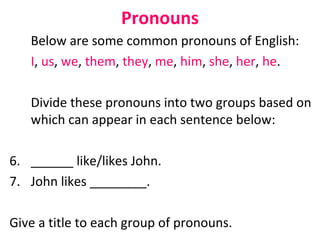
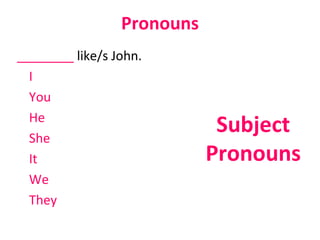
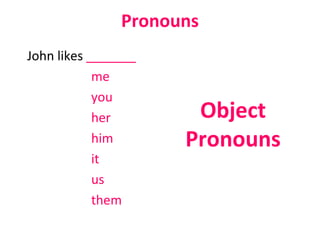
Pronouns Below are some common pronouns of English:  I ,  us ,  we ,  them ,  they ,  me ,  him ,  she ,  her ,  he .  Divide these pronouns into two groups based on which can appear in each sentence below:  ______ like/likes John.  John likes ________.  Give a title to each group of pronouns.
Pronouns ________  like/s John.  I You He She It We  They Subject Pronouns
Pronouns John likes  _______ me you her him it us them Object Pronouns
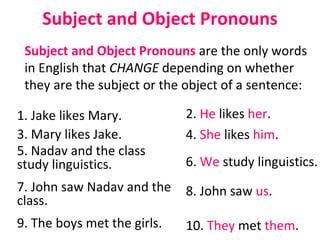
Subject and Object Pronouns Subject and Object Pronouns  are the only words in English that  CHANGE  depending on whether they are the subject or the object of a sentence:  1. Jake likes Mary.  3. Mary likes Jake. 2.  He  likes  her . 4.  She  likes  him .  5. Nadav and the class study linguistics.  7. John saw Nadav and the class. 9. The boys met the girls.  6.  We  study linguistics.  8. John saw  us .  10.  They  met  them .
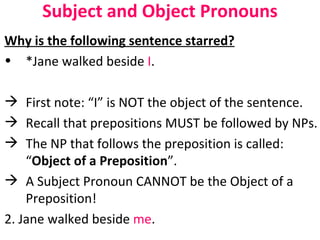
Subject and Object Pronouns Why is the following sentence starred?   *Jane walked beside  I .  First note: “I” is NOT the object of the sentence.  Recall that prepositions MUST be followed by NPs.  The NP that follows the preposition is called: “ Object of a Preposition ”.  A Subject Pronoun CANNOT be the Object of a Preposition!  2. Jane walked beside  me .
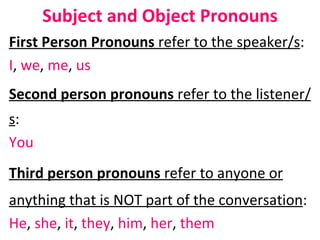
Subject and Object Pronouns First Person Pronouns  refer to the speaker/s :  I ,  we ,  me ,  us Second person pronouns  refer to the listener/s : You Third person pronouns  refer to anyone or anything that is NOT part of the conversation :  He ,  she ,  it ,  they ,  him ,  her ,  them
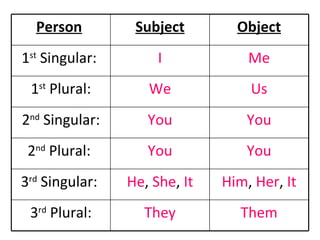
Object Subject Person   Me I 1 st  Singular:  Us We 1 st  Plural: You You 2 nd  Singular: You You 2 nd  Plural:  Him ,  Her ,  It He ,  She ,  It 3 rd  Singular:  Them They 3 rd  Plural:
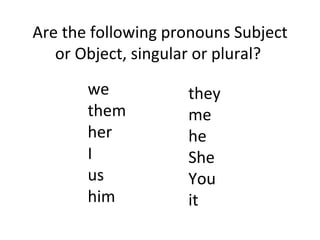
Are the following pronouns Subject or Object, singular or plural?  we them her I us him they me he She You it
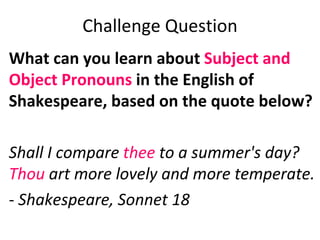
Challenge Question What can you learn about  Subject and Object Pronouns  in the English of Shakespeare, based on the quote below?   Shall I compare  thee  to a summer's day? Thou  art more lovely and more temperate.   -  Shakespeare, Sonnet 18
2 nd  Challenge Question Could an Object Pronoun be the  subject  of a subordinate clause?
Homework Read and do all the exercises of lesson 21
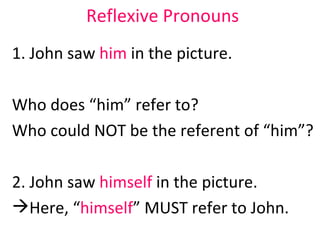
Reflexive   Pronouns 1. John saw  him  in the picture.  Who does “him” refer to?  Who could NOT be the referent of “him”?  2. John saw  himself  in the picture.  Here, “ himself ” MUST refer to John.
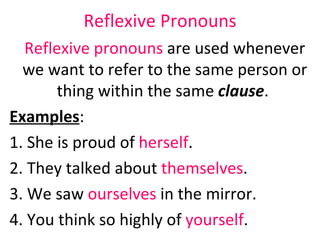
Reflexive   Pronouns Reflexive pronouns  are used whenever we want to refer to the same person or thing within the same  clause .  Examples :  1. She is proud of  herself .  2. They talked about  themselves .  3. We saw  ourselves  in the mirror.  4. You think so highly of  yourself .
Reflexive   Pronouns Why do we say that  Reflexive   Pronouns  refer to the same person or thing within the same  clause , and NOT within the same  sentence ?  Observe:  [John thinks] [that  he  is smart].  *[John thinks] [that  himself  is smart].  [Mary ate] [while  she  was reading].  *[Mary ate] [while  herself  was reading].  [Mike slept] and then [ he  ate lunch].  *[Mike slept] and then [ himself  ate lunch].
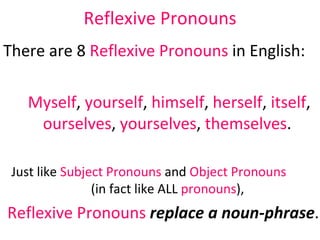
Reflexive   Pronouns There are 8  Reflexive   Pronouns  in English: Myself ,  yourself ,  himself ,  herself ,  itself ,  ourselves ,  yourselves ,  themselves .  Just like  Subject Pronouns  and  Object Pronouns   (in fact like ALL  pronouns ),  Reflexive Pronouns   replace a noun-phrase .
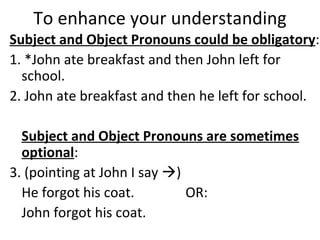
To enhance your understanding Subject and Object Pronouns could be obligatory :  1. *John ate breakfast and then John left for school.  2. John ate breakfast and then he left for school. Subject and Object Pronouns are sometimes optional :  3. (pointing at John I say   )  He forgot his coat.  OR:  John forgot his coat.
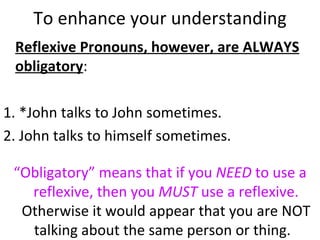
To enhance your understanding Reflexive Pronouns, however, are ALWAYS obligatory :  1. *John talks to John sometimes.  2. John talks to himself sometimes.  “ Obligatory” means that if you  NEED  to use a reflexive, then you  MUST  use a reflexive.  Otherwise it would appear that you are NOT talking about the same person or thing.
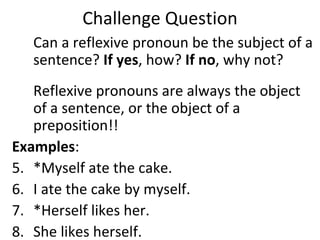
Challenge Question Can a reflexive pronoun be the subject of a sentence?  If yes , how?  If no , why not?  Reflexive pronouns are always the object of a sentence, or the object of a preposition!! Examples : *Myself ate the cake. I ate the cake by myself.  *Herself likes her. She likes herself.
Homework Read and do all the exercises of lesson 22
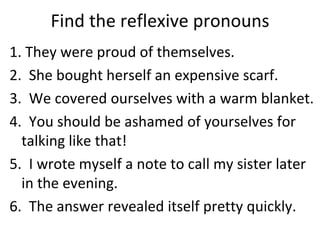
Find the reflexive pronouns 1. They were proud of themselves. 2.  She bought herself an expensive scarf. 3.  We covered ourselves with a warm blanket. 4.  You should be ashamed of yourselves for talking like that! 5.  I wrote myself a note to call my sister later in the evening. 6.  The answer revealed itself pretty quickly.
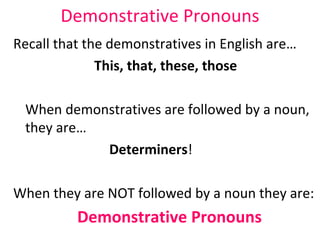
Demonstrative Pronouns Recall that the demonstratives in English are… This, that, these, those When demonstratives are followed by a noun, they are… Determiners ! When they are NOT followed by a noun they are:  Demonstrative Pronouns
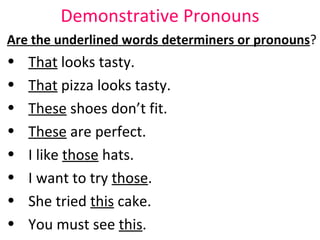
Demonstrative Pronouns Are the underlined words determiners or pronouns ?  That  looks tasty.  That  pizza looks tasty.  These  shoes don’t fit.  These  are perfect.  I like  those  hats.  I want to try  those .  She tried  this  cake.  You must see  this .
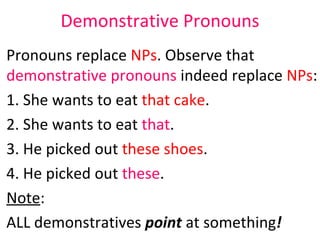
Demonstrative Pronouns Pronouns replace  NPs . Observe that  demonstrative pronouns  indeed replace  NPs :  1. She wants to eat  that cake .  2. She wants to eat  that .  3. He picked out  these shoes .  4. He picked out  these .  Note : ALL demonstratives  point  at something !
Homework Read and do all the exercises of lesson 23
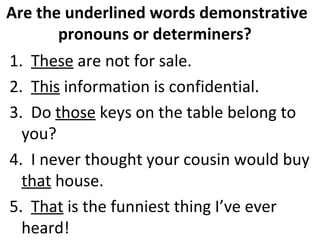
Are the underlined words demonstrative pronouns or determiners?  1.  These  are not for sale. 2.  This  information is confidential. 3.  Do  those  keys on the table belong to you? 4.  I never thought your cousin would buy  that  house. 5.  That  is the funniest thing I’ve ever heard!
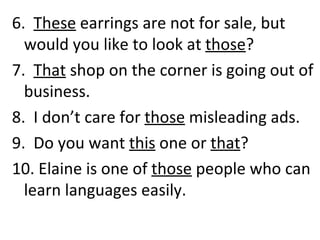
6.  These  earrings are not for sale, but would you like to look at  those ? 7.  That  shop on the corner is going out of business. 8.  I don’t care for  those  misleading ads. 9.  Do you want  this  one or  that ? 10. Elaine is one of  those  people who can learn languages easily.
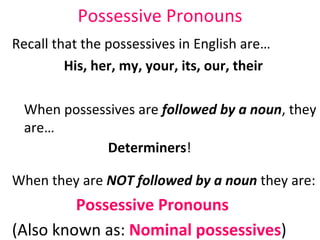
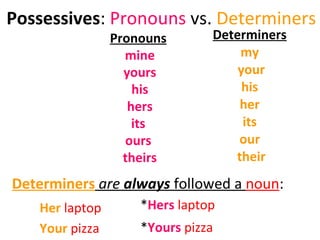
Possessive Pronouns Recall that the possessives in English are… His, her, my, your, its, our, their  When possessives are  followed by a noun , they are… Determiners ! When they are  NOT followed by a noun  they are:  Possessive Pronouns (Also known as:  Nominal possessives )
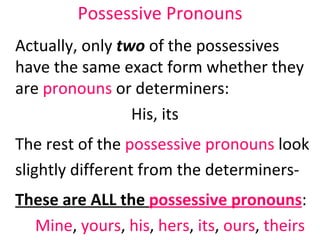
Possessive Pronouns Actually, only  two   of the possessives have the same exact form whether they are  pronouns  or determiners:  His, its The rest of the  possessive pronouns  look slightly different from the determiners-  These are ALL the  possessive pronouns : Mine ,  yours ,  his ,  hers ,  its ,  ours ,  theirs
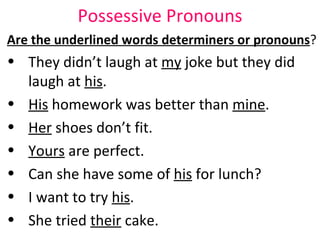
Possessive Pronouns Are the underlined words determiners or pronouns ?  They didn’t laugh at  my  joke but they did laugh at  his .  His  homework was better than  mine .  Her  shoes don’t fit.  Yours  are perfect.  Can she have some of  his  for lunch?  I want to try  his .  She tried  their  cake.
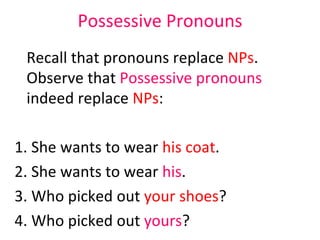
Possessive Pronouns Recall that pronouns replace  NPs . Observe that  Possessive pronouns  indeed replace  NPs :  1. She wants to wear  his coat .  2. She wants to wear  his .  3. Who picked out  your shoes ?  4. Who picked out  yours ?
Homework Read and do all the exercises of lesson 24
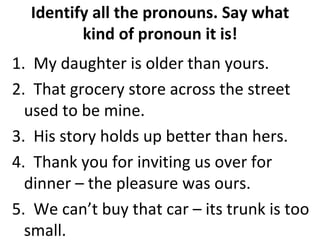
Identify all the pronouns. Say what kind of pronoun it is! 1.  My daughter is older than yours. 2.  That grocery store across the street used to be mine. 3.  His story holds up better than hers. 4.  Thank you for inviting us over for dinner – the pleasure was ours. 5.  We can’t buy that car – its trunk is too small.
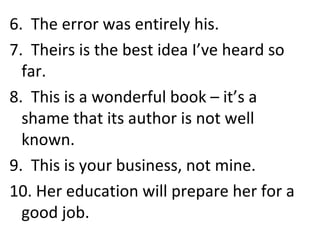
6.  The error was entirely his. 7.  Theirs is the best idea I’ve heard so far. 8.  This is a wonderful book – it’s a shame that its author is not well known. 9.  This is your business, not mine. 10. Her education will prepare her for a good job.
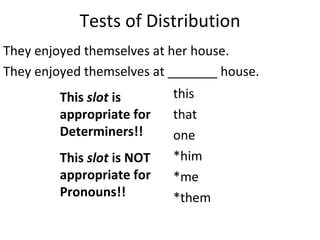
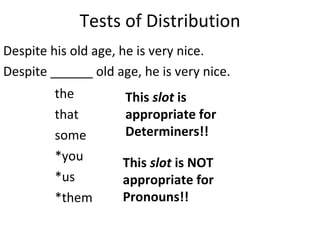
Tests of Distribution They enjoyed themselves at her house.  They enjoyed themselves at _______ house.  this that one *him *me *them This  slot  is appropriate for Determiners!! This  slot  is NOT appropriate for Pronouns!!
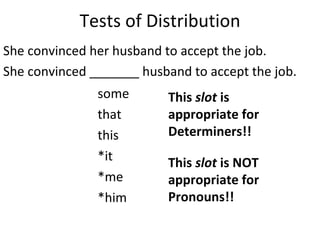
Tests of Distribution Despite his old age, he is very nice.  Despite ______ old age, he is very nice.  the that some *you *us *them This  slot  is appropriate for Determiners!! This  slot  is NOT appropriate for Pronouns!!
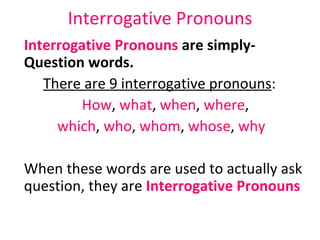
Tests of Distribution She convinced her husband to accept the job.  She convinced _______ husband to accept the job.  some that this *it *me *him This  slot  is appropriate for Determiners!! This  slot  is NOT appropriate for Pronouns!!
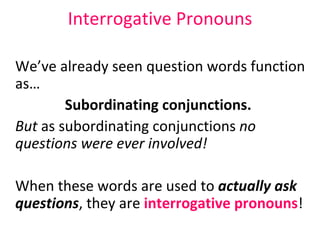
Interrogative Pronouns Interrogative Pronouns  are simply-  Question words.   There are 9 interrogative pronouns :  How ,  what ,  when ,  where ,  which ,  who ,  whom ,  whose ,  why When these words are used to actually ask question, they are  Interrogative Pronouns
Interrogative Pronouns We’ve already seen question words function as… Subordinating conjunctions.  But  as subordinating conjunctions  no questions were ever involved! When these words are used to  actually   ask questions , they are  interrogative pronouns !
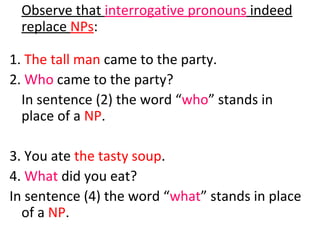
Observe that  interrogative pronouns  indeed replace  NPs :  1.  The tall man  came to the party.  2.  Who  came to the party?  In sentence (2) the word “ who ” stands in place of a  NP .  3. You ate  the tasty   soup .  4.  What  did you eat?  In sentence (4) the word “ what ” stands in place of a  NP .
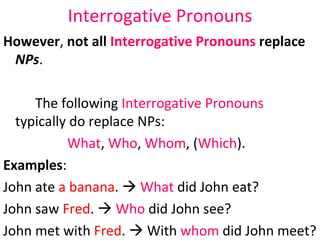
Interrogative Pronouns However ,  not all  Interrogative Pronouns  replace  NPs .  The following  Interrogative Pronouns   typically do replace NPs:  What ,  Who ,  Whom , ( Which ).  Examples : John ate  a banana .     What  did John eat?  John saw  Fred .     Who  did John see?  John met with  Fred .    With  whom  did John meet?  John wants  that one .     Which  does John want?
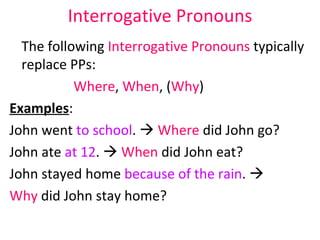
Interrogative Pronouns The following  Interrogative Pronouns  typically replace PPs: Where ,  When , ( Why ) Examples : John went  to school .     Where  did John go?  John ate  at 12 .     When  did John eat?  John stayed home  because of the rain .     Why  did John stay home?
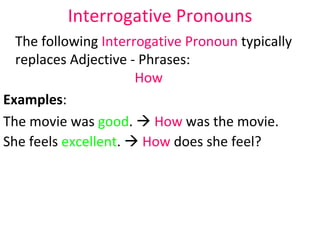
Interrogative Pronouns The following  Interrogative Pronoun  typically replaces Adjective - Phrases:    How Examples :  The movie was  good .     How  was the movie.  She feels  excellent .     How  does she feel?
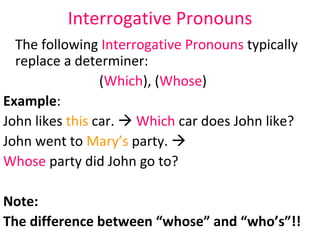
Interrogative Pronouns The following  Interrogative Pronouns  typically replace a determiner:  ( Which ), ( Whose ) Example :  John likes  this  car.     Which  car does John like? John went to  Mary’s  party.     Whose  party did John go to?  Note:  The difference between “whose” and “who’s”!!
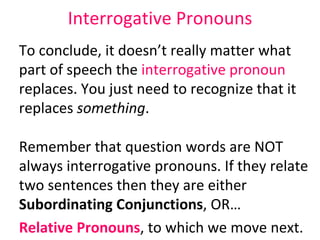
Interrogative Pronouns To conclude, it doesn’t really matter what part of speech the  interrogative pronoun  replaces. You just need to recognize that it replaces  something .  Remember that question words are NOT always interrogative pronouns. If they relate two sentences then they are either  Subordinating Conjunctions , OR…  Relative Pronouns , to which we move next.
Homework Read and do all the exercises of lesson 25
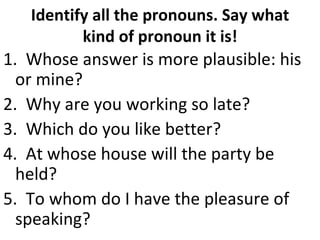
Identify all the pronouns. Say what kind of pronoun it is! 1.  Whose answer is more plausible: his or mine? 2.  Why are you working so late? 3.  Which do you like better? 4.  At whose house will the party be held? 5.  To whom do I have the pleasure of speaking?
6.  How did she arrive at that conclusion? 7.  When will we take our lunch break? 8.  What is it about this candidate that you don’t like? 9.  Where did your sister meet her? 10. Who is going to clean up your mess? 11. We came across a friend of ours at the mall yesterday. 12. I can't find my pencil. Can I use yours?
Subjects and Predicates- Review It is easy to identify the predicate of a sentence:  Simply look for the verb! Every  sentence of English has a verb.  The  subject  of the sentence answers the  questions:  Who  or  What   predicate ?
Note : Direct objects also answer the questions:  Who  or  What .  However , direct objects appear AFTER the verb, while  subjects  appear BEFORE the verb.  Example:   1. John sold his car.     To find the object we ask :   What  did John sell?     To find the subject we ask :   Who  sold his car?
Subjects   and  Predicates 1. John ate.     What’s the verb?      So, what is the  predicate ?    Who  ate?    So, what is the  subject ?  2. The tall man slept all night.    What’s the  predicate ?  What’s the  subject ?   3. The winds blew strong.  4. The chair broke yesterday.  Eat.  Ate .  John. John . Slept . The tall man .
Every  clause  has a subject and a predicate!! [I think] [that Frank is a good man] [but he isn’t right for the job]. [While they were eating], [darkness descended over the campsite].  After she finished working she was late for our meeting, but I wasn’t upset.  Although Susan doesn’t live in the U.S., her English is excellent.  They acted as if nothing happened, and that was quite insensitive of them.
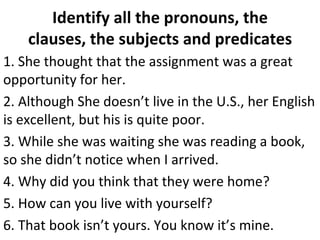
Identify all the pronouns, the clauses, the subjects and predicates 1. She thought that the assignment was a great opportunity for her.  2. Although She doesn’t live in the U.S., her English is excellent, but his is quite poor.  3. While she was waiting she was reading a book, so she didn’t notice when I arrived.  4. Why did you think that they were home?  5. How can you live with yourself?  6. That book isn’t yours. You know it’s mine.
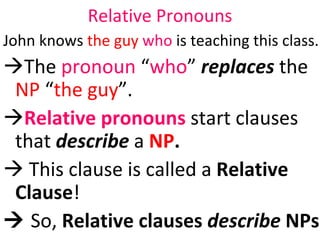
Relative Pronouns John knows  the guy   who  is teaching this class.   The  pronoun  “ who ”  replaces  the  NP  “ the guy ”.   Relative pronouns   start clauses that   describe   a   NP .    This clause is called a  Relative Clause !    So,  Relative clauses  describe  NPs
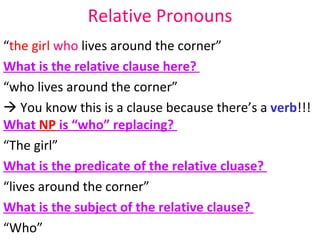
Relative Pronouns “ the girl   who  lives around the corner” What is the relative clause here?  “ who lives around the corner”    You know this is a clause because there’s a  verb !!!  What  NP  is “who” replacing?  “ The girl” What is the predicate of the relative cluase?  “ lives around the corner” What is the subject of the relative clause?  “ Who”
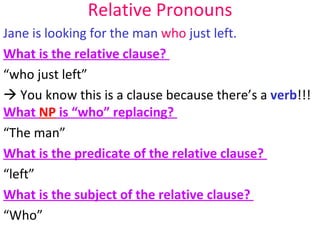
Relative Pronouns Jane is looking for the man  who  just left.  What is the relative clause?  “who just left”   You know this is a clause because there’s a  verb !!! What  NP  is “who” replacing?  “The man” What is the predicate of the relative clause?  “left” What is the subject of the relative clause?  “Who”
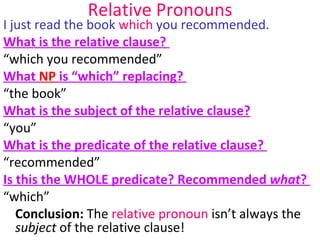
Relative Pronouns I just read the book  which  you recommended.  What is the relative clause?  “which you recommended” What  NP  is “which” replacing?  “the book” What is the subject of the relative clause?   “you” What is the predicate of the relative clause?  “recommended” Is this the WHOLE predicate? Recommended  what ?  “ which” Conclusion:  The  relative pronoun  isn’t always the  subject  of the relative clause!
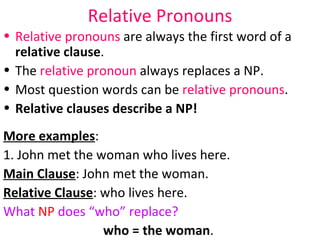
Relative Pronouns Relative pronouns  are always the first word of a  relative clause . The  relative pronoun  always replaces a NP. Most question words can be  relative pronouns . Relative clauses describe a NP! More examples :  1. John met the woman who lives here.  Main Clause : John met the woman.  Relative Clause : who lives here.  What  NP  does “who” replace?  who = the woman .
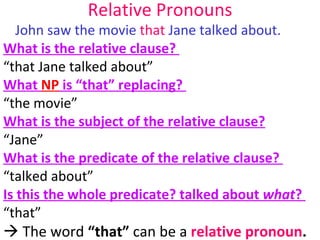
Relative Pronouns John saw the movie  that  Jane talked about.  What is the relative clause?  “ that Jane talked about” What  NP  is “that” replacing?  “ the movie” What is the subject of the relative clause?   “ Jane” What is the predicate of the relative clause?  “ talked about” Is this the whole predicate? talked about  what ?  “ that”    The word  “that”  can be a   relative pronoun .
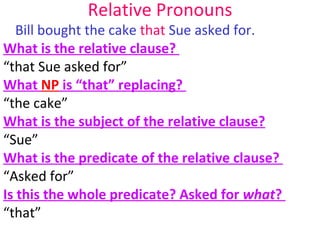
Relative Pronouns Bill bought the cake  that  Sue asked for.  What is the relative clause?  “ that Sue asked for” What  NP  is “that” replacing?  “ the cake” What is the subject of the relative clause?   “ Sue” What is the predicate of the relative clause?  “ Asked for” Is this the whole predicate? Asked for  what ?  “ that”
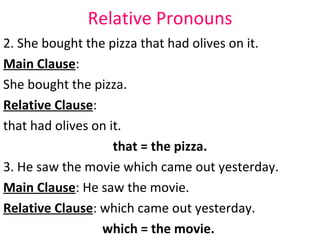
Relative Pronouns 2. She bought the pizza that had olives on it.  Main Clause :  She bought the pizza.  Relative Clause :  that had olives on it.  that = the pizza.  3. He saw the movie which came out yesterday.  Main Clause : He saw the movie.  Relative Clause : which came out yesterday.  which = the movie.
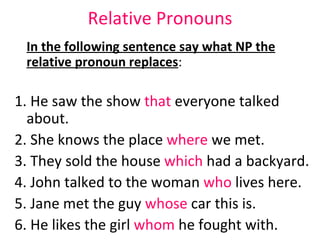
Relative Pronouns In the following sentence say what NP the relative pronoun replaces : 1. He saw the show  that  everyone talked about. 2. She knows the place  where  we met.  3. They sold the house  which  had a backyard. 4. John talked to the woman  who  lives here.  5. Jane met the guy  whose  car this is.  6. He likes the girl  whom  he fought with.
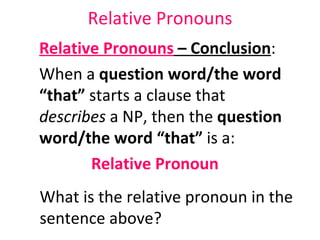
Relative Pronouns Relative Pronouns  – Conclusion :  When a  question word/the word “that”  starts a clause that  describes  a NP, then the  question word/the word “that”  is a:  Relative Pronoun What is the relative pronoun in the sentence above?
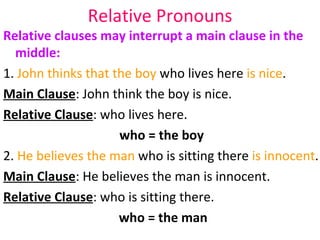
Relative Pronouns Relative clauses may interrupt a main clause in the middle:  1.  John thinks that the boy  who lives here  is nice .  Main Clause : John think the boy is nice.  Relative Clause : who lives here.  who = the boy   2.  He believes the man  who is sitting there  is innocent .  Main Clause : He believes the man is innocent.  Relative Clause : who is sitting there.  who = the man
Relative Pronouns Challenge question :  Make up sentences with the words “ why ”, “ when ”, “ where ” and “ whose ” as relative pronouns.
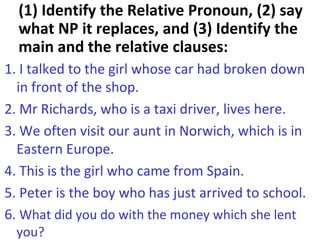
(1) Identify the Relative Pronoun, (2) say what NP it replaces, and (3) Identify the main and the relative clauses: 1. I talked to the girl whose car had broken down in front of the shop. 2. Mr Richards, who is a taxi driver, lives here. 3. We often visit our aunt in Norwich, which is in Eastern Europe. 4. This is the girl who came from Spain. 5. Peter is the boy who has just arrived to school. 6.  What did you do with the money which she lent you?
Relative Pronouns  vs. Subordinating Conjunctions What is the difference between subordinating conjunctions and relative pronouns?  1. Subordinating conjunctions  don’t  replace  NPs.  Relative pronouns  do  replace  a NP.  2. Subordinate clauses  don’t  describe  a NP.  Relative clauses  do  describe  a NP.
Relative Pronouns  vs. Subordinating Conjunctions 1. John thought that the meal was tasty.  Clause I : John thought.  Clause II : that the meal was tasty.  that = ? Result : “that” in (1) is NOT a  relative pronoun . It is a  subordinating conjunction .
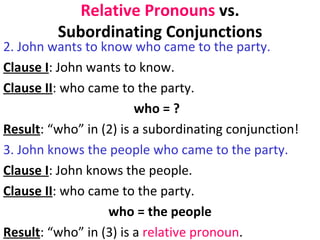
Relative Pronouns  vs. Subordinating Conjunctions 2. John wants to know who came to the party.  Clause I : John wants to know.  Clause II : who came to the party.  who = ?  Result : “who” in (2) is a subordinating conjunction! 3. John knows the people who came to the party.  Clause I : John knows the people.  Clause II : who came to the party.  who = the people Result : “who” in (3) is a  relative pronoun .
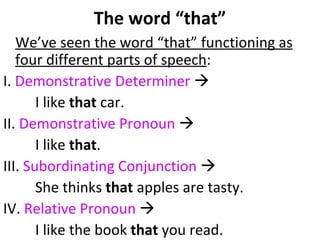
The word “that” We’ve seen the word “that” functioning as four different parts of speech :  I.  Demonstrative Determiner      I like  that  car.  II.  Demonstrative Pronoun      I like  that .  III.  Subordinating Conjunction      She thinks  that  apples are tasty.  IV.  Relative Pronoun      I like the book  that  you read.
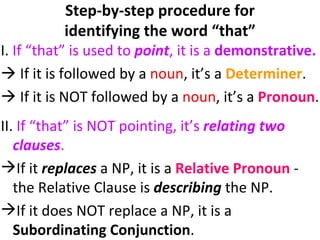
Step-by-step procedure for identifying the word “that” I.  If “that” is used to  point , it is a  demonstrative.      If it is followed by a  noun , it’s a  Determiner .     If it is NOT followed by a  noun , it’s a  Pronoun .  II.  If “that” is NOT pointing, it’s  relating two clauses . If it  replaces  a NP, it is a  Relative Pronoun  - the Relative Clause is  describing  the NP.  If it does NOT replace a NP, it is a  Subordinating Conjunction .
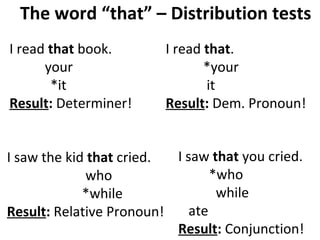
The word “that” – Distribution tests I read  that  book.    your *it Result :  Determiner! I read  that . *your it Result :  Dem. Pronoun!  I saw the kid  that  cried. who *while  Result :  Relative Pronoun! I saw  that  you cried.  *who while ate Result :  Conjunction!
Step-by-step procedure for identifying Question Words I.  If a question word is used to  actually ask a question , it is an  interrogative   pronoun .   Example :  What  did you eat?  II.  If it is NOT used to ask a question, it is  relating two clauses . If it  replaces  a NP, it is a  Relative Pronoun  - the Relative Clause is  describing  the NP.  Example : I know the boy [ who  lives here].  If it does NOT replace a NP from the main clause, it is a  Subordinating Conjunction .  Example : I don’t know [ when  the movie starts].
Homework Read and do all the exercises of lesson 26
Possessives :  Pronouns  vs.  Determiners Determiners   my  your his  her  its  our  their Pronouns   mine yours his hers its  ours  theirs Determiners   are  always  followed a  noun :  Her   laptop Your   pizza   * Hers   laptop   * Yours   pizza
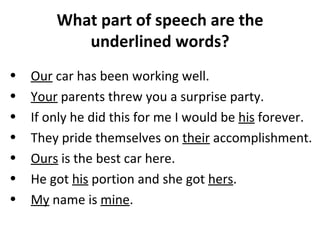
What part of speech are the underlined words? Our  car has been working well.  Your  parents threw you a surprise party.  If only he did this for me I would be  his  forever.  They pride themselves on  their  accomplishment.  Ours  is the best car here.  He got  his  portion and she got  hers .  My  name is  mine .
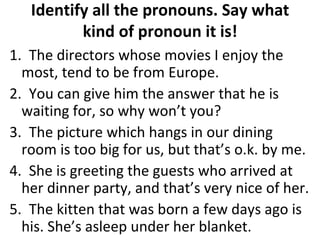
Identify all the pronouns. Say what kind of pronoun it is! 1.  The directors whose movies I enjoy the most, tend to be from Europe. 2.  You can give him the answer that he is waiting for, so why won’t you? 3.  The picture which hangs in our dining room is too big for us, but that’s o.k. by me. 4.  She is greeting the guests who arrived at her dinner party, and that’s very nice of her.  5.  The kitten that was born a few days ago is his. She’s asleep under her blanket.
6.  I couldn’t understand the document that I had written myself. 7.  You should seek advice from your friend whom you trust the most with this. 8.  We usually watch TV in the room which is in the back of our house. 9.  The gas station attendant who gave us directions to that park was courteous. 10. We are playing tennis with the woman who won that yesterday.

Unit 7 pronouns

  • 1.
    Pronouns Pronouns are words that replace noun-phrases John smiled. He smiled. The girl smiled. 4. She smiled. 5. The nice students smiled. 6. They smiled.
  • 2.
    Pronouns It isoften the case that a pronoun MUST replace a noun-phrase : 1. *The man bought lunch and then the man ate it. 2. The man bought lunch and then he ate it. 3. The teacher: “*Nadav Sabar is the teacher of LCD 120”. 4. I am the teacher of LCD 120. 5. *John told Mary that John likes Mary. 6. John told Mary that he likes her .
  • 3.
    Pronouns Below aresome common pronouns of English: I , us , we , them , they , me , him , she , her , he . Divide these pronouns into two groups based on which can appear in each sentence below: ______ like/likes John. John likes ________. Give a title to each group of pronouns.
  • 4.
    Pronouns ________ like/s John. I You He She It We They Subject Pronouns
  • 5.
    Pronouns John likes _______ me you her him it us them Object Pronouns
  • 6.
    Subject and ObjectPronouns Subject and Object Pronouns are the only words in English that CHANGE depending on whether they are the subject or the object of a sentence: 1. Jake likes Mary. 3. Mary likes Jake. 2. He likes her . 4. She likes him . 5. Nadav and the class study linguistics. 7. John saw Nadav and the class. 9. The boys met the girls. 6. We study linguistics. 8. John saw us . 10. They met them .
  • 7.
    Subject and ObjectPronouns Why is the following sentence starred? *Jane walked beside I . First note: “I” is NOT the object of the sentence. Recall that prepositions MUST be followed by NPs. The NP that follows the preposition is called: “ Object of a Preposition ”. A Subject Pronoun CANNOT be the Object of a Preposition! 2. Jane walked beside me .
  • 8.
    Subject and ObjectPronouns First Person Pronouns refer to the speaker/s : I , we , me , us Second person pronouns refer to the listener/s : You Third person pronouns refer to anyone or anything that is NOT part of the conversation : He , she , it , they , him , her , them
  • 9.
    Object Subject Person Me I 1 st Singular: Us We 1 st Plural: You You 2 nd Singular: You You 2 nd Plural: Him , Her , It He , She , It 3 rd Singular: Them They 3 rd Plural:
  • 10.
    Are the followingpronouns Subject or Object, singular or plural? we them her I us him they me he She You it
  • 11.
    Challenge Question Whatcan you learn about Subject and Object Pronouns in the English of Shakespeare, based on the quote below? Shall I compare thee to a summer's day? Thou art more lovely and more temperate. - Shakespeare, Sonnet 18
  • 12.
    2 nd Challenge Question Could an Object Pronoun be the subject of a subordinate clause?
  • 13.
    Homework Read anddo all the exercises of lesson 21
  • 14.
    Reflexive Pronouns 1. John saw him in the picture. Who does “him” refer to? Who could NOT be the referent of “him”? 2. John saw himself in the picture. Here, “ himself ” MUST refer to John.
  • 15.
    Reflexive Pronouns Reflexive pronouns are used whenever we want to refer to the same person or thing within the same clause . Examples : 1. She is proud of herself . 2. They talked about themselves . 3. We saw ourselves in the mirror. 4. You think so highly of yourself .
  • 16.
    Reflexive Pronouns Why do we say that Reflexive Pronouns refer to the same person or thing within the same clause , and NOT within the same sentence ? Observe: [John thinks] [that he is smart]. *[John thinks] [that himself is smart]. [Mary ate] [while she was reading]. *[Mary ate] [while herself was reading]. [Mike slept] and then [ he ate lunch]. *[Mike slept] and then [ himself ate lunch].
  • 17.
    Reflexive Pronouns There are 8 Reflexive Pronouns in English: Myself , yourself , himself , herself , itself , ourselves , yourselves , themselves . Just like Subject Pronouns and Object Pronouns (in fact like ALL pronouns ), Reflexive Pronouns replace a noun-phrase .
  • 18.
    To enhance yourunderstanding Subject and Object Pronouns could be obligatory : 1. *John ate breakfast and then John left for school. 2. John ate breakfast and then he left for school. Subject and Object Pronouns are sometimes optional : 3. (pointing at John I say  ) He forgot his coat. OR: John forgot his coat.
  • 19.
    To enhance yourunderstanding Reflexive Pronouns, however, are ALWAYS obligatory : 1. *John talks to John sometimes. 2. John talks to himself sometimes. “ Obligatory” means that if you NEED to use a reflexive, then you MUST use a reflexive. Otherwise it would appear that you are NOT talking about the same person or thing.
  • 20.
    Challenge Question Cana reflexive pronoun be the subject of a sentence? If yes , how? If no , why not? Reflexive pronouns are always the object of a sentence, or the object of a preposition!! Examples : *Myself ate the cake. I ate the cake by myself. *Herself likes her. She likes herself.
  • 21.
    Homework Read anddo all the exercises of lesson 22
  • 22.
    Find the reflexivepronouns 1. They were proud of themselves. 2. She bought herself an expensive scarf. 3. We covered ourselves with a warm blanket. 4. You should be ashamed of yourselves for talking like that! 5. I wrote myself a note to call my sister later in the evening. 6. The answer revealed itself pretty quickly.
  • 23.
    Demonstrative Pronouns Recallthat the demonstratives in English are… This, that, these, those When demonstratives are followed by a noun, they are… Determiners ! When they are NOT followed by a noun they are: Demonstrative Pronouns
  • 24.
    Demonstrative Pronouns Arethe underlined words determiners or pronouns ? That looks tasty. That pizza looks tasty. These shoes don’t fit. These are perfect. I like those hats. I want to try those . She tried this cake. You must see this .
  • 25.
    Demonstrative Pronouns Pronounsreplace NPs . Observe that demonstrative pronouns indeed replace NPs : 1. She wants to eat that cake . 2. She wants to eat that . 3. He picked out these shoes . 4. He picked out these . Note : ALL demonstratives point at something !
  • 26.
    Homework Read anddo all the exercises of lesson 23
  • 27.
    Are the underlinedwords demonstrative pronouns or determiners? 1. These are not for sale. 2. This information is confidential. 3. Do those keys on the table belong to you? 4. I never thought your cousin would buy that house. 5. That is the funniest thing I’ve ever heard!
  • 28.
    6. These earrings are not for sale, but would you like to look at those ? 7. That shop on the corner is going out of business. 8. I don’t care for those misleading ads. 9. Do you want this one or that ? 10. Elaine is one of those people who can learn languages easily.
  • 29.
    Possessive Pronouns Recallthat the possessives in English are… His, her, my, your, its, our, their When possessives are followed by a noun , they are… Determiners ! When they are NOT followed by a noun they are: Possessive Pronouns (Also known as: Nominal possessives )
  • 30.
    Possessive Pronouns Actually,only two of the possessives have the same exact form whether they are pronouns or determiners: His, its The rest of the possessive pronouns look slightly different from the determiners- These are ALL the possessive pronouns : Mine , yours , his , hers , its , ours , theirs
  • 31.
    Possessive Pronouns Arethe underlined words determiners or pronouns ? They didn’t laugh at my joke but they did laugh at his . His homework was better than mine . Her shoes don’t fit. Yours are perfect. Can she have some of his for lunch? I want to try his . She tried their cake.
  • 32.
    Possessive Pronouns Recallthat pronouns replace NPs . Observe that Possessive pronouns indeed replace NPs : 1. She wants to wear his coat . 2. She wants to wear his . 3. Who picked out your shoes ? 4. Who picked out yours ?
  • 33.
    Homework Read anddo all the exercises of lesson 24
  • 34.
    Identify all thepronouns. Say what kind of pronoun it is! 1. My daughter is older than yours. 2. That grocery store across the street used to be mine. 3. His story holds up better than hers. 4. Thank you for inviting us over for dinner – the pleasure was ours. 5. We can’t buy that car – its trunk is too small.
  • 35.
    6. Theerror was entirely his. 7. Theirs is the best idea I’ve heard so far. 8. This is a wonderful book – it’s a shame that its author is not well known. 9. This is your business, not mine. 10. Her education will prepare her for a good job.
  • 36.
    Tests of DistributionThey enjoyed themselves at her house. They enjoyed themselves at _______ house. this that one *him *me *them This slot is appropriate for Determiners!! This slot is NOT appropriate for Pronouns!!
  • 37.
    Tests of DistributionDespite his old age, he is very nice. Despite ______ old age, he is very nice. the that some *you *us *them This slot is appropriate for Determiners!! This slot is NOT appropriate for Pronouns!!
  • 38.
    Tests of DistributionShe convinced her husband to accept the job. She convinced _______ husband to accept the job. some that this *it *me *him This slot is appropriate for Determiners!! This slot is NOT appropriate for Pronouns!!
  • 39.
    Interrogative Pronouns InterrogativePronouns are simply- Question words. There are 9 interrogative pronouns : How , what , when , where , which , who , whom , whose , why When these words are used to actually ask question, they are Interrogative Pronouns
  • 40.
    Interrogative Pronouns We’vealready seen question words function as… Subordinating conjunctions. But as subordinating conjunctions no questions were ever involved! When these words are used to actually ask questions , they are interrogative pronouns !
  • 41.
    Observe that interrogative pronouns indeed replace NPs : 1. The tall man came to the party. 2. Who came to the party? In sentence (2) the word “ who ” stands in place of a NP . 3. You ate the tasty soup . 4. What did you eat? In sentence (4) the word “ what ” stands in place of a NP .
  • 42.
    Interrogative Pronouns However, not all Interrogative Pronouns replace NPs . The following Interrogative Pronouns typically do replace NPs: What , Who , Whom , ( Which ). Examples : John ate a banana .  What did John eat? John saw Fred .  Who did John see? John met with Fred .  With whom did John meet? John wants that one .  Which does John want?
  • 43.
    Interrogative Pronouns Thefollowing Interrogative Pronouns typically replace PPs: Where , When , ( Why ) Examples : John went to school .  Where did John go? John ate at 12 .  When did John eat? John stayed home because of the rain .  Why did John stay home?
  • 44.
    Interrogative Pronouns Thefollowing Interrogative Pronoun typically replaces Adjective - Phrases: How Examples : The movie was good .  How was the movie. She feels excellent .  How does she feel?
  • 45.
    Interrogative Pronouns Thefollowing Interrogative Pronouns typically replace a determiner: ( Which ), ( Whose ) Example : John likes this car.  Which car does John like? John went to Mary’s party.  Whose party did John go to? Note: The difference between “whose” and “who’s”!!
  • 46.
    Interrogative Pronouns Toconclude, it doesn’t really matter what part of speech the interrogative pronoun replaces. You just need to recognize that it replaces something . Remember that question words are NOT always interrogative pronouns. If they relate two sentences then they are either Subordinating Conjunctions , OR… Relative Pronouns , to which we move next.
  • 47.
    Homework Read anddo all the exercises of lesson 25
  • 48.
    Identify all thepronouns. Say what kind of pronoun it is! 1. Whose answer is more plausible: his or mine? 2. Why are you working so late? 3. Which do you like better? 4. At whose house will the party be held? 5. To whom do I have the pleasure of speaking?
  • 49.
    6. Howdid she arrive at that conclusion? 7. When will we take our lunch break? 8. What is it about this candidate that you don’t like? 9. Where did your sister meet her? 10. Who is going to clean up your mess? 11. We came across a friend of ours at the mall yesterday. 12. I can't find my pencil. Can I use yours?
  • 50.
    Subjects and Predicates-Review It is easy to identify the predicate of a sentence: Simply look for the verb! Every sentence of English has a verb. The subject of the sentence answers the questions: Who or What predicate ?
  • 51.
    Note : Directobjects also answer the questions: Who or What . However , direct objects appear AFTER the verb, while subjects appear BEFORE the verb. Example: 1. John sold his car.  To find the object we ask : What did John sell?  To find the subject we ask : Who sold his car?
  • 52.
    Subjects and Predicates 1. John ate.  What’s the verb?  So, what is the predicate ?  Who ate?  So, what is the subject ? 2. The tall man slept all night.  What’s the predicate ? What’s the subject ? 3. The winds blew strong. 4. The chair broke yesterday. Eat. Ate . John. John . Slept . The tall man .
  • 53.
    Every clause has a subject and a predicate!! [I think] [that Frank is a good man] [but he isn’t right for the job]. [While they were eating], [darkness descended over the campsite]. After she finished working she was late for our meeting, but I wasn’t upset. Although Susan doesn’t live in the U.S., her English is excellent. They acted as if nothing happened, and that was quite insensitive of them.
  • 54.
    Identify all thepronouns, the clauses, the subjects and predicates 1. She thought that the assignment was a great opportunity for her. 2. Although She doesn’t live in the U.S., her English is excellent, but his is quite poor. 3. While she was waiting she was reading a book, so she didn’t notice when I arrived. 4. Why did you think that they were home? 5. How can you live with yourself? 6. That book isn’t yours. You know it’s mine.
  • 55.
    Relative Pronouns Johnknows the guy who is teaching this class.  The pronoun “ who ” replaces the NP “ the guy ”.  Relative pronouns start clauses that describe a NP .  This clause is called a Relative Clause !  So, Relative clauses describe NPs
  • 56.
    Relative Pronouns “the girl who lives around the corner” What is the relative clause here? “ who lives around the corner”  You know this is a clause because there’s a verb !!! What NP is “who” replacing? “ The girl” What is the predicate of the relative cluase? “ lives around the corner” What is the subject of the relative clause? “ Who”
  • 57.
    Relative Pronouns Janeis looking for the man who just left. What is the relative clause? “who just left”  You know this is a clause because there’s a verb !!! What NP is “who” replacing? “The man” What is the predicate of the relative clause? “left” What is the subject of the relative clause? “Who”
  • 58.
    Relative Pronouns Ijust read the book which you recommended. What is the relative clause? “which you recommended” What NP is “which” replacing? “the book” What is the subject of the relative clause? “you” What is the predicate of the relative clause? “recommended” Is this the WHOLE predicate? Recommended what ? “ which” Conclusion: The relative pronoun isn’t always the subject of the relative clause!
  • 59.
    Relative Pronouns Relativepronouns are always the first word of a relative clause . The relative pronoun always replaces a NP. Most question words can be relative pronouns . Relative clauses describe a NP! More examples : 1. John met the woman who lives here. Main Clause : John met the woman. Relative Clause : who lives here. What NP does “who” replace? who = the woman .
  • 60.
    Relative Pronouns Johnsaw the movie that Jane talked about. What is the relative clause? “ that Jane talked about” What NP is “that” replacing? “ the movie” What is the subject of the relative clause? “ Jane” What is the predicate of the relative clause? “ talked about” Is this the whole predicate? talked about what ? “ that”  The word “that” can be a relative pronoun .
  • 61.
    Relative Pronouns Billbought the cake that Sue asked for. What is the relative clause? “ that Sue asked for” What NP is “that” replacing? “ the cake” What is the subject of the relative clause? “ Sue” What is the predicate of the relative clause? “ Asked for” Is this the whole predicate? Asked for what ? “ that”
  • 62.
    Relative Pronouns 2.She bought the pizza that had olives on it. Main Clause : She bought the pizza. Relative Clause : that had olives on it. that = the pizza. 3. He saw the movie which came out yesterday. Main Clause : He saw the movie. Relative Clause : which came out yesterday. which = the movie.
  • 63.
    Relative Pronouns Inthe following sentence say what NP the relative pronoun replaces : 1. He saw the show that everyone talked about. 2. She knows the place where we met. 3. They sold the house which had a backyard. 4. John talked to the woman who lives here. 5. Jane met the guy whose car this is. 6. He likes the girl whom he fought with.
  • 64.
    Relative Pronouns RelativePronouns – Conclusion : When a question word/the word “that” starts a clause that describes a NP, then the question word/the word “that” is a: Relative Pronoun What is the relative pronoun in the sentence above?
  • 65.
    Relative Pronouns Relativeclauses may interrupt a main clause in the middle: 1. John thinks that the boy who lives here is nice . Main Clause : John think the boy is nice. Relative Clause : who lives here. who = the boy 2. He believes the man who is sitting there is innocent . Main Clause : He believes the man is innocent. Relative Clause : who is sitting there. who = the man
  • 66.
    Relative Pronouns Challengequestion : Make up sentences with the words “ why ”, “ when ”, “ where ” and “ whose ” as relative pronouns.
  • 67.
    (1) Identify theRelative Pronoun, (2) say what NP it replaces, and (3) Identify the main and the relative clauses: 1. I talked to the girl whose car had broken down in front of the shop. 2. Mr Richards, who is a taxi driver, lives here. 3. We often visit our aunt in Norwich, which is in Eastern Europe. 4. This is the girl who came from Spain. 5. Peter is the boy who has just arrived to school. 6. What did you do with the money which she lent you?
  • 68.
    Relative Pronouns vs. Subordinating Conjunctions What is the difference between subordinating conjunctions and relative pronouns? 1. Subordinating conjunctions don’t replace NPs. Relative pronouns do replace a NP. 2. Subordinate clauses don’t describe a NP. Relative clauses do describe a NP.
  • 69.
    Relative Pronouns vs. Subordinating Conjunctions 1. John thought that the meal was tasty. Clause I : John thought. Clause II : that the meal was tasty. that = ? Result : “that” in (1) is NOT a relative pronoun . It is a subordinating conjunction .
  • 70.
    Relative Pronouns vs. Subordinating Conjunctions 2. John wants to know who came to the party. Clause I : John wants to know. Clause II : who came to the party. who = ? Result : “who” in (2) is a subordinating conjunction! 3. John knows the people who came to the party. Clause I : John knows the people. Clause II : who came to the party. who = the people Result : “who” in (3) is a relative pronoun .
  • 71.
    The word “that”We’ve seen the word “that” functioning as four different parts of speech : I. Demonstrative Determiner  I like that car. II. Demonstrative Pronoun  I like that . III. Subordinating Conjunction  She thinks that apples are tasty. IV. Relative Pronoun  I like the book that you read.
  • 72.
    Step-by-step procedure foridentifying the word “that” I. If “that” is used to point , it is a demonstrative.  If it is followed by a noun , it’s a Determiner .  If it is NOT followed by a noun , it’s a Pronoun . II. If “that” is NOT pointing, it’s relating two clauses . If it replaces a NP, it is a Relative Pronoun - the Relative Clause is describing the NP. If it does NOT replace a NP, it is a Subordinating Conjunction .
  • 73.
    The word “that”– Distribution tests I read that book. your *it Result : Determiner! I read that . *your it Result : Dem. Pronoun! I saw the kid that cried. who *while Result : Relative Pronoun! I saw that you cried. *who while ate Result : Conjunction!
  • 74.
    Step-by-step procedure foridentifying Question Words I. If a question word is used to actually ask a question , it is an interrogative pronoun . Example : What did you eat? II. If it is NOT used to ask a question, it is relating two clauses . If it replaces a NP, it is a Relative Pronoun - the Relative Clause is describing the NP. Example : I know the boy [ who lives here]. If it does NOT replace a NP from the main clause, it is a Subordinating Conjunction . Example : I don’t know [ when the movie starts].
  • 75.
    Homework Read anddo all the exercises of lesson 26
  • 76.
    Possessives : Pronouns vs. Determiners Determiners my your his her its our their Pronouns mine yours his hers its ours theirs Determiners are always followed a noun : Her laptop Your pizza * Hers laptop * Yours pizza
  • 77.
    What part ofspeech are the underlined words? Our car has been working well. Your parents threw you a surprise party. If only he did this for me I would be his forever. They pride themselves on their accomplishment. Ours is the best car here. He got his portion and she got hers . My name is mine .
  • 78.
    Identify all thepronouns. Say what kind of pronoun it is! 1. The directors whose movies I enjoy the most, tend to be from Europe. 2. You can give him the answer that he is waiting for, so why won’t you? 3. The picture which hangs in our dining room is too big for us, but that’s o.k. by me. 4. She is greeting the guests who arrived at her dinner party, and that’s very nice of her. 5. The kitten that was born a few days ago is his. She’s asleep under her blanket.
  • 79.
    6. Icouldn’t understand the document that I had written myself. 7. You should seek advice from your friend whom you trust the most with this. 8. We usually watch TV in the room which is in the back of our house. 9. The gas station attendant who gave us directions to that park was courteous. 10. We are playing tennis with the woman who won that yesterday.