Clause and Sentence
Structure
• Simple sentences have only one clause.
• Clauses usually consist of a noun group.
• Clauses can also have another noun group
as the object or complement.
• Clauses can have an adverbial, also called an
adjunct.
•Changing the order of the words in a clause
can change its meaning.
•Compound sentences consist of two or
more main clauses. Complex sentences
always include a subordinate clause, as well
as one or more main clauses.
• A simple sentence has one clause, beginning
with a noun group called the subject.
• The subject is the person or thing that the
sentence is about.
• The subject is followed by a verb group,
which tells you what the subject is doing, or
describes the subject’s situation.
I waited.
The girl screamed.
• The verb group may be followed by another
noun group, which is called the object.
• The object is the person or thing affected by
the action or the situation.
He opened the car door.
She married a young engineer.
• After link verbs like ‘be’, ‘become’, ‘feel’, and
‘seem’, the verb group may be followed by a
noun group or an adjective, called a
compliment.
• The compliment tells you more about the
subject.
She was a doctor.
He was angry.
The verb group, the object, or the compliment
can be followed by an adverb or a prepositional
phrase, called an adverbial.
The adverbial tells you more about the action or
situation, for example how, when, or where it
happens.
Adverbials are also called adjuncts.
They shouted loudly.
She won the competition last week.
He was a policeman in London.
The word order of clause is different when the
clause is a statement, a question or a
command.
He speaks English very well. (statement)
Did she buy a present? (question)
Listen! (command)
• A compound sentence has two or more
main clauses: that is, clauses that are
equally important.
• You join compound sentences with
‘and’, ‘but’, or ‘or’.
He met Ann at the bus station and went
home.
I wanted to visit my granny but I fell too
tired.
You can eat your lunch now or you can
wait for us.
• The order of the two clauses can
change the meaning of the sentence.
He went home and met Ann at the
station.
• If the subject of both clauses is the
same, you usually omit the subject in
the second clause.
I wanted to visit my granny but felt too
tired.
• A complex sentence contains a
subordinate clause and at least one
main clause.
• A subordinate clause gives information
about a main clause.
• A subordinate clause is introduced by a
conjunction such as ‘because’, ‘if’,
‘that’, or a ‘wh’-word.
• Subordinate clauses can come before,
after or inside the main clause.
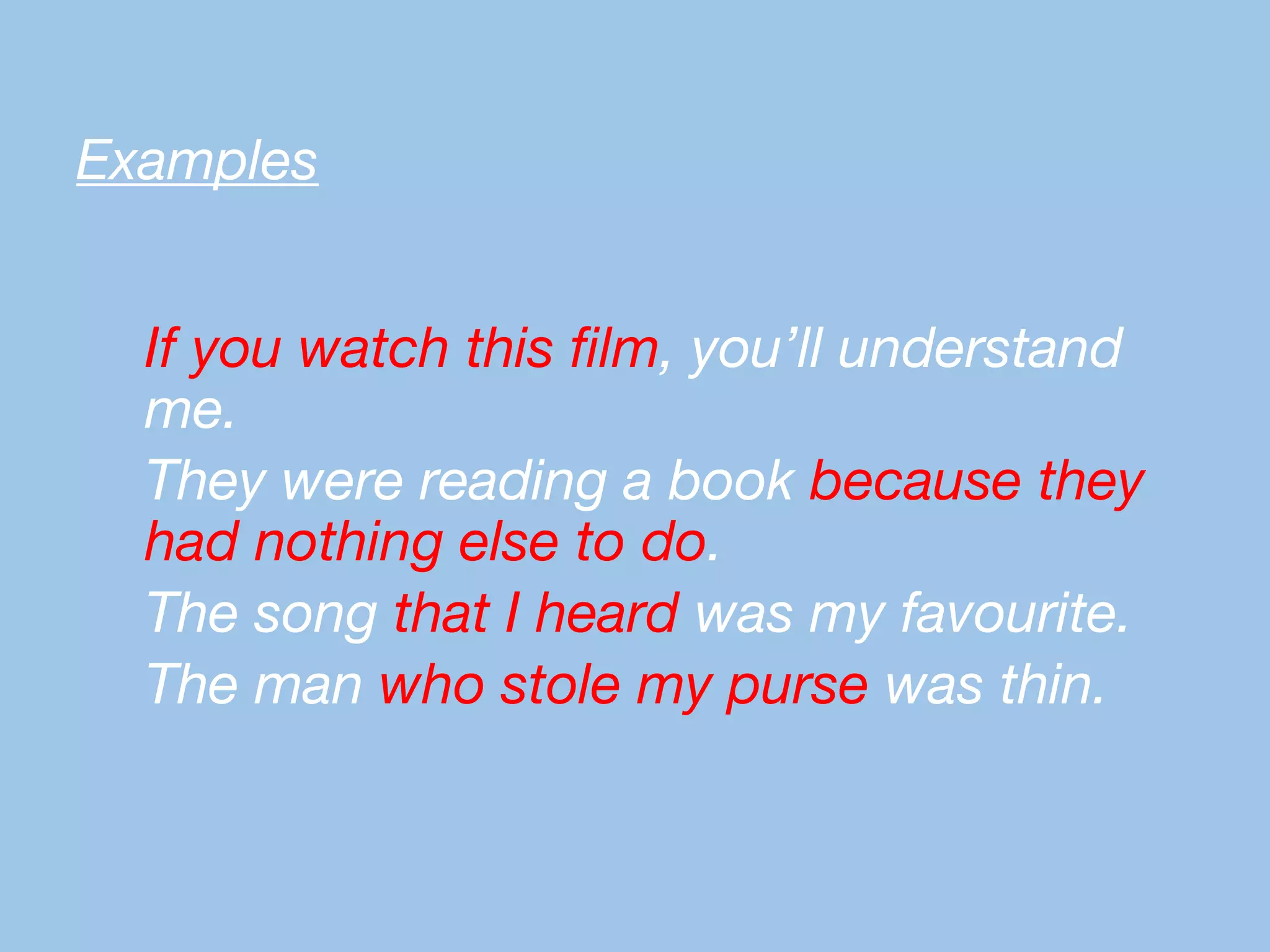
Examples
If you watch this film, you’ll understand
me.
They were reading a book because they
had nothing else to do.
The song that I heard was my favourite.
The man who stole my purse was thin.

Sentence and clause in english

  • 1.
  • 2.
    • Simple sentenceshave only one clause. • Clauses usually consist of a noun group. • Clauses can also have another noun group as the object or complement. • Clauses can have an adverbial, also called an adjunct. •Changing the order of the words in a clause can change its meaning. •Compound sentences consist of two or more main clauses. Complex sentences always include a subordinate clause, as well as one or more main clauses.
  • 3.
    • A simplesentence has one clause, beginning with a noun group called the subject. • The subject is the person or thing that the sentence is about. • The subject is followed by a verb group, which tells you what the subject is doing, or describes the subject’s situation. I waited. The girl screamed.
  • 4.
    • The verbgroup may be followed by another noun group, which is called the object. • The object is the person or thing affected by the action or the situation. He opened the car door. She married a young engineer.
  • 5.
    • After linkverbs like ‘be’, ‘become’, ‘feel’, and ‘seem’, the verb group may be followed by a noun group or an adjective, called a compliment. • The compliment tells you more about the subject. She was a doctor. He was angry.
  • 6.
    The verb group,the object, or the compliment can be followed by an adverb or a prepositional phrase, called an adverbial. The adverbial tells you more about the action or situation, for example how, when, or where it happens. Adverbials are also called adjuncts. They shouted loudly. She won the competition last week. He was a policeman in London.
  • 7.
    The word orderof clause is different when the clause is a statement, a question or a command. He speaks English very well. (statement) Did she buy a present? (question) Listen! (command)
  • 8.
    • A compoundsentence has two or more main clauses: that is, clauses that are equally important. • You join compound sentences with ‘and’, ‘but’, or ‘or’. He met Ann at the bus station and went home. I wanted to visit my granny but I fell too tired. You can eat your lunch now or you can wait for us.
  • 9.
    • The orderof the two clauses can change the meaning of the sentence. He went home and met Ann at the station. • If the subject of both clauses is the same, you usually omit the subject in the second clause. I wanted to visit my granny but felt too tired.
  • 10.
    • A complexsentence contains a subordinate clause and at least one main clause. • A subordinate clause gives information about a main clause. • A subordinate clause is introduced by a conjunction such as ‘because’, ‘if’, ‘that’, or a ‘wh’-word. • Subordinate clauses can come before, after or inside the main clause.
  • 11.
    Examples If you watchthis film, you’ll understand me. They were reading a book because they had nothing else to do. The song that I heard was my favourite. The man who stole my purse was thin.