
Syntax and Teaching grammar


Lesson:THREE


Dra. Rosario María Burneo
Unit five: The lexicon
• The lexicon is the set of all words in a language that
  are registered in a dictionary.
• An entry is each word included in a dictionary.
 Each word provides information about meaning,
  pronunciation, word class, derivation and
  inflection, etc.
Lexical Verbs
 Lexical verbs are all the verbs in the language, except
  auxiliary verbs.

Complement configuration: number and kind of
 complements that each individual verb might take.

-   He bought a house (NP)
-   She is smart
-   Mike works in this company
-   He suggested that you should come to the meeting
Unit six: Clauses I
•   A clause contains basically an NP (subject) and a VP
    (predicate).

Each clause:
1. Has a finite verb (tensed verb).

2. The verb takes one or more complements;

3. Each clause expresses mood (indicative, interrogative,
     imperative);

•   A sentence contains two or more clauses.
Main and subordinate clauses
- Main clauses express full meaning.
- Subordinate clauses must be attached to a main clause to
  express a complete meaning.

Sentences:
- Compound = two or more independent clauses joined by
  conjunctions.
  Martha cooks lunch and Sam sets the table
- Complex = a main clause and one or more subordinate
  clauses.
  Sam believed that his house was haunted
Subordinate clauses

1.Complement clauses, which occur in noun slots
           as complements of verbs:

  Mike regretted that he has visited
             Paula (DO)
  Mike regretted his actions (DO).
Relative clauses modify nouns:

 The book which you gave Laura is interesting.

The book that you gave Laura is interesting

   The boy who is at the door is very smart
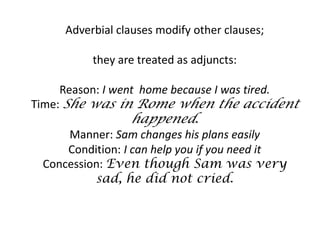
Adverbial clauses modify other clauses;

           they are treated as adjuncts:

    Reason: I went home because I was tired.
Time: She was in Rome when the accident
                    happened.
       Manner: Sam changes his plans easily
       Condition: I can help you if you need it
  Concession: Even though Sam was very
            sad, he did not cried.
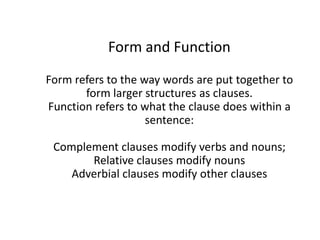
Form and Function
Form refers to the way words are put together to
       form larger structures as clauses.
Function refers to what the clause does within a
                    sentence:

 Complement clauses modify verbs and nouns;
       Relative clauses modify nouns
    Adverbial clauses modify other clauses
God bless you

 Thank you

Lesson three

  • 1.
    Syntax and Teachinggrammar Lesson:THREE Dra. Rosario María Burneo
  • 2.
    Unit five: Thelexicon • The lexicon is the set of all words in a language that are registered in a dictionary. • An entry is each word included in a dictionary. Each word provides information about meaning, pronunciation, word class, derivation and inflection, etc.
  • 3.
    Lexical Verbs  Lexicalverbs are all the verbs in the language, except auxiliary verbs. Complement configuration: number and kind of complements that each individual verb might take. - He bought a house (NP) - She is smart - Mike works in this company - He suggested that you should come to the meeting
  • 4.
    Unit six: ClausesI • A clause contains basically an NP (subject) and a VP (predicate). Each clause: 1. Has a finite verb (tensed verb). 2. The verb takes one or more complements; 3. Each clause expresses mood (indicative, interrogative, imperative); • A sentence contains two or more clauses.
  • 5.
    Main and subordinateclauses - Main clauses express full meaning. - Subordinate clauses must be attached to a main clause to express a complete meaning. Sentences: - Compound = two or more independent clauses joined by conjunctions. Martha cooks lunch and Sam sets the table - Complex = a main clause and one or more subordinate clauses. Sam believed that his house was haunted
  • 6.
    Subordinate clauses 1.Complement clauses,which occur in noun slots as complements of verbs: Mike regretted that he has visited Paula (DO) Mike regretted his actions (DO).
  • 7.
    Relative clauses modifynouns: The book which you gave Laura is interesting. The book that you gave Laura is interesting The boy who is at the door is very smart
  • 8.
    Adverbial clauses modifyother clauses; they are treated as adjuncts: Reason: I went home because I was tired. Time: She was in Rome when the accident happened. Manner: Sam changes his plans easily Condition: I can help you if you need it Concession: Even though Sam was very sad, he did not cried.
  • 9.
    Form and Function Formrefers to the way words are put together to form larger structures as clauses. Function refers to what the clause does within a sentence: Complement clauses modify verbs and nouns; Relative clauses modify nouns Adverbial clauses modify other clauses
  • 10.
    God bless you Thank you