Organic compost
Represented To:
Dr. Abdulrahman
Represented By:
Muhammad Shahzad Alam
BAGF14E301

Department of Agronomy
University college of Agriculture, University of Sargodha, Sargodha
Organic compost
Compost
“Compost is organic matter that has been decomposed
and recycled as a fertilizer and soil amendment”.
•Compost is a key ingredient in organic farming.
•End product of the decomposition of organic matter.
Grass clippings
Food scraps
Leaves
Compost
Kitchen scraps
Garden trimmings
Organic compost
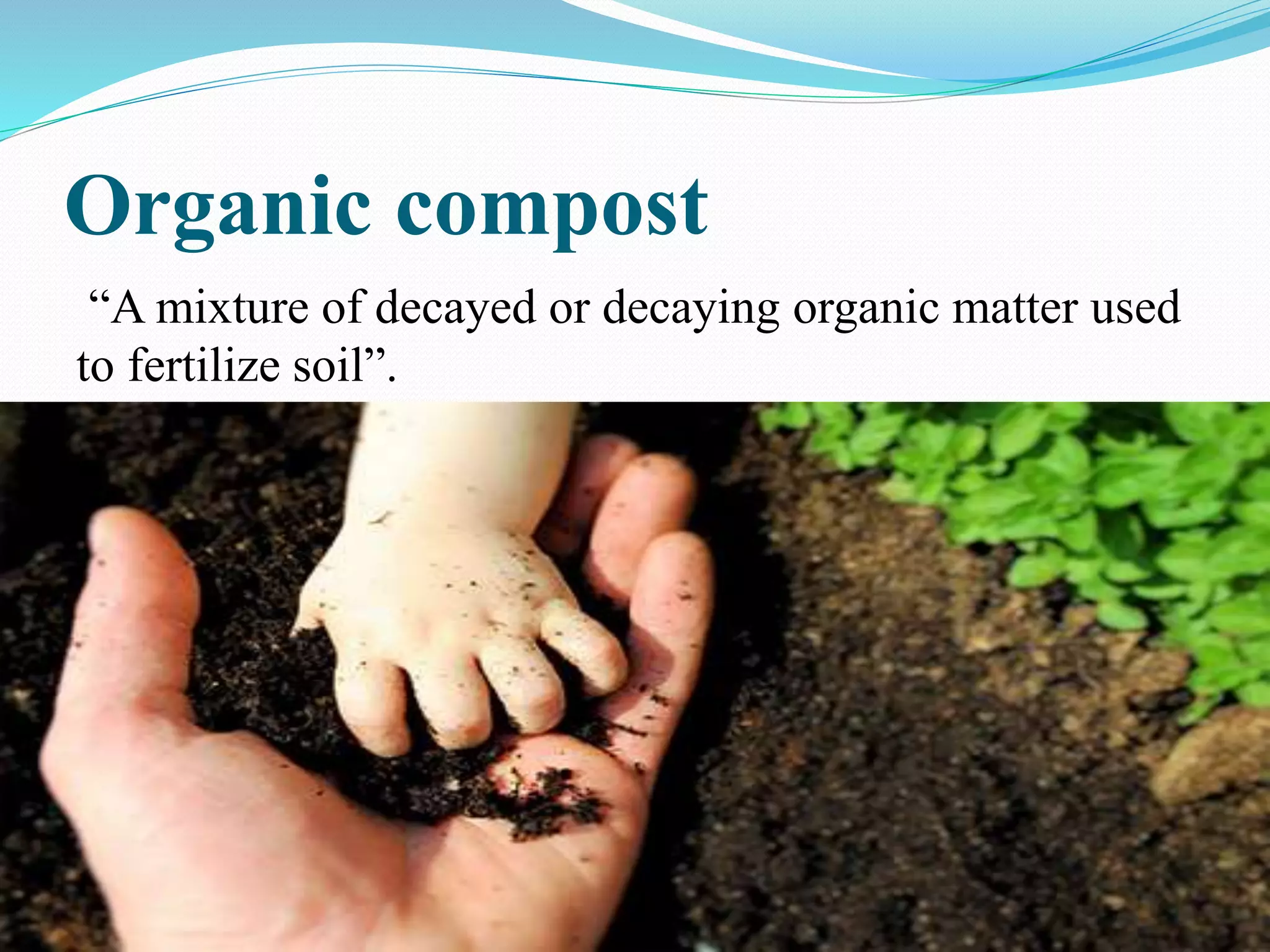
“A mixture of decayed or decaying organic matter used
to fertilize soil”.
Introduction
 Organic Compost is usually made by gathering plant
material, such as leaves, grass clippings, and
vegetable peels, into a pile or bin and letting.
 It decompose as a result of the action of aerobic
bacteria, fungi, and other organisms.
 Composting is an ancient agriculture technology
going back to biblical time that still has importance in
modern agriculture.
Conti…
 Compost enables dairymen and livestock owners to
reduce the volume of manure leaving their operation.
 provides a source of nutrients and organic matter for
surrounding farms.
Nutrient profile of compost
S.No Parameters Quantity
1 Organic matter 70%
2 pH 7.5
3 Organic carbon 33.11%
4 Nitrogen 1.82%
5 Phosphorus 1.29%
6 Potassium 1.25%
7 Fe(ppm) 1019
8 Mn(ppm) 111
9 Cu(ppm) 180
10 Zn(ppm) 286
Techniques of composting
1) Cold composting
2) Hot composting
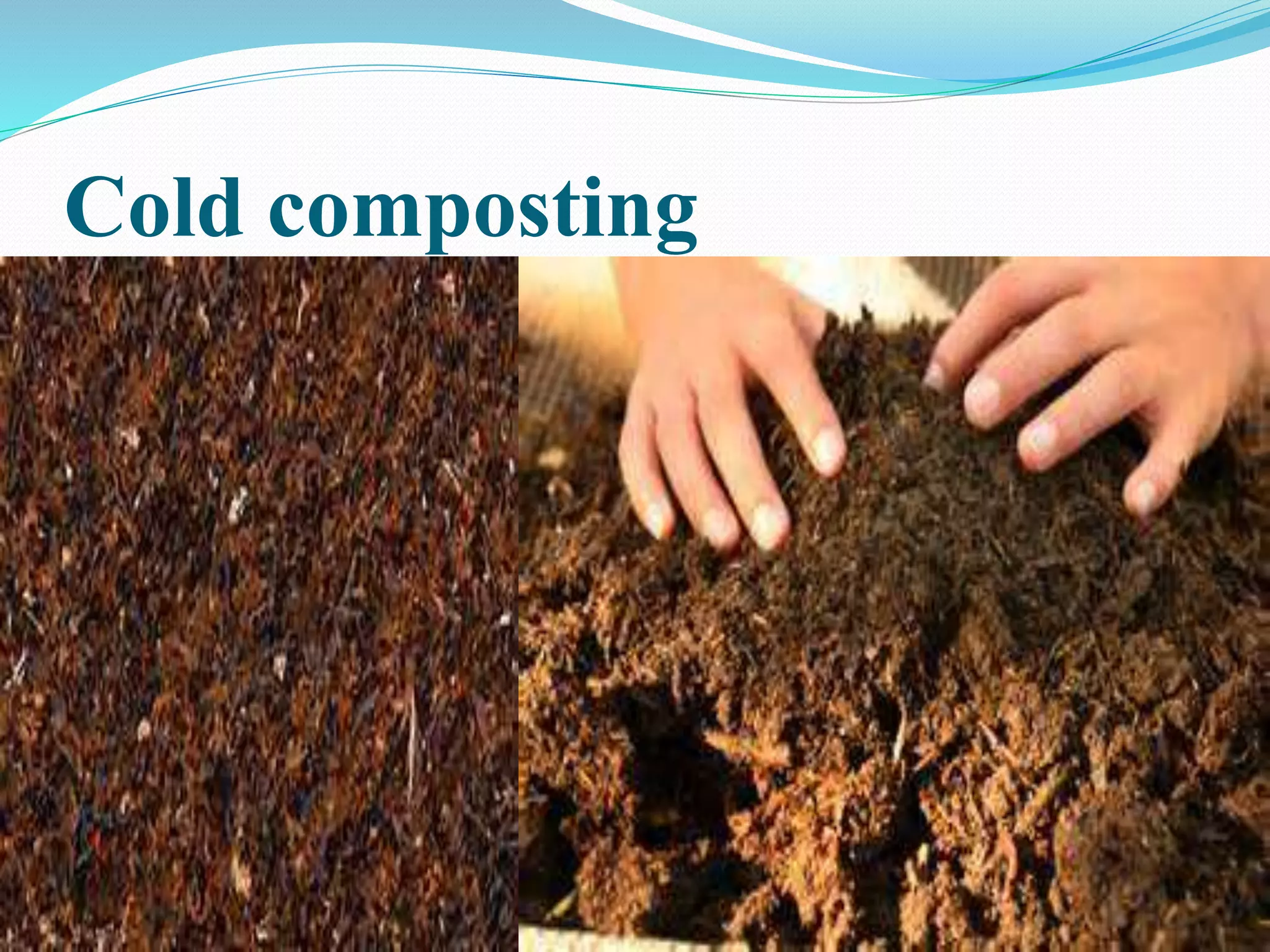
Cold composting
•Cold composting is one of the easiest forms of
composting.
•Many beneficial nutrients in cold compost remain
uncompromised by high temperatures.
• The process is slower.
•Once established, the cold composting bins will provide
you with a continuous supply of lawn and garden food.
Cold composting
Hot composting
• A hot pile requires enough high-nitrogen materials to
get the pile to heat up.
• Microbial activity within the compost pile is at its
optimum level, which results in finished compost in a
much shorter period of time.
• It requires some special equipment, as well as time
and diligence.
Conti…
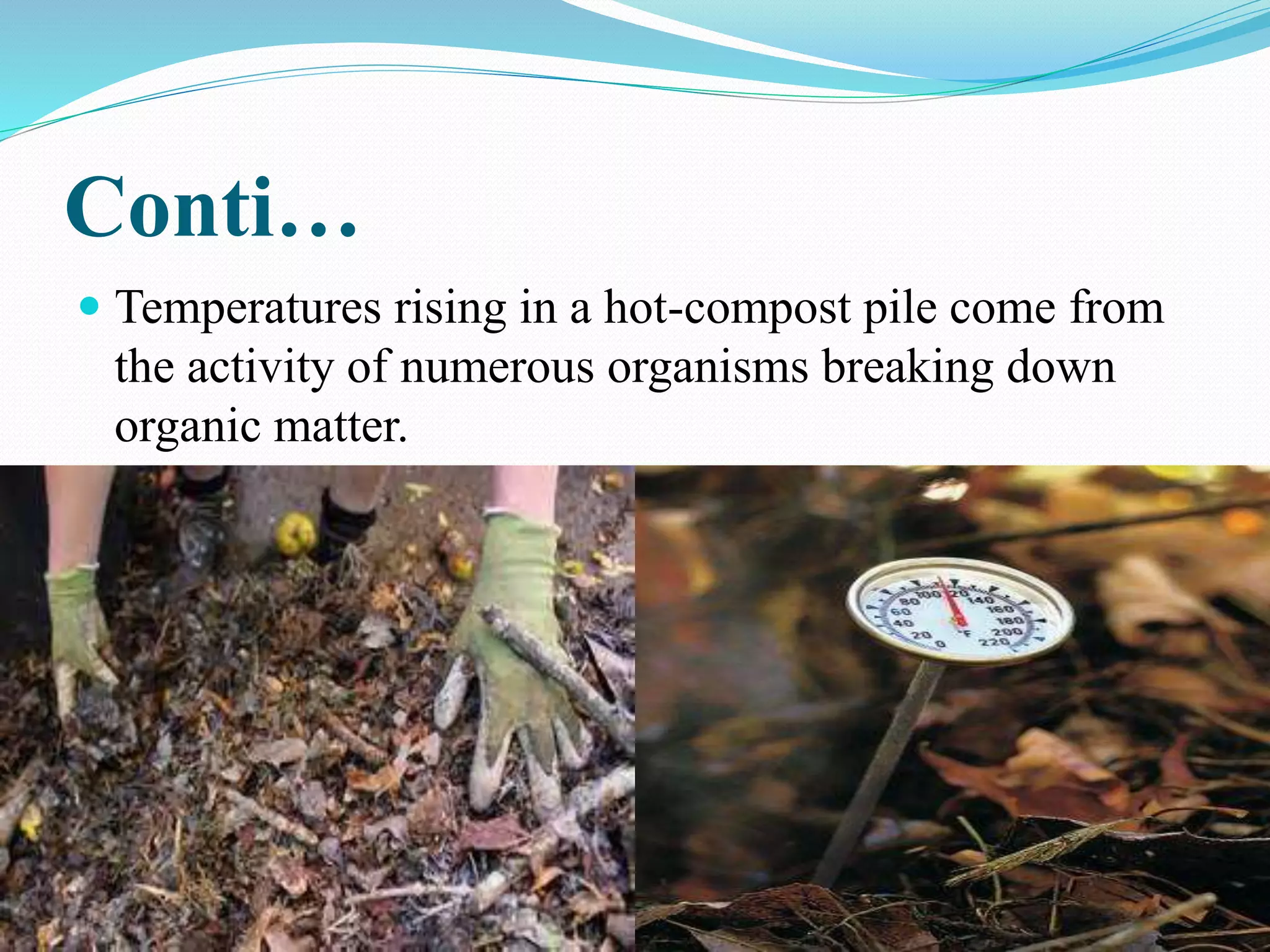
 Temperatures rising in a hot-compost pile come from
the activity of numerous organisms breaking down
organic matter.
Material required for
composting
1. Farm refuse
• Weeds
• Stubbles
• Crop residues
• Remnants of fodder
Conti…
2. Animal dung
 Cow dung
 Buffalo dung
 Poultry dung
3. Town refuse
 Night soil
 Street refuse
 Municipal fuse
Types of composting
1. Aerobic composting
2. Anaerobic composting
3. Vermicomposting
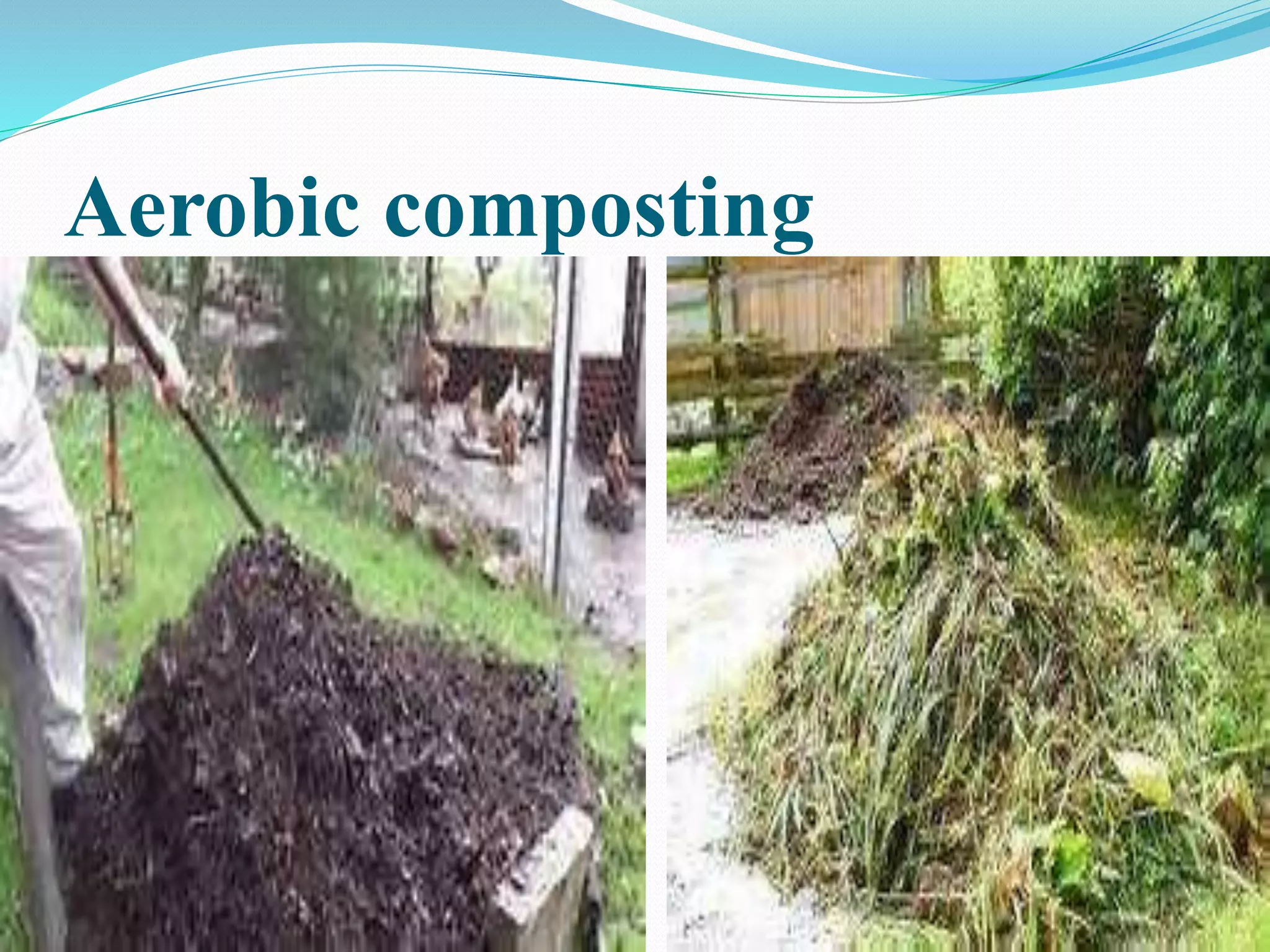
1. Aerobic composting
• This means to compost with air.
• Organic waste will break down quickly and is not
prone to smell.
• This type of composting is high maintenance, since it
will need to be turned every couple days to keep air in
the system and your temperatures up.
Conti…
• It is also likely to require accurate moisture
monitoring.
• This type of compost is good for large volumes of
compost.
Aerobic composting
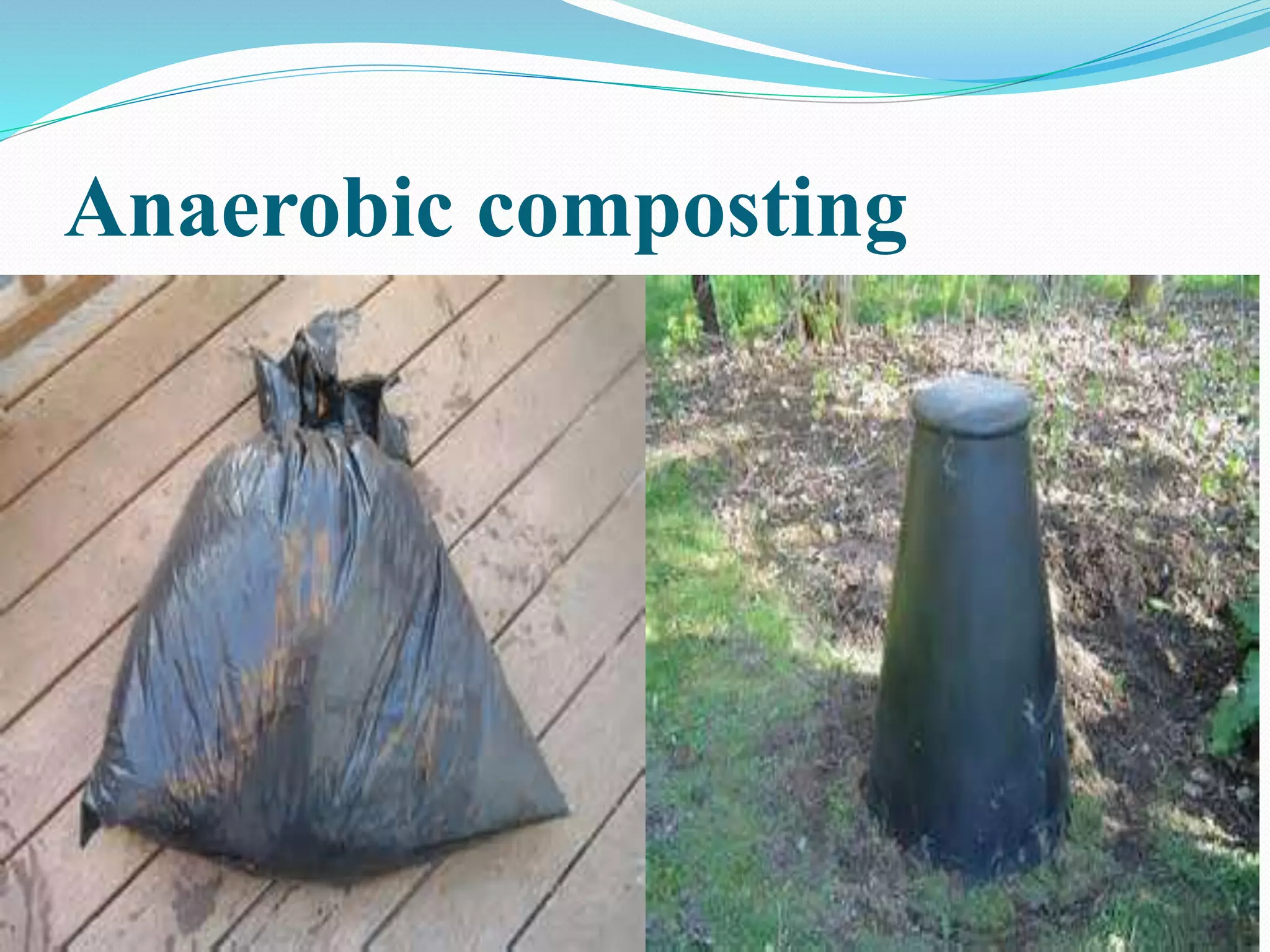
2. Anaerobic composting
• This is composting without air.
• Anaerobic composting is low maintenance since
you simply throw it in a pile and wait a couple
years.
• Compost may take years to break down.
• Anaerobic composts create the awful smell most
people associate with composting.
• The bacteria break down the organic materials into
harmful compounds like ammonia and methane.
Anaerobic composting
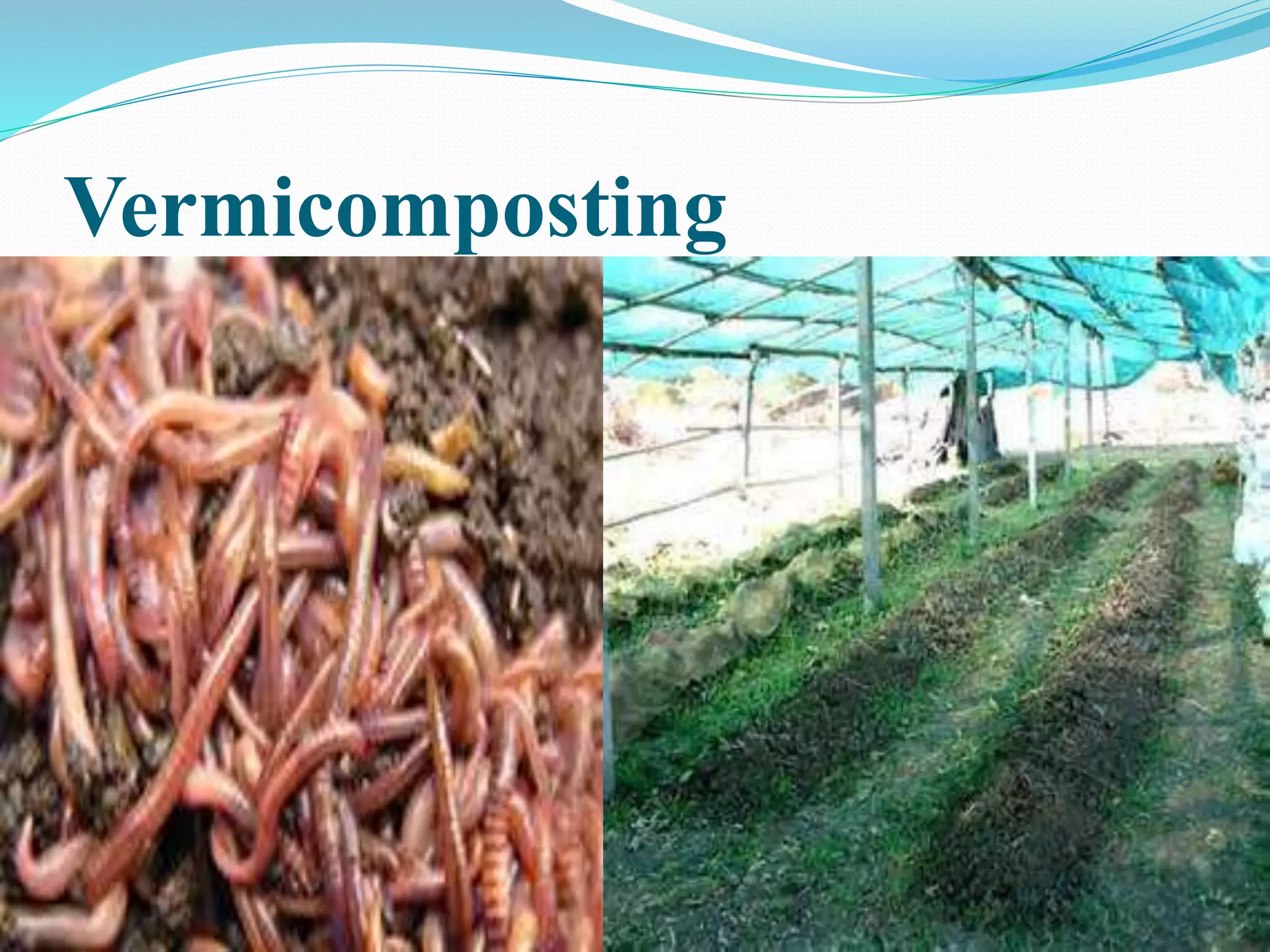
3. Vermicomposting
• This is most beneficial for composting food waste
with worms.
• Oxygen and moisture are required to keep this
compost healthy.
• This is medium maintenance compost since you need
to feed your worms and monitor the conditions.
Vermicomposting
Methods of composting
Four method are useful for on-farm composting.
 The passively aerated static pile method
 The aerated static pile method
 The turned pile method.
 The in-vessel method.
Turned pile method.
• A unit pile is about 5(l)
×1(w) ×1(h) m3 in size.
• Straw is stacked in layers of
20 cm height, 1 m width, and
5 m length to form a pile.
• The pile is sprinkled with
water (Plate 1) for adequate
moisture content, followed by
addition of a FYM layer 5
cm high.
1. Compost pile in preparation
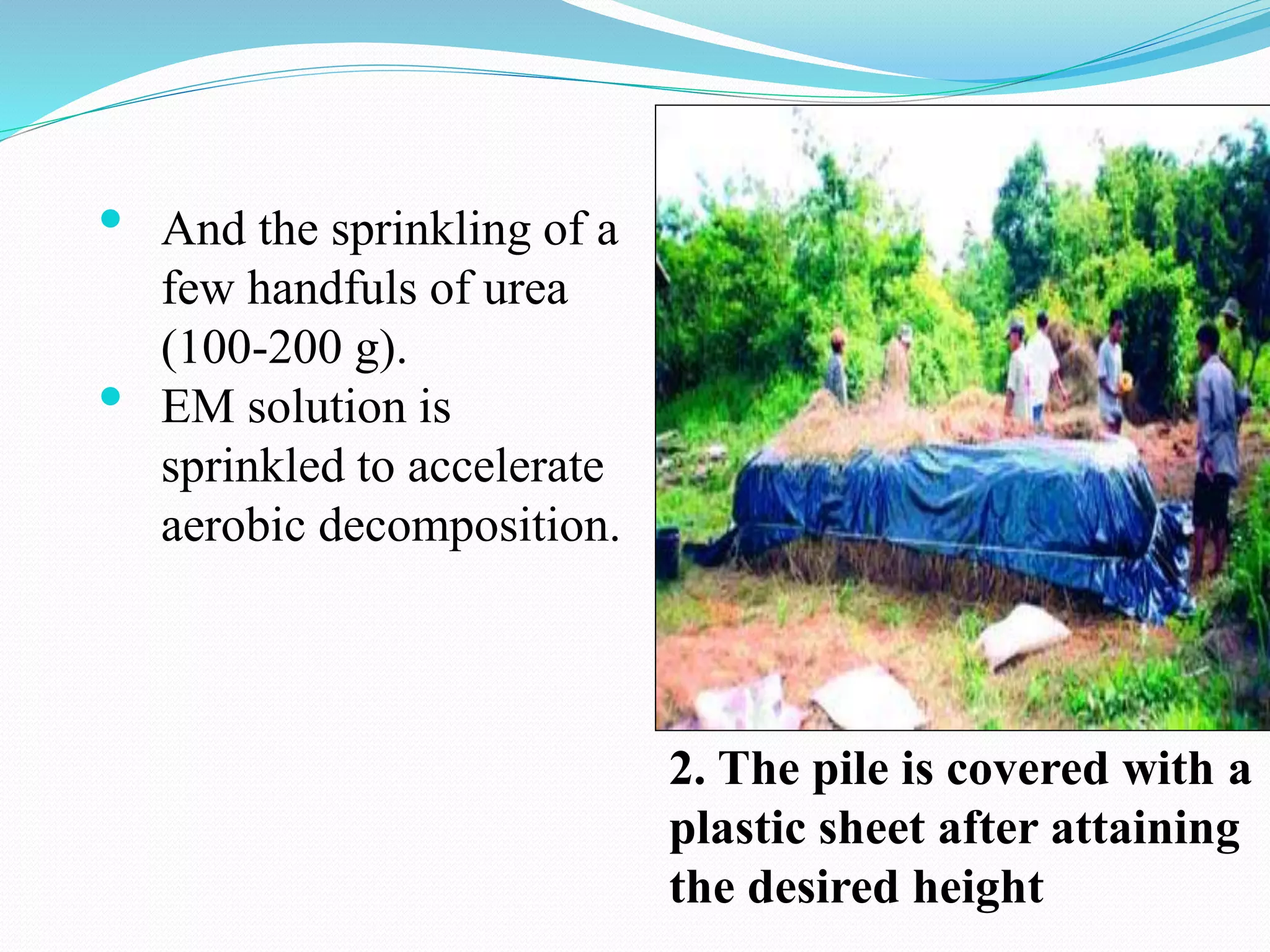
2. The pile is covered with a
plastic sheet after attaining
the desired height
• And the sprinkling of a
few handfuls of urea
(100-200 g).
• EM solution is
sprinkled to accelerate
aerobic decomposition.
• The pile is turned after
two weeks (Plate 3)
and then again after
another week.
• Normally, the
compost is ready two
weeks later when the
heap has cooled down
and the height of the
pile has fallen to about
70 cm.
3.The pile is being turned
Turned pile method
Aerated Static Pile
Composting
 In aerated static pile composting, organic waste is
mixed together in one large pile instead of rows.
 To aerate the pile, layers of loosely piled bulking
agents (e.g., wood chips, shredded newspaper) are
added so that air can pass from the bottom to the top
of the pile.
 The piles also can be placed over a network of pipes
that deliver air into or draw air out of the pile.
 Air blowers might be activated by a timer or a
temperature sensors.
Aerated static pile method
In-vessel composting
 In-vessel composting generally describes a group of
methods that confine the composting materials within
a building, container, or vessel.
 In-vessel composting systems can consist of metal or
plastic tanks or concrete bunkers in which air flow
and temperature can be controlled, using the
principles of a "bioreactor".
Conti…
 Generally the air circulation is metered in via buried
tubes that allow fresh air to be injected under
pressure, with the exhaust being extracted through
a biofilter, with temperature and moisture conditions
monitored using probes in the mass to allow
maintenance of optimum aerobic decomposition
conditions.
In-vessel method
Application of Compost
 Five to seven tons of compost per acre is a generally
acceptable rate of application for field dispersal.
 Intensive garden situations can use up to 10 tons per
acre.
18 in
For a developed field, compost integration should be
no deeper than eight inches.
8 in
Compost should
be applied in the
spring prior to
planting
Midseason as an
amendment side
dress
And in fall prior
to cover
cropping
Compost should be applied 3 times…
Importance or agronomic
benefits of compost
 Nutrient value.
 Excellent soil conditioning agent.
 Increases organic content.
 Improves soil texture.
 Improves soil permeability.
 Improves water-holding capacity.
 Encourages soil microflora and fauna.
Conti…
 Recycles waste material on site.
 Adds large amounts of humus to soil.
 Increases soil fertility and stabilizes elements such as
nitrogen.
 Hugely increases biological activity in soil.
 Creates outlet for potentially harmful excess of raw
manure in animal based agriculture.
 Compost is a wonderful example of alchemy,
changing waste material into vitally important
materials.
Conclusion
 In organic cropping systems, compost provides a
primary source of nutrients for the crop.
 In conventional cropping systems, compost provides
a supplementary nitrogen source that compliments
fertilizer nitrogen to provide a more sustainable
farming system.
 Compost enables dairymen and livestock owners to
reduce the volume of manure leaving their operation
and provides a source of nutrients and organic matter
for surrounding farms.
Organic compost
Organic compost
Organic compost

Organic compost

  • 2.
    Organic compost Represented To: Dr.Abdulrahman Represented By: Muhammad Shahzad Alam BAGF14E301  Department of Agronomy University college of Agriculture, University of Sargodha, Sargodha
  • 3.
  • 4.
    Compost “Compost is organicmatter that has been decomposed and recycled as a fertilizer and soil amendment”. •Compost is a key ingredient in organic farming. •End product of the decomposition of organic matter.
  • 5.
  • 6.
    Organic compost “A mixtureof decayed or decaying organic matter used to fertilize soil”.
  • 7.
    Introduction  Organic Compostis usually made by gathering plant material, such as leaves, grass clippings, and vegetable peels, into a pile or bin and letting.  It decompose as a result of the action of aerobic bacteria, fungi, and other organisms.  Composting is an ancient agriculture technology going back to biblical time that still has importance in modern agriculture.
  • 8.
    Conti…  Compost enablesdairymen and livestock owners to reduce the volume of manure leaving their operation.  provides a source of nutrients and organic matter for surrounding farms.
  • 9.
    Nutrient profile ofcompost S.No Parameters Quantity 1 Organic matter 70% 2 pH 7.5 3 Organic carbon 33.11% 4 Nitrogen 1.82% 5 Phosphorus 1.29% 6 Potassium 1.25% 7 Fe(ppm) 1019 8 Mn(ppm) 111 9 Cu(ppm) 180 10 Zn(ppm) 286
  • 10.
    Techniques of composting 1)Cold composting 2) Hot composting
  • 11.
    Cold composting •Cold compostingis one of the easiest forms of composting. •Many beneficial nutrients in cold compost remain uncompromised by high temperatures. • The process is slower. •Once established, the cold composting bins will provide you with a continuous supply of lawn and garden food.
  • 12.
  • 13.
    Hot composting • Ahot pile requires enough high-nitrogen materials to get the pile to heat up. • Microbial activity within the compost pile is at its optimum level, which results in finished compost in a much shorter period of time. • It requires some special equipment, as well as time and diligence.
  • 14.
    Conti…  Temperatures risingin a hot-compost pile come from the activity of numerous organisms breaking down organic matter.
  • 15.
    Material required for composting 1.Farm refuse • Weeds • Stubbles • Crop residues • Remnants of fodder
  • 16.
    Conti… 2. Animal dung Cow dung  Buffalo dung  Poultry dung 3. Town refuse  Night soil  Street refuse  Municipal fuse
  • 17.
    Types of composting 1.Aerobic composting 2. Anaerobic composting 3. Vermicomposting
  • 18.
    1. Aerobic composting •This means to compost with air. • Organic waste will break down quickly and is not prone to smell. • This type of composting is high maintenance, since it will need to be turned every couple days to keep air in the system and your temperatures up.
  • 19.
    Conti… • It isalso likely to require accurate moisture monitoring. • This type of compost is good for large volumes of compost.
  • 20.
  • 21.
    2. Anaerobic composting •This is composting without air. • Anaerobic composting is low maintenance since you simply throw it in a pile and wait a couple years. • Compost may take years to break down. • Anaerobic composts create the awful smell most people associate with composting. • The bacteria break down the organic materials into harmful compounds like ammonia and methane.
  • 22.
  • 23.
    3. Vermicomposting • Thisis most beneficial for composting food waste with worms. • Oxygen and moisture are required to keep this compost healthy. • This is medium maintenance compost since you need to feed your worms and monitor the conditions.
  • 24.
  • 25.
    Methods of composting Fourmethod are useful for on-farm composting.  The passively aerated static pile method  The aerated static pile method  The turned pile method.  The in-vessel method.
  • 26.
    Turned pile method. •A unit pile is about 5(l) ×1(w) ×1(h) m3 in size. • Straw is stacked in layers of 20 cm height, 1 m width, and 5 m length to form a pile. • The pile is sprinkled with water (Plate 1) for adequate moisture content, followed by addition of a FYM layer 5 cm high. 1. Compost pile in preparation
  • 27.
    2. The pileis covered with a plastic sheet after attaining the desired height • And the sprinkling of a few handfuls of urea (100-200 g). • EM solution is sprinkled to accelerate aerobic decomposition.
  • 28.
    • The pileis turned after two weeks (Plate 3) and then again after another week. • Normally, the compost is ready two weeks later when the heap has cooled down and the height of the pile has fallen to about 70 cm. 3.The pile is being turned
  • 29.
  • 30.
    Aerated Static Pile Composting In aerated static pile composting, organic waste is mixed together in one large pile instead of rows.  To aerate the pile, layers of loosely piled bulking agents (e.g., wood chips, shredded newspaper) are added so that air can pass from the bottom to the top of the pile.  The piles also can be placed over a network of pipes that deliver air into or draw air out of the pile.  Air blowers might be activated by a timer or a temperature sensors.
  • 31.
  • 32.
    In-vessel composting  In-vesselcomposting generally describes a group of methods that confine the composting materials within a building, container, or vessel.  In-vessel composting systems can consist of metal or plastic tanks or concrete bunkers in which air flow and temperature can be controlled, using the principles of a "bioreactor".
  • 33.
    Conti…  Generally theair circulation is metered in via buried tubes that allow fresh air to be injected under pressure, with the exhaust being extracted through a biofilter, with temperature and moisture conditions monitored using probes in the mass to allow maintenance of optimum aerobic decomposition conditions.
  • 34.
  • 35.
    Application of Compost Five to seven tons of compost per acre is a generally acceptable rate of application for field dispersal.  Intensive garden situations can use up to 10 tons per acre.
  • 36.
    18 in For adeveloped field, compost integration should be no deeper than eight inches. 8 in
  • 37.
    Compost should be appliedin the spring prior to planting Midseason as an amendment side dress And in fall prior to cover cropping Compost should be applied 3 times…
  • 38.
    Importance or agronomic benefitsof compost  Nutrient value.  Excellent soil conditioning agent.  Increases organic content.  Improves soil texture.  Improves soil permeability.  Improves water-holding capacity.  Encourages soil microflora and fauna.
  • 39.
    Conti…  Recycles wastematerial on site.  Adds large amounts of humus to soil.  Increases soil fertility and stabilizes elements such as nitrogen.  Hugely increases biological activity in soil.  Creates outlet for potentially harmful excess of raw manure in animal based agriculture.  Compost is a wonderful example of alchemy, changing waste material into vitally important materials.
  • 40.
    Conclusion  In organiccropping systems, compost provides a primary source of nutrients for the crop.  In conventional cropping systems, compost provides a supplementary nitrogen source that compliments fertilizer nitrogen to provide a more sustainable farming system.  Compost enables dairymen and livestock owners to reduce the volume of manure leaving their operation and provides a source of nutrients and organic matter for surrounding farms.