MASTER CREDIT SEMINAR
ON
R F I D – A MODERN TECHNIQUE IN ANIMAL
IDENTIFICATION
RAMESWAR PANDA
ENROLL.NO- V/13/240
LIVESTOCK PRODUCTION AND MANAGEMENT
BOMBAY VETERINARY COLLEGE
Outline
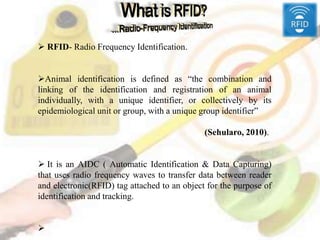
 RFID- Radio Frequency Identification.
Animal identification is defined as “the combination and
linking of the identification and registration of an animal
individually, with a unique identifier, or collectively by its
epidemiological unit or group, with a unique group identifier”
(Sehularo, 2010).
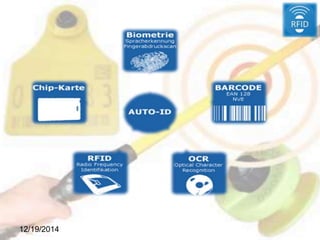
 It is an AIDC ( Automatic Identification & Data Capturing)
that uses radio frequency waves to transfer data between reader
and electronic(RFID) tag attached to an object for the purpose of
identification and tracking.

12/19/2014
12/19/2014
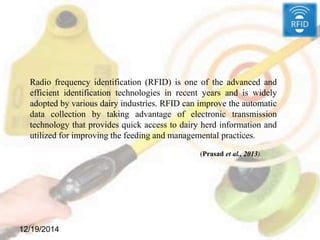
Radio frequency identification (RFID) is one of the advanced and
efficient identification technologies in recent years and is widely
adopted by various dairy industries. RFID can improve the automatic
data collection by taking advantage of electronic transmission
technology that provides quick access to dairy herd information and
utilized for improving the feeding and managemental practices.
(Prasad et al., 2013).
HOW RFID INVENTED
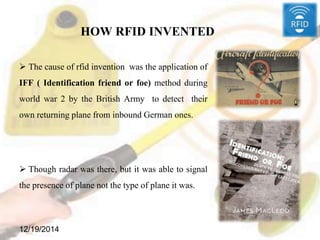
 The cause of rfid invention was the application of
IFF ( Identification friend or foe) method during
world war 2 by the British Army to detect their
own returning plane from inbound German ones.
 Though radar was there, but it was able to signal
the presence of plane not the type of plane it was.
12/19/2014
TORY OF RFID
12/19/2014
12/19/2014
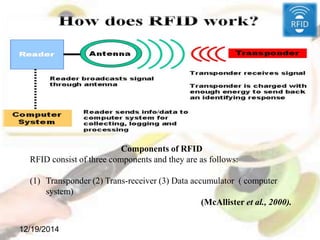
Components of RFID
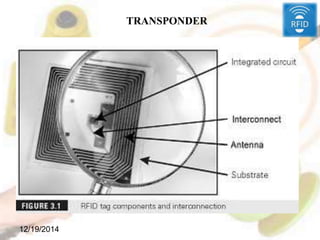
RFID consist of three components and they are as follows:
(1) Transponder (2) Trans-receiver (3) Data accumulator ( computer
system)
(McAllister et al., 2000).
12/19/2014
• TRANSPONDER
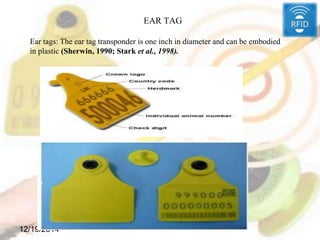
EAR TAG
12/19/2014
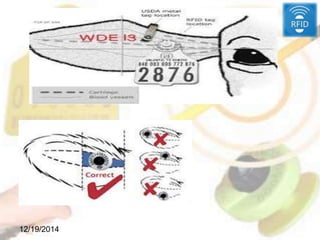
Ear tags: The ear tag transponder is one inch in diameter and can be embodied
in plastic (Sherwin, 1990; Stark et al., 1998).
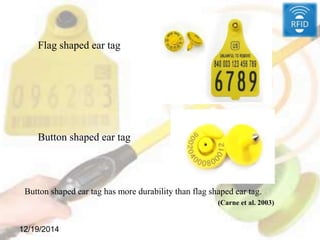
Flag shaped ear tag
Button shaped ear tag
12/19/2014
Button shaped ear tag has more durability than flag shaped ear tag.
(Carne et al. 2003)
12/19/2014
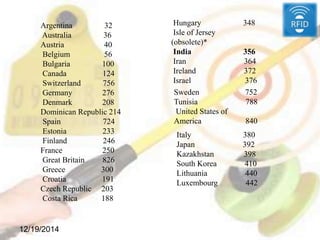
Argentina 32
Australia 36
Austria 40
Belgium 56
Bulgaria 100
Canada 124
Switzerland 756
Germany 276
Denmark 208
Dominican Republic 214
Spain 724
Estonia 233
Finland 246
France 250
Great Britain 826
Greece 300
Croatia 191
Czech Republic 203
Costa Rica 188
Hungary 348
Isle of Jersey
(obsolete)*
India 356
Iran 364
Ireland 372
Israel 376
Italy 380
Japan 392
Kazakhstan 398
South Korea 410
Lithuania 440
Luxembourg 442
Sweden 752
Tunisia 788
United States of
America 840
12/19/2014
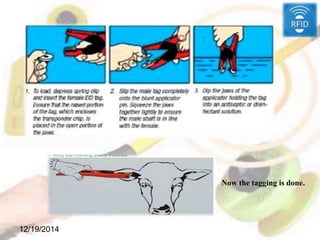
Now the tagging is done.
12/19/2014
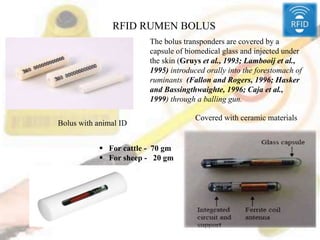
RFID RUMEN BOLUS
 For cattle - 70 gm
 For sheep - 20 gm
Covered with ceramic materials
Bolus with animal ID
The bolus transponders are covered by a
capsule of biomedical glass and injected under
the skin (Gruys et al., 1993; Lambooij et al.,
1995) introduced orally into the forestomach of
ruminants (Fallon and Rogers, 1996; Hasker
and Bassingthwaighte, 1996; Caja et al.,
1999) through a balling gun.
12/19/2014
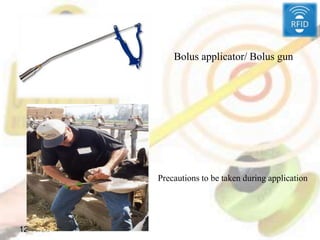
Bolus applicator/ Bolus gun
Precautions to be taken during application
12/19/2014
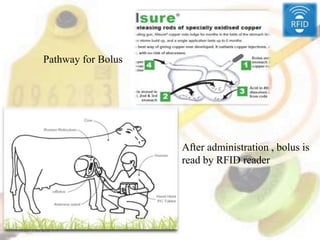
Pathway for Bolus
After administration , bolus is
read by RFID reader
12/19/2014
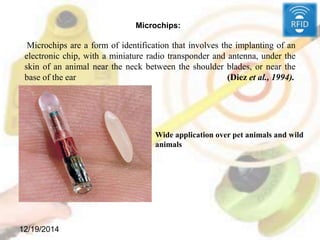
Microchips:
Microchips are a form of identification that involves the implanting of an
electronic chip, with a miniature radio transponder and antenna, under the
skin of an animal near the neck between the shoulder blades, or near the
base of the ear (Diez et al., 1994).
Wide application over pet animals and wild
animals
12/19/2014
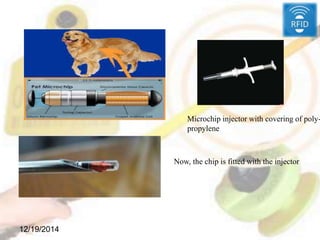
Microchip injector with covering of poly-
propylene
Now, the chip is fitted with the injector
12/19/2014
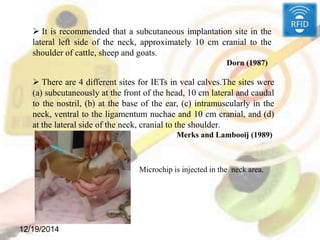
 It is recommended that a subcutaneous implantation site in the
lateral left side of the neck, approximately 10 cm cranial to the
shoulder of cattle, sheep and goats.
Dorn (1987)
 There are 4 different sites for IETs in veal calves.The sites were
(a) subcutaneously at the front of the head, 10 cm lateral and caudal
to the nostril, (b) at the base of the ear, (c) intramuscularly in the
neck, ventral to the ligamentum nuchae and 10 cm cranial, and (d)
at the lateral side of the neck, cranial to the shoulder.
Merks and Lambooij (1989)
Microchip is injected in the neck area.
12/19/2014
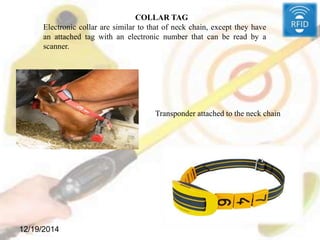
COLLAR TAG
Electronic collar are similar to that of neck chain, except they have
an attached tag with an electronic number that can be read by a
scanner.
Transponder attached to the neck chain
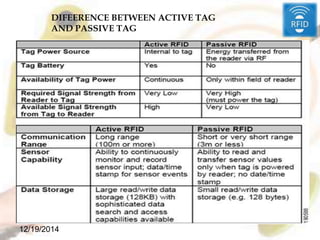
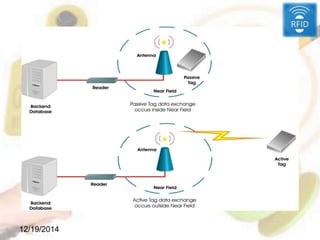
DIFEERENCE BETWEEN ACTIVE TAG
AND PASSIVE TAG
12/19/2014
12/19/2014
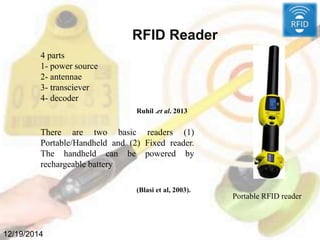
RFID Reader
12/19/2014
4 parts
1- power source
2- antennae
3- transciever
4- decoder
Ruhil .et al. 2013
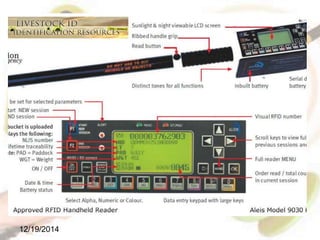
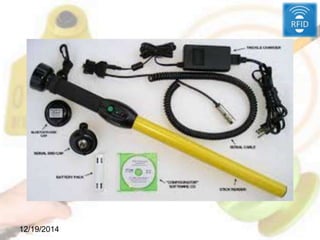
There are two basic readers (1)
Portable/Handheld and (2) Fixed reader.
The handheld can be powered by
rechargeable battery
(Blasi et al, 2003).
Portable RFID reader
12/19/2014
neck band
12/19/2014
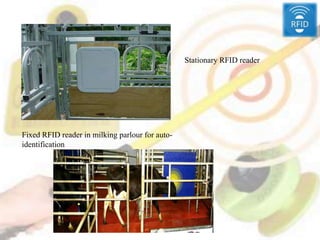
Stationary RFID reader
Fixed RFID reader in milking parlour for auto-
identification
12/19/2014
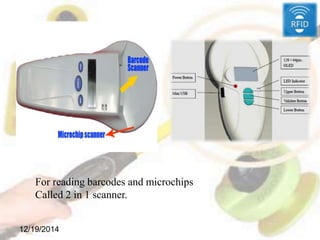
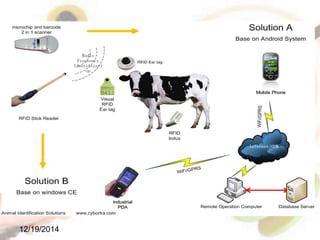
For reading barcodes and microchips
Called 2 in 1 scanner.
12/19/2014
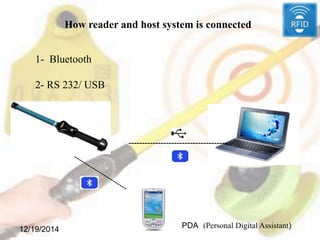
How reader and host system is connected
1- Bluetooth
2- RS 232/ USB
-------------------------------------
PDA (Personal Digital Assistant)
12/19/2014
12/19/2014
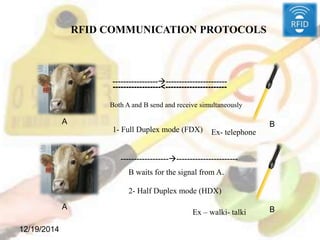
RFID COMMUNICATION PROTOCOLS
----------------------------------------
------------------<-----------------------
Both A and B send and receive simultaneously
1- Full Duplex mode (FDX)
B waits for the signal from A.
-----------------------------------------
2- Half Duplex mode (HDX)
Ex- telephone
Ex – walki- talki
A B
A B
12/19/2014
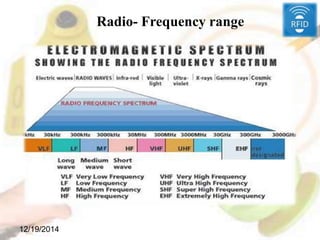
Radio- Frequency range
12/19/2014
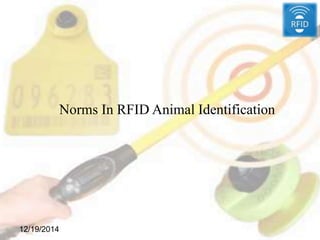
Norms In RFID Animal Identification
12/19/2014
International Committee for Animal Recording (ICAR)
ICAR recommends three-way RFID ear tags (visual laser-printed,
bar-coded and microchip-embedded). These tags are commonly used
in India.
(Ruhil et al 2013)
12/19/2014
 All RFID appliances are regulated under ISO standards
1- 11784
2- 11785 Barge et al 2012
 ISO 11784- defines the code structure of the RFID transponder
ISO 11785 - readability of RFID reader
( ICAR 2009)
 The ISO compliant RFID animal identification transponder
operates at a frequency of 134 kHz and stores a 64-bit code.
( Ruhil et al 2013)
 The ISO solution of 64-bit coded tags limits the complexity of
the transponders and their cost
(Saa et al. 2005).
12/19/2014
 For cattle, sheep and goats, the code structure and the operating
frequencies must be compliant with the International Organization
for Standardization 11784 and 11785 standards (International
Organization for Standardization 1996a, b), which were defined and
adopted in the early 1970s (Rossing 1999) and then approved by the
International Committee for Animal Recording (ICAR 2005).

No standards are at present defined for pig identification.
 The introduction of new ISO standard, ISO 14223:2003
(International Organization for Standardization 2003) could allow
the exploitation of the new possibilities offered by RFID technology.
(Sydanheimo et al. 2006).
12/19/2014
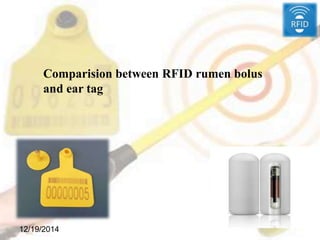
Comparision between RFID rumen bolus
and ear tag
12/19/2014
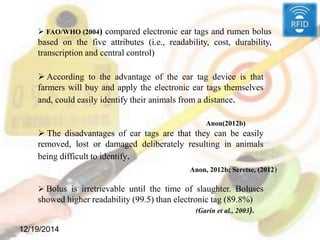
 According to the advantage of the ear tag device is that
farmers will buy and apply the electronic ear tags themselves
and, could easily identify their animals from a distance.
Anon(2012b)
 The disadvantages of ear tags are that they can be easily
removed, lost or damaged deliberately resulting in animals
being difficult to identify.
Anon, 2012b; Seretse, (2012)
 FAO/WHO (2004) compared electronic ear tags and rumen bolus
based on the five attributes (i.e., readability, cost, durability,
transcription and central control)
 Bolus is irretrievable until the time of slaughter. Boluses
showed higher readability (99.5) than electronic tag (89.8%)
(Garin et al., 2003).
 The recovery of the rumen bolus after slaughter is more
problematic than the removal of an electronic ear tag
(Fallon, 2001; Merchant, 2002).
 Reading of a bolus seems to be more difficult and time
consuming than reading of injectable transponders and electronic
ear tags when hand-held readers are used.
Klindtworth et al. (1999)
 Ear tags and rumen boluses were both suitable for electronic
identification purposes, but boluses were shown to have a higher
retention rate and to potentially pose less welfare problems
(Ribo et al., 2001; JRC, 2002).
 Compared to bolus, ear tags cannot be reused or recycled
(Anon, 2012b) .
12/19/2014
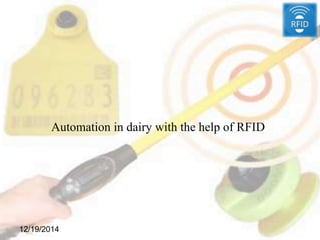
Automation in dairy with the help of RFID
12/19/2014
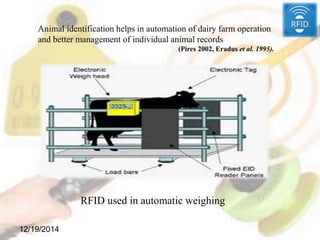
Animal identification helps in automation of dairy farm operation
and better management of individual animal records
(Pires 2002, Eradus et al. 1995).
RFID used in automatic weighing
12/19/2014
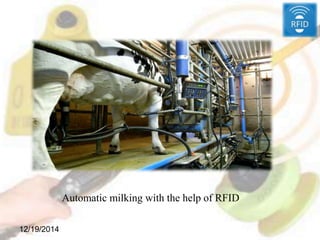
Automatic milking with the help of RFID
12/19/2014
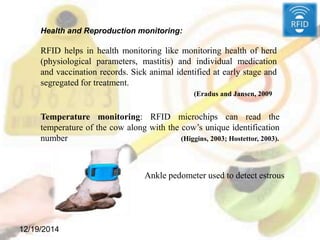
Temperature monitoring: RFID microchips can read the
temperature of the cow along with the cow’s unique identification
number (Higgins, 2003; Hostettor, 2003).
Health and Reproduction monitoring:
RFID helps in health monitoring like monitoring health of herd
(physiological parameters, mastitis) and individual medication
and vaccination records. Sick animal identified at early stage and
segregated for treatment.
(Eradus and Jansen, 2009
Ankle pedometer used to detect estrous
12/19/2014
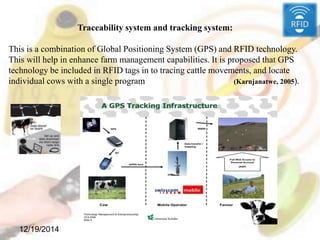
Traceability system and tracking system:
This is a combination of Global Positioning System (GPS) and RFID technology.
This will help in enhance farm management capabilities. It is proposed that GPS
technology be included in RFID tags in to tracing cattle movements, and locate
individual cows with a single program (Karnjanatwe, 2005).
12/19/2014
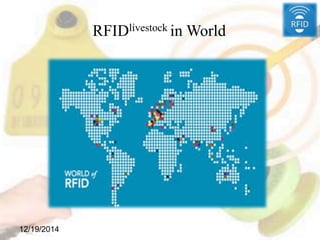
RFIDlivestock in World
12/19/2014
The radio frequency identification (RFID) of each single head of
cattle is already mandatory in many countries.
(Smith et al. 2008).
In the European Union, electronic identification of sheep and
goats by radiofrequency has been mandatory since January
2010 implemented by Commission Decision 2006/968/EC.,
but for cattle it is voluntary.
NLIS is the largest animal ID system in
the world.
12/19/2014
RFIDlivestock in India
12/19/2014
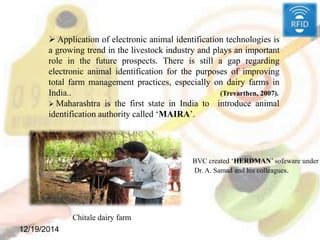
 Application of electronic animal identification technologies is
a growing trend in the livestock industry and plays an important
role in the future prospects. There is still a gap regarding
electronic animal identification for the purposes of improving
total farm management practices, especially on dairy farms in
India.. (Trevarthen, 2007).
 Maharashtra is the first state in India to introduce animal
identification authority called ‘MAIRA’.

BVC created ‘HERDMAN’ sofeware under
Dr. A. Samad and his colleagues.
Chitale dairy farm
12/19/2014
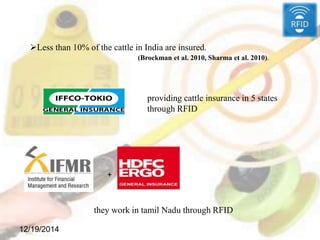
Less than 10% of the cattle in India are insured.
(Brockman et al. 2010, Sharma et al. 2010).
+
providing cattle insurance in 5 states
through RFID
they work in tamil Nadu through RFID
12/19/2014
CONCLUSION
12/19/2014
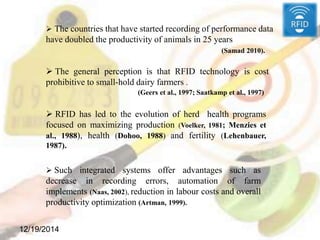
 The countries that have started recording of performance data
have doubled the productivity of animals in 25 years
(Samad 2010).
 The general perception is that RFID technology is cost
prohibitive to small-hold dairy farmers .
(Geers et al., 1997; Saatkamp et al., 1997)
 RFID has led to the evolution of herd health programs
focused on maximizing production (Voelker, 1981; Menzies et
al., 1988), health (Dohoo, 1988) and fertility (Lehenbauer,
1987).
 Such integrated systems offer advantages such as
decrease in recording errors, automation of farm
implements (Naas, 2002), reduction in labour costs and overall
productivity optimization (Artman, 1999).
12/19/2014
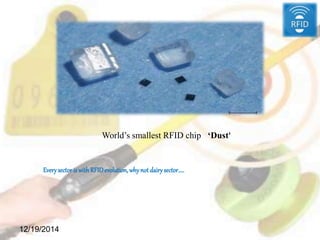
Everysector is withRFIDevolution,whynot dairysector…..
World’s smallest RFID chip ‘Dust’
12/19/2014
12/19/2014
Barge, P., Campo, M. W., Piccarolo, P., Racioppi, F., Torassa, C. and Tortia, C. 2009.
Web based systems and RFID for meat traceability. Proceedings of XXXIII CIOSTA
CIGR VConference ‘‘Technology and management to ensure sustainable agriculture,
agro-systems, forestry and safety’’, Jun. 1719, Reggio Calabria, Italy.
Burose, F., Anliker, T., Herd, D., Jungbluth, T. and Za¨ ner, M. 2010. Readability of
electronic ear tags in stationary antenna systems. Landtechnik 6: 446449.
Caja, G., Conill, C., Nehring, R. and Ribo` , O. 1999. Development of a ceramic bolus
for the permanent electronic identification of sheep, goats and cattle. Comput. Electron.
Agric. 24: 4563.
Caja, G., Herna´ ndez-Jover, M., Conill, C., Garı´n, D., Alabern, X., Farriol, B. and
Ghirardi, J. 2005. Use of ear tags and injectable transponders for the identification and
traceability of pigs from birth to the end of the slaughter line. J. Anim. Sci.83: 22152224.
Council Regulation (EC). No 21/2004 of 17 December 2003 establishing a system
for the identification and registration of ovine and caprine animals and amending
Regulation (EC) No 1782/2003 and Directives 92/102/EEC and 64/432/EEC.
International Organization for Standardization. 1996a. Agricultural equipment.
Radio-frequency identification of animals Code structure. ISO 11784:1996 (E). 2nd
ed. ISO, Geneva,Switzerland.
REFERENCES
12/19/2014
Klindtworth, M., Wendl, G., Klindtworth, K. and Pirkelmann, H. 1999. Electronic
identification of cattle with injectable transponders. Comput. Electron. Agric. 24: 6579.
Lambooij, E., van’t Klooster, C. E., Rossing, W., Smits, A. C. and Pieterse, C. 1999.
Electronic identification with passive transponders in veal calves. Comput. Electron.
Agric. 24: 8190.
Rossing, W. 1999. Animal identification: introduction and history. Comput.
Electron.Agric. 24: 14.
Saa, C., Mila´ , M. J., Caja, G. and Ghirardi, J. J. 2005. Costevaluation of the use
of conventional and electronic identification and registration systems for the national
sheep and goat populations in Spain. J. Anim. Sci. 83: 12151225.
12/19/2014
THANK YOU

Rfid a modern technique in animal identification

  • 1.
    MASTER CREDIT SEMINAR ON RF I D – A MODERN TECHNIQUE IN ANIMAL IDENTIFICATION RAMESWAR PANDA ENROLL.NO- V/13/240 LIVESTOCK PRODUCTION AND MANAGEMENT BOMBAY VETERINARY COLLEGE
  • 2.
    Outline  RFID- RadioFrequency Identification. Animal identification is defined as “the combination and linking of the identification and registration of an animal individually, with a unique identifier, or collectively by its epidemiological unit or group, with a unique group identifier” (Sehularo, 2010).  It is an AIDC ( Automatic Identification & Data Capturing) that uses radio frequency waves to transfer data between reader and electronic(RFID) tag attached to an object for the purpose of identification and tracking. 
  • 3.
  • 4.
    12/19/2014 Radio frequency identification(RFID) is one of the advanced and efficient identification technologies in recent years and is widely adopted by various dairy industries. RFID can improve the automatic data collection by taking advantage of electronic transmission technology that provides quick access to dairy herd information and utilized for improving the feeding and managemental practices. (Prasad et al., 2013).
  • 5.
    HOW RFID INVENTED The cause of rfid invention was the application of IFF ( Identification friend or foe) method during world war 2 by the British Army to detect their own returning plane from inbound German ones.  Though radar was there, but it was able to signal the presence of plane not the type of plane it was. 12/19/2014
  • 6.
  • 7.
    12/19/2014 Components of RFID RFIDconsist of three components and they are as follows: (1) Transponder (2) Trans-receiver (3) Data accumulator ( computer system) (McAllister et al., 2000).
  • 8.
  • 9.
    EAR TAG 12/19/2014 Ear tags:The ear tag transponder is one inch in diameter and can be embodied in plastic (Sherwin, 1990; Stark et al., 1998).
  • 10.
    Flag shaped eartag Button shaped ear tag 12/19/2014 Button shaped ear tag has more durability than flag shaped ear tag. (Carne et al. 2003)
  • 11.
    12/19/2014 Argentina 32 Australia 36 Austria40 Belgium 56 Bulgaria 100 Canada 124 Switzerland 756 Germany 276 Denmark 208 Dominican Republic 214 Spain 724 Estonia 233 Finland 246 France 250 Great Britain 826 Greece 300 Croatia 191 Czech Republic 203 Costa Rica 188 Hungary 348 Isle of Jersey (obsolete)* India 356 Iran 364 Ireland 372 Israel 376 Italy 380 Japan 392 Kazakhstan 398 South Korea 410 Lithuania 440 Luxembourg 442 Sweden 752 Tunisia 788 United States of America 840
  • 12.
  • 13.
  • 14.
    RFID RUMEN BOLUS For cattle - 70 gm  For sheep - 20 gm Covered with ceramic materials Bolus with animal ID The bolus transponders are covered by a capsule of biomedical glass and injected under the skin (Gruys et al., 1993; Lambooij et al., 1995) introduced orally into the forestomach of ruminants (Fallon and Rogers, 1996; Hasker and Bassingthwaighte, 1996; Caja et al., 1999) through a balling gun.
  • 15.
    12/19/2014 Bolus applicator/ Bolusgun Precautions to be taken during application
  • 16.
    12/19/2014 Pathway for Bolus Afteradministration , bolus is read by RFID reader
  • 17.
    12/19/2014 Microchips: Microchips are aform of identification that involves the implanting of an electronic chip, with a miniature radio transponder and antenna, under the skin of an animal near the neck between the shoulder blades, or near the base of the ear (Diez et al., 1994). Wide application over pet animals and wild animals
  • 18.
    12/19/2014 Microchip injector withcovering of poly- propylene Now, the chip is fitted with the injector
  • 19.
    12/19/2014  It isrecommended that a subcutaneous implantation site in the lateral left side of the neck, approximately 10 cm cranial to the shoulder of cattle, sheep and goats. Dorn (1987)  There are 4 different sites for IETs in veal calves.The sites were (a) subcutaneously at the front of the head, 10 cm lateral and caudal to the nostril, (b) at the base of the ear, (c) intramuscularly in the neck, ventral to the ligamentum nuchae and 10 cm cranial, and (d) at the lateral side of the neck, cranial to the shoulder. Merks and Lambooij (1989) Microchip is injected in the neck area.
  • 20.
    12/19/2014 COLLAR TAG Electronic collarare similar to that of neck chain, except they have an attached tag with an electronic number that can be read by a scanner. Transponder attached to the neck chain
  • 21.
    DIFEERENCE BETWEEN ACTIVETAG AND PASSIVE TAG 12/19/2014
  • 22.
  • 23.
    RFID Reader 12/19/2014 4 parts 1-power source 2- antennae 3- transciever 4- decoder Ruhil .et al. 2013 There are two basic readers (1) Portable/Handheld and (2) Fixed reader. The handheld can be powered by rechargeable battery (Blasi et al, 2003). Portable RFID reader
  • 24.
  • 25.
  • 26.
    Stationary RFID reader FixedRFID reader in milking parlour for auto- identification
  • 27.
    12/19/2014 For reading barcodesand microchips Called 2 in 1 scanner.
  • 28.
    12/19/2014 How reader andhost system is connected 1- Bluetooth 2- RS 232/ USB ------------------------------------- PDA (Personal Digital Assistant)
  • 29.
  • 30.
    12/19/2014 RFID COMMUNICATION PROTOCOLS ---------------------------------------- ------------------<----------------------- BothA and B send and receive simultaneously 1- Full Duplex mode (FDX) B waits for the signal from A. ----------------------------------------- 2- Half Duplex mode (HDX) Ex- telephone Ex – walki- talki A B A B
  • 31.
  • 32.
    12/19/2014 Norms In RFIDAnimal Identification
  • 33.
    12/19/2014 International Committee forAnimal Recording (ICAR) ICAR recommends three-way RFID ear tags (visual laser-printed, bar-coded and microchip-embedded). These tags are commonly used in India. (Ruhil et al 2013)
  • 34.
    12/19/2014  All RFIDappliances are regulated under ISO standards 1- 11784 2- 11785 Barge et al 2012  ISO 11784- defines the code structure of the RFID transponder ISO 11785 - readability of RFID reader ( ICAR 2009)  The ISO compliant RFID animal identification transponder operates at a frequency of 134 kHz and stores a 64-bit code. ( Ruhil et al 2013)  The ISO solution of 64-bit coded tags limits the complexity of the transponders and their cost (Saa et al. 2005).
  • 35.
    12/19/2014  For cattle,sheep and goats, the code structure and the operating frequencies must be compliant with the International Organization for Standardization 11784 and 11785 standards (International Organization for Standardization 1996a, b), which were defined and adopted in the early 1970s (Rossing 1999) and then approved by the International Committee for Animal Recording (ICAR 2005).  No standards are at present defined for pig identification.  The introduction of new ISO standard, ISO 14223:2003 (International Organization for Standardization 2003) could allow the exploitation of the new possibilities offered by RFID technology. (Sydanheimo et al. 2006).
  • 36.
    12/19/2014 Comparision between RFIDrumen bolus and ear tag
  • 37.
    12/19/2014  According tothe advantage of the ear tag device is that farmers will buy and apply the electronic ear tags themselves and, could easily identify their animals from a distance. Anon(2012b)  The disadvantages of ear tags are that they can be easily removed, lost or damaged deliberately resulting in animals being difficult to identify. Anon, 2012b; Seretse, (2012)  FAO/WHO (2004) compared electronic ear tags and rumen bolus based on the five attributes (i.e., readability, cost, durability, transcription and central control)  Bolus is irretrievable until the time of slaughter. Boluses showed higher readability (99.5) than electronic tag (89.8%) (Garin et al., 2003).
  • 38.
     The recoveryof the rumen bolus after slaughter is more problematic than the removal of an electronic ear tag (Fallon, 2001; Merchant, 2002).  Reading of a bolus seems to be more difficult and time consuming than reading of injectable transponders and electronic ear tags when hand-held readers are used. Klindtworth et al. (1999)  Ear tags and rumen boluses were both suitable for electronic identification purposes, but boluses were shown to have a higher retention rate and to potentially pose less welfare problems (Ribo et al., 2001; JRC, 2002).  Compared to bolus, ear tags cannot be reused or recycled (Anon, 2012b) .
  • 39.
    12/19/2014 Automation in dairywith the help of RFID
  • 40.
    12/19/2014 Animal identification helpsin automation of dairy farm operation and better management of individual animal records (Pires 2002, Eradus et al. 1995). RFID used in automatic weighing
  • 41.
  • 42.
    12/19/2014 Temperature monitoring: RFIDmicrochips can read the temperature of the cow along with the cow’s unique identification number (Higgins, 2003; Hostettor, 2003). Health and Reproduction monitoring: RFID helps in health monitoring like monitoring health of herd (physiological parameters, mastitis) and individual medication and vaccination records. Sick animal identified at early stage and segregated for treatment. (Eradus and Jansen, 2009 Ankle pedometer used to detect estrous
  • 43.
    12/19/2014 Traceability system andtracking system: This is a combination of Global Positioning System (GPS) and RFID technology. This will help in enhance farm management capabilities. It is proposed that GPS technology be included in RFID tags in to tracing cattle movements, and locate individual cows with a single program (Karnjanatwe, 2005).
  • 44.
  • 45.
    12/19/2014 The radio frequencyidentification (RFID) of each single head of cattle is already mandatory in many countries. (Smith et al. 2008). In the European Union, electronic identification of sheep and goats by radiofrequency has been mandatory since January 2010 implemented by Commission Decision 2006/968/EC., but for cattle it is voluntary. NLIS is the largest animal ID system in the world.
  • 46.
  • 47.
    12/19/2014  Application ofelectronic animal identification technologies is a growing trend in the livestock industry and plays an important role in the future prospects. There is still a gap regarding electronic animal identification for the purposes of improving total farm management practices, especially on dairy farms in India.. (Trevarthen, 2007).  Maharashtra is the first state in India to introduce animal identification authority called ‘MAIRA’.  BVC created ‘HERDMAN’ sofeware under Dr. A. Samad and his colleagues. Chitale dairy farm
  • 48.
    12/19/2014 Less than 10%of the cattle in India are insured. (Brockman et al. 2010, Sharma et al. 2010). + providing cattle insurance in 5 states through RFID they work in tamil Nadu through RFID
  • 49.
  • 50.
    12/19/2014  The countriesthat have started recording of performance data have doubled the productivity of animals in 25 years (Samad 2010).  The general perception is that RFID technology is cost prohibitive to small-hold dairy farmers . (Geers et al., 1997; Saatkamp et al., 1997)  RFID has led to the evolution of herd health programs focused on maximizing production (Voelker, 1981; Menzies et al., 1988), health (Dohoo, 1988) and fertility (Lehenbauer, 1987).  Such integrated systems offer advantages such as decrease in recording errors, automation of farm implements (Naas, 2002), reduction in labour costs and overall productivity optimization (Artman, 1999).
  • 51.
    12/19/2014 Everysector is withRFIDevolution,whynotdairysector….. World’s smallest RFID chip ‘Dust’
  • 52.
  • 53.
    12/19/2014 Barge, P., Campo,M. W., Piccarolo, P., Racioppi, F., Torassa, C. and Tortia, C. 2009. Web based systems and RFID for meat traceability. Proceedings of XXXIII CIOSTA CIGR VConference ‘‘Technology and management to ensure sustainable agriculture, agro-systems, forestry and safety’’, Jun. 1719, Reggio Calabria, Italy. Burose, F., Anliker, T., Herd, D., Jungbluth, T. and Za¨ ner, M. 2010. Readability of electronic ear tags in stationary antenna systems. Landtechnik 6: 446449. Caja, G., Conill, C., Nehring, R. and Ribo` , O. 1999. Development of a ceramic bolus for the permanent electronic identification of sheep, goats and cattle. Comput. Electron. Agric. 24: 4563. Caja, G., Herna´ ndez-Jover, M., Conill, C., Garı´n, D., Alabern, X., Farriol, B. and Ghirardi, J. 2005. Use of ear tags and injectable transponders for the identification and traceability of pigs from birth to the end of the slaughter line. J. Anim. Sci.83: 22152224. Council Regulation (EC). No 21/2004 of 17 December 2003 establishing a system for the identification and registration of ovine and caprine animals and amending Regulation (EC) No 1782/2003 and Directives 92/102/EEC and 64/432/EEC. International Organization for Standardization. 1996a. Agricultural equipment. Radio-frequency identification of animals Code structure. ISO 11784:1996 (E). 2nd ed. ISO, Geneva,Switzerland. REFERENCES
  • 54.
    12/19/2014 Klindtworth, M., Wendl,G., Klindtworth, K. and Pirkelmann, H. 1999. Electronic identification of cattle with injectable transponders. Comput. Electron. Agric. 24: 6579. Lambooij, E., van’t Klooster, C. E., Rossing, W., Smits, A. C. and Pieterse, C. 1999. Electronic identification with passive transponders in veal calves. Comput. Electron. Agric. 24: 8190. Rossing, W. 1999. Animal identification: introduction and history. Comput. Electron.Agric. 24: 14. Saa, C., Mila´ , M. J., Caja, G. and Ghirardi, J. J. 2005. Costevaluation of the use of conventional and electronic identification and registration systems for the national sheep and goat populations in Spain. J. Anim. Sci. 83: 12151225.
  • 55.